May 31 – Jun 2, 2025 /
Xi Qu Centre /
Ann Rabar never considered herself an outdoorsy person. Growing up in Houston, Texas, she felt more comfortable in urban environments. That changed drastically when, at the age of 26, she joined an all women’s climbing club and went on a camping trip outside Austin. “I wasn’t especially seeking nature, but through climbing I learned how to be a part of it,” she says.
Since then, climbing has headlined a list of physical and performative pursuits she developed throughout her life, including gymnastics and theatre. Though she pursued them individually, she never saw a path to merge all those disparate interests, until French choreographer Rachid Ouramdane asked her to participate in Corps Extrêmes – a show that brings together all manner of extreme sports, interpretive dance, acrobatics, high-lining and climbing.

“Not since climbing did something feel so for me,” says the climber on the unique venture. “When I saw the diversity of the crew – the acrobats, athletes and dancers working together, and that I was able to re incorporate my gymnastics into it and perform as I did when I was doing theatre – I thought: ‘Oh, this is definitely something I can do.’”
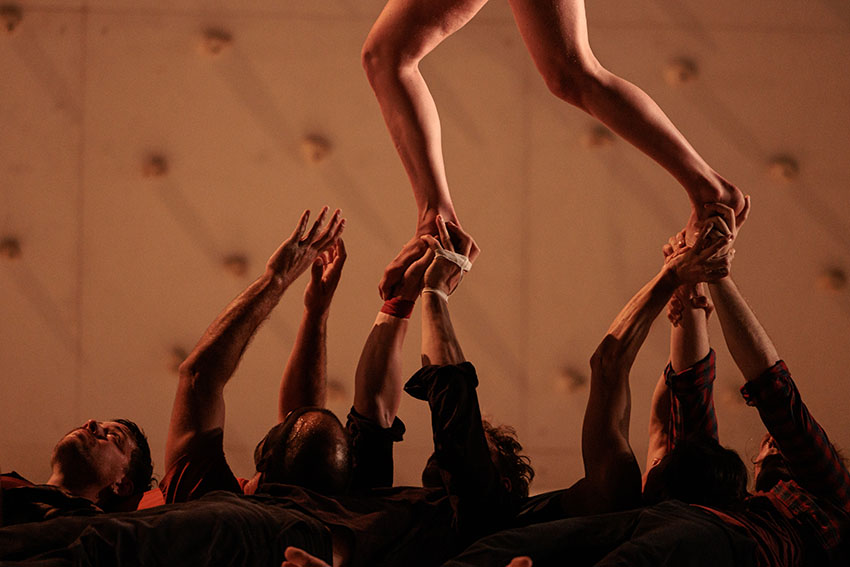
A part of Van Cleef & Arpel’s Dance Reflections programme and Le French May, the Hong Kong presentation of Corps Extrêmes took place West Kowloon’s Xiqu Centre, where Rabar, among others, showcased their niche skills under Ouramdane’s direction. A high-liner hangs and walks on a thin cord suspended six to seven metres above the ground, across the stage. A group of dancers and acrobats below, climbing on each other in cohesive formations, leap with various flips and gestures mimicking him in an attempt to reach him, but fall short. To a similar end, Rabar and other climbers eventually scale the climbing wall installed on the stage, executing synchronised movements that alternate between using the climbing holds on the wall and standing on each other’s shoulders. The motion of rising and falling, and the act of striving for something just out of reach, were consistent motifs among the varied disciplines on display.
“It’s about always looking to go beyond,” says Ouramdane of the choreography. “It’s about finding that balance, when you’re pushing yourself just enough but not over the top. But you only become aware of that when you are confronted by your physical limits.”
Based in Paris, where he is the director of Chaillot – Théâtre National de la Danse, Ouramdane conceived of the show during the pandemic, when he was confined to the mountainous environment of the French Alps where he was raised. He began meeting climbers, base jumpers, high-liners and others who are associated with extreme sports, and brought them together for Corps Extrêmes. “A lot of people think that [the performers] are crazy. They play with death. But it’s the opposite, actually; they’re highly aware of their body and are in deep dialogue with nature.”
When Ouramdane initially staged this show, he began outdoors, in open-air venues, to reflect the alignment extreme sports share with nature. His aim changed, as he adapted the show for smaller-scale, indoor venues, to bringing nature into the context of the theatre. Similarly, the performers aim to demonstrate in theatres what it feels like to partake in these extreme activities out in nature. “I try to show them a glossary of climbing movement, of how we move and how it feels, the contemplation, the decision, the improvisation – all of it.”

They also reflected challenges inherent in the various acts. In a particularly memorable scene for Rabar, the climber had to adapt to working with a team of people, in contrast to her usual climbing practice, which is solitary. This shift happens when Rabar is slowly being rolled down the wall and subsequently caught by the other performers. “Climbing is something that is private and I control almost every aspect,” she says. “For this specific segment, I can try to help them by moving my weight but suddenly I’m a literal burden to another human.”
It’s small emotional nuances that Ouramande and his troupe are seeking to portray, especially in trying new creative disciplines, those that might not be considered by mainstream audiences but are well understood by the performers themselves. “Acrobats realise the potential they have as climbers, climbers realise the potential they have as acrobats, whether it’s the ability to hang from a rock or off someone else. They’ve just realised how to develop new nuances within their own practices,” says Ouramdane. “I really do believe that we are capable of more than we think; we just need the possibility to experiment with our potential, and I think we see that transformation with the way we’ve organised this choreography.”
While the nuance that Ouramdane seeks to project is somewhat lost in choreography, specifically the obvious allusions to the rise and fall and reaching for something beyond, the novel combination of climbing, acrobatics, high-lining and dance is refreshing. In this way, Ouramdane achieves what he set out to do – integrating nature and the theatre while making us aware of the limits of the human body.
戲曲中心大劇院
5月31日-6月2日
安・哈柏(Ann Rabar)從不自視為戶外運動愛好者。在德克薩斯州休斯頓長大的她,覺得都市環境更為自在。但自從在26歲那年加入了女子攀岩俱樂部,並參加了一次在奧斯汀的郊外露營之旅後,這一切都徹底改變了。「我並非刻意追尋自然,但通過攀岩,我學會了如何融入其中。」她說道。
自此,攀岩成為她畢生追求的體能和表演項目中最重要的一環,這些愛好還包括體操和戲劇。雖然她曾分別涉足這些領域,卻始終未能找到能將這些迥異興趣融合起來的途徑。直到法國編舞家哈希德.烏蘭登(Rachid Ouramdane)邀請她參與《無涯之軀》(Corps Extrêmes),該演出將各類極限運動、即興舞蹈、雜技、高空走繩與攀岩融為一體。
「自攀岩之後,還從未有什麼事情讓我覺得如此契合,」 這位攀岩者談及此次獨特嘗試時說道,「當我看到如此多元的團隊——雜技演員、運動員和舞者共同協作,而我還能在其中重拾自己的體操功底,能像過去在戲劇舞台上那樣表演,當時我就知道:『嗯,這是我勝任有餘的事。』」
作為梵克雅寶Dance Reflections 項目及法國五月藝術節參演節目,《無涯之軀》在香港的演出於西九文化區戲曲中心上演。哈柏與眾多表演者在哈希德.烏蘭登的指導下,共同呈現了他們的獨特技藝。一名高空走繩者在距離地面 6至7米的細繩上懸吊、行走,橫越整個舞台;下方,一群舞者與雜技演員以緊密配合的隊形相互托舉,通過各種空翻和模仿動作試圖觸及高空走繩者,卻總功虧一簣。與之呼應,哈柏等攀岩者最終以同步節奏登上舞台上的攀岩壁,他們或使用岩壁岩點,或站上彼此的肩頭。這種起起落落的動態,以及對觸不可及之物的執著追尋,成為整場跨界演出貫穿始終的主題。
「這關乎不斷尋求超越,」 烏蘭登闡述他的編舞理念時說道,「關鍵在於找到一種平衡,將自我推向極限卻不越界。但唯有當你直接面對身體極限時,才能領悟到這種平衡。」
作為常駐巴黎的夏約宮國家劇院總監,烏蘭登在疫情期間孕育了這場演出創意。彼時他正困居在從小長大的法國阿爾卑斯山區,開始與登山者、低空跳傘運動員、高空走繩者等極限運動愛好者交流,最終將他們匯聚到《無涯之軀》的創作中。「很多人覺得這些表演者瘋了,是在與死神共舞,」他說道,「但事實恰恰相反——他們對身體有著絕對掌控,且與自然對話。」
烏蘭登最初構思這部作品時,選擇在戶外露天場地演出,以體現極限運動與自然的一致。隨著演出改編為適合小型室內劇場的形式,他的創作目標轉向將自然融入劇場環境。同樣,表演者力求在劇場中展現在自然中進行這些極限運動時的真實體驗。「我試圖向觀眾展示一套攀岩詞彙表,我們的移動方式、身體感知、沈思過程、決策判斷以及即興演出,所有這一切。」
他們也揭示了不同表演形式中的固有挑戰。令哈柏尤印象尤為深刻的是,這位攀岩者必須適應團隊協作,這與她獨來獨往的攀岩習慣截然不同。這一轉變發生在她被緩緩放下岩壁、隨後被其他表演者接住的時刻。「攀岩本是項私密運動,我能掌控幾乎每個細節,」 她說道,「但在這個特定片段中,我雖然試圖通過調整重心來配合隊友,卻突然實實在在成了他人的負擔。」
烏蘭登與他的演出團隊致力於刻畫的,正是這些微妙的情感層次,尤其是在嘗試那些或許未被主流觀眾理解、但表演者卻深刻領悟的先鋒藝術領域時。「雜技演員發現了自己作為攀岩者的潛力;攀岩者也意識到自身的雜技可能,無論是懸掛岩壁還是依託他人。他們方才領悟到如何在自己的技藝中開拓新維度,」烏蘭登說道,「我深信,我們的能力遠超自身認知,只是需要機會去測試自己的潛能。而我認為這場編舞的創作方式,正是見證了這種蛻變。」
儘管烏蘭登試圖傳遞的細膩意涵在編舞中有所減損,尤其是對起落浮沉、追尋觸不可及之事的直白隱喻,但攀岩、雜技、高空走繩與舞蹈的新穎組合仍令人耳目一新。通過這種方式,烏蘭登實現了他的初衷——將自然融入劇場的同時讓我們認知到人類身體的極限。