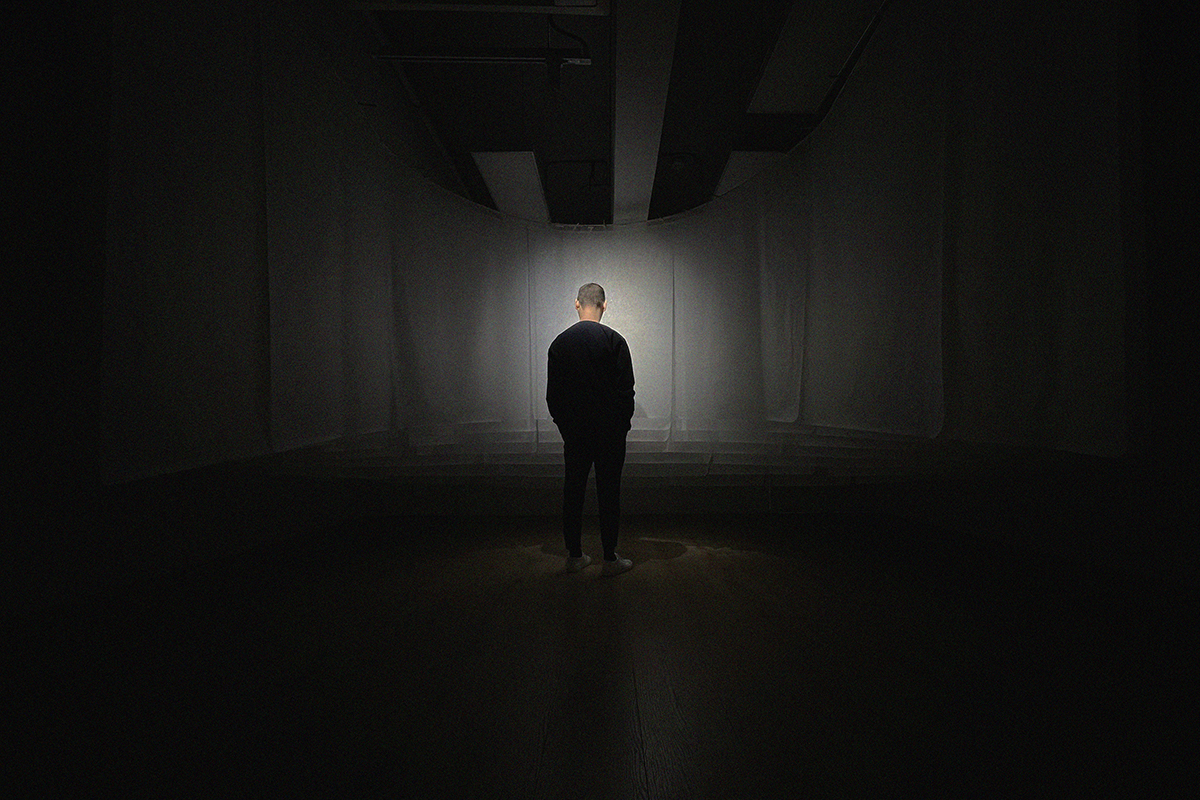
Szelit Cheung’s paintings offer viewers open spaces in which to wander, escape or retreat. Neither abstract nor realistic, they feature imaginative architectural settings that are at the same time familiar and unknown. Fascinated by the concept of the void, the Hong Kong artist builds structural and poetic landscapes that attempt to embody the texture and complexity of emptiness expressed through a rich range of colours and contrasts. With no foreground or tangible objects to hold onto, the gaze plunges immediately into a geometrical world of light and shadows where time appears suspended. Light radiates and exceeds frames, including the canvas itself, while the void tends to echo the projection of our own selves.
Caroline Ha Thuc: Do you remember why you originally wanted to be an artist? Szelit Cheung: I love the process of making art; it is as simple as that. The only thing I can remember from childhood was drawing with a pencil for hours until the sun went down. There was nothing that made me happier than painting and drawing. Then, in high school, when I first began learning about the history of art and classical paintings, I became curious and passionate about the old master paintings and wanted to learn all the secrets and tricks. I didn’t really know what I wanted to be back then or have any idea what an artist actually does, but one thing I am sure of is that I love art. I just thought, “Why not have a go and figure out the rest along the way?” Turns out it was one of the best decisions I have ever made. I love what I do, and I was fortunate to have the opportunity to slowly develop into what I am now.

CHT: You work in different media, but recently it seems that painting has occupied an increasingly major place in your practice. Why? SC: Art can take many forms. Whenever an idea pops into my head, I like to test it out through different experiments with various techniques. It helps me think creatively and decide the best medium to express my idea. I love to paint, as I can express my emotions and thoughts in the flow of the colours and brushstrokes on canvas. The process of oil painting particularly brings me a great sense of peace. Every little step matters, from preparing the ground to gradually applying the oil paint layer by layer and finalising the details. It takes weeks and months to work on an oil painting, but it is very rewarding to see the overlapping of colours, different thicknesses of paint, strengths and emotions blend into a unique vision.
CHT: You have been exploring light and colour to create space, or rather to open spaces and depth. What is your working methodology? SC: Trying everything is the way I work. To be honest, I am not a planner, and I do not have a particular routine or method when developing an idea. I tend to just go with the flow, see where it takes me and be more spontaneous about the process of making art. Sometimes, I use different materials and simply build shapes and forms out of whatever I have, just like children playing with building blocks, and I remain curious about everything.
My inspirations come from everyday discoveries. Take the series Hidden Form (2023) as an example. I was inspired by a tree branch I found on my way back to the studio two or three years ago. I placed it in a corner, and one day the light from the window created an interesting composition with the branch and its shadow. I recorded the relationship between the object and the shadow on the wall in my sketchbook.

CHT: How did you then work from this sketch? The outcome looks far from a tree branch. Instead, it reveals curves that open up invisible spaces. SC: The tree branch leaning against a wall formed a triangle. It wasn’t intentional at first but the result turned out to be unexpected and extraordinary. Shadows are incredibly special, and what interests me the most is how they play a significant role in defining an invisible yet present three-dimensional form. A cast shadow does much more than offer depth and layers to a painting. I wanted to emphasise the poetic interaction between the object, light and shadow, breaking the norm and changing the way we perceive.
I was captivated by the idea of invisible forms created by an object and its cast shadow. I experimented with different materials and placed them on the wall, floor or ceiling to shape invisible forms that could only be viewed from a specific angle. After countless trials with different combinations of materials, angles and intensities of light, I discovered that by bending a copper rod and placing the light at the right angle, it creates a fascinating invisible arch. That’s how this series gradually developed.
CHT: On your website, you say the “void is a transitional state between the moment of looking at the emptiness and the moment before reckoning and feeling it”. Where does your fascination for the void come from? And how did you come to define or interpret it in this way? SC: It all began with a question I asked myself years ago: how do I remember a space, particularly an empty one? Is it because of the paint on the walls, the footprints on the floor, the dust floating in the air, a fleeting moment of light or even just a passing glance? Whenever I observe these small details within a space, I unintentionally enter a contemplative state. Why do spaces evoke such wonderful imagination? What exactly is empty space? How can we present and sense the void? Thus, I wanted to explore the essence of the void and see how far it would take me.

CHT: We often associate the idea of the void with something formless. Are you creating structures as frames to capture it? SC: To me, the void is not something that can be easily defined. It is more like a philosophical reflection or a poetic journey of experiential existence that will endure. Bringing an idea to life is not an easy task. For me, the process of attempting to visualise and explore void or emptiness is more intriguing than anything else. There is more to be seen, beyond a mere image. The experience extends beyond the canvas. Space itself appears simple yet possesses immense power, with certain qualities within. I am curious and open to various methods, as long as they help me achieve what I want to convey. Creating structures, drawing or painting are just a few of the many ways to approach this grand concept. Two years ago, I created an installation titled Endless at Rossi & Rossi Gallery. It was a sculpture made of layers of Japanese washi paper on the ceiling, inviting the audience to engage with space and feel the void I sought to create.
CHT: In most of your work, the architectural components form a kind of stage. The interplay between positive and negative spaces creates a tension that suggests something might suddenly happen. In Dark I (2021), for example, the beam of light could be interpreted as an invitation to enter the painting and explore the unknown space behind the wall. Are there any hidden narratives behind these pieces? SC: A story tends to have an ending and I am not trying to tell any. Instead, I aim to create a state of mind that allows the audience to feel and experience the essence of the void I have discovered through various means. In the exhibition Dark (2023), my intention was to capture the essence of void through darkness. In contrast to previous attempts, I simplified the forms and focused more on the interplay of light and darkness to convey a state of nothingness.
CHT: However, I sense a strong presence in your paintings, probably as a counterpoint to emptiness. Even light is intensely embodied. SC: I believe the concepts of “emptiness” and “being” need to exist in a balanced state, as they are equally important and inseparable. They rely on each other to highlight their own existence. For instance, if we draw a circle on paper, we not only see the circle itself but also the line defining its boundaries.
CHT: This tension also emerges from the imbalance among the various forms you create. One typical example is Cut I (2023). A massive concrete block obscures the horizon, compelling the gaze to seek escape in the small open space you have created. How do you build your architectural spaces? SC: I develop architectural spaces through various means, such as drawing sketches or creating models. During the process of crafting Cut I (2023), I produced numerous models to examine how light permeates through a space. The ceiling is angled in different ways to draw the viewer’s attention to the beam of light, while also fostering a sense of intimacy within the space.

CHT: Are you referring to building smaller paper structures to experiment with light? SC: Yes. Artists have their own visualisation tools and, for me, creating physical models is an effective way to swiftly explore and materialise my ideas. An idea remains abstract until it takes physical form. I have a multitude of imagined three-dimensional spaces that I wish to explore. Typically, I begin by sketching a few quick compositions and forms that I feel inclined to paint. Then I proceed to constructing models using various materials. This process helps me visualise how light interacts with the space and enables me to understand the relationship between spatial dimensions and materials, ultimately informing the optimal image for the painting.
CHT: Do you draw every day? SC: All the time. I am either sleeping or working. I paint and draw as long as I can every day. There are countless possibilities and avenues to explore, and I strive to experience and accomplish as much as I can.
CHT: Two years before Dark, the exhibition Space also explored the concepts of time and space through different architectural settings. However, the palette was different, featuring more pink and red tones. What happened in between these two exhibitions? SC: Colours have the ability to influence mood and evoke a sense of void. By integrating colour with form and space, a unique presence is created. The colour palette for each exhibition is deliberately chosen based on the underlying idea, inspiration, context and more. The Space exhibition revolved around the interplay between display spaces and artworks. I wanted the audience to feel a touch of warmth when they entered the exhibition, which aligned with the presence of a red entrance door. On the other hand, for Dark (2023), my aim was to depict a series of dark spaces with a focus on how warm light enters and interacts with the space itself. This series leans towards orange-reddish tones and encompasses a range of atmospheres and moods.
CHT: Do you believe that specific colours can better convey the idea of void that you strive to embody? SC: To me, colour is boundless and it can harmonise with any idea. One of my daily routines involves recording colours or shades I come across on paper and displaying them on the wall. This repetitive process helps me develop a deep understanding of colour. It’s fascinating how a colour can evoke entirely different emotions in diverse cultures, regions, age groups and eras. Typically, before starting a painting, I conduct a few quick studies to experiment with different colour schemes and determine which one best serves the intended purpose. This process aids me in selecting the most suitable colour to visualise the idea I wish to express.
For example, during my participation in a residency programme at The Shophouse in Tai Hang [in June and July 2023], where I had the opportunity to work in a three-storey historical building with a red terrazzo floor, I deliberately employed a classical green colour commonly found in western classical oil paintings. This choice created a strong contrast and completely transformed the overall experience.
CHT: Are you influenced by any artists such as Escher, who created endless spaces? SC: I am curious and interested in everything. I’ve fallen in love with a few artists, like James Turrell and Olafur Eliasson. Both artists are very good at altering our senses, turning something normal into something special and changing the way how we see and feel.

CHT: Architecture holds a central position in your artistic world, with earlier paintings like Space (2020) featuring elements like Gothic church windows. Are you inspired by specific types of building? SC: Tadao Ando is one of my favourite architects but, in general, I enjoy visiting various types of architecture, ranging from churches to museums around the world. Travel plays a significant role in my life as an artist. It provides an excellent opportunity to learn by observing and understanding how different spaces affect our emotions and moods, as well as observing people’s reactions to various buildings. I take pleasure in observing the interplay of light and shadow within a structure and capturing the atmosphere in my memory. This process helps shape my imaginative perception of space.
CHT: You also play with scale, creating ambiguities. For example, Dark I (2023) is a large painting that showcases a basement window or a grid, which could be associated with narrow spaces. On the other hand, in the series Mado (2023), you use very small formats to depict larger spaces. How do you decide on these formats and how do you navigate these tensions? SC: Yes, I enjoy working with different scales, especially when creating pieces for specific exhibitions, as I try to respond to the exhibition space itself. The space I created in Dark I is actually quite spacious. The double-height ceiling provides a sense of openness, creating an expansive and visually striking interior. Full-height windows are positioned at the bottom, offering views beyond and enhancing the connection between the interior and exterior spaces. That’s why this piece is the largest among all the paintings, taking up the entire wall at the exhibition.
As for Mado (2023), the size of these paintings is determined by their placement. At Rossi & Rossi Gallery, there is a long, narrow corridor with a low ceiling. Instead of placing a large painting there, I wanted to have a series of small ones scattered on the wall, allowing the audience to freely wander around within these spaces.
CHT: There is also a sense of oppression in the spaces you describe. You push viewers into corners or spaces where they have no choice but to plunge into the unknown, hoping something more luminous can arise. Is there any spiritual aspect to your work? SC: I don’t intentionally seek to convey a specific form of spirituality or mysticism in my artwork. My goal is to encourage the audience to pause in front of my work, take a few seconds to contemplate, and experience the moods and atmosphere I have created. The unknown or uncertainty can be intimidating at times, but where is the excitement if we know everything in life?
CHT: Some of your paintings have enigmatic titles like Cut or Mado. What are you referring to? SC: Coming up with compelling titles is one of the most challenging tasks for me as a painter. I find it difficult to encapsulate my works in a few simple yet memorable words. I tend to keep the titles more conceptual rather than precise, allowing room for the audience to interpret and understand them in their own way. However, sometimes title ideas come naturally to me, offering a glimpse into my mindset during the art-making process.
The title Cut was inspired by an experiment with paper. I had the idea of creating slit-like openings to manipulate light. I prepared a pile of paper and experimented with different cutting techniques. Through this process, I observed how the changes in light and shadow were influenced by the size of the openings and the direction of the light source. It allowed me to quickly visualise the idea and space I wanted to paint.
Mado is named after the Japanese word for “window”. One of my favourite moments in the studio is observing the soft light that enters through the window. It is calming and soothing to witness the ever-changing play of light and shadow. Each moment is unique, creating atmosphere and evoking emotions. To me, it resembles a painting. This inspired me to create a series of small paintings on wood scattered on the wall, each capturing a different, distinct moment of light and shadow entering a space through a window, reshaping the way we see and feel.
CHT: Why use the title Dark twice? SC: Dark is an interesting perspective to explore light and space. I wanted to delve deeper into this theme. Without darkness, light loses its meaning and vice versa.
CHT: Lastly, would you inhabit the spaces that you create? SC: It would be a literal dream come true if I could live in the spaces I create.
張施烈的畫作為觀眾提供開放的空間,給人漫步、逃離和後退的機會。他的畫作既不抽象也不現實,建築環境富想像力,帶來既熟悉又陌生的感覺。這位香港藝術家喜歡虛空的概念,構建出具結構性和詩意的景觀,透過豐富的色彩和對比體現虛空的質感和複雜。由於畫作沒有前景和有形物,觀眾的目光會立即陷入光影的幾何世界,時間彷彿停頓。四散的光線超越框架和畫布,而虛空往往會呼應我們自己的投影。
Caroline Ha Thuc: 你記得自己為什麼想成為藝術家嗎?張施烈: 我喜歡創作藝術的過程,就是這麼簡單。我唯一的童年回憶就是小時候會花上好幾個小時用鉛筆畫畫,一直畫到太陽下山為止,繪畫是最能讓我快樂的事情。高中時我第一次接觸藝術史和古典畫,對古典名畫產生了好奇和熱誠,很想學習當中所有秘密和技巧。那時我真的不知道自己想成為什麼,也不知道藝術家實際上是做什麼,我唯一知道的就是我熱愛藝術。所以我就想:「為什麼不先試試,再慢慢探索餘下的路?」事實證明這是我做過其中一個最好的決定,我熱愛我在做的事,也很幸運有機會慢慢發展成現在的樣子。
CHT: 你使用不同的媒介進行創作,但繪畫似乎在你的近作中佔據越來越重要的地位。為什麼?張施烈: 藝術可以有很多種形式。每當我的腦海出現想法時,我會用不同的實驗和技術進行測試,這樣我可以更有創意地思考,然後選出最能表達我心中所想的媒介。我喜歡畫畫,因為我可以透過畫布上色彩和筆觸的流動來表達我的情感和想法,畫油畫的過程更可以帶來很大的平靜。每個小步驟都很重要,無論是準備底色、塗上一層層油彩,還是確定最終細節。畫一幅油畫需要數星期甚至數個月的時間,但可以看到顏色的重疊、顏料的不同厚度、力量和情感融合,營造獨特的視覺效果是非常值得的。
CHT: 你一直以光和顏色創造空間,或者應該說是創造開放的空間和深度。你的創作方式是什麼?張施烈: 勇於嘗試就是我的創作方式。老實說,我不是一個很有計劃的人,在構思時沒有特定的套路和方法。我傾向順其自然,隨遇而安,隨心創作藝術。有時我會使用不同的材料,以手頭上的東西建造形狀和形式,像小朋友玩積木一樣,我也對所有事物都保持好奇。
我的靈感來自日常的發現。以《Hidden Form》(2023年)系列為例,我的靈感來自兩三年前回工作室途中發現的一根樹枝。我把它放在一個角落裡,有一天窗外的光線與樹枝和它的影子構成了一個有趣的構圖,我就把物件和牆上影子的關係紀錄在素描畫簿中。
CHT: 那麼你是如何根據這個草圖進行創作的?因為作品的最終成品看起來不像樹枝,反而揭示出打開無形空間的曲線。張施烈: 樹枝靠在牆上形成了一個三角形,我並不是故意的,但結果卻令人意外、不同凡享。陰影從來都是非常特別的,我最感興趣的是它們如何在定義隱形但存在的三維形式時發揮重要的作用。投影不單止令畫作更有深度和層次,我還想強調物件、光和影之間的詩意互動,它們打破常規,改變我們的認知。
我很喜歡研究物件和它的投影所創造的無形形式。我將不同的材料放在牆壁、地板和天花板上,嘗試塑造出只能從特定角度觀看的無形形式。經過無數次不同材料、角度和光度組合的嘗試後,我發現用曲銅棒在正確的角度放置光源可以創造出迷人的隱形拱門。就是這樣,這個系列就逐漸形成。
CHT: 你在自己的網站上寫道「『空』是一種過渡的狀態,由觀看空時,至產生想像與感受前,之間的一種過渡狀態」。為什麼你會這麼喜歡虛空?為什麼你會這樣定義和解釋虛空?張施烈: 這一切都源自我多年前問自己的問題:我到底是如何記住空間、甚至是空的空間?是因為牆上的油漆、地上的腳印、空氣中飄浮的灰塵、轉瞬即逝的光線,還是一閃而過的目光?每當我觀察空間中的這些小細節時,我就會不自覺地進入沉思的狀態。空間為何能喚起如此奇妙的想像?究竟空的空間是什麼?我們如何可以呈現和感受虛空?於是我想探索虛空的本質,看看會有什麼發現。
CHT: 我們經常會將「虛空」的概念與無形的事物連結,你是否想創造結構作為捕捉它的框架?張施烈: 對我來說,虛空不是一個可以輕易定義的東西,它比較像是一種哲學反思,或是一場耐久的生存體驗詩意之旅。將想法化為現實並不是一件容易的事,對我來說,嘗試想像和探索虛空的過程比任何事情都有趣。圖像所表達的並不單止是畫布上看到的東西,空間本身看似簡單,卻藏著強大的力量,蘊含著某些特質。我對各種方式抱持好奇和開放的態度,只要它們能幫我實現心中所想,創造結構、繪圖或繪畫只是其中幾種實現這種宏大概念的方式。兩年前,我為Rossi & Rossi畫廊創作了名為《Endless》的裝置作品,那是一件由多層日本和紙製成的雕塑,在天花板上邀請觀眾與空間互動,感受我創造的虛空。
CHT: 在你大部分作品中,建築元素成為了舞台,正負空間的相互作用產生一種張力,暗示可能會出現突發的事情。例如在《Dark I》(2021年)中,光線邀請觀眾進入畫作,探索牆後未知的空間。這些作品的背後是否有不為人知的故事?張施烈: 故事往往會有結局,但我不想訴說任何結局,我反而想創造一種心態,讓觀眾感受和體驗我透過各種方式發現的虛空本質。在展覽「黑」(2023年)中,我想透過黑暗捕捉虛空的本質,與之前相比,這次我將形式簡化,專注於光暗的相互作用,傳達一種虛無的狀態。
CHT: 但我在你的畫作中感受到一種強烈的存在感,可能是為了與虛空形成對立,連光線也強烈地體現出來。張施烈: 我認為「空虛」和「存在」的概念需要以平衡的狀態存在,因為它們同樣重要且缺一不可,透過互相依賴來凸顯自己的存在。假如我們在紙上畫一個圓形,我們見到的除了是圓形本身,還有定義圓形邊界的線條。
CHT: 這種張力也源自於你創造的各種形式之間的不平衡,一個典型的例子就是在《Cut I》(2023年)中,巨大的混凝土塊遮蓋了地平線,迫使人們的目光嘗試在你創造的狹小開放空間中逃離。你是如何建造你的建築空間的?張施烈: 我開發建築空間的方式有很多種,例如畫草圖和建造模型等。在創作《Cut I》(2023年)的過程中,我製作了許多模型來研究光線滲透空間的方式。天花板以不同的方式傾斜,將觀眾的注意力吸引到光束上,同時也加強空間內的親密感。
CHT: 你的意思是建造小的紙造結構來進行光的實驗嗎?張施烈: 沒錯,每位藝術家都有自己實現概念的工具,對我來說,建造實體模型可以快速探索和實現我的概念,概念在實體呈現之前只屬抽象。有很多想像中的三維空間我都想探索,通常我會先快速畫一些喜歡的構圖和形式,然後用各種材料建造模型。這個過程讓我想像光與空間的互動方式,令我理解空間維度與材料之間的關係,最終構成最適合成畫的圖像。
CHT: 你每天都會畫畫嗎?張施烈: 我隨時都在畫畫,只要不是睡覺的時間我都在工作。我每天都會盡可能畫畫,可以探索的可能性和方式有很多,我想盡力去體驗和達成最多的事情。
CHT: 「黑」兩年前的展覽「空間」也透過不同的建築背景探索時間和空間的概念,但展覽的色調很不同,以粉紅色和紅色作主調。在這兩個展覽之間發生了什麼事?張施烈: 顏色能夠影響情緒,喚起虛空感,顏色與形式和空間的結合可以創造出獨特的存在,每個展覽的調色都是根據構思、靈感和背景等精心選擇。「空間」展覽圍繞展示空間和藝術品之間的相互作用,我希望觀眾入場時可以感受到一絲溫暖,與紅色大門同出一轍。而在「黑」(2023年)中,我的目標是描繪一系列黑暗的空間,著重呈現暖光如何進入並與空間本身互動。系列偏向橙紅色調,蘊含一系列氛圍和情緒。
CHT: 你認為特定的顏色可以更有效傳達你努力體現的虛空概念嗎?張施烈: 對我來說,顏色是無邊際的,可以融和任何概念。我的其中一項日常工作是將我平日遇到的顏色和色調畫在紙上,再將它們展示在牆上,這個反覆的過程可以加深我對顏色的理解。顏色在不同的文化、地區、年齡層和時代中可以喚起截然不同的情感,非常有趣。在開始繪畫前,我通常會快速研究和嘗試不同的配色,再找出最能達到預期效果的顏色,這個過程讓我可以選出最能實現我心中所想的色調。
例如在參加大坑The Shophouse駐留計劃期間(2023年6月至7月),我有機會在一棟紅色水磨石地板的三層歷史建築中工作,我特意採用了西方古典油畫中常見的古典綠色。這個選擇營造出強烈的對比,徹底改變了整個體驗。
CHT: 你有受到莫里茨.科內利斯.艾雪等創造無盡空間的藝術家影響嗎?張施烈: 我對所有事物都充滿好奇和興趣,我很喜歡詹姆斯.特瑞爾和奧拉佛.艾里亞森等的藝術家。兩位藝術家都非常擅長改變我們的感官,將普通的東西變得特別,改變我們觀看和感受的方式。
CHT: 建築在你的藝術世界中佔據了重要的地位,《Space》(2020年)等早期的畫作以哥德式教堂窗戶等元素作為特色。你有受到哪種特定類型的建築啟發嗎?張施烈: 安藤忠雄是其中一位我最喜歡的建築師,不過整體來說我都很喜歡參觀世界各地不同類型的建築,無論是教堂還是博物館亦然。作為一位藝術家,旅行在我的生活中很重要,讓我學習觀察和理解不同的空間如何影響人們的情緒和心情,以及觀察人們對不同建築的反應。我很喜歡觀察建築內光與影的相互作用,並捕捉我記憶中的氛圍,這個過程有助塑造我對空間的想像感知。
CHT: 你還會探索大小,製造歧義。《Dark I》(2023年)是一幅大型畫作,展示了地下室的窗戶或網格,讓人想起狹窄的空間。但在《Mado》系列(2023年)中,你卻以非常小的畫作來描繪大的空間。你是如何決定這些尺寸,又如何應對這種張力?張施烈: 沒錯,我喜歡不同大小的作品,特別是在為特定展覽創作時,因為我希望可以回應展覽本身的空間。我在《Dark I》中創造的空間其實是相當寬敞的,雙層高樓底帶來一種開放感,營造出寬敞且視覺上引人注目的內部空間。落地窗戶位於底部,讓人可以望向遠處,增強了內外空間之間的連結。這就是為什麼這幅作品是所有畫作中最大的,佔據了展覽的整面牆。
至於《Mado》(2023年)畫作的尺寸是根據它們的位置所決定的。Rossi & Rossi Gallery有一條狹長的走廊,樓底很矮。我不想在那裡放一幅大畫,反而想在牆上分散放置一些小型畫作,讓觀眾在空間中自由漫步。
CHT: 你所描繪的空間也有一種壓迫感,你把觀眾推入角落或空間,令他們別無選擇,只能投入未知,盼望能看見光明。你的作品有涉及靈性的方面嗎?張施烈: 我無意在作品中傳達某種特定形式的靈性或神秘主義,只是想鼓勵觀眾在我的作品前稍作思考,體會我所營造的情緒和氛圍。未知和不確定性有時的確會令人懼怕,但如果我們能夠預知未來,生活還有什麼值得期待呢?
CHT: 你有些畫作的名稱很神秘,例如《Cut》和《Mado》等,它們有什麼意思?張施烈: 作為一位畫家,我認為要想出引人注目的名稱是其中一個最大的挑戰。我覺得要用幾個簡單但令人難忘的字眼來概括我的作品很困難,我希望名稱能夠表達概念而不是講求準確,讓觀眾可以以自己的方式詮釋和理解作品。不過有時命名的過程來得很自然,呈現出我在藝術創作過程中的心態。
《Cut》這個名稱的靈感來自於一次用紙做的實驗,我想創造一些狹縫狀的開口來控制光線,因此我準備了一堆紙張,嘗試了不同的切割技術。在這個過程中,我觀察到開口的大小和光源的方向如何影響光影的變化,讓我能夠快速實現我想畫的概念和空間。
《Mado》源自日文的「窗戶」一詞。我在工作室其中一個最喜歡的時刻就是觀察從窗戶射進室內的柔和光線,光影的無盡變化令人感到平靜舒適。每個時刻都是獨一無二的,可以營造氛圍並喚起情感,對我來說就像一幅畫一樣。這啟發了我在木頭上創作了一系列小畫掛在牆上,每幅都捕捉到光影透過窗戶進入空間的獨特時刻,重塑我們看見和感受的方式。
CHT: 為什麼會使用「黑」這個標題兩次?張施烈: 黑暗是探索光和空間時一個有趣的視角,我想更深入地研究這個主題。沒有黑暗,光就會失去意義,反之亦然。
CHT: 最後,你會住在你創造的空間裡嗎?張施烈: 如果我能活在自己創造的空間裡,簡直是夢想成真。