Author: Caroline Ha Thuc

Yip Kai Chun 葉啟俊

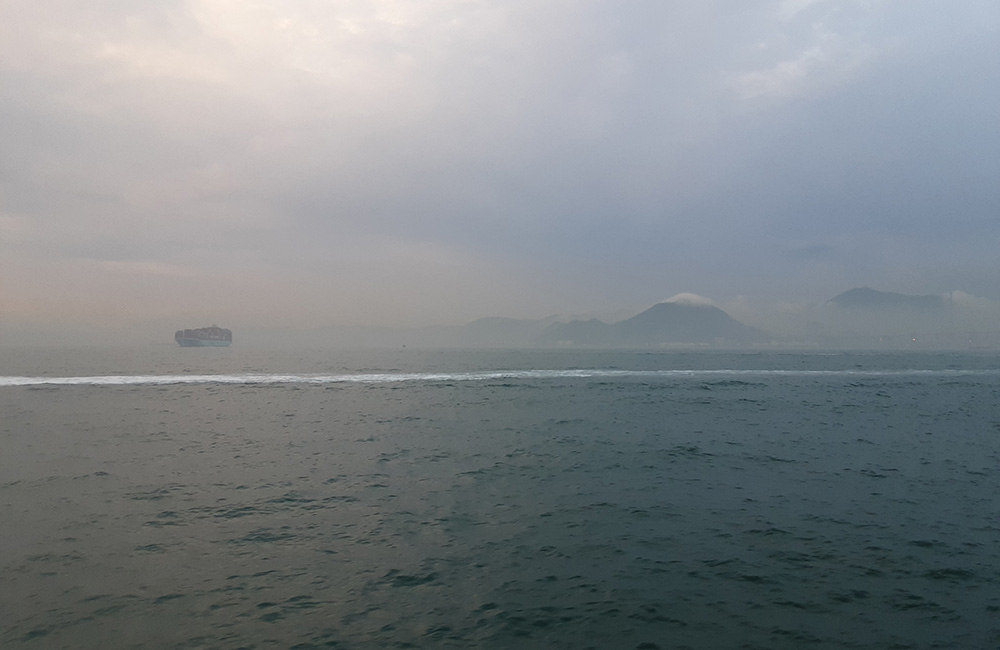
How to draw a line across the sea? /Peng Chau Cinema /Hong Kong /Nov 15 – Dec 21, 2025 / Yip Kai Chun’s solo exhibition occupies the lobby and former ticket office of the old Peng Chau Cinema, which has recently reopened to host art events. The building’s architecture is typical of the 1970s, featuring a concrete floor, broad columns and walls covered with small blue tiles reminiscent of swimming pool mosaics. The space is filled with natural light and has been thoughtfully used by Clarissa Lim, the curator, who has skilfully created a setting that resonates with Yip’s reflections on island life and his long-term experience as a resident of Peng Chau, where he has lived for the past eight years. In this new series of works, Yip invites us to share his insular gaze and to consider the surrounding landscape from his vantage point, one shaped by observing his environment from the ferry he takes every day, a routine that has profoundly influenced and transformed his relationship with geography. Scroll: Kowloon on the …

Chan Kwan Lok 陳鈞樂

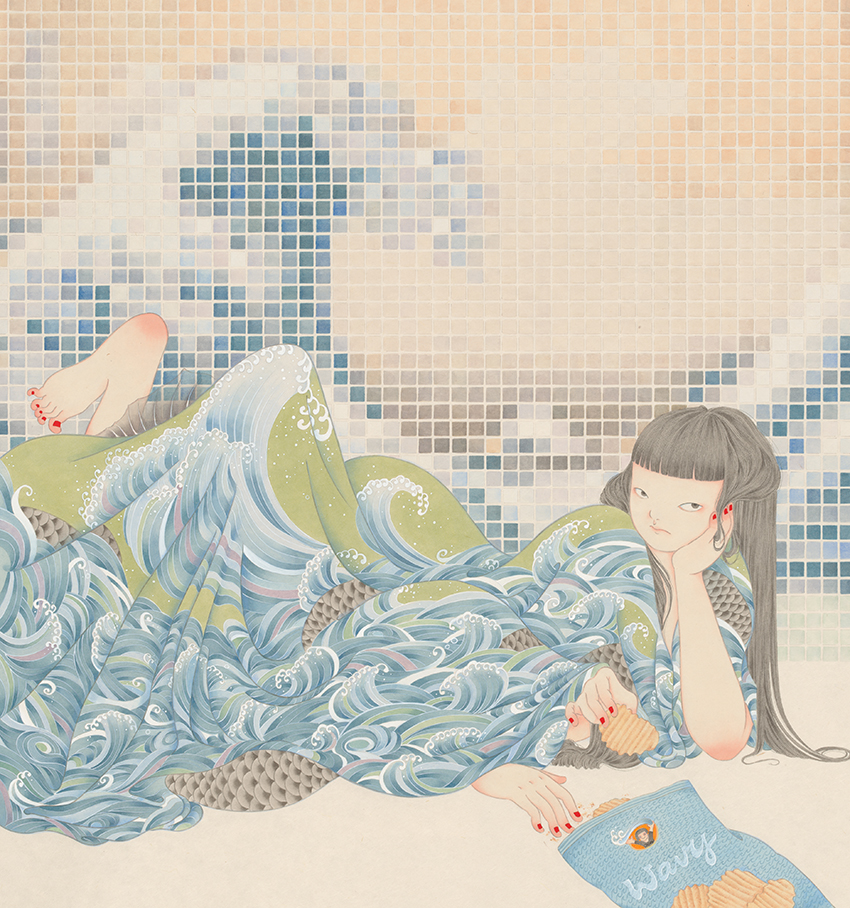
Weaving together Chinese traditional techniques, Japanese iconography and contemporary critical perspectives, the practice of Hong Kong artist Chan Kwan Lok draws on his daily experiences and observation of nature. His works depict human beings – and often himself – grappling with their environment, set against grand landscapes that both subsume and permeate them, while confronting their own emotions. The delicate ink lines facilitate the intertwining of worlds and perceptions, where elements overflow and merge. The sea, along with the forest and the mountain, provides the artist with particularly inspiring settings. CHT: Coral Reef (2013) and The Odyssey in Waves (2014) are among your first long handscrolls. Both depict the ocean. Later, one of your solo exhibitions was titled Threading Ocean. Where does this interest for the sea come from? Chan Kwan Lok: The first long scroll painting about the ocean can be traced back to my childhood work The Ocean (1999). I created it while having dim sum with my family, using pages torn from my school dictation book, drawing one page at a time …

Hilarie Hon 韓幸霖

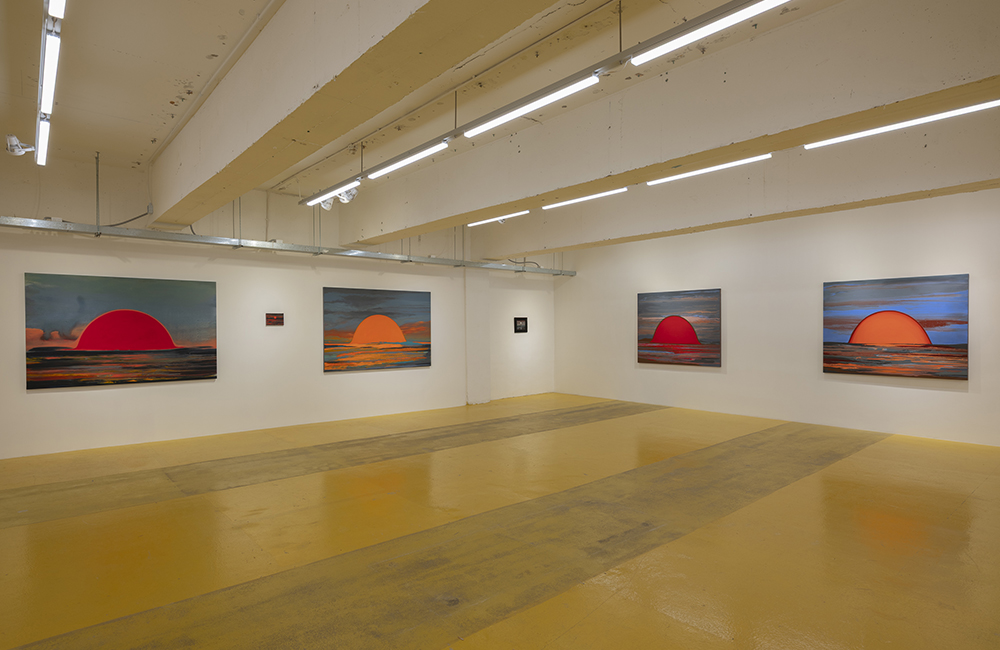
Shaping Surface into Light /Gallery EXIT /Hong Kong /Aug 30 – Sep 17, 2025 / There is, first of all, an immediate shock. On either side of the space, the pure colours of Hilarie Hon’s paintings vibrate and strike with dazzling intensity. In her new solo exhibition at Gallery Exit, the same motif recurs everywhere: an immense sun slipping into the sea at sunset. The tones are vivid – flamboyant orange, scarlet red and fuchsia pink against bright blues. These colours radiate through the room, producing an initial pleasure that feels raw and almost physical. But what arises from these works is not pure joy. Rather, it is a kind of nostalgia, a feeling inevitably tied to that fleeting instant when day falters and yields to night. Hilarie Hon has been painting sunsets since 2017. It is an obsession for the artist, who, as a child, developed the habit of watching the sunset from Plover Cove Reservoir Dam. When she struggled with sleeplessness and nightmares, her father would take her for night walks to the …

Trevor Yeung 楊沛鏗

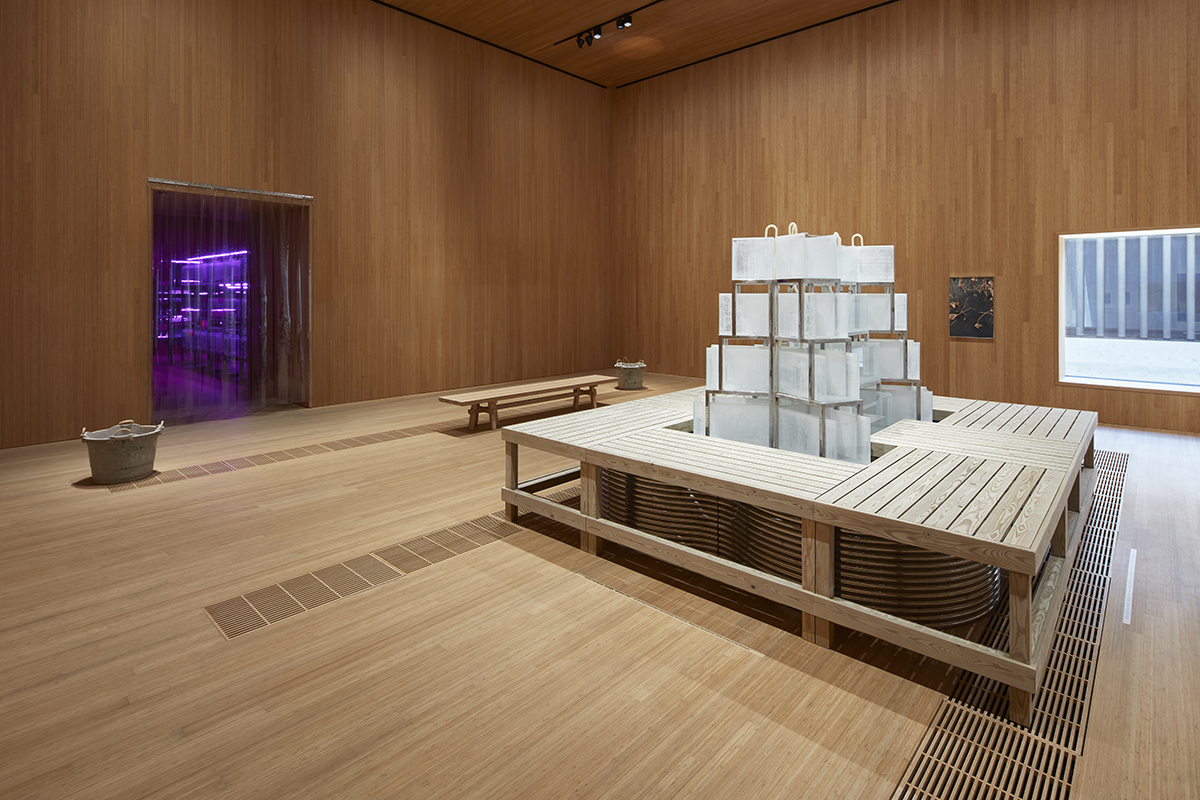
Courtyard of Attachments /M+ /Jun 14 – Oct 12, 2025 /Caroline Ha Thuc / Courtyard of Attachments, Trevor Yeung’s exhibition at M+, constitutes the Hong Kong iteration of the artist’s presentation for the 2025 Venice Biennale. Distributed across three rooms, one of which is devoted to video documentation, the exhibition has been reconfigured to suit the institutional context of the museum. The original installation featured four site-specific works that incorporated two distinct bodies of water: seawater outdoors and freshwater sourced from the Venice canal indoors. Central to the project is the notion of relationships explored through absence, mostly articulated through the presentation of 74 uninhabited fish tanks. At M+, this absence is intensified: not only are the fish missing but the water itself has also been removed. The exhibition thus distances visitors even further from the living ecosystems that once animated the installation. Consequently, issues such as water quality, ecological interdependence and human-aquatic relationships are displaced. Instead, questions of care and attachment are replaced by an encounter with their impossibility. The exhibition ultimately stages a …

Chak Chung 翟宗浩

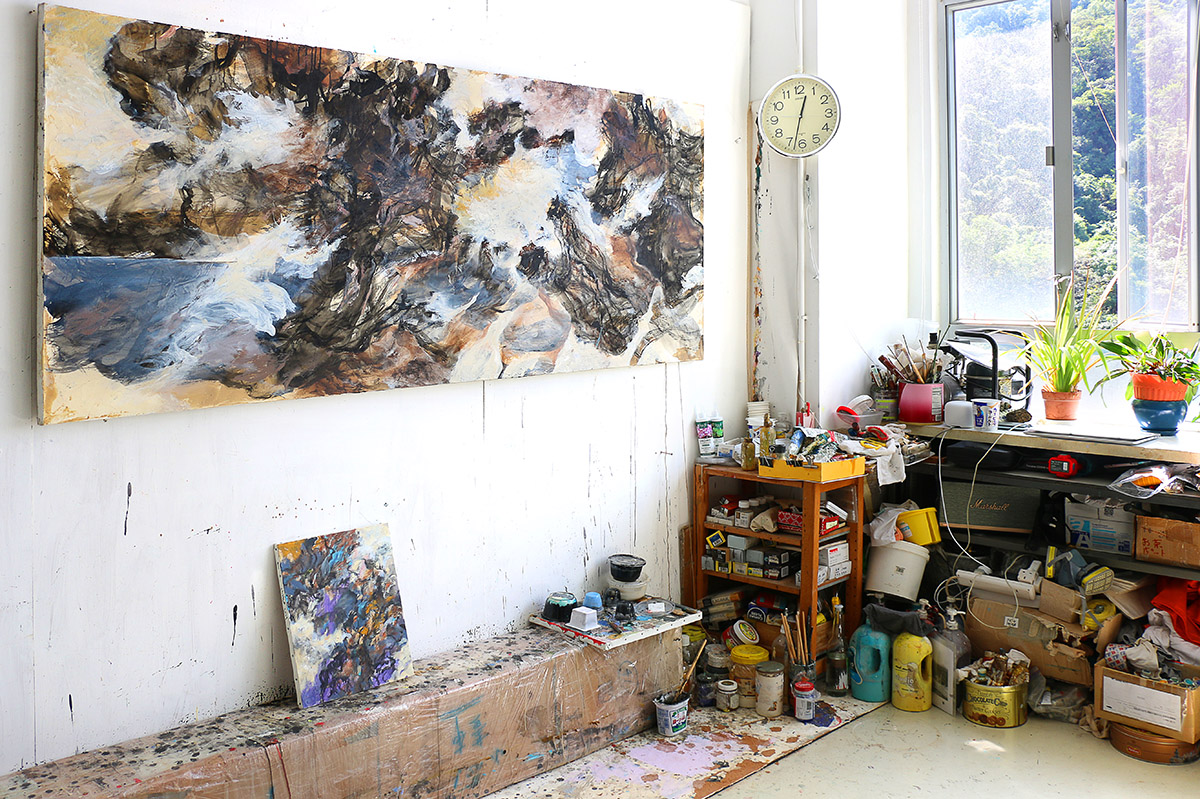
A graduate of the Department of Fine Arts at The Chinese University of Hong Kong in the early 1980s, Chak Chung was deeply influenced by the renowned artist Liu Kuo-sung. Over the past four decades, he has engaged in an extensive exploration of diverse painting traditions, from Chinese landscape to modernism. Shortly after completing his undergraduate studies, Chak relocated to Tokyo to further his artistic education, subsequently moving to New York, where he resided and worked until 2009. Upon returning to Hong Kong, he established his studio in Fotan, where he continues to investigate the possibilities of painting as a medium, striving to grasp the elusive beauty and inherent chaos of the natural elements and the human condition. Caroline Ha Thuc: Most of your artworks are landscape paintings and portraits of Hong Kong. They express the pull and push between elements and are generally free from people. Chak Chung: Socialising is one of my major weaknesses. I find people’s behaviours intimidating, and interacting with strangers drains my energy. Maybe that is why I am drawn to …

Wing Po So 蘇詠寶

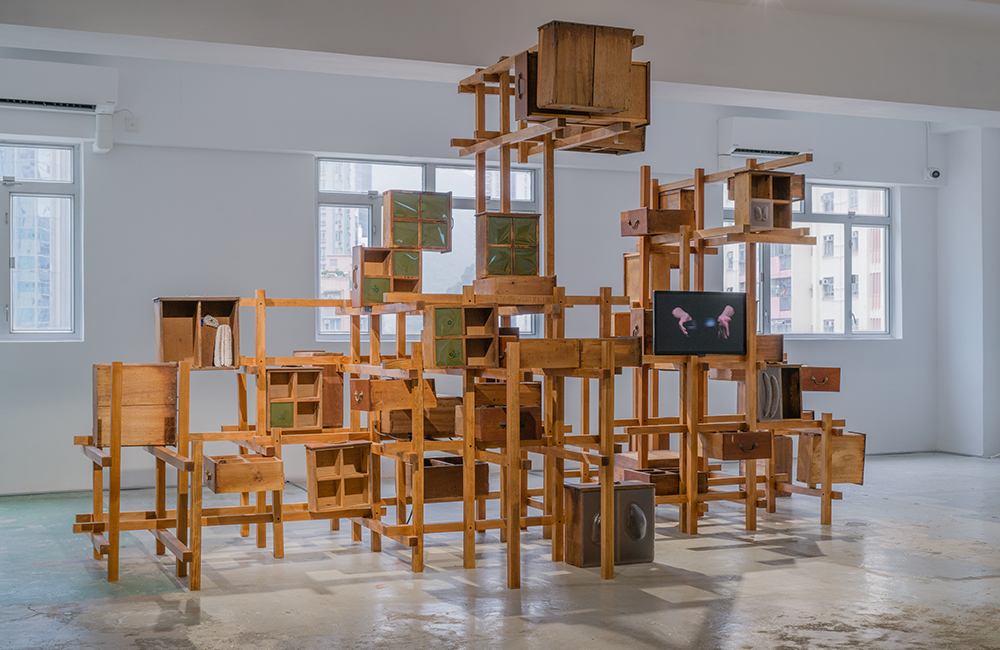
Take Turns Para SiteHong KongMar 15 – May 25, 2025 Wing Po So’s new installation presents itself as a constellation of three sculptural compositions – or “islands”, as the artist refers to them – constructed from old drawers once used in traditional Chinese medicine shops. These drawers, stacked and assembled in varying configurations, give rise to angular structures that appear simultaneously orderly and illogical. Some are positioned vertically, others inverted, open or shut, interlocked with precarious balance, ultimately producing a sense of organised chaos. Within the cold, stark environment of the gallery, the installation emerges as a living enclave – warm wood tones, the subtle scent of earth or dried herbs and a nearly recognisable soundscape evoking rhythmic breaths or pulses, all contributing to a multisensory experience. So seeks to recreate the dynamic choreography characteristic of traditional Chinese pharmacies. Having grown up in her parents’ shop, she experienced the daily rituals first-hand: opening and closing drawers, climbing stools to reach higher levels, bending towards lower compartments, crushing dried plants, grinding powders and blending ingredients. In this …

Tsang Kin-Wah 曾建華

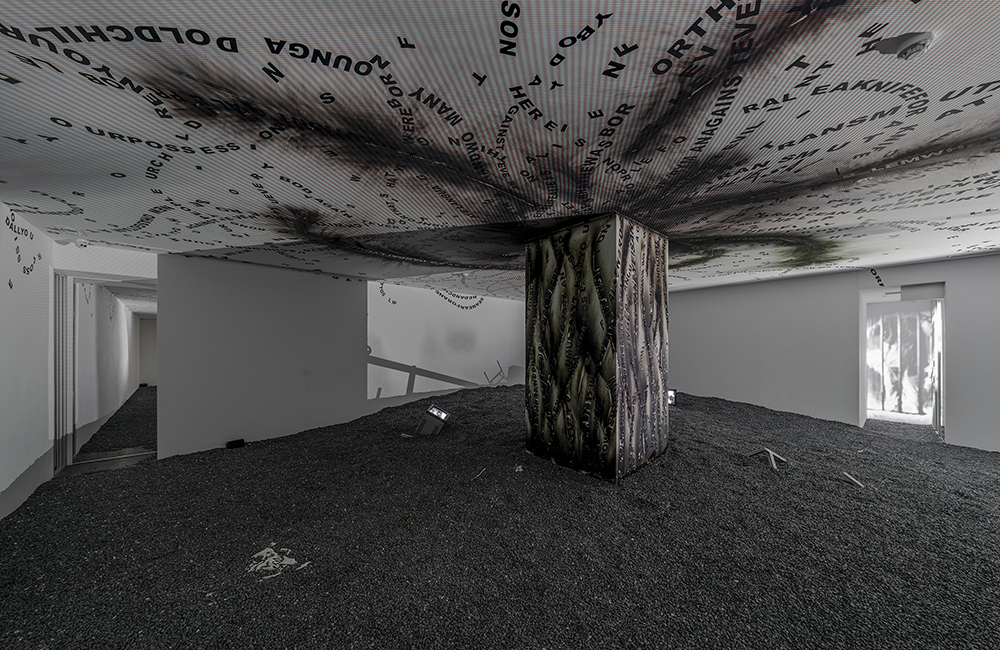
T REE O GO D EVIL /gdm /Hong Kong /Mar 19 – May 24, 2025 / Tsang Kin-Wah’s latest solo exhibition, T REE O GO D EVIL, is conceived as a total installation – an immersive visual and auditory environment that blends the artist’s characteristic use of textual quotations with edited video excerpts, including films or online clips depicting scenes of violence. The work revisits the artist’s enduring thematic concerns, drawing inspiration from the Bible, prophetic imagery of the apocalypse and current events to interrogate the contemporary meaning of moral values such as good and evil, the human capacity for judgement and humanity’s place within what Tsang frequently describes as an illusory world. Visitors enter the gallery through a narrow corridor, crossing metal grilles almost imperceptibly before arriving in the main exhibition space. At its centre stands a large pillar, a massive tree whose trunk is covered in letters and phrases. Its branches extend across the ceiling, made of coiled and uncoiled text, as well as suspended words and letters. While the formal language is …

Michele Chu 朱凱婷

Multidisciplinary artist Michele Chu explores how human bodies interact and express our deep and often hidden emotions. Through performances and interactive installations, her practice engages with the tensions and societal norms that govern the public space and our cultural customs. Delicate and subtle, her work also involves sharing parts of her own intimacy and personal memory as an invitation for viewers to journey inward and question the threads that bind us to one another and the world we inhabit. Caroline Ha Thuc: Your practice revolves around the ideas of intimacy and personal emotion. What triggered this interest? Michele Chu: My interest in intimacy dates to my graduate school, where I became aware of how many of my friends were struggling with loneliness. The juxtaposition of connection [through friendship] and isolation prompted me to question the nature of intimacy and what fosters closeness between people.  Because intimacy is so inherently human-centred, in conjunction with doing academic research, I also conducted fieldwork through street interventions with strangers. These insights directly informed the design of one of my …

Chen Wei 陳維

Entering Chen Wei’s new solo exhibition at Blindspot Gallery is akin to stepping into an alternate space-time continuum. Where visitors enter, the title is displayed on a semi-transparent silver partition, illuminated by undulating waves of light that oscillate like a musical frequency. This partition functions as a threshold, inviting visitors to traverse into the world of the Chinese artist, renowned for his meticulously staged photographs and his enigmatic universe, situated between dream and reality. Chen has conceptualised and curated the gallery space, integrating its peeling walls and concrete flooring to construct an environment reminiscent of a theatrical stage. Through the subtle interplay of light, shadow lines that echo the linear compositions of his artworks and a carefully orchestrated dialogue between colours and textures, the exhibition creates a cohesive visual and spatial experience. The artist demonstrates here that image-making is not his sole end but that he rather operates as an architect or a stage designer whose apparatus aims to question our collective sense of reality and our ability to seize it.  The artist has long …

Kurt Chan 陳育強

Kurt Chan received formal training in traditional Chinese art in the late 1970s and later studied contemporary art in the US in the mid-80s. For almost 25 years, he focused on mixed media sculpture, aiming to bridge the influences of both traditions. Recently, though, he decided to go back to ink painting and calligraphy, questioning the very essence of painting and landscapes as representations of reality and nature. His new experiments reflect his desire to continue challenging the artistic means of expression and, at the same time, respond to the current global political and ecological crisis.  Caroline Ha Thuc:  It has been five years now since you retired from The Chinese University of Hong Kong to focus exclusively on your art practice. What are your takeaways from your long teaching experience? Kurt Chan: I taught at The Chinese University for 27 years, focusing on mixed media, art history and theory. I have witnessed a significant change in how art is taught. In the 1980s, there were only a few art students at The Chinese University, and they were still learning …