Everybody Wanna Be Happy /
CHAT (Centre for Heritage, Arts and Textile) /
Hong Kong /
Nov 11, 2023 – Feb 13, 2024 /
The title of Thai artist Jakkai Siributr’s recent show at CHAT sounds slightly forced. While the “wanna” conveys playfulness, “Everyone wanna be happy” – a definitive statement, not a question – borders on aggression.
That uneasy dichotomy sets the tone for exhibition itself, where vibrantly hued textile pieces belie bleaker histories – of dispossessed individuals and stripped-away identities.
On a weekend afternoon, there was a stark contrast between grim, violent narratives in Siributr’s art and the lighthearted atmosphere of The Mills.
Siributr’s first retrospective outside Thailand, Everyone Wanna be Happy provides a good overview of the artist’s ouerve, ranging from textile art to installations to wearable art, but some of the exhibits could perhaps use more explanatory notes, including the socio-historical events that inspired them.
The artist, born in Bangkok in 1969, is known for textile art that questions official narratives.
Exposed to the artform from an early age, Siributr comes from a family of weavers; his aunt was a batik artist. His interest in unpacking narratives also stems from his family history. In the mid-20th century, his great-grandmother took in the wife and daughters of royal page Chit Singhaseni, after he was executed over the strange death of the Thai monarch King Rama VIII in 1946. It was later found that there was no definitive proof that Singhaseni played a role in the king’s death.
Towards the beginning of the exhibition is Transient Shelter (2014), featuring embroidered versions of uniform jackets worn by Thai civil servants.

Where there should be official sashes and badges are Buddhist charms, bow-tied ribbons and folk amulets, including a necklace of wood good-luck phalluses, undermining the power usually elicited by these uniforms.
Our clothes communicate our identity, and this is highlighted in the Airbourne series (2022) and 《HK/T20》HK/T20 (2023) and 《T/HK20》T/HK20 (2023), where the artist stitches together uniforms gathered from workers who lost their jobs during the pandemic. What’s left behind are shredded work uniforms, work badges and, ironically, amulets – supposedly to protect their owners against bad spirits. The discarded garments express a feeling of emptiness and loss, leaving the viewer to wonder who the faces behind these discarded garments are, but also knowing that they would never know.
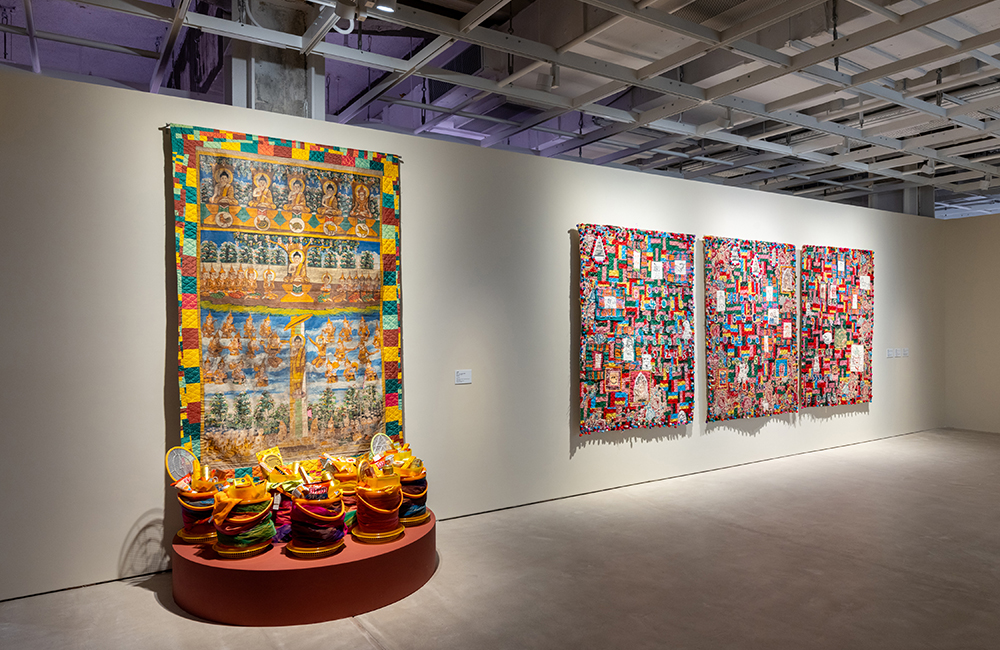
On the contrary, faces are present in Yellow Fever and White Plague, but they are nameless faces, obscured amid the kaleidoscopic tapestry of colours. The works are a commentary on racist attacks and discrimination during the Covid pandemic. They’re hung from the ceiling, with viewers encouraged to walk up to and around them, coming up close to the faces. At times, the faces look like they are simultaneously coming out from beneath the surface, receding into the background or perhaps both – a reminder that the fight for rights is a constant negotiation and the path towards inclusion is never straightforward.
In Changing Room (2017), a participatory installation, viewers are invited to try on military jackets worn by the Thai army and Muslim-Malay headgear. The white caps are embroidered with images of violence borrowed from media coverage of southern Thailand, home to some of the country’s most active insurgents, while the jackets are embroidered with happy scenes imagined by Muslim children, also from the south. By donning the caps and clothes, viewers embody that conflict between violence and innocence, hope and hopelessness.
In the public space downstairs, a few large-scale textile pieces (IDP Story Cloth 1-4, 2016) depict scenes of protest, violence and persecution. With dashes of bright pink, red and yellow, the tone is almost celebratory – until you hone in on the details.
Noteworthy is the lack of a linear narrative – the images are arranged in a haphazard manner, with no apparent beginning or end. As such, it’s not a singular event, but masses of them, with the protesters’ cries reverberating around The Mills, mixing with the conviviality of the weekend crowd.
In the same space, the artist has set up a weaving workshop for the public. If weaving is a way to challenge official narratives, does it also provide a platform for us to stitch our own stories – and be happy?
Featured image: Exhibition view of Everybody Wanna Be Happy by Jakkai Siributr at CHAT (Centre for Heritage, Arts and Textile). Courtesy the artist and CHAT.
《人人嚮往快樂》
香港CHAT六廠(六廠紡織文化藝術館)
2023年11月11日至2024年2月13日
CHAT六廠(六廠紡織文化藝術館)最近為賈凱.斯里布特舉辦展覽,以《人人嚮往快樂》為題,題目是定義式陳述而不是問句,聽起來難免有點咄咄逼人。
對立的命名為展覽定下了基調,色彩斑爛的紡織作品粉飾著段段黑暗歷史,包括人們身無分文、身份被剝奪等。
南豐紗廠周末下午的輕鬆氣氛,與斯里布特所表達的陰暗暴力故事形成強烈對比。
《人人嚮往快樂》是斯里布特首次在泰國以外舉辦的回顧展,展覽全方位展示了藝術家過去的作品,包括紡織藝術、裝置以及可穿戴藝術。當然,部份展品要是附上更深人的說明,例如是啟發創作的社會歷史事件資料,便會更加完美。
斯里布特1969年生於曼谷,以質疑官方論述的紡織藝術而為人熟悉。由於家人以織布維生,姨母更是馬來蠟染藝術家,所以他自幼已接觸紡織藝術。他對拆解故事的興趣也源自家族歷史。在20世紀中,斯里布特的曾祖母收留了王室侍者哲.辛哈塞尼的妻子和女兒。這位侍者因為泰國君主拉瑪八世在1946年離奇駕崩而被處決。經調查後,發現並沒有真憑實據表明辛哈塞尼有份導至國王駕崩。
進場首先看到的是《臨時居所》(2014年),作品是不同版本的泰國公務員制服外套,每款均有刺繡裝飾。
原本綴以官方飾帶和徽章的地方換上了佛教飾物、絲帶蝴蝶結和各種民間護身符,包括一些木製的陽具形吉祥物,就像削弱了這些制服一般情況下所展現的權力。
衣服表達我們的身份,而藝術家在《空氣傳播》系列(2022年),還有《HK/T20》 HK/T20(2023年)和《T/HK20》 T/HK20(2023年)中便重點帶出這個意念。他把疫情期間失業工人的制服縫合,最後留下了撕碎的工作服、工作徽章,還有本來應保護主人免遭惡運的護身符,盡顯諷刺意味。這些被棄置的衣物表現出空虛失落,令參觀者反思棄置衣物背後的面孔,同時也明白最終不會有任何答案。
相反,《黃熱病》和《白瘟疫》均是以臉孔為主題的作品。兩幅掛毯均採用了如萬花筒般繽紛的色彩,相對之下人臉面目模糊、寂寂無名,反映出疫情下的種族主義襲擊和歧視。作品從天花懸掛,鼓勵觀眾繞著作品近距離看清臉孔。有時候,作品上的臉孔好像同一時間從表面走出來,又或一同退到背景中,又或者兩者皆是。這種表達手法提醒我們爭取權利是不斷進行的談判,然而而共融大同之路永不平坦。
《更衣室》(2017年)是參與式裝置,邀請觀眾穿上泰國陸軍的軍褸和穆斯林馬來人的頭飾。白色蓋帽上的刺繡借用了媒體報導的暴力影像,這些影像來自泰國反對份子最活躍的南部;軍褸上的刺繡圖案則來自穆期林兒童想像的快樂場景,他們同樣來自泰南。觀眾試上帽子和服裝,可以體會暴力與純真、希望與絕望之間的衝突。
下一層的公共空間放置了幾幅大型織物作品(《IDP Story Cloth 1-4》,2016年),上面描繪了示威、暴力和迫害的場面。作品用上了近乎喜氣洋洋的鮮艷粉紅、紅色和黃色,只要專心觀察箇中細節時,便明白實情並非如此。
值得留意的,是展品中沒有時序而是隨意放置,不設起點也沒有終點。因此,觀眾所看到的並非單一事件,而是許多故事的集成。南豐紗廠周末遊人的歡聲笑語與示威者的吶喊混在一起,響徹整個場地。
藝術家也在同一空間為公眾舉辦織布工作坊。如果編織是挑戰官方論述的方式,那麼工作坊是否在提供平台,讓我們編寫自己的故事,然後感到快樂?