Silent Sojourns /
WMA Space /
Hong Kong /
Apr 19 – Jun 30, 2024 /
John Batten /
Hong Kong documentary filmmaker and artist Chan Hau Chun’s Silent Sojourns is the second project commissioned under WMA’s 2023/24 theme of “Home”. Chan has reconstructed-as-installation a Hong Kong residential unit divided into separate, black-panelled rooms inside WMA Space, its gallery in a nondescript office building. In these small-roomed exhibition spaces, Chan attempts to recreate the interior atmosphere of what she describes as an “ordinary-looking (residential) building” housing many subdivided flats in an undisclosed location in Hong Kong, possibly Sham Shui Po, where many such flats are located.
Chan initially visited “a homeless acquaintance” in this building in late 2018. Over the following five years, she visited regularly and lived in the building, meeting residents from different floors. She began filming, including talking to residents, in 2019. In an excellent, zine-like booklet, containing photography, drawings, one- or two-line aphorisms, a formal explanatory essay and four pieces of poetry, Chan outlines her own observations, emotions and the reflections of residents. This exhibition is intriguing as it mixes a political message about substandard housing with an overtly artistic presentation of the lives of residents in such poor accommodation.
Housing is Hong Kong’s most enduring social issue because – to keep it simple – the government relies on high-priced land sales and land premiums from private property development for revenue; residential property is then sold at high prices to private owners who consider it both home and investment. Public rental housing is sought-after, even by the middle class, as it offers ultra-cheap, albeit small accommodation compared to the high costs of private rental housing. Often caught in this private rental trap are the city’s elderly poor, recent immigrants and families from the mainland ineligible for public housing, and those with mental, health and addiction issues whose itinerant lives reduce their accommodation options to very small, cheaper rooms in subdivided flats.
Chan’s exhibition is sensitive and articulate, and portrays systemic poverty completely differently from the organisation most active in poverty-alleviation reform, the Society of Community Organization (SoCO), whose many exhibitions and published books in collaboration with experienced photojournalists explicitly push for social and housing policy changes. These books, and an excellent video about West Kowloon, show the poor living conditions of cage homes and subdivided flats, accompanied by graphic stories by individual residents.
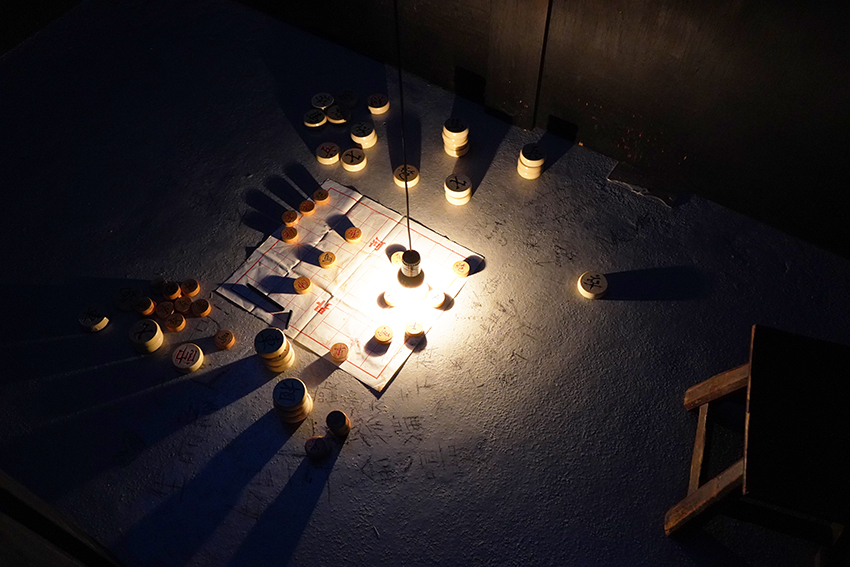
In Chan’s videos, the residents are similar; in the exhibition, we meet and learn a little about their lives through videoed interviews inside the small homes in which they live. Another, shorter video filmed on the street gives, I suppose, a context of abstracted alienation. Inside the completely black-walled, labyrinth-like, partitioned rooms, the exhibition also includes photographs, text, hanging dimmed lights, an illuminated kitchen pot and various publications to read (including the “transcript” of a dream), and a Chinese chess game in progress on the ground amid graffiti/scribblings on the floor. At the exhibition entrance is a large hand-written “reminder notice” written on a small table top:
To me
Remember, all your hard work means
nothing. Remind yourself that your
ultimate dream is to die freely.
These words set the exhibition’s personal, sometimes poignant, existential approach. Chan states, “Weary figures are eclipsed by the visible and invisible rooms, as they traverse different times and spaces. Here, solitude is perhaps a peculiar common tongue, shared among strangers living under the same roof.”
This feeling is highlighted throughout the exhibition, but revealed to visitors is the struggle of how best to present the exhibition – the layout, the location of videos, the darkness of the spaces and so on – and, by extension, the residents themselves. Available to read is an extraordinary three-page discussion “on space” between Chan and the exhibition curator Chloe Chow, giving an unusual glimpse behind the scenes of exhibition-making, something never usually discussed in public.
The voice of the artist is inevitable in an exhibition, but is an uneasy position for Chan. Possibly, as a filmmaker, it is the film that contains her entire message, but a physical exhibition requires added objects, and these are loaded with other, nuanced meanings. Chan and Chow both discuss how to approach the exhibition, as its physical appearance influences everything so much. In one exchange, Chan says: “Perhaps the reason I don’t want to show the agony of the partitioned rooms is that there is also beauty. There’s warmth and sweetness in it.” However, she is explicit about the exhibition’s social role: “The reason I started this project is that I believe society’s structures and procedures have dehumanised [the residents] for too long. So I don’t want to invade their lives with a specific objective, but rather to envision the complexities of their existence.”
This exhibition requires the viewer to read much material provided by the artist, watch videos and sit in uncomfortable, dark, tightly partitioned spaces, and consider the wise words about life and their circumstances by the residents, all honestly spoken. It can be taken, as the artist says at one point, as “a salute to the beauty and cunning of life”.
踱步
WMA空間
香港
2024年4月19日 至6月30日
John Batten
香港紀錄片導演兼藝術家陳巧真的《踱步》是WMA 2023/24年度主題「家」的第二個委託創作項目。陳巧真於不起眼的辦公大樓內的WMA空間中,將一個香港住宅單位分隔成獨立的黑色板間房,重建成裝置藝術。陳巧真嘗試在這些狹小的展覽房間內,重現她所述的「普通(住宅)大樓」的室內氛圍。她沒有公開大樓的地點,有可能是深水埗,因為那裡有許多類似的劏房。
陳巧真於2018年底第一次前往這棟大樓拜訪一位「無家可歸的朋友」,在之後的五年裡,她都會定期前往大樓,更住進大樓,並結識不同樓層的住客。她於2019年開始拍攝,並與住客聊天。她的作品包括一本精美的小冊子,如同雜誌一樣。小冊子內有照片、繪畫、一兩句的格言、一篇正式的說明文章和四首詩歌,陳巧真在小冊子中概述了她個人的觀察、情感和對居民的反思。展覽結合了對簡陋房屋的政治信息和以過份藝術的形式呈現的居民生活,相當引人入勝。
住屋長久以來都是香港的社會問題,簡單來說,是因為政府依賴高價土地出售和私人地產發展的土地溢價賺取收入。住宅物業隨後以高價售予私人業主,讓他們用作自住和投資。公屋供不應求,連中產人士也希望分一杯羹。因為與昂貴的私人住宅相比,公屋的空間雖小,但價格非常低廉。被迫以高價租賃私人住宅的有貧窮老人、新移民、沒有資格申請公屋的內地家庭,以及有精神、健康和吸毒問題的人。他們居無定所,只能選擇狹小便宜的劏房。
陳巧真的展覽敏感而理據清晰,與最積極推動扶貧改革的香港社區組織協會(社協)所描繪系統性貧困的方式截然不同。社協與經驗豐富的攝影記者合作,在許多展覽和出版書籍中明確推動社會和住屋政策改革。這些書籍以及一段關於西九龍的精彩影片展示了籠屋和劏房的惡劣居住環境,紀錄了居民的真實故事。
在陳巧真的影片中,居民的情況都非常相似。在展覽中,我們可以在他們居住的小房間裡觀看錄製的採訪,見識和了解他們的生活。而另一段較短的街頭拍攝影片,則提供了一種抽象疏離的背景。房間完全由黑色牆壁分隔,像迷宮一樣。內有一些照片、文字、昏暗的吊燈、發光的廚房鍋和各種出版物供閱讀(包括一段夢的「謄本」),以及在畫滿塗鴉的地板上玩到一半的中國象棋遊戲。展覽入口處有一張小桌子,上面以大字寫了一張「提醒告示」:
給自己的話
記住,你所有的努力都
毫無意義。提醒自己,你
最終的夢想是自由地死去。
這些文字設定了展覽個人、有時感人的存在方式。陳巧真寫道:「在可見與不可見的房間,在不同時空中往返。在這裏,孤獨或許説是一種奇特的共同語言,互不相識但共處一室。」
整個展覽都強調了這種感覺,但展覽的呈現方式,包括佈局、影片播放位置、空間的黑暗程度,以及居民本身等,也向參觀者展露了展示作品的困難。參觀者可以閱讀陳巧真和展覽策展人周麗珊關於「空間」的三頁精彩討論,文章讓人窺探展覽製作的幕後故事,這些故事通常不會在公開場合討論。
藝術家的聲音無可避免地會充斥於展覽中,但對陳巧真來說這卻是一件令她不自在的事。她作為一名電影人,也許所有的感受都已經透過電影表達,但展覽卻需要更多物件補充,而這些物件都充滿其他細微的含義。陳巧真和周麗珊分享了她們看待展覽的方式,因為展出的所有物件都對主題有莫大影響。在一次交流中,陳巧真說:「為甚麼我不想呈現板間房的痛苦,是因為當中不只是痛苦,還有美麗。還有人的溫暖和美好。」然而,她亦明確說明了展覽的社會作用:「我之所以開始這個項目,是因為我認為社會的結構和程序已經剝奪(居民)人性太久了,所以我不想有目的地入侵他們的生活,而是想設想他們存在的複雜性。」
展覽要求參觀者閱讀許多藝術家提供的材料、觀看影片,坐在不舒服的黑暗分隔空間裡思考居民對於個人生活和處境的格言,所有文字都非常真實。正如藝術家曾說,展覽可以是「向生活的美麗和狡詐致敬」。