Nervous Thrasher / Current Plans / Hong Kong / Feb 3, 2024
The way drones glide through the sky looks effortless, even elegant. But the mechanics behind it are anything but. Propellers turn the rotary motion of blades into linear thrust, creating a disruptive wake. A raw display of power aside, the noise is raucous.
All of that comes together in Samuel Swope’s art practice, which he demonstrated for an audience in February at Current Plans, hosted at Spring Workshop in Wong Chuk Hang, as the inaugural project of UnderCurrents, a “year-long series of experimental happenings”.
The event was called Nervous Thrasher and, in Swope’s words, was a performative installation involving acts of real-time sonification of airborne sculptures, in which data is collected and mapped into audio form.

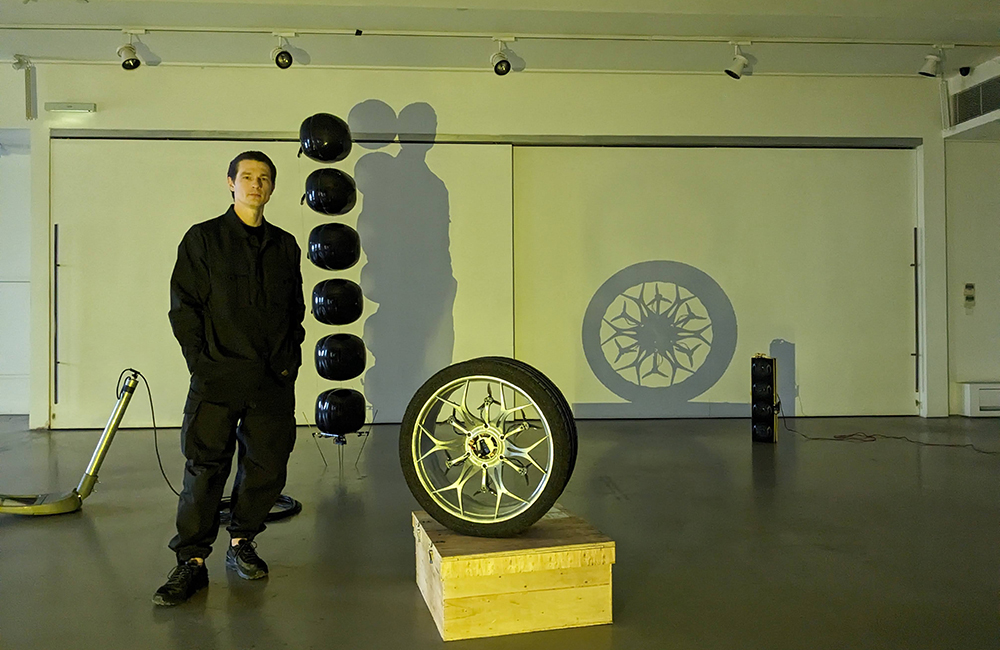
One sculpture was a column of six black balloon-like vessels filled with helium, with a drone as its base in a visual nod to Sputnik, the first human-made satellite, which was launched by the USSR in October 1957. During his performance, Swope approached it to plug in the battery, treating the sculpture like an otherworldly object in the yellowish glow that filled the space. The feel was a blend of science fiction, particularly films that feature unidentified aerial phenomena, and the askew sensation of B-movie humour.
Sensors in the sculpture help it avoid obstacles – walls, viewers, the artist himself – and forge the synthesised sound that we hear. In other words, the sound server’s tonal output is a means for the sculpture to communicate, a reflection of how its underlying program interprets the sculpture’s spatial position and awareness. As flight controller data is mapped to sound waves, we know that the sculpture is indeed thinking.
Swope strives to find harmony between his hardware and audio synthesis. For him, sound is a multisensory interface, an extension of our ocular-centric experiences. His practice consistently uses air – and transitively, flight – as a medium for art. The artist has built upon that by considering the physics of sound waves and how sound is reliant on air. This encapsulates not only the noise created by the whirring of propellers but also how a drone-based sculpture’s movement can be translated into sound.

Another sculpture in Nervous Thrasher bore a hyperrealistic resemblance to a car tyre. It was engineered to be light enough that it could become airborne, but had enough heft to rip through air like a muscle car – a nod to American Midwestern garage culture, where gearheads rebuild engines and modify automobiles to craft customised high-performance vehicles, as well as the “Mongkok culture” that is “alien” to the artist.
Within Spring Workshop’s space, Swope rolled the tyre around with deliberation, at times steering it into areas where viewers were seated on the floor. Within the wheel, embedded beneath its hub and spokes, were drone propellers. After downing a few gulps of beer, Swope activated the blades and the wheel took flight, seemingly defying gravity. It tore through the air, much like how drag racers rev their engines before shooting down a straight track.
It was an unexpectedly powerful display – noise from the propellers echoed in the enclosed room, their turbulence blowing into viewers in all directions, while deep bass tones synthesised using data from the flight controller bled from a subwoofer. The viewers’ bodies felt all of this.

Nervous Thrasher was a lengthy performance in two takes, a choice that Swope made to cultivate abrasive, climactic moments as his sculptures took flight and moved through the air, convulsing, gliding or swerving before viewers. The activity of sculptures created by Swope whipped up different forms of energy – wide arcs of motion exhibiting a confident display of power, fidgety displacements emanating frenetic bursts of intensity.
Hyperreal fabrication and mechanical engineering aside, Swope’s set-up involved a sound server and artificial neural network. It was easy to focus on the technical intricacies of the artist’s creations and lose sight of his artistry. He brought these elements together in Nervous Thrasher seamlessly, his own body a part of the performative installation, presenting a situation where viewers were compelled to experience his airborne sculptures in more than one way, basked in an otherworldly glow.
無人機在空中飛翔時看起來很輕鬆,甚至優雅,但背後的操作卻大相逕庭。螺旋槳將槳葉的旋轉轉化為連貫的驅動力,產生混亂的尾流,除了直接展示出力量之外,亦會產生刺耳的噪音。
Samuel Swope的藝術實踐就呈現了以上種種,他二月份在黃竹坑Current Plans由Spring Workshop舉辦的活動中向觀眾展示,作為UnderCurrents「為期一年的一系列實驗」的首個項目。
活動名為「Nervous Thrasher」,套用Swope的說法,作品是一個表演裝置,包含雕塑在空中的實時發聲,收集數據並將資料轉化成聲音。
其中一個雕塑由六個充滿氦氣的黑氣球組成柱子,放在一架無人機上,向蘇聯1957年10月發射的第一顆人造衛星Sputnik致敬。在表演的過程中, Swope走近雕塑然後插上電池,讓它在滿佈整個空間的黃色光芒中成為一個超脫的物體,彷彿混合了科幻小說(尤其以神秘太空現象為題的電影)和B級片的幽默歪斜感。
雕塑的感測器讓它可以避開牆壁、觀眾和藝術家本人等障礙物,並形成我們聽到的合成聲。換句話說,聲音伺服器輸出的音調是雕塑溝通的語言,反映出底層程式對雕塑空間位置和意識的詮釋。當飛行控制器的數據轉化成聲波時,我們可以知道雕塑確實在思考。
Swope致力在硬件和合成聲之間找出平衡,他認為聲音是一種多感官介面,為我們以視覺為主的體驗作出延伸。他以空氣和飛行作為藝術媒介,同時考慮聲波的物理以及聲音對空氣的依賴,不但呈現出螺旋槳產生的嗡嗡噪音,還體現了無人機雕塑的轉動的聲音轉化方式。
「Nervous Thrasher」的另一個雕塑與車胎非常相似,它輕得可以在空中飛行,但也夠重可以像由車迷重裝引擎並改裝車身而自製的高性能車輛一樣在空中穿越,藝術家希望透過作品對美國中西部車房文化以及他認為是「陌生」的「旺角文化」致敬。
Swope在Spring Workshop的空間內小心翼翼地滾動輪胎,偶爾會轉向觀眾坐著的地板區域。嵌入輪子輪圈和輻條下的是無人機的螺旋槳。Swope喝了幾口啤酒,然後啟動槳葉,輪子隨即飛起,像在抵抗地心吸力一樣。它迅速穿越空氣,好比飆車者在直線賽道上加速引擎一樣。
表演意外地震撼,螺旋槳發出的噪音在封閉的房間內迴響,湍流從各方吹向觀眾,透過飛行控制器數據合成的深沉低音從重低音喇叭同時發出,由觀眾的身體清楚感受到。
「Nervous Thrasher」是一場分開兩次進行的長表演, Swope之所以這樣選擇,是為了在雕塑在空中飛行和移動,並在觀眾面前震動、滑行和轉向時營造出刺耳的高潮時刻。Swope創作的雕塑活動激發起不同形式的能量,廣闊的移動弧線展現出自信的力量,煩躁的排氣則爆發出狂熱的強度。
除了超像真的組裝和機械工程外,Swope的裝置還涵蓋了聲音伺服器和人工神經網絡。觀眾很容易將注意力集中在藝術家創作的複雜技術上,而忽略了他的藝術性。他在「Nervous Thrasher」中將這些元素無縫結合,自己的身體成為表演裝置的一部份,迫使觀眾沐浴在超脫的光芒中,以多種方式體驗他的空中雕塑。