Transcendence /
Santa Maria della Pietà /
Venice /
Apr 19 – Sep 30, 2024 /
Against the backdrop of information overload and techno culture, our attention is constantly focused and optimised on digital platforms. The rationalist worldview that we can ameliorate the human condition through hyper-utilitarian goals, such as expanding the physical reality of our mind with artificial intelligence, has sparked a revival of self-development, spiritual well-being and a new openness to the religious and the numinous.
For multidisciplinary sculptor and artist Wallace Chan, the pursuit of a meditative state and the ability of the mind to transcend the boundaries of space and time have taken the form of a lifelong exploration of the philosophy of non-duality, where conflict and harmony are interchangeable realities. After moving to Hong Kong from Fuzhou in 1961 aged five, Chan began as a gemstone apprentice aged 16. Believing that all things in the world possess an inner spirit, he developed an uncanny understanding of materiality, leading to his invention of the “Wallace cut” in 1987. Inspired by multiple exposures used in photography, this pioneering gem-carving technique employs reverse thinking to create the illusion of a three-dimensional image. With a desire to create expressive yet lightweight jewellery pieces, Chan started working with titanium, a futuristic material widely used in the aerospace industry that contrasts with jade and gemstones. The strength and lightness of titanium have enabled him to create larger sculptural works with a floating, ethereal quality.
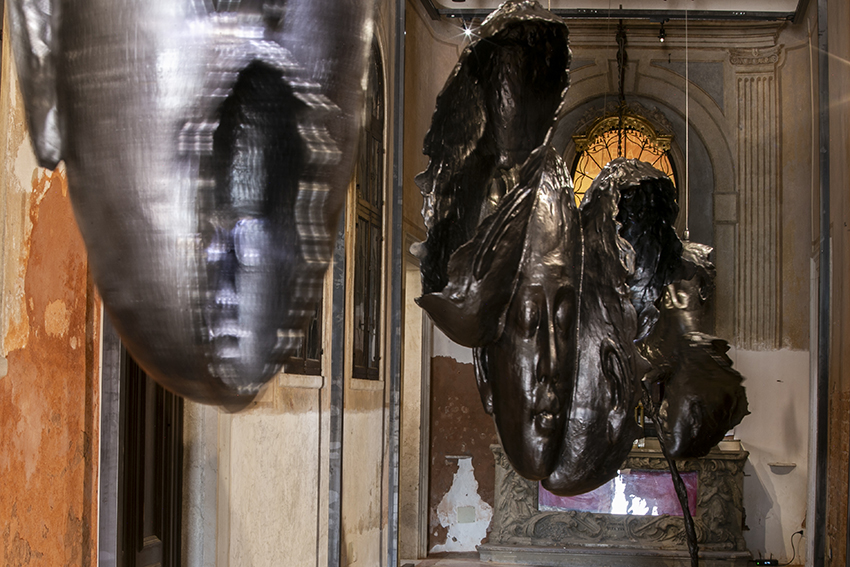
In the heart of Venice, next to Piazza San Marco, amid the city’s buzzing crowds and busy canals, lies an exhibition whose dim lighting and tranquil, almost otherworldly atmosphere offer a contemplative escape. At the intersection between the material and the metaphysical, Transcendence is a site-specific installation featuring four large-scale titanium sculptures suspended from the chapel ceiling. Guiding visitors from noise and conflict to tranquility, the journey through the exhibition symbolises rebirth, creating space for introspection.

Minimal and timeless in its aesthetics, the centrepiece of the exhibition is an evocative sculpture resembling a skull-like alien with dark portals through its eyes and mouth. At first glance, this androgynous figure appears menacing, embodying the conflict and materialism impacting our world. However, upon closer inspection, the sculpture reveals a gentler side, a hidden sleeping figure encouraging viewers to find new perspectives within turmoil. The chapel space acts as a metaphor for renewal, contrasting with the themes of conflict and destruction. It’s a powerful narrative of finding hope and new beginnings amid chaos.
The final section of the exhibition features an intriguing interplay of religious and philosophical symbols. A figure of Christ and a Buddha stand on an altar, their praying positions reversed to comment on their interconnectedness in pursuit of truth and liberation. This is not about specific religious beliefs but rather a broader reflection on the unity of the universe and the growing interest in the metaphysical and spiritual in contemporary society.
Enhancing the sensory experience is experimental musician Brian Eno’s ambient soundscape I Dormienti. Originally composed for a project at London’s Roundhouse, Eno’s piece incorporates elements reminiscent of chanting and the mbira, an African musical instrument. The subtle noises and atmospheric sounds interact with the sculptures, bringing the space to life. The sculptures themselves embody a mixture of yin and yang, exemplified by two twisted, concave heads designed for viewers to place their own heads inside. As sound waves hit the hollow sides, they bounce around the curved surfaces, crafting a unique, immersive experience.
A self-reflective journey meant to be experienced and felt, the show encourages visitors to walk around, absorb the tranquil environment and engage with the works on a personal level. Known for his instinctive approach, Chan invites viewers to draw their own interpretations, finding moments of connection and contemplation.
In a world saturated with noise and conflicts, this exhibition offers a serene, thought-provoking respite, where chaos is transformed into opportunities for enlightenment. In Chan’s words: “We need to stay silent inside [our minds] in an ever-complex and noisy world to find solitude. If we can’t control the how we react in the moment, how can we move towards clarity and find wisdom?”
Featured image: Installation view of Wallace Chan: Transcendence, 2024. Photo by ©Federico Sutera.
超越
聖瑪利亞痛苦之母堂
威尼斯
2024年4月19日至9月30日
Jessica Wan
在資訊超載和科技文化的背景下,我們的注意力長期集中在數碼平台上。理性主義的世界觀認為我們可以透過超功利主義的目標改善人類的現狀,如利用人工智能擴展我們心靈的實際現實情況,重新開發個人發展、精神福祉以及對宗教和神秘主義的開放性。
對於跨領域雕塑家和藝術家陳世英來說,對冥想狀態的追求以及思維超越時空界限的能力,是他一生對非二元哲學的探索形式。在非二元哲學中,衝突與和諧是可互換的現實。在1961年,當時5歲的陳世英從福州搬到香港,其後在他16歲時成為寶石學徒。他深信萬物有靈,故此對物質性發展出獨特的理解,並於1987年發明了「世英切割」。這種創新的寶石雕刻技術受攝影的多重曝光啟發,以逆向思維創造出三維圖像的錯覺。為了創造出達意且輕巧的珠寶作品,陳世英開始使用充滿未來感的鈦金屬。這種物料常用於航天業,與玉器和寶石形成鮮明對比。鈦金屬的強度和輕盈讓他創造出能夠懸浮、輕巧的大型雕塑作品。
威尼斯的中心盡是喧囂的人群和繁忙的運河,展覽就座落於聖馬可廣場附近。展覽昏暗的燈光和寧靜得近乎超脫的氣氛,為人提供了一個冥想的喘息空間。「超越」是一個場域特定裝置藝術展覽,展出四件懸掛在教堂天花板上的大型鈦金屬雕塑,交集了物質和超自然元素。展覽引導參觀者從喧囂和衝突走向寧靜,參觀過程象徵重生,為人創造出內省的空間。
展覽的中心作品是一件簡約和超越時代的雕塑,意圖喚起參觀者的回憶。雕塑外型像一個貌似骷髏的外星人,眼睛和嘴巴都是黑暗的洞。乍看之下,這個雌雄同體的形象頗具威脅性,體現了影響世界的衝突和物質主義。不過仔細觀察後會發現雕塑也有溫和的一面,隱藏了一個沉睡中的人物,鼓勵參觀者在動盪中尋找新的視角。教堂的空間象徵著重生,與衝突和毀滅的主題形成對比,以有力的敘事方式叫人在混亂中尋找希望和新開始。
展覽最後的部份展示了宗教和哲學符號之間有趣的互動。祭壇上有一對祈禱方向相反的基督像和佛像,說明他們在追求真理和解脫方面的連繫。作品探討的不是宗教信仰,而是對宇宙統一以及當代社會對超自然和靈性日益關注的深層反思。
實驗音樂家Brian Eno的環境音樂作品《I Dormienti》增強了參觀者的感官體驗。Brian Eno的作品本來是為倫敦圓屋劇場的項目而創作,融合了類似念經和非洲拇指琴的元素。微妙的噪音和神秘的聲音與雕塑互動,為空間注入生命。雕塑本身體現了陰陽的混合,兩個扭曲的頭部呈凹形,讓參觀者將自己的頭部放進去。當聲波撞擊空心側面時,它們會在曲面上反彈,創造出獨特的沉浸式體驗。
展覽是一次自省的旅程,旨在讓參觀者體驗和感受,鼓勵參觀者四處走動,沉浸在寧靜的環境中,以個人方式與作品互動。陳世英以他直覺的創作方式聞名,邀請參觀者自行解讀,尋找連結和沉思的時刻。
在充滿噪音和衝突的世界裡,展覽提供了一個平和寧靜而發人深省的喘息空間,將混亂轉化為啟蒙的機會。陳世英自言:「在日益複雜和喧囂的世界裡,我們需要[在內心]保持沉默,尋找寂靜。如果不能控制自己當下的反應,我們又怎能走向明淨,尋找智慧?」