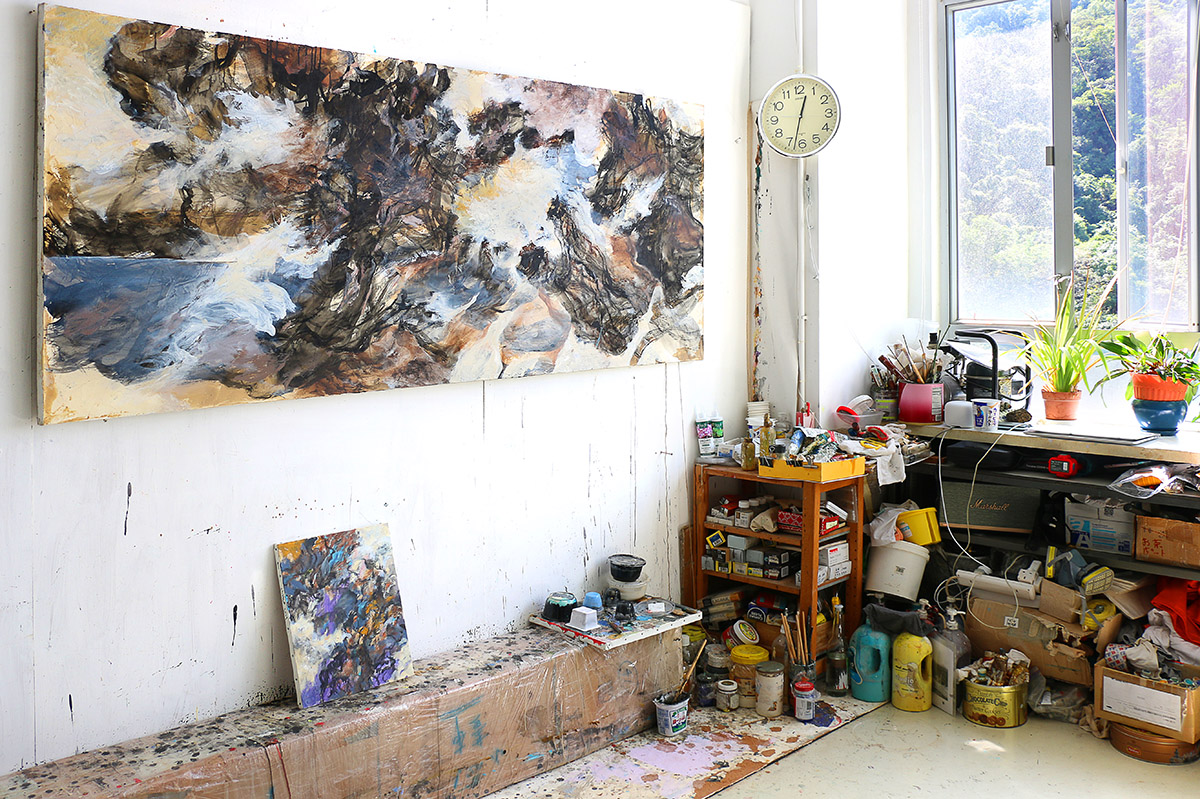
A graduate of the Department of Fine Arts at The Chinese University of Hong Kong in the early 1980s, Chak Chung was deeply influenced by the renowned artist Liu Kuo-sung. Over the past four decades, he has engaged in an extensive exploration of diverse painting traditions, from Chinese landscape to modernism. Shortly after completing his undergraduate studies, Chak relocated to Tokyo to further his artistic education, subsequently moving to New York, where he resided and worked until 2009. Upon returning to Hong Kong, he established his studio in Fotan, where he continues to investigate the possibilities of painting as a medium, striving to grasp the elusive beauty and inherent chaos of the natural elements and the human condition.

Caroline Ha Thuc: Most of your artworks are landscape paintings and portraits of Hong Kong. They express the pull and push between elements and are generally free from people. Chak Chung: Socialising is one of my major weaknesses. I find people’s behaviours intimidating, and interacting with strangers drains my energy. Maybe that is why I am drawn to painting landscapes rather than focusing on mankind. I find solace in observing the sea, the sky and the ocean. These natural elements calm me and provide a sense of peace. The push-and-pull dynamics represent the endless turbulence of introspection.
CHT: Is painting the landscape of Hong Kong an attempt to revisit Chinese classical painting? CC: I have been in this field for too long. It seems that no one has made any significant breakthroughs in classical Chinese painting for quite a while. As I am near the end of my journey, I would like to make one last attempt at pursuing this quest. I’m not certain if I can achieve the goal but it’s worth a try.
CHT: What could the relevance of this classical approach to painting be when thinking about our current relationship with nature? CC: In the past, one of the mainstream schools of thought was to be “one in harmony” with Mother Earth. Similarly, the ancient Chinese philosophical ideology of 天人合一 [unity of nature and humanity] reflects this concept. Since then, our tie with nature has evolved and is now quite different.
Personally, neither exactly sits right with me. For instance, nature has presented itself as a reckless, ruthless entity. It has always acted on its accord and has no intention to be benevolent and all-loving towards mankind. The human species is merely one small fraction of the vast ecosystem, while nature encompasses the totality of the universe. Such is the overarching theme of all my paintings.
CHT: Why is it important for you to work in dialogue with this heritage? CC: Heidegger once mentioned that the common norms of society, whether spoken or not, are unanimous everywhere. Their governing power has long existed before you and I were born. Such benchmarks teach us all matters in life, from the books we read or are prohibited to the ways we assess our surrounding environment. At the end, we are moulded into a so-called “normal person”. Our identity or self-searching has little to do with originality and thus emancipation. We are who we are, which is a cross-section of time and history: the result of a long line of heritage.
CHT: You were aboard for almost 30 years; what motivated you to come back? CC: My return was triggered by two unexpected incidents.
The first involves Franz Dahlem, a friend and former gallery owner from Germany. One day, he asked me, as an Asian, what I was bringing to the art scene in New York. I felt ashamed.
The second event harks back to my years living in downtown New York City, which coincided with the tragic occurrence of 9/11 and the collapse of the Twin Towers. In the aftermath of that disaster, the neighbourhood was heavily secured by armed personnel and food supplies dwindled significantly. I managed to survive for two weeks. This experience led me to explore two fundamental questions – a: who am I? And b: what is the meaning of life?

CHT: What do you think of your identity now? CC: I believe that no one can completely master their self. Based on Chinese philosophy, my goal is akin to that of ancient Greek masters: namely, why can’t humans be as infinite as mountains? This puzzle guides us toward the ultimate. “Where do I come from and where am I going?”
When I began painting Hong Kong shan shui (山水), it symbolised a sense of eternity. However, over the years, my artistic expression has evolved. What once was a pure homage to nature has gradually incorporated subtle references to my emotional connection with my homeland, Hong Kong. For example, in The Whistle Blower (2025), I depict a form resembling a windpipe or whistle in the lower right corner. The white vapour emanating from it serves as a warning signal – a call for friends to flee.
CHT: In the 17th-century painter Shitao’s famous treatise about painting, Sayings on Painting from Bitter Gourd Monk, he says that there should be no rule, or rather a rule saying that there is no rule: would you agree? CC: I wholeheartedly agree with Shitao’s viewpoint. In my artistic practice, I strive for unpredictability. This approach serves as a time-recording mechanism through which I convey my perspective of “no beginning or end”. Embracing a free spirit, my art becomes an expression that contrasts against rigid structures and constraints. Rules establish a basis for predictability. Therefore, I believe the real challenge lies in how we can anticipate the dynamics of nature without falling into monotony.
CHT: In his treatise, he describes the sea and mountains as interconnected, which is also what we see in your landscapes. CC: To me, the sky, the ocean and the mountains form a vast and interconnected unity. In Lacan’s words, these elements represent a mirror image, indifferent to one another. The philosopher introduced such a mirror to illustrate the concept of self-alienation. But what is the self without the influence of the outside world? I once perceived the sunset as a vibrant red circle descending and eventually being enveloped by the sea. C’est la vie! The so-called fireball will, as always, rise again from the east tomorrow. Fire, water, wood, metal and earth are intricately intertwined.

CHT: You told me that you tried to empty your mind before painting but that then you were “going crazy”. Can you elaborate on that? CC: Achieving a state of total relaxation and mindfulness is more akin to meditating than to going crazy. In truth, the mind cannot become entirely blank. Instead, I attempt to eliminate all secular distractions and concentrate solely on the canvas. At that moment, a multitude of possibilities and ideas emerge. One could say that the endorphins start to take control, marking the commencement of the creative journey.
CHT: In some cases, it really feels you are bringing forth the chaos on the canvas. In After the Black Rain (2024), for instance, one can observe a struggle between the black lines that traverse the composition and the broad areas of white that appear to collapse in on themselves. How can you manage to give birth to new forms from such catastrophic chaos? CC: Energy is always an encounter of the static against the mobile, cold struggling with warm, finite versus endless.
The interpretation of this fine drawing can be divided into two layers. On the physical level, the black and grey represent landmasses. They interlock and juxtapose to exist, just as we entwine with nature. The vertical and horizontal lines form the spinal framework, the structure, to balance, neutralise and harmonise such a meltdown. This wonderful marriage creates stability and miraculously enhances the composition.
On a metaphysical level, one can distinguish five individual droplets that emerge from the lower left corner. They symbolise little people like myself. These good fellows are dear friends who are leaving Hong Kong.
CHT: Chinese painters have usually not painted on site but rather constructed imaginary scenes in their studio. On the contrary, you take your paper and pencils when hiking and draw outside. CC: The human brain is extraordinary. Our subconscious is adept at processing and filtering specific elements. When we visit a new environment or encounter novel situations, fleeting thoughts may arise. These ideas can be positive or negative but how we react largely reflects our inner self. The outcome represents the reality or true essence of that particular scene or moment. In short, as artists, there is a choice: either we utilise [the objects through our gaze] as a medium to cultivate back in the studio; or, through our creations, we strive to enact, symbolise and sublimate such experiences.
Back in the studio, with the bases from the sketches laid down on the canvas, transformation begins. According to Alain [philosopher Émile-Auguste Chartier], within the process, a superb artist will revamp the raw material, including the original drawings, into something that even amazes her or himself. That is sublimation.

CHT: In your painting, a large white mass features both the sea and clouds, sometimes simultaneously. Traditionally, they stand for the void, something from which everything can emerge. Yet if we look at paintings such as They All Line Up and Leave (2023), they offer a rather dense surface. CC: I’m truly glad you brought this up. The portrayal of the blank space as a representation of the infinite has become somewhat cliched, akin to the fable of the Emperor’s new clothes. To mitigate this risk, I have sought to redefine the true meaning of the void by visually incorporating rich elements beneath layers. The large white and occasionally blue planes in my paintings strive to reveal intricate details, allowing colours to subtly emerge. In this way, I confine the beautiful hues in a delicate sanctuary instead of abandoning them entirely.
Over time, I have developed a strong aversion to large white areas or blank colour fields. As a countermeasure, I strive to incorporate various colours that subtly seep through the lighter top layer to enrich the surface of the canvas. These light tones play a very crucial role in creating definition for the islands, peninsulas, land formations and other structural elements within my work, all of which are essential to my artistic vision.
CHT: In your work, there is no perspective but rather a sense of gravity that leads to a strong dynamic, not necessarily pushing things downwards but taking them in a circular or revolving movement. Are these the dynamics of creation? CC: The sheer power of nature is always fascinating. Documentaries about hurricanes, tsunamis, avalanches and floods capture my attention. Back when I was still living in New York, I frequently travelled upstate to worship Niagara Falls. I often envisioned qi as the invincible flow of perpetually moving air masses. When it surges, the vacuum gets replenished, thus creating a vast, invisible current. Imagine if we look at it from afar, this circulation will initiate a huge, dynamic, circular swirl.
CHT: At the same time, there are many geometrical lines that structure your paintings: the horizontal ones, marking the marine horizon that is always present around Hong Kong, but also many others that seem rather to hold the whole composition. How do you integrate these elements? Do they serve as a kind of backbone to your painting? CC: People oftentimes ask why I choose oil paint and a western medium to induce the Chinese spirit in my art. This choice reflects my upbringing during the period of colonialism. I find myself neither fully aligned with the east nor the west. Similarly, Hong Kong is a city that is full of concrete. Therefore, parts of the wilderness left undeveloped have transformed into an objet petit a [an unattainable object of desire, in Lancanian theory] for modern men like myself. In my paintings, the level lines mostly signify the ocean’s horizons, while the vertical strokes likely symbolise architectural structures. These geometric elements are introduced to contrast with the hills, islands, trees, waves and other organic elements.

CHT: You also decompose natural elements. For example, in Tolo Harbour (2024), the landscape depicted is deconstructed, as if bands have shifted both horizontally and diagonally, pushed by the effects of tectonic plate dynamics. CC: [Philosopher] Nelson Goodman once cited a butterfly as an example. When we see it in the field, that colourful Tinkerbell is an insect. After taxidermy, it becomes a sample of its species.
To be honest, I can come up with plenty of deconstructivist dogmas or dissect them with the logic of postmodernism’s fragmentation theories. They may be mechanisms in my subconscious, but none of that matters.
Feeling happy and enchanted while laying down the strokes: I simply need that music. Lusting for beauty and yearning for the aesthetic is a sincere response to my inner longing. The unpredictability and creativity of art bring forth excitement. I enjoy every moment in the midst of it.
CHT: Tell me more about your self-portrait as an octopus. CC: In my youth, I often felt unfocused. This led my mother to refer to me as an octopus, due to its many tentacles reaching in various directions. This imagery has subsequently been integrated into some of my works.
CHT: At the back of your drawings and sketches, I can also see lots of writing. How do words interact with your act of painting? CC: Ideas are like bubbles in wine; they emerge and dissipate while I contemplate. These thoughts and emotions evolve over time. Writing serves as a memorandum. I frequently revisit and transform previous works without hesitation. Jotting down notes serves a dual purpose: it reminds me of the original concept, denoting a specific idea, and inspires further development.
CHT: You add layer after layer, revisiting the same painting many times, sometimes over several years. Some paintings bear different dates, for example An Uncanny Gay Day (2021-23). How is your gaze changing over the time? CC: Inside the studio, I am an absolute tyrant. When revisiting old pieces and finding them shallow or not up to par, I never hesitate to give them a surgical facelift. “The world has more than enough masterpieces” is my motto. It means there is no room for another mediocre “Chak”. The various dates on An Uncanny Gay Day denote a marking, cautioning that perfection is still beyond my reach.
CHT: Beauty seems paramount for you, or at least a sense of balance and harmony. When do you feel satisfied? CC: That’s right. My art revolves around the unachievable goal of aesthetic pleasure and poetry. Consequently, I find myself continually striving for a level of enchantment that often feels elusive.
[Poet, playwright and novelist] Théophile Gautier once pondered what life would entail if flowers ceased to exist. Beauty, including music, is essential for humans. To me, nature is full of beauty and wonder. Through creation, artists transcend material reality and challenge the very essence of nature.

CHT: Are there any writers, philosophers or artists who have influenced you? You’ve mentioned philosopher Martin Buber and art critic Robert Pincus-Witten. CC: Robert and Gabriel Laderman were my mentors at Queens College, CUNY [City University of New York]. So were Liu Kuo-sung and James Watt, who accompanied my growing up at The Chinese University of Hong Kong. They remind me of the presence of extraordinarily knowledgeable individuals.
Philosophers from diverse cultures offer valuable insights, making it challenging to pinpoint just one influence. For instance, I appreciate Wittgenstein’s assertion that “the limit of my language is the end of my world”. Additionally, Ch’ien Mu, in his work Ten Lectures on Life, pointed out that a learned individual does not retire. Instead, they uphold their morality until the end, ultimately laying down peacefully without regret.
CHT: Beyond the search for the essence of the forces that shape the world, you told me that painting is above all about life. What did you mean? CC: In ancient Greece, “alive” was defined as an “animal/being that is speaking”. Life and force or energy can be considered two sides of the same coin. Both point to the very essence of existence. Once involved with existence for the moment, we are under the short-sighted, trivial, materialistic, narrow-minded, confusing spell of phenomenology.
A lot of people disfavour Heidegger and label him a Nazi supporter. On the other hand, his dissertation on life has made a strong impact. He explained that existence is everywhere. It shines through tiny flowers in the field or the cloud above us. Even though we feel it immensely, no one can verify existence. As a result, existence is an everlasting enigma.
Flowers bloom to let us know they have survived. What about humans? We labour and the end product becomes the affirmation. Distinguishing masterpieces and actions of heroes accumulate, which shape the world. Artists work hard to create a painting, a sculpture, an installation. The totality reflects who they are. Through searching for the truth, the process and its reminder become the alibi. That is culture and civilisation.
翟宗浩於1980年代初畢業於香港中文大學藝術系,他深受著名藝術家劉國松的影響。在過去四十年,他廣泛探索中國山水畫到現代主義等多種繪畫方式。從本科畢業後不久,翟宗浩便移居東京繼續深造藝術,之後再移居紐約,並在紐約居住和工作至2009年。回到香港後,他在火炭設立了工作室,繼續探索繪畫作為媒介的可能性,用以捕捉大自然和人類生態之間虛幻的美與固有的混亂。
Caroline Ha Thuc: 你的作品大部分都是香港的風景畫和寫實畫像,描述了不同元素之間的推拉,而且通常不受人類的影響。翟宗浩:社交是我最大的弱點之一。我害怕他人的行動,而且與陌生人交流亦會耗盡我的能量。或許因此我更傾向繪畫風景而不是人。觀看大海、天空和海洋可以撫慰我的心情。這些大自然的元素讓我平靜,為我帶來平和的感覺。推拉的動態變化象徵著人類之間沒完沒了的動盪。
CHT: 你是不是試圖通過繪畫香港風景再次探索中國古典畫?翟宗浩:我在這個領域已經太久了。似乎在這段時間裡沒有人能在中國古典畫領域中取得任何重大突破。我的旅程已近尾聲,所以我想最後一次放手一搏嘗試追求這個境界。我不知道自己能否實現這個目標,但值得一試。
CHT: 這種古典繪畫方法與我們現時與大自然的關係有何關聯?翟宗浩:以往的其中一種主流思想是與地球「和諧共存」。中國古代哲學思想「天人合一」也反映了這個理念。我們與大自然的關係隨著時間發生了變化,如今已截然不同。
就我個人而言,以上的兩種說法我皆不盡然同意。大自然一直都是一個危險且無情的存在。它總是隨心所欲,從未對人類展示過仁愛與寬容。人類只是這個浩瀚的生態中的一小部分,而大自然則擁有整個宇宙。這正是我所有畫作的核心主題。
CHT: 為什麼與大自然對話對你來說如此重要?翟宗浩:海德格曾說過,無論是否曾明示,社會的共同規範在任何地方都是一樣的。它們的影響力在你我出生之前早已存在。這些規範教導我們生活中的一切,從我們閱讀過的或被禁的書籍,到我們如何認識周圍的環境。最終,我們會被塑造成所謂的「正常人」。我們的身份或自我探索並非原創,更談不上解放。我們就是我們,是時間和歷史的其中的個橫切面:是漫長的傳承的結晶。
CHT: 你在國外生活了將近30年,是什麼促使你回來?翟宗浩:我會回來是因為兩件出乎意料的事。
第一件事與Franz Dahlem有關。他是我的朋友,曾在德國經營畫廊。有一天,他問我身為一個亞洲人為紐約的藝術界帶來什麼。我感到很羞愧。
第二件事是我回想起曾住在紐約市中心的那幾年。那時候碰上了911事件和雙子塔倒塌的悲劇。災難後,社區戒備森嚴,到處都是武裝人員,食物的供應也大幅減少。我勉強撐了兩個星期。這段經歷讓我思考兩個基本問題──一:我是誰? 二:生命的意義是什麼?
CHT: 你現在如何看待自己的身份?翟宗浩:我相信沒有人能夠完全了解自己。我的想法建基於中國哲學,與古希臘大師的看法相似:人類為何不能像山一樣無限?這個謎題引導我們走向最終的問題。「我從哪裡來,又要到哪裡去?」
當我開始畫香港的山水時,它象徵著一種永恆。然而經過這麼多年,我的藝術表達方式亦有所改變。曾經對大自然純粹的敬慕如今逐漸微妙地融入了我對家鄉香港的感情。例如,在《Whistle Blower》(2025年)中,我在畫的右下角描繪了一個類似氣管或哨子的圖案。其中噴出的白色蒸汽就像是一種警示--呼喚朋友逃離。
CHT: 十七世紀畫家石濤在其著名的繪畫理論著作《苦瓜和尚畫語錄》中寫道,繪畫不應有規則,或者說,應該有一條規則說明沒有規則:你同意嗎?翟宗浩:我完全同意石濤的觀點。在我的藝術實踐中,我追求不可預測性。這種方法如同一種時間記錄機制,我藉此傳達自己「無始亦無終」的理念。我的藝術擁抱自由精神,與僵硬的結構和限制形成對比。規則為可預測性建立了基礎。因此,我認為真正的挑戰是如何在不掉入單調不變的陷阱的情況下預測大自然的動態變化。
CHT: 在他的理論著作中,他將海洋與高山描述為相互聯繫,而我們在你的山水畫中也看到了這一點。翟宗浩:對我來說,天空、海洋和高山是一個廣闊並相互聯繫的整體。用Lacan的話來說,這幾樣元素就像鏡中影像,對彼此漠不關心。這位哲學家利用鏡子來闡明自我異化的概念。但是,沒有了外在影響的自我又是什麼呢?我曾經將夕陽看作一個鮮豔的紅色圓圈逐漸下降,最後被大海所籠罩。這就是生命!這個所謂的火球,明天仍將如常從東方升起。火、水、木、金、土,錯綜複雜地糾纏在一起。
CHT: 你告訴過我,你在繪畫前嘗試清空思緒,但之後卻「瘋起來」。請問你能詳細說說嗎?翟宗浩:想做到完全放鬆和正念狀態的話,與其說是發瘋,不如說更像是冥想。事實上,我的腦袋不可能完全放空。相反,我嘗試排除一切世俗的干擾,並專注於畫布。那一刻,無數的可能性和想法湧現。可以說,內啡肽開始佔據主導地位, 並開始了我的創意之旅。
CHT: 在某些時候,你會覺得自己正在畫布上創造混亂。例如,在《After the Black Rain》(2024年)中,觀者可以看到貫穿全圖的黑色線條與看似自己崩塌的寬闊白色區域之間的掙扎對比。你是如何從如此災難性的混亂中孕育出新形態的?翟宗浩:能量總是在靜態與動態的碰撞、冷與熱的掙扎、有限與無限的對抗之中產生。
這幅畫作可分為兩個層次解讀。在物理層面上,黑色和灰色代表陸地。它們互相糾纏著並存,就像我們與大自然交織在一起一樣。垂直和水平的線條是作品的脊椎,形成結構以平衡、中和及協調這種混亂。這種奇妙的結合營造了穩定性,並神奇地昇華了構圖。
在比喻的角度上,人們可以看到左下角冒出的五個分開的水滴。它們象徵著像我這樣的小人物。這些人即將離開香港。
CHT: 中國畫家通常不在現場作畫,而是在工作室裡描繪想像的場景。與他們相反,你會在行山時帶備紙筆在戶外作畫。翟宗浩:人類的大腦非常奇妙。我們的潛意識很擅長處理和過濾特定的元素。當我們置身於一個陌生的環境或遇到新的境遇時,腦海中會閃過一些想法。這些想法可能是正面的,也可能是負面的,但是我們的反應很大程度上反映了我們的內心。最終的結果代表了特定場景或時刻的真實或本質。簡而言之,我們身為藝術家有一個選擇:要麼利用我們看到的事物作為創作媒介,並在工作室裡進行創作;要麼透過創作具體化、象徵化和昇華自己的經歷。
回到工作室,以草圖為基礎,畫布由此蛻變。根據Alain(哲學家Émile-Auguste Chartier)的說法,在這個過程中,一位優秀的藝術家會將原始素材,包括原本的畫,改造成令她自己都驚嘆的作品。這就是昇華。
CHT: 在你的畫作中,一大片的白色既是海洋,也是雲海,有時同時是兩者。傳統上,它們象徵虛空,萬物皆可在其中出現。可是,當我們觀賞像《They All Line Up and Leave》(2023年)這樣的作品時會發現它們的表面頗厚重。翟宗浩:我很高興你提到了這一點。利用空白代表無限已經有些過於普遍,就像皇帝的新衣的寓言般。為了避免這種情況,我嘗試透過在層次之下加入豐富的視覺元素來重新定義虛空。我的作品中大片的白色和偶爾出現的藍色展現了錯綜複雜的細節,讓色彩巧妙地顯現。透過這種方式,我將美麗的色彩保護在一個精緻的框架中,而不是完全放棄它們。
隨著時間發展,我越來越討厭大片的白色或空白。為了對抗這種趨勢,我把各種顏色巧妙地滲透到較淺的表層以豐富畫布的表面。這些淺色調在定義我作品中的島嶼、半島、地形和其他結構元素方面發揮了重要的作用,而這些亦是我的藝術理念中必需的元素。
CHT: 你的作品中沒有透視感,反而有帶著強烈動感的引力感。不一定是將物件向下推,而是將它們帶向圓弧或旋轉的軌跡。這就是創作的變革嗎?翟宗浩:大自然絕對的力量總是令人著迷。我深受關於颶風、海嘯、雪崩和洪水的紀錄片吸引。當我還住在紐約的時候,我經常去北部觀賞尼亞加拉大瀑布。我常常將「氣」想像成永恆催動的無敵空氣流動。當它上升時,真空的部分會被補充,從而形成一股強大、看不見的氣流。想像一下,如果我們從遠處看,這種循環會帶來一個巨大、動態的圓形漩渦。
CHT: 同時,你的作品中也有很多以幾何線條構成的結構:水平線條代表著香港周圍一直存在的海平線,但似乎也有許多其他線條支撐著整個構圖。你是如何整合這些元素的?它們是否你的畫中的某種支柱?翟宗浩:人們常常問我為什麼選擇在油畫和西方媒介中融入我的中國藝術精神。這個選擇反映了我在殖民時期的成長經歷。我發現自己既不完全認同東方價值觀,也不完全認同西方價值觀。同樣地,香港是一個處處都是混凝土的城市,因此部分未開發的郊野,對於像我這樣的現代人來說,是「objet petit a」(Lancan理論中意指無法實現的慾望)。在我的畫中,水平線大多象徵海平線,而垂直線條則多數象徵建築結構。加入這些幾何元素是為了與山丘、島嶼、樹木、海浪和其他有機元素形成對比。
CHT: 你也會分解自然元素。例如在《Tolo Harbour》(2024年)中解構景觀,線條彷彿在板塊動力學的影響下橫向和斜向移動。翟宗浩:[哲學家] Nelson Goodman曾以蝴蝶為例。當我們在田野間看到它時,那隻色彩繽紛的小精靈是一隻昆蟲。經過標本剝制處理後,它就變成了蝴蝶標本。
說實話,我可以想出很多解構主義的學說,或是用後現代主義的碎片化理論邏輯來解釋。它們或許是我潛意識裡的想法,但這些都不重要。
在下筆的時候我感到快樂和享受:我只是需要那種音樂。對美麗的渴望和對美學的嚮往,是對我內心所追求的真誠回應。藝術的變幻莫測和創意令我興奮。我享受其中的每一刻。
CHT: 請跟我詳細說說你的八爪魚自畫像。翟宗浩:我小時候常常注意力不集中,所以媽媽把我比喻成八爪魚,因為它的觸手會伸向不同方向。後來,我的一些作品中也會融入這個意像。
CHT: 在你的畫作和素描背後,我能看到很多文字。文字與你畫畫有何關聯?翟宗浩:想法就像葡萄酒中的氣泡,它們會浮現但在我沉思時又會消散。這些想法和情感隨著時間變化。文字就像一份備忘錄。我經常回看並毫不猶豫地修改之前的作品。記筆記有兩個作用:它讓我想起最初的概念,表達一個特定的想法,並激發進一步的創作。
CHT: 你一層又一層地添加,多次重畫同一幅畫,有時甚至會持續數年。有些畫有多個創作日期,例如《An Uncanny Gay Day》(2021-23年)。你的看法如何隨著時間改變?翟宗浩:在工作室裡,我完全是一個暴君。當我重看舊作,發現它們顯得膚淺或不達標時,我會毫不猶豫地為它們整容。 「世界上有多不勝數的傑作」是我的座右銘。這意味著沒有空間容納一個平庸的「翟先生」。 《An Uncanny Gay Day》上的多個日期是標記,提醒我完美仍然遙不可及的。
CHT: 美對你來說似乎非常重要,或者至少要達到平衡與和諧的感覺。你什麼時候會感到滿足?翟宗浩:沒錯。我的藝術追求對美學的欣賞和詩意這一遙遠的目標。因此,我發現自己不斷地追求一種常常感覺虛幻的魅力。
[詩人、劇作家和小說家] Théophile Gautier曾經思考過如果花不復存在,生活將會變成怎樣。美,包括音樂,是人類的必需品。對我來說,大自然充滿了美麗和奇蹟。透過創作,藝術家超越物質現實,挑戰大自然的本質。
CHT: 有沒有哪位作家、哲學家或藝術家對你產生過影響?你提到了哲學家Martin Buber和藝術評論家Robert Pincus-Witten。翟宗浩:Robert和Gabriel Laderman是我在紐約市立大學皇后學院的導師。劉國松和James Watt也是我的導師,他們陪伴我在香港中文大學成長。他們讓我想起了那些才華洋溢的傑出人物。
來自不同文化的哲學家們都提供了寶貴的見解,因此很難只選出一位曾對我造成過影響的人物。例如,我很欣賞Wittgenstein的名言:「我的語言限制就是我的世界的盡頭」。此外,錢穆在他的《人生十論》中指出,博學的人不會退休,他們會堅守自己的道德準則直至最後,無悔地離開世界。
CHT: 你曾說畫畫除了探索塑造世界的力量本質之外,最重要的是它與生命息息相關。你這是什麼意思?翟宗浩:在古希臘,「活著」被定義為「在說話的動物/存在」。生命與力量或能量可以被視之為一體兩面。兩者都指向存在的本質。一旦我們成為存在的一部分,就會陷入短視、瑣碎、唯物主義、狹隘和混亂的現象學魔咒之中。
很多人不喜歡Heidegger,標籤他為納粹支持者。可是在另一面,他關於生命的論述卻帶來了巨大的影響。他指出存在無所不在。它在田野裡的小花或我們頭頂的雲朵之間閃耀。縱使我們強烈地感受到它,但無人能證實其存在。因此,存在本身是一個永遠的謎團。
花朵以綻放讓我們知道它們存在。那麼人類呢?我們勞作,而最終的成果就是我們存在的證明。優異的作品和英雄的行動不斷累積並塑造著世界。藝術家們辛勤創作一幅畫作、一件雕塑、一件裝置藝術作品。這些作品的整體反映了他們是誰。在探求真理時,過程及其痕跡成為了證據。這就是文化和文明。