xi xi su su /
Mother’s Tankstation /
London /
Mar 14 – Apr 17, 2025 /
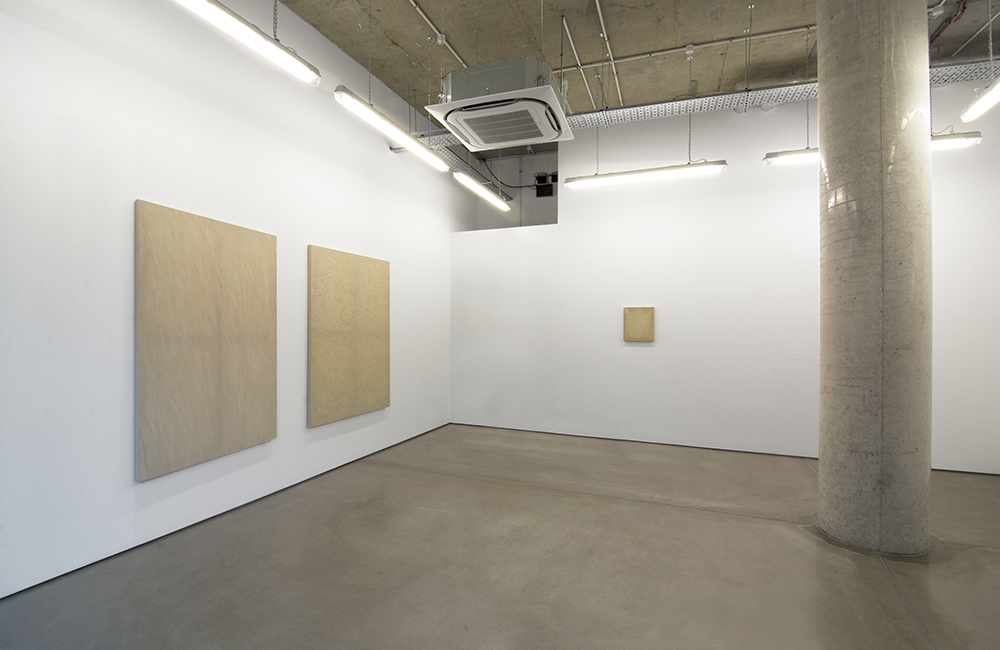
Nai-Jen Yang’s paintings unfold like whispered secrets, resisting immediate comprehension. In her first solo exhibition in London, at Mother’s Tankstation, surfaces made of gentle, meticulous brushstrokes evoke both lightness and weight, demanding time not as an aesthetic luxury but as a fundamental requirement for their visual effects to register.
Looking at works like Bon Iver, Bon Iver and white noise (2024), the eye initially finds little to grasp. Yang’s process involves months of sustained engagement with individual canvases, listening to the same musical pieces while building up surfaces through thousands of repetitive marks. Working with oil paint and rabbit skin glue on fabrics such as calico, muslin and canvas, she creates surfaces that shift between opacity and translucence depending on angle and light.

Applied without traditional gesso, the rabbit skin glue creates microscopic crystalline formations that catch and refract light throughout the day. From certain angles, these appear as tiny prisms embedded in the surface. The fabric remains partially transparent, revealing stretcher bars and wall behind, exposing the painting’s physical support, part of Yang’s ongoing inquiry into “what painting could be”.
Yang’s mark-making practice becomes a form of visual coyness. Applied in layers so subtle they initially appear absent, they emerge gradually for viewers who allow time for optical adjustment. Each stroke seems to hover just at the threshold of visibility, requiring sustained attention to register fully. This cumulative approach can take months to complete, with Yang working the same passage repeatedly until achieving the precise degree of presence she seeks.
Despite visually minimal and abstract affinities, her methodology diverges from the spiritual materiality central to the Korean Dansaekhwa movement. Emerging in the 1970s after the Korean War, Dansaekhwa (or “monochrome painting”) pursued repetition, material engagement and a meditative process as paths toward transcendence, often effacing personal narrative. Yang, by contrast, grounds her work in personal experiences, embedding what she calls critical dimensions that push back against contemporary fast-viewing habits.
This resistance is enacted through duration rather than spectacle. Yang’s paintings don’t compete for attention through dramatic gesture or scale but through accumulated effects that reward slow and repeated looking. The crystallised glue creates surfaces that photograph obscurely, asserting painting’s irreducible physicality in an increasingly dematerialised cultural moment.
The exhibition’s title, xi xi su su, an onomatopoeia describing rustling leaves, signals Yang’s interest in the relationship between sound and visual experience. Music flows through her studio practice as she listens to everything from classical piano to animation soundtracks, sometimes playing the same pieces for weeks while developing individual works. These rhythms shape her gestural patterns, creating what might be understood as painted music – not illustration of sound but embodiment of its temporal qualities.

This openness reflects Yang’s broader approach to painting as an enquiry and site of explorations. Born in Taiwan and trained at the Royal College of Art in London, she navigates a position shaped by both material explorations in process-based painting and topical issues around attention and temporality. Her recent works explore visual language in Chinese landscape paintings, particularly the cun (皴) methods, based on a brushstroke technique used to represent texture, form and volume, as presented in the Mustard Seed Garden Manual of Painting (1679). This retrospective turn has led her toward the core question of what painting means to her – formally, materially, philosophically.
Standing in Mother’s Tankstation’s intimate gallery space, just off East London’s busy streets, Yang’s paintings create space for painting’s capacity to assert different relationships with time and attention. Her work proposes that the medium’s continued relevance lies in its capacity to alter how we see, one mark, one moment, one sustained look at a time.
xi xi su su
倫敦Mother’s Tankstation
2025年3月14至4月17日
楊乃臻的畫作有如向你悄悄傾訴秘密,並請你不要即時看懂。她的首個倫敦個展在Mother’s Tankstation舉行,這裡可以看到洋溢溫婉細緻、剛柔並重的筆觸,然而需要花時間欣賞的並非美學奢華,而是從最基本的視覺效果中找共鳴。
細看畫作如《Bon Iver, Bon Iver and white noise》( 2024年)時,目光最初會感到缺乏落腳點。楊氏的創作過程歷經數月,她持續與每個畫布交流,聽著相同的背景選曲,再留下數以千計的重覆著墨。她在厚棉布、平紋細布或帆布等畫布上以油畫顏料和兔皮膠著色,根據當時的角度和光線,創作出在不透明和半透明之間變化的作品。
兔皮膠毋須與傳統石膏一同使用,可以形成微細的晶體結構,在一日不同時份捕捉和折射光線。從某些角度觀察,畫布表面就像嵌入了許多小型棱鏡。畫布保持部分透明,顯露出布後的實體支撐,包括框條和畫板。這正是楊氏其中一個不斷探討的問題:「繪畫的可能性」。
楊氏的著墨實踐在視覺上帶點害羞。每個色層輕輕畫上,驟眼看去彷彿並不存在,每每需要觀者花點時間,讓眼睛在光學調整後方可逐漸呈現。每一筆似乎都徘徊在看得到與看不到之間,需要持續專注才會完全顯現。這種疊加的方法需要幾個月才能成事,楊氏反覆進行同一個段落,直至達到她所追求的精確效果。
儘管視覺上有著極簡和抽象的吸引力,楊氏所採用的方法卻有別於韓國單色畫運動的核心精神。單色畫於韓戰後的 1970 年代出現,這種畫風追求重複、注重物料和冥想過程,以超越為目標,個人敘事或會被刪除。相比之下,楊氏的作品以非常個人的體會為基礎,蘊藏了她所說的關鍵維度,反抗當代快速觀看的習慣。
這種抗衡是通過持續時間而不是搶眼來實現。楊氏的畫作沒有採取戲劇性的姿態或規模來爭取注意,而是營造累積而來的效果,令放慢和重複觀畫的人得到回報。膠水結晶創造出模糊表面,在越來越遠離物質化的文化時刻中,提出繪畫不可還原的物理性。
展覽名為「xi xi su su」,是樹葉沙沙作響的擬聲詞,說明了楊氏對聲音與視覺體驗特別感興趣。她的工作室中經常播放音樂,由古典鋼琴至動畫配樂各適其適,有時在創作某個作品時,她會在幾個星期內播著同一首作品。這些節奏塑造了她的手勢模式,所以作品可以理解為畫出來的音樂——不是聲音的說明,而是體現出稍縱即逝的特質。
這種開放性反映了楊氏將繪畫視為探究和探索場域的宏觀方法。她出生於台灣,受學於倫敦皇家藝術學院,她在重視過程的繪畫中探索物料,也關注集中力和時間性等主題。近作探討了中國山水畫中的視覺語言,特別是表現紋理、形式和體積,稱為皴的筆觸技巧,就如《芥菜園畫譜》(1679年)中所呈現的一樣。這種鑑古知今的轉變,在形式上、物質上和思想上將她引向了反思,尋找繪畫對她的真正意義。
Mother’s Tankstation座落倫敦東部附近的繁忙街道,提供了親切的畫廊空間,讓楊氏的畫作得以訴說時間與專注力之間的不同關係。她的作品提出,能否對這種媒介產生共鳴,視乎我們可不可以改變觀畫方式:每一次只持續觀察一筆和一個時刻。