Recently, Zheng Bo has been using the lagoon in the French South Pacific territory of New Caledonia as a temporary studio and daily research site. Drawn there by its exceptionally clean air and status as one of the world’s largest, most biodiverse lagoons, he works through direct, low-tech immersion – swimming, observing, filming. Reflecting on what he refers to as “eco-sensibility”, the Hong Kong artist is evolving his long-standing concerns with queer ecology and social imagination into a more modest but radical aim: “learning to live on Earth” through pleasure, beauty and care. Moving between humour, anarchist thought and close observation, he asks what art can do – not to fix the ecological crisis and save nature but to transform how we perceive and relate to it.

Caroline Ha Thuc: You’ve already spent several months this year in New Caledonia and now you’re back there to work. Is this a new temporary studio? What drew you there? Zheng Bo: It was quite accidental. Some time ago, I read a report by a Swiss company that monitors air quality globally. They identified only three places in the world with truly clean air, and one of them was New Caledonia. I looked it up on a map and realised it wasn’t that far from Hong Kong – mentally it feels distant but actually it takes about the same travel time as going to London. I knew nothing about the place before I came. When I discovered it has one of the world’s largest lagoons, with incredibly rich marine biodiversity, I felt I had to go.
CHT: Do you dive there? ZB: You don’t need to. That’s what makes it wonderful. The lagoon is shallow, so you can observe an entire ecosystem just by swimming. I’ve always been reluctant to rely on technology – my practice favours simple, direct processes. Here, I swim every day and have access to the diversity of the reef just through my own body.
CHT: Your new video, The Political Life of a Coral Lagoon 1 (2025), was filmed underwater. Why choose the New Caledonian lagoon as a setting, rather than somewhere closer to home like Hong Kong? ZB: I live on Lantau Island and swim often, but the water near the Pearl River Delta is not as clear as in the Pacific. On the eastern side, around Sai Kung, visibility is better, but still, you don’t see the diversity of coral and fish that you do in New Caledonia. In Hong Kong, marine biodiversity is surprisingly extraordinary yet invisible. The water quality hides it. I probably would have to dive to encounter that world – and that’s not my way of working.
I don’t start with a concept and then find a place to match it. I start by being there, by sensing and feeling. Each work grows from that immersion. That’s how my project Pteridophilia (2016) began in Taiwan – ferns revealed themselves to me only once I was there.

CHT: Your video draws on British scientist Iain Couzin, who has studied and modelled fish schools. He suggested that fish might move through intuition rather than leadership, following a collective process of decision-making. Do they always make the right decision? ZB: I don’t know if they make the right decision. I watched a lecture Couzin gave and read a few articles but I did not study his mathematical models. The video is based on his research insights yet I cannot verify them. I am only starting to observe fish and it will take much more time. What I observed, though, is how certain fish shape their nests with sand. It is extraordinary, as these nests resemble sculptures. You probably know the images of a pufferfish building her nest using sand and creating sculptural installations for mating. I recently saw a sapphire damselfish doing exactly this.
I have been working with various types of plants for more than a decade but the underwater world is totally new to me. I am so ignorant.
CHT: What did you discover underwater? How have fish or coral changed your sense of ecology and kinship? ZB: Corals fascinate me because they are both animal and plant. When I first picked up one hard coral, it felt like a stone, but when I put it back in the water, it came alive at night. Of course, I knew this intellectually but feeling it through touch changed my perception entirely. My fingers got slightly stung. It’s through this sensation that I began to feel their aliveness. My mind is changing through contact.
CHT: Your practice often grows from what you call “eco-sensibility” – a kind of embodied learning. How do you cultivate that here? ZB: My main attempt is intimacy – with place, with the lagoon, with its inhabitants. I swim every day in the same area. Repetition, patience, familiarity – these are crucial. Understanding happens through both the mind and the body. After days of swimming, knowledge becomes empirical; it passes through sensation. These are what I call eco-sensibility exercises. These are simple daily practices, like sketching weeds, singing to trees or performing the “drinking sun exercise” in which the artist faces the sun, closes his eyes and breathes slowly, as if letting the sun fill him], designed to help us move away from human-centric ways of experiencing. I hope that such small exercises can encourage all of us to pay more attention to what lives with us, which might ripple into longer-term care.
CHT: Your work has historically engaged with questions of social justice and queer ecology. How do those concerns intersect with the marine environment? ZB: Maybe I’ve become more modest in my ambitions. I now understand my practice to be learning to live on Earth. It’s less about social change and more about rethinking how we live well. It’s about cultivating pleasure and beauty, together with ecological responsibility. I’m not saving the ocean but aim to live in ways that acknowledge and celebrate its vitality.
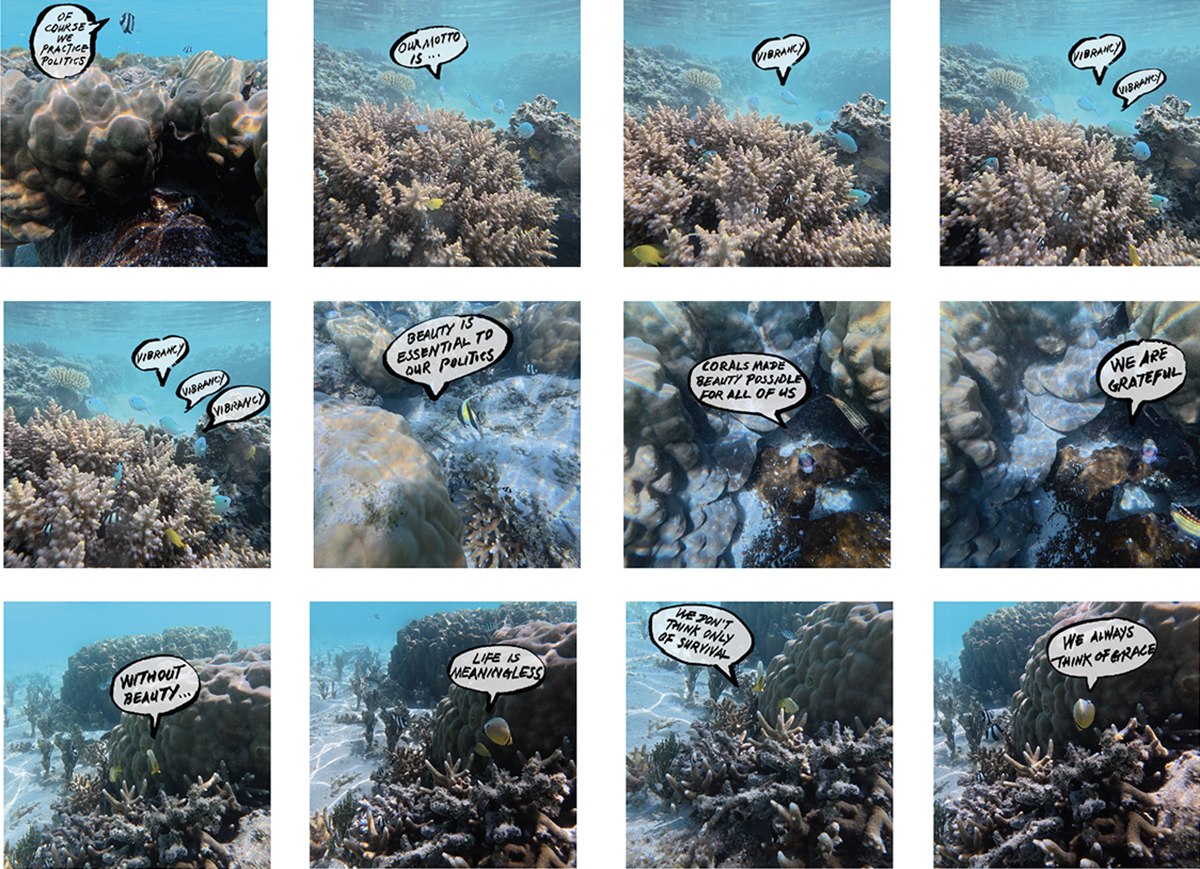
CHT: At the beginning of the video The Political Life of a Coral Lagoon 1, a fish is saying “Without beauty, life is meaningless”. Is beauty – both human and nonhuman – part of your politics now? ZB: Absolutely. I’ve long been interested in beauty because it has an ethical dimension; it draws us closer. This is why I love to work with dancers, because they are beautiful. Beauty is not decorative – it’s relational. The beauty of this lagoon is truly beyond my imagination.


Courtesy the artist.
CHT: Yet this beauty is threatened by the impact of anthropogenic activities and climate change. ZB: Yes. I have never been obsessed with climate change and I don’t think fear is a sustainable motivator.
CHT: In 2019, you created the film The Political Life of Plants, in which you explored plants as political subjects. The question of decision-making was already an important thread of your work. Now, you refer to “the politics of the lagoon”. What do you mean by that? ZB: Initially, I studied how plants appear in human political histories. Later, I became more interested in how they practise politics on their own – how they negotiate coexistence. The same applies here. Marine lives conduct politics beyond our human frameworks of equality or representation. We tend to frame things as “biological” when in fact they could also be political. Extending the political imaginary to fish doesn’t mean forcing analogies but recognising that our categories are too narrow. As with gender or sexuality, “politics” can be made capacious enough to hold difference.

Courtesy the artist.
CHT: Yet in the video, fish are talking, using typical human expressions that resemble a series of moral rules, claims or axioms – for instance, when they state “Here in the lagoon, being different is a given; many of us change sex”. How do you negotiate between this form of anthropocentrism and fish’s specific realm? ZB: I’m not looking to apply fish behaviour to humans – it’s not a recipe. I’m simply observing. Of course, viewers will bring their own interpretations. I like to leave things open; ambiguity is fertile. The text of the video, for example, was inspired by anarchist thinking, not by any specific marine model. I was mainly referencing Murray Bookchin’s book The Ecology of Freedom: The Emergence and Dissolution of Hierarchy (1982). He never talks about coral lagoons but when I read this work, the kind of society he was dreaming about seems quite similar to what I sense here in the coral lagoon. It’s not a democratic system. It’s not an authoritarian system. It’s anarchistic, complex and balanced.
CHT: You have also been influenced by Thomas D Seeley’s book Honeybee Democracy (2010). How do you make the connection? ZB: Seeley described in detail the democratic processes that honeybees go through in choosing the locations of their homes. As a scientist, he was willing to see honeybees’ collective decision-making not only as biological but also as political.
CHT: Human beings keep searching for ideas and models outside their sphere: we look at trees, rhizomes, ants and so on, each time interpreting them the way we wish to. What can we really learn from these fish when we are so different from them? ZB: The Chinese pre-modern notion of 悟 (wu) is relevant here. It’s not copying: it’s studying and then applying. We observe, sense and practise, in order to come to understand the principles, the forces and the meanings of something that may have seemed beyond our reach.
CHT: In your past work, you focused on humans and non-humans’ relationships – for instance, Pteridophilia challenges anthropocentric norms by depicting explicit sensual and sexual encounters between young men and ferns in Taiwan. In this new series of work, human beings have totally disappeared. Why? ZB: My practice is like a garden. Each project is different and has a different hue. Together they constitute a dynamic garden. Human beings are always part of it. They don’t need to appear all the time.
CHT: The video begins very smoothly with the subtle sound of waves and perfect images of the lagoon that resemble a screen saver. Suddenly, some comic bubbles appear above fish, and one states: “Of course we practise politics; our motto is…” And all the others answer: “Vibrancy, vibrancy, vibrancy!” The effect is comic. Why this start, and what do you have in mind when referring to vibrancy? ZB: For me, a good life is about material simplicity and ecological vibrancy. In Chinese, “vibrancy” (生) also means to give birth and to live. It’s about being part of the planetary vitality. And yes, humour is important too – sometimes the lightest tone carries the deepest truth. The video was commissioned by a museum in Korea that encourages family visits. I thought that the comic form was a way to invite families and children to engage playfully with ecological thinking.
CHT: The last image of the video shows a shark, cut abruptly as if mid-scene. Why end there? ZB: It’s a cliffhanger – this is just chapter one of a series. It leaves the story suspended, as life itself often is. I’ve had another turn in my practice. It does not mean I will stop working with plants – there is a lot of seagrass here, so I will probably combine different approaches.
CHT: The film’s movement – its gentle drifting, its floating camera – feels very bodily. How did you achieve that? ZB: At first, I thought of hiring a professional underwater cinematographer but the budget was tight and eventually I decided to film myself. That turned out to be the right decision. After months of daily swimming, I could move with the water. The floating camera is simply my own drifting body – an amateur immersion rather than a professional gaze.
CHT: You’ve also made a series of marine drawings, Mer de Corail (2025-), using wooden twigs. Why this choice of tool? ZB: It was practical. I couldn’t find proper brushes in New Caledonia, so I used found twigs instead. But that constraint became liberating: I could discard them afterwards, return them to the earth. The process emphasises impermanence and freedom – core values in my work.

Courtesy the artist and Kiang Malingue.
CHT: Why did you wish to complement the video with this series of drawings, and how do these different media change our perception of the lagoon? ZB: Drawing, compared to video making, allows me to see better. I would spend half an hour to draw a hard coral. Filming takes less than a minute.
CHT: In the past, you have collaborated with scientists, for instance with ecologist Matthias Rillig and biologist Roosa Laitinen, who studies plant adaptation. Is this also something you think about in New Caledonia, in order to delve deeper into your understanding of the lagoon? ZB: Yes, but I need some time. I need to swim more and develop more basic feeling for the lagoon before I can engage in a meaningful conversation with a marine biologist.
CHT: Finally, what do you believe art can do in the face of ecological crisis? ZB: Honestly, art alone won’t save us. I doubt it changes our collective behaviour. But it can transform perception, and that matters. We are not as smart as we think. I used to teach about climate change and the sixth mass extinction. But now I think participative workshops are more effective: through diverse exercises, students become much more aware of the ecological situation in Hong Kong. As Ming dynasty philosopher Wang Yangming said: “Knowing without acting is not true knowing.”
法屬南太平洋領地新喀里多尼亞的礁湖最近成為了鄭波的臨時工作室與日常研究場所。吸引他的是這裡極為清新的空氣,以及世上其中一個最大、生物最多樣的礁湖。這位香港藝術家以游泳、觀察和拍攝這些直接且低科技的沉浸方式進行創作,他將這種實踐稱為「生態感悟」,並將他關注的生態酷兒與社會想像轉化為更謙遜但激進的目標:透過歡愉、美感與關懷來「學習如何在地球上生活」。他在幽默、無政府主義思想與細緻觀察之間穿梭,思考藝術的作用,不是為了解決生態危機或拯救自然,而是改變我們對自然的感知與聯繫。
Caroline Ha Thuc: 今年你已經在新喀里多尼亞逗留了數個月,現在又回去了。這是你新的臨時工作室嗎?是什麼吸引你去哪裡? 鄭波: 其實是偶然的。早前我讀到一份由一家瑞士公司發表的全球空氣質素報告,他們指全球只有三個地方的空氣屬於真正清新,其中一個就是新喀里多尼亞。我查地圖後發現那裡離香港其實不遠,心理上感覺很遠,但實際上旅行時間和去倫敦差不多。我來之前對這個地方一無所知,當我發現這裡有世上其中一個最大的礁湖,而且海洋生物多樣性極為豐富,我就覺得一定要來看看。
CHT: 你有在那裡潛水嗎? 鄭波: 不需要的,而這正是美妙之處。礁湖水淺,只要游泳就能觀察整個生態系統。我一直不想依賴科技,喜歡簡單直接的創作過程。在這裡,我每天游泳,只靠自己的身體就能接觸到豐富的珊瑚礁生態。
CHT: 你新的錄像作品《仙湖之治1》(2025年)是在水下拍攝的。為什麼會選擇新喀里多尼亞礁湖,而不是香港之類離家較近的地方? 鄭波: 我住在大嶼山,也經常游泳,但珠江三角洲的水質沒有太平洋那麼清澈。東邊一帶如西貢水域的能見度較高,但仍無法看到新喀里多尼亞那般多樣的珊瑚與魚類。在香港,海洋生物多樣性其實很驚人,但水質將它們隱藏了。若在香港,我可能要潛水才能觀察水底世界,但這不是我的創作方式。
我不會先有概念再找場地,而是先到現場,繼而感受和體會,每件作品都從沉浸中自然生成。我在台灣創作的《蕨戀》(2016年)也是如此,去到現場才知道那裡有蕨類。
你的錄像作品引用了英國科學家伊安︱可辛對魚群的研究,他專門鑽研魚群行為和建立數學模型,提出魚群可能靠直覺而非領導做集體決定。
CHT: 魚群的決定通常正確嗎? 鄭波: 我不知道它們的決定是否正確。我聽過伊安︱可辛的講座,也讀過幾篇他的文章,但沒有研究過他的數學模型。錄像是基於他的研究分析,但我無法驗證結果。我只是剛剛開始觀察魚類,要下定論還需要很長時間。不過我留意到某些魚會用沙築巢,巢穴像雕塑一樣。你可能有見過雞泡魚用沙築巢求偶的相片,我最近見過有一條孔雀雀鯛也會做同樣的事。
我研究各類植物已超過十年,但水底世界對我來說是個全新領域,讓我覺得自己很無知。
CHT: 你在水底有什麼發現?魚和珊瑚有改變你對生態與親屬關係的理解嗎?鄭波: 珊瑚令我著迷,因為它既是動物又是植物。我第一次拿起硬的珊瑚時,它就像一塊石頭,但放回水後,它又在晚上活起來。在認知上我當然知道它的習性,但觸感的體驗完全改變了我的感知。我的手指還被輕微刺到,正是這種感官體驗讓我開始感受到它們的生命力。與自然的接觸改變了我的心智。
CHT: 你的創作常源於你稱為「生態感悟」的身體化學習,在這裡你如何培養這種感悟?鄭波: 我的主要方法是親密接觸,與場地、礁湖及當中生物互動。我每天在同一個區域游泳,重複、耐性和熟悉感很重要。理解是心智與身體共同作用的結果,游泳幾天後,知識會透過感官變成經驗,我稱之為「生態感悟練習」。這些簡單的日常行為,例如畫雜草、對樹唱歌,或做「飲日功」,能讓我們從以人類為中心的感知中抽離。我希望這些小練習能讓我們更留意與自己共生的生命,並延伸到長期的關注。
CHT: 你的創作歷來關注社會正義與酷兒生態,這些議題如何與海洋環境交疊? 鄭波: 或許現在我的野心克制了一點。現在我將創作理解為「學習如何在地球上生活」,較少著眼於社會改變,較多重新思考我們如何好好生活,著眼孕育歡愉、美感與生態責任。我不是想拯救海洋,而是以尊重與欣賞其生命力的方式生活。
CHT: 在《仙湖之治1》的錄像開頭,一條魚說:「沒有美,生命毫無意義」。美感(無論人類或非人主體)現在是你政治的一部分嗎? 鄭波: 絕對是。我一直對美很有興趣,因為它帶有倫理維度,使我們靠近。這也是我喜歡與舞者合作的原因,因為他們本身就很美。美不是用來裝飾,而是在關係之中生成的。礁湖的美就超乎我想像。
CHT: 然而這種美受到人類活動與氣候變化威脅。 鄭波: 是的,但我不太執著於氣候變化,也不認為以恐懼作為推動力能夠長久。
CHT: 你在2019年的錄像《植物的政治生活》探討植物作為政治主體,決策問題一直都是你創作中重要的核心議題。你現在指的「礁湖的政治」又是什麼意思? 鄭波: 起初,我研究植物在人類政治歷史中出現的方式,後來我更有興趣探討它們自身如何實踐政治,如何與政治協商共存。同樣的道理,也適用於這裡。海洋生物的政治行為,不受人類所設立的平等或代表制框架所限。我們傾向把事情框定為「生物學」,但其實也可能涉及政治。把政治想像延伸到魚,不是要強行作類比,而是承認我們的分類實在過於狹窄。「政治」可以寬容包容差異,就像性別和性取向一樣。
CHT: 然而在錄像中,魚會用一套類似道德規則、主張或公理的語言說話,例如「在礁湖裡,差異就是常態,我們許多都會變性」。你如何在這種帶有人類中心主義色彩的表述方式,與魚類自身的存在領域之間取得平衡? 鄭波: 我並不是想把魚類的行為套用在人類身上,那不是一套可照本宣科的公式,我所做的只是觀察。當然,觀眾會帶入自己的解讀。我喜歡讓事物保持開放,模糊與曖昧往往最能孕育不同詮釋。錄像文字的靈感來自無政府主義思想,而非特定海洋模型。我主要參考了默里︱布克欽的《自由生態學》(1982年),他從不談及珊瑚礁湖,但在閱讀這本書時,我覺得他想像的那種社會形態,與我在珊瑚礁湖中所感受到的很相似。它不是一種民主體系,也不是威權結構,而是帶有一種無政府的秩序,複雜而平衡。
CHT: 你也受到了托馬斯‧希爾利的《蜜蜂民主》(2010年)所影響,你如何將兩者之間連繫起來?
鄭波: 托馬斯︱希爾利詳述蜜蜂選址的民主過程。作為一名科學家,他將蜜蜂的集體決策理解為既屬生物層面,同時亦具有政治意涵。
CHT: 人類不斷在自身範疇外尋找思想與模型,我們觀察樹木、根莖、螞蟻等,反覆以人類的投射作解讀。面對與魚類之間的巨大差異,我們能從它們身上獲得哪些啟示? 鄭波: 中國古代「悟」的概念很適合。不是單純模仿,而是學懂後再應用。我們透過觀察、感知與實踐,去理解那些原本看似超出我們認知範疇的原則、力量與意義。
你過去的作品多探討人類與非人的關係,例如《蕨戀》透過描繪台灣青年與蕨類之間明顯的感官與性互動,挑戰以人類為中心的規範。這個新系列卻不見人類的蹤影,為什麼會有這樣的轉變?
我的創作就像一座花園,每個項目的主題和色彩各異,構成一個動態花園。人類永遠都是其中一個元素,但未必每次都會出現。
CHT: 錄像以平穩的節奏開場,伴隨微弱的海浪聲,以及宛如螢幕保護程式般完美的礁湖畫面。突然,魚群上方冒出幾個漫畫氣泡,其中一條魚說:「當然我們會實踐政治,我們的座右銘是22」其他魚則齊聲回應:「生,生,生!」為什麼會有這樣的開場?「生」又指什麼?鄭波: 對我來說,活得好在於簡單的物質與生態的活力。「生」也蘊含生育與生活的意思,關乎成為地球生命力的一部分。幽默也很重要,有時最輕鬆的語調,反而傳達最深的道理。錄像由一間鼓勵家庭參觀的韓國博物館委託創作,我覺得採用漫畫的形式,能讓家庭與孩子以輕鬆玩樂的方式接觸生態議題。
CHT: 錄像最尾出現了一條鯊魚,然後畫面突然中斷。為什麼會選擇這樣收尾? 鄭波: 這樣做的目的是想製造懸念,這錄像只是整個系列的第一章。故事保持懸而未決的狀態,就像生命本身。我在創作上也迎來了新的轉向,這不代表我會停止有關植物的創作。這裡有大量海草,所以我可能會嘗試結合不同的創作方式。
CHT: 錄像緩慢漂浮的節奏與漂浮式的攝影帶來強烈的身體感。你是怎樣做到的? 鄭波: 起初我想找專業水底攝影師拍攝,但由於預算有限,最後我決定自己拍攝,後來發現這個決定非常正確。每日游泳持續幾個月後,我開始可以隨水漂浮移動。那個漂浮的鏡頭其實就是我自己隨水漂流的身體,比較像一種業餘的投入,而不是專業的眼光。
CHT: 你也以樹枝創作了水底素描系列《珊瑚海》(2025年至今),為什麼會選擇樹枝?鄭波: 其實是出自實際考量,因為在新喀里多尼亞找不到合適的畫筆,所以就乾脆用樹枝。但這種限制反而令我創作得更自由,我用完之後可以把樹枝丟棄,讓它們回到土地裡。這個過程強調無常與自由,而這正是我創作中的核心價值。
CHT: 為什麼會選擇以素描來補充錄像?這些不同的媒介又如何改變我們對礁湖的感知?鄭波: 比起錄像,繪畫讓我能看得更仔細。我會花半小時畫一株硬珊瑚,但拍影片只要不到一分鐘。
CHT: 過去你曾與生態學家馬提亞斯‧瑞利格與植物適應生物學家魯薩‧賴蒂寧等科學家合作。在新喀里多尼亞,你也會考慮透過這種合作方式讓自己更深入理解礁湖嗎? 鄭波: 會,但需要些時間。首先我要多游泳,建立對礁湖的基本感受,才能與海洋生物學家進行更深層次的交流。
CHT: 最後,你認為在生態危機面前,藝術能夠發揮什麼作用? 鄭波: 老實說,單靠藝術無法拯救世界,我也懷疑它是否足以改變集體行為。但藝術的確能改變感知,而這點非常重要,因為我們沒有想像中聰明。我以前會教氣候變化和第六次大滅絕,但現在我覺得參與式工作坊更有效。透過多種練習,學生能更深切了解香港的生態狀況。正如明代哲學家王陽明所說:「知而不行,非真知也。」