Pavilion /
New Taipei City Art Museum /
Taipei /
Sep 9, 2025 – Jan 4, 2026 /
György Ligeti’s Lux Aeterna, a piece for 16-part mixed choir, is notoriously difficult for musicians and vocalists to perform. Its rhythmic subdivisions and complexities melt away the performers’ sense of traditional bar lines. Entrances are subtle, so much so that listeners aren’t meant to consciously perceive them, which means members of the choir need to maintain perfect control over pitch at extremely soft levels, gradually finding their way into micropolyphonic composition. Each of the 16 singers has a unique part, so there’s no space for error in intonation, no room for someone else to pick up the slack.
The result is a piece of music that feels alien to ears more accustomed to conventional tastes. It’s downright hallucinatory. Most people know Lux Aeterna through Stanley Kubrick’s cinematic treatment of it in 2001: A Space Odyssey, in which the track sculpts an air of mystery around a monolith – a rectangular black slab of non-human origin.

That’s precisely what walking into Samson Young’s Pavilion (2025) feels like. A new commission made by the artist for the New Taipei City Art Museum, Pavilion was a 28-minute-long, multi-channel sound and video installation that occupied a cavernous gallery. Young drew inspiration from Kubrick’s film as well as THINK, a multi-screen film produced by Charles and Ray Eames for IBM at the 1964-65 New York World’s Fair.
It’s easy to get lost in the spectacle of Pavilion. Seven massive screens overhead play a mishmash of news archive footage, clips from sports matches (maybe football, maybe something else) and automotive races, scenes from US President Lyndon B Johnson’s inauguration in 1965 and the 1964 Olympics, images of lenses, smart streetlamps and cabinets of curiosities, shots from the New York World’s Fair itself and more. All of this is heavily edited or generated using artificial intelligence tools, with glimpses of the Taipei Male Choir spliced in. The singers perform new choral arrangements devised by Young, who drew on classical requiems.

Photo: Chu Chi-hung. Courtesy Kiang Malingue and NTCAM.
THINK was shown to the public at a time of techno-optimism. The Space Race, for instance, was in full swing, fuelling a sense of limitless human ingenuity that could take us to new frontiers. Here on Earth, Nobel laureate and AI pioneer Herbert A Simon declared in 1965 that “machines will be capable, in 20 years, of doing any work a man can do.” The Eameses’ film was a 10-minute production that captured similar themes. It needed 22 screens for its full presentation about how computers could be used to process information and solve problems. The purpose was to demystify this new piece of technology and make it feel accessible.
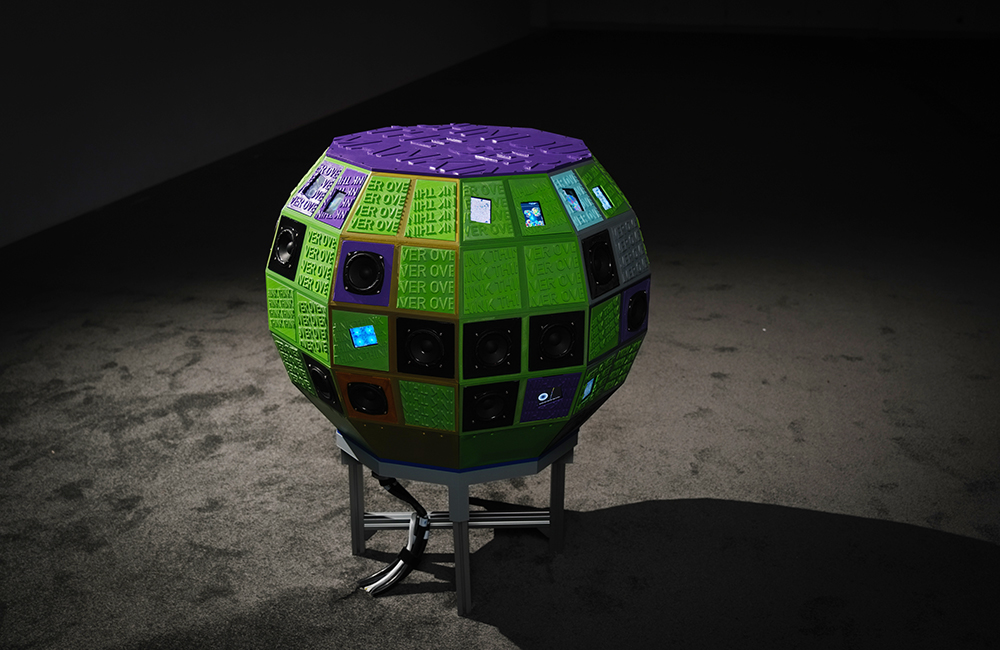
That’s hardly the mood in 2025. Pavilion is a gorgeous piece of work, never risking detours into the sloppish imagery that so many of us have developed an aversion to over the past year or two. Young’s use of AI-generated imagery makes his message cryptic but the result is instinctively coherent. Layer in the choir’s arrangement and the experience of Pavilion initially feels like something to be revered, even in awe of. The pair of spherical 3D-printed speakers that emit the choir’s skilful intoning – one in all black, the other a motley of purple, green and orange panels, both with tiny LCD screens embedded and running custom software – even become easy to miss amid the splendour.
Despite the veneer of sanctified beauty that envelops the viewer, contemporary techno-pessimism is a constant undercurrent. Archival footage only serves as a reminder that the bright future once envisioned by the Eameses and their patrons never came to fruition, and current developments point to inequality, loss of agency, even decline. Perhaps that’s what we’re meant to mourn in this requiem – a radiant vision shaped by brilliant minds that was never truly meant to be.

Photo: Chu Chi-hung. Courtesy Kiang Malingue and NTCAM.
Young presented a second work in the show, with Variations of 96 Chords in Space (2023/25) reworked as a companion to Pavilion. Spread across six screens, the installation is an exploration in probability expressed in audiovisual form. Every “variation” is associated with a specific Pantone, its chord expressed through a viola, a self-playing piano, crotales – tuned metal discs – and the trickling and splashing of water from a small fountain within a Tibetan singing bowl. Some or all of these elements are activated in each clip, and a computer program arranges them to finally form the “colour chords”.
This work didn’t have the same currency or heft as Pavilion, and felt like an addendum or afterthought. But it was intricate, well-designed and again gorgeous. A few moments spent with Young’s colour chords might just be the right transition before we are dislodged back into New Taipei.
展亭
新北市美術館
台北
2025年9月9日至2026年1月4日
György Ligeti 的《Lux Aeterna》是一首由16聲部混聲合唱的作品,以其極高演奏難度聞名。其節奏的分節和複雜性打破了演奏者對傳統小節線的認知。聲部的進入時機非常微妙,讓聽眾難以察覺。這意味著合唱團成員必須在極為輕柔的音量下保持完美的音準,逐步融入這首多聲部作品。16位歌手有各自獨特的部分,因此表演不能有任何失誤,也沒有讓其他人可以挽救的空間。
這首作品對於習慣傳統音樂的人來說會顯得怪異,甚至覺得迷幻。大多數人是透過史丹利・寇比力克的電影《2001太空漫遊》認識《Lux Aeterna》。在電影中,這首曲子為一塊源自外星的黑色長方形石板營造出神秘的氣氛。
這正是走進楊嘉輝的《展亭》(2025年)時的感覺。這件由楊嘉輝為新北市美術館創作的新作品《展亭》,是一個28分鐘的多頻道影像聲音裝置,放置在一個巨大的展廳中展出。楊嘉輝的創作靈感來自於寇比力克的電影,以及Charles Eames和Ray Eames為 IBM 在1964-65年紐約世界博覽會製作的多螢幕影像作品《THINK》。
《展亭》的壯觀很容易令人迷失其中。七塊凌空巨型螢幕播放各式新聞檔案畫面、體育比賽(可能是足球,也可能是其他項目)和賽車的片段、1965年美國總統詹森的就職典禮和1964年奧運會的片段,還有攝像鏡頭、智能路燈、珍奇櫃、紐約世界博覽會的現場畫面等等。這些畫面全都經過大量剪輯或使用人工智能工具生成,其中還穿插著台北男聲合唱團的片段。他們演唱著楊嘉輝新編的合唱歌曲,歌曲靈感來自古典安魂曲。
《THINK》這部影片在科技樂觀主義盛行的時代面世。當時的太空競賽競爭激烈,激發了大眾對人類無窮創意的信心,相信我們可以突破極限。在1965年,諾貝爾獎得主、人工智能先驅Herbert A Simon曾說:「20年內,機器能做任何人類能夠做的工作。」Eames夫婦製作的這部10分鐘的影片也表達了相似的主旨。這部影片用了22個螢幕完整呈現電腦如何處理資訊和解決問題,目的是為撇開這種新技術的神秘感,使其更易於被大眾理解和使用。
在2025年,情況已經截然不同。《展亭》是一件非常精美的作品,完全沒有如近年部分令評多人厭倦的製作般粗製濫造。楊嘉輝利用人工智能生成影像使資訊的呈現顯得更為複雜,但最終效果卻和諧。配合合唱團的編曲,《展亭》給人的第一印象令人驚嘆,甚至敬畏。一對球形的3D列印喇叭播放著合唱團精湛動人的吟唱,其中一個通體黑色,另一個則由紫色、綠色和橙色的面板組成。兩個喇叭都嵌有微型LCD螢幕,運行著定制的軟件,在如此壯觀的作品中,這個小細節很容易被忽略。
儘管這件作品華美震撼,但貫徹作品的暗湧是現今的科技悲觀主義。檔案畫面提醒我們Eames夫婦和他們的支持者曾構想的美好未來並未實現,而且當前的發展趨勢正走向不平等、失控,甚至是衰落。或許這才是我們在這首安魂曲中應該哀悼的──一個由傑出人物所建構的輝煌願景,卻注定無法實現。
楊嘉輝在展覽中還展出了另一件作品《96和弦空間變奏》(2023/25年),這件作品是為配合《展亭》而重新創作的。該裝置橫跨六個螢幕,以視聽形式探索機率。每個「變奏」都與一個特定的潘通色號相關聯,和弦是透過中提琴、自動演奏的鋼琴、鐃鈸(一種調音金屬圓盤)以及藏式頌缽內的水聲來呈現。每個片段中都會運用到上述的部分或全部元素,由電腦程式將它們排列組合成「色彩和弦」。
這件作品雖然不如《展亭》般捕捉時代或厚重,更像是一個附加或後補的創作,但它也是精緻複雜、設計巧妙、同樣美麗吸引。在回到新北市之前,花一點時間沉浸在楊嘉輝的色彩和弦之中或許正是合適的過渡。