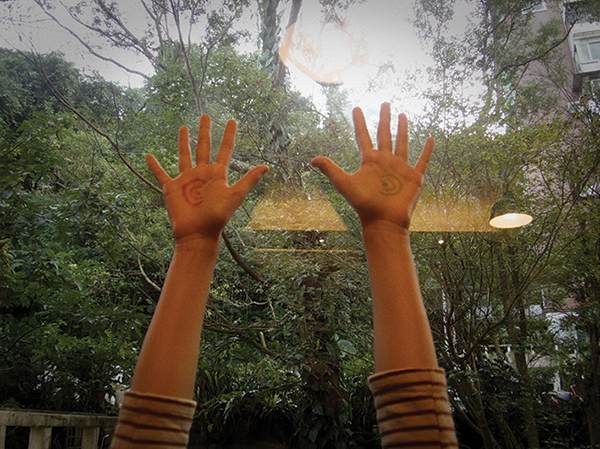
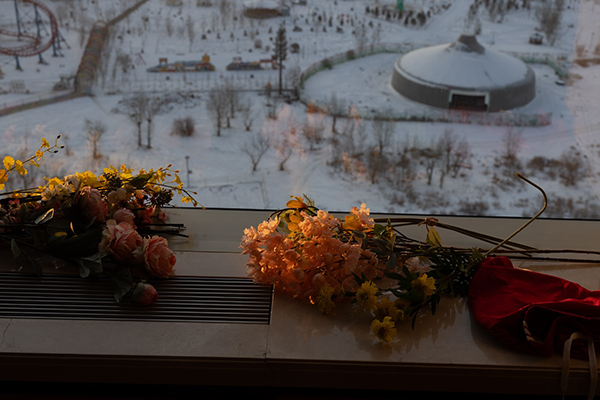
Inspired by the 1960s art collective Fluxus, Hong Kong’s Rooftop Institute has published a new book, Event Scores 2: Ideas between Artist-Parents and Their Kids, exploring ‘instructional art’ between artist-parents and their children, contributed by 45 artist-parents from around the world. These alternative ways for parent-child interactions are suggestions for action open to the reader’s interpretation, ranging from helping parents and children co-create with anything around them, to reflecting on their relationship and getting along with each other.
Editors Yim Sui Fong and Joey Chung introduce the story behind the book and share examples, when as artists and young mothers they originally collected ideas from other artist-parents that all parents could use while their children were at home during COVID. Event Scores 2 is a new book, published in English and Chinese, of further alternative ideas by artist-parents from around the world.
When Howie Tsui and his family settled in Canada’s Thunder Bay, a sparsely populated, blue-collar corner of northern Ontario, his connection to Hong Kong was getting stretched. It was 1984, after a few years in Lagos. But like many members of the Hong Kong diaspora who were born in the 1970s and 80s, one medium dropped him back into the city’s orbit: its pop culture and entertainment.
It arrived on videocassettes, mailed from Hong Kong and flown across the Pacific Ocean before it landed in the city, situated by Lake Superior. For young Tsui, that connection had a particularly personal layer: to satisfy the requirements for being new immigrants, his father had started a videocassette manufacturing business in Canada. The tapes that his uncle used to record programmes in Hong Kong could have been products made by the family business.
On these tapes were slapstick comedies, wuxia action flicks and other output from a golden age of Hong Kong cinema, starring the likes of Andy Lau, Tony Leung, Stephen Chow and Michael Hui. There were also episodes of dubbed Japanese animated series that were popular among kids in the city, like Doraemon and Dr Slump. Some of the tapes were bought; others were bootlegged.
The Banquet by Howie Tsui, Paint pigment and ink on mulberry paper mounted on silk, 106.5 x 219 cm, 2023. Courtesy the artist and Hanart TZ Gallery.
In Thunder Bay, those tapes meant a lot to Tsui. He watched them in the basement of the house he lived in, over and over again, iconic scenes getting burned into his memory. Decades later, the visual grammar of that era’s films became an important source of inspiration in his artistic practice, but only after the artist found a sense of reassurance that allowed him to create work that stood out distinctly from the contemporary art canon that surrounded him.
Tsui studied art at the University of Waterloo in Canada in the late 1990s and early 2000s, and felt like the work that he wanted to create didn’t quite chime with the art that was being made by the people around him. It wasn’t clear to the artist-in-training that the style he was after—inspired by cartoons, anime and fantastical imagery—could find an audience. But that changed when Tsui discovered publications like Giant Robot, a zine that showcased popular culture, cinema, design and art with an Asian-American bent, as well as Juxtapoz, a magazine that focused on street art, illustration, and pop and urban art. Tsui also found resonance in superflat, the art movement defined by Takashi Murakami that picked up steam in the early 2000s.
Avatars of Entombment #2 (Offering) by Howie Tsui, 3 colour silkscreen on Crane Lettra cotton paper, 61 x 45.7 cm, 2022. Available edition: AP 3/5, AP 4/5 Courtesy the artist and Hanart TZ Gallery.
Indeed, Tsui’s early work had a distinct Japanese flair to it. In the series Of Manga and Mongrels (2006–08), he lifted elements from drawings by the Edo-period ukiyo-e artist Hokusai, then inked his own caricatures of anime characters over the forms. Many are a mess of limbs and bodies, perhaps with tusks or bat ears or extra sets of eyes. In his next body of work, Of Shunga & Monsters (2007–08), Tsui doubled down on using Japanese imagery as a base for his own characters, then upped the visual complexity. He used entangled bodies from erotic illustrations, merging and reworking them to make a new set of characters’ grotesque faces. On top of intertwined, mid-coitus bodies that were first printed in the 18th and 19th centuries, Tsui moulded facial shapes, adding hair or moustaches, scales or eyes, twisted horns or amphibian features, deforming and transmuting the figures in deliberate body horror that was far more freakish and organic than his Mongrels.
As Tsui’s practice progressed, he still mined a sinister mind space – but in a manner that was playful and characteristic of the Hong Kong entertainment that he enjoyed so much. His art gradually drew more from the culture of the city where he was born, flashes of it punctuating his images.
The artworks in his Horror Fables series – first presented in 2009 at the Carleton University Art Gallery in Ottawa, then in 2010 at MAI (Montréal, arts interculturels) – incorporated scenes from Chinese and Japanese folklore and legends, some of which he encountered through the taped TV shows and films that he watched in his family’s Thunder Bay basement.
Tsui found the drive to ramp up the intensity in this set of work, using ink and paint to put a chaotic mishmash of supernatural scenes on mulberry paper. Here, the cinematic hat-tips are more explicit. In Forest Romp (2009), for instance, we see a man bound to a tree, arrows protruding from his torso. It’s a scene from The Yang’s Saga, a 1985 six-episode fantasy action series that aired on Hong Kong television channel TVB Jade. The show was a stylised retelling of the story of one family’s defence against invaders across three generations during the Song dynasty. Tsui paints the figure with his face peeled off and hanging from his chin – a gruesome fate suffered by the reincarnated thunder deity, who was dispatched to the mortal realm to assist the Yang clan (and was played by Tony Leung in the TVB adaptation).
Parallax Chambers (Abyss) by Howie Tsui. Courtesy the artist.
Several hefty threads converged in Horror Fables. It was the first time Tsui had featured landscape in his work, and he drew inspiration from Ming dynasty scroll painters’ brushwork for this new layer. He depicts grisly scenes – the peeled face; a man severed in half and dragged on the ground nearby, leaving a trail of blood behind him; impalement; tongue-ripping; bodies cooked in a cauldron; sea monsters; ghosts; and a man whose eyes have been plucked out, his head and hands the only parts of his body protruding from a crate. These depictions highlight the terror woven into lore that’s handed down from one generation to the next, first as oral tradition, then recorded in text, and perhaps eventually in still or moving images. At the same time, they lampoon the fear that is pervasive in media, advertising and political messaging. Think of the bloody moments in Forest Romp lifted from The Yang’s Saga – they were aired on TV during prime time, as entertainment, with some of Hong Kong’s hottest actors starring.
Ahead of the opening of The Cradle Rocks Above an Abyss, an exhibition of Tsui’s work at Hanart and the artist’s long-overdue first solo show in Hong Kong, he recalled one vivid sensation that he experienced whenever he visited the city in his youth. The way the water hit his body when he showered in his uncle’s apartment in Hong Kong, Tsui said, felt different from his experience in Thunder Bay. Maybe it was variations in the water’s mineral content, or perhaps it was a visceral marker for home or something like it. Like many diasporic families, Tsui’s regularly returned to their roots. Hong Kong and its patchwork culture was not an abstract concept gleaned on a screen; it was something that Tsui had a chance to live and breathe. Every homecoming, if that’s the right word, was a gentle reintroduction to the city. As the artist said during a brief conversation at Hanart, he had to have spent time away from Hong Kong to develop his way of making art.
Retainers of Anarchy (2016) is a five-channel algorithmic animation work, first seeded as a concept in 2010, after Tsui saw a digitally animated version of a well-known Song dynasty scroll, Along the River During the Qingming Festival, produced for the Chinese Pavilion at the Shanghai World Expo. After the artist got over the initial sense of awe and wonder the installation was meant to evoke, he realised that its depiction of a harmonious, idealistic society mirrored a narrative that the state worked hard to propagate. Again, applying his own brand of wry humour, Tsui jacked the style of the original scroll painting, adding his own twist to depict a range of characters in the Kowloon Walled City, a lawless, cramped place that had its own way of life.
The artist folds scenes from wuxia novels, Cantonese films and real-life Hong Kong into the same universe. In one unit, a man makes bouncing bamboo noodles, riding a bamboo stick to press dough. In another, a rice cooker signals that it’s finished while men shuffle mahjong tiles, their game undisturbed. Outside the city’s walls, vampires controlled by a Taoist priest hop by a beggars’ gang, a martial arts clan that often appears in the novels of wuxia writers like Jin Yong (aka Louis Cha). The fact that wuxia fiction was banned in mainland China until 1980 adds to the irreverence of the work.
Ambitious single-channel animation sequence Parallax Chambers (2018-) was shown at Tai Kwun as part of the INK CITY exhibition in 2021, as well as at Hanart this year. The scenes are loaded with references to wuxia novels and films, but also visuals that Cantonese speakers and those who know Hong Kong might chuckle at – a wireless telephone cooking in a pot of congee refers to a local expression that means to chat incessantly on the phone, and a giant grouper in a glass tank looks like it could be found at one of the city’s seafood restaurants. An algorithm determines the combinations of animated segments that appear on screen, the lighting that goes with them, the sounds that play, and when and how fast laser beams ricochet across the screen (a motif from old wuxia films), as well as shifts between rooms and spaces. The generative work is immensely fun to watch, each section painstakingly drawn by the artist, while his collaborators assisted him with programming, sound design and animation.
Parallax Chambers (Winged Assassin) by Howie Tsui, Lenticular lightbox, 62.5 x 62.5 cm, edition of 8, 2018. Courtesy the artist and Burrad Arts Foundation, Vancouver.
That’s all to say that Tsui’s practice, like his algorithmic video works, is still evolving. In recent ink and paint drawings on mulberry paper, he warps scenes from the 1984 TVB adaptation of The Duke of Mount Deer, a series of novels penned by Jin Yong with a comedic take on the wuxia genre. Tsui manages to draw a line between nostalgia and novelty, giving people a fresh way to think about their roots in Hong Kong, no matter which shores they grew up on.
Featured image: Pyromancers (detail) by Howie Tsui, Paint pigment and ink on mulberry paper mounted on silk, 74.3 x 106 cm, 2023. Courtesy the artist and Hanart TZ Gallery.
Retainers of Anarchy (Tavern Havoc) by Howie Tsui, Ink and paint pigment on mulberry paper, 209 × 109 × 2 cm, 2015. Courtesy the artist and ART LABOR Gallery Shanghai and Vancouver.
事實上,徐氏的早期作品便散發著獨特的東洋風。在《Of Manga and Mongrels》 (2006–08年)系列中,他從江戶時代葛飾北齋的浮世繪畫作中提煉出元素,創作出自己的動畫人物形態,很多人物的四肢與身體亂作一團,有些長有獠牙、蝙蝠耳朵,甚至是多一雙眼睛。徐氏在後續的《Of Shunga & Monsters》(2007-08年)中,更強烈地以日式意境作為筆下角色的基調,再提升視覺複雜性。他把風月插圖中交纏的身體合併重組,拼湊出全新的怪誕面相。他所參考的作品最先刊於18、 19 世紀,當中畫有魚水之歡中交疊的身體。除了這些體形,徐氏也改造了畫作中的臉形,加上頭髮、鬍鬚、鱗片、眼睛、扭角甚或是兩棲動物的特徵,刻意地把人物體形扭曲變異,營造出的恐怖感和有機形成效果均遠遠超越前作。
David Zwirner is pleased to present The Point Is Matter, a solo exhibition of new and recent work by Wolfgang Tillmans at the gallery’s location in Hong Kong. The exhibition’s title stems from Tillmans’s long-term understanding of his work sitting between the physical reality and presence of the world he works and lives in and the conceptual, sociopolitical, sensual, and spiritual concerns that underpin his practice. Presented across both floors of the gallery, the works on view include depictions of changing forms of atmosphere and elusive natural phenomena; pictures that explore notions of time and temporality; and images that engage with the artist’s expansive conceptions of the still life and the portrait. Tillmans punctuates the exhibition with works made in Addis Ababa, Berlin, Lagos, and Mongolia, along with those taken in Hong Kong and Shenzhen, sensitively invoking resonant associations between the local and the world at large, while advocating for an experience of connectedness that is rooted in the process of looking.
This exhibition follows his 2023 solo exhibition Fold Me at David Zwirner New York and his major 2022–2023 traveling retrospective To look without fear at The Museum of Modern Art, New York, the Art Gallery of Ontario, Toronto, and the San Francisco Museum of Modern Art. This will be the artist’s fifth solo exhibition with the gallery and his second at David Zwirner Hong Kong.
Kiang Malingue presents anus whisper, an exhibition of recent installations, sculptures, and films by Wong Ping. Inspired by the experience of paracusia, Crumbling Earwax, Georges Bataille’s The Solar Anus, and a tête-à-tête with a stranger in bed in the afternoon, the sizeable artworks thematically and formally correspond to one another, exploring the aesthetic meaning(-lessness) of bullshit, expanding Wong’s curious body of art that revolves around circular narratives and motifs.
Xiyadie Butterfly Dream Mar 26 – May 11, 2024 Opening: Saturday, Mar 23, 4pm – 6.30pm Artist will be present
Artist talk: Xiyadie in conversation with Hera Chan Saturday, Mar 23, 3pm – 4pm (conducted in English and Mandarin)
Blindspot Gallery 15/F Po Chai Industrial Building 28 Wong Chuk Hang Road Wong Chuk Hang, Hong Kong +852 2517 6238 Tuesday – Saturday, 10.30am – 6.30pm Special opening hours on Monday, Mar 25, 12pm – 6pm
Butterfly Dream is Xiyadie’s debut solo exhibition at Blindspot Gallery. Presenting over thirty works including unseen works from the early 1980s to the present, it is the largest exhibition of Xiyadie ever presented.
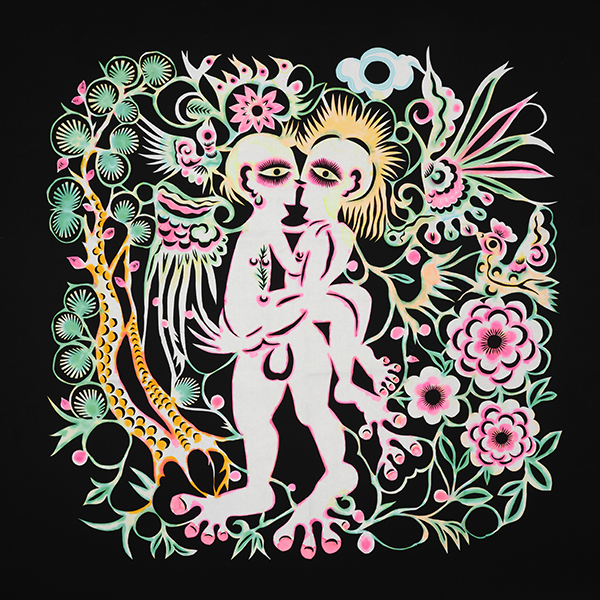
Born in 1963 in Weinan, Shaanxi province, Xiyadie is a self-taught traditional Chinese papercut artist who uses a medium with origins dating back to the Eastern Han Dynasty (25-220 CE) to narrate his journey of coming out from rural China as a homosexual person. His autobiographical papercuts chronicle his transformation through an environment that does not lend political agency to queer identifying people, while also reflecting the struggle of a marginalized individual as a migrant worker in the big city. The exhibition titled Butterfly Dream alludes to the artist’s pseudonym Xiyadie, meaning the Siberian Butterfly, emblematic of resilience and its flamboyant beauty. It signifies the artist’s determined pursuit of freedom and endurance in the harshest conditions.
Before the opening reception (4pm – 6.30pm on March 23), there will be an artist talk at 3pm – 4pm, moderated by Hera Chan. Chan is Adjunct Curator, Asia-Pacific, supported by Asymmetry Art Foundation, at Tate. The talk will be conducted in English and Mandarin.
Chan Ting, Dony Cheng Hung, Magdalen Wong, Annie Wan Lai Kuen, Kwan Sheung Chi, Wong Ping, Oscar Chan Yik Long, Winsome Wong, Nadim Abbas,Wong Kai Kin, Andrew Luk, Benny To Kai On, Doris Wong Wai Yin, Lulu Ngie,Howie Tsui, Hilarie Hon, Louise Soloway Chan, Tap Chan, Chow Chun Fai,Angela Su, Green Mok
Hung Up on You
Mar 19 – Jun 15, 2024
Ping Pong Gintonería 129 Second Street L/G Nam Cheong House Sai Ying Pun, Hong Kong +852 9035 6197 Tuesday – Sunday, 6pm – 10pm
Hung Up on You, which features paintings, drawings, video installations and sculptures by some of Hong Kong’s leading contemporary artists, marks Ping Pong Gintonería’s 10th anniversary.
Warring States Cyberpunk / Tai Kwun Contemporary / Hong Kong / Dec 9, 2023 – Mar 3, 2024 /
Futuristic DIY attitudes, military-style uniforms, grimy tech gear and the “high tech, low life” motif—the aesthetics of cyberpunk saturate our visual media so much that its countercultural origins are drowned out in its neon glow. Maybe this is because fiction is spilling into real life, and our survival instincts are kicking in as the consumer technology presented to us becomes increasingly enmeshed with our daily activities, algorithms and capitalistic overdrive shaping new habits without us realising.
Invoking cyberpunk in East Asian metropolises such as Hong Kong and Tokyo is a dicey proposition. It’s too easy to let the look of things overshadow the big ideas. But that didn’t stop animation director and visual artist Kongkee (aka Kong Khong-chang) from using the genre as one of his starting points in the show Warring States Cyberpunk, in which he layered imagined undertakings and musings of Qu Yuan, a poet whose suicide by drowning inspired the annual Dragon Boat Festival, over the stylistic choices typically associated with cyberpunk.
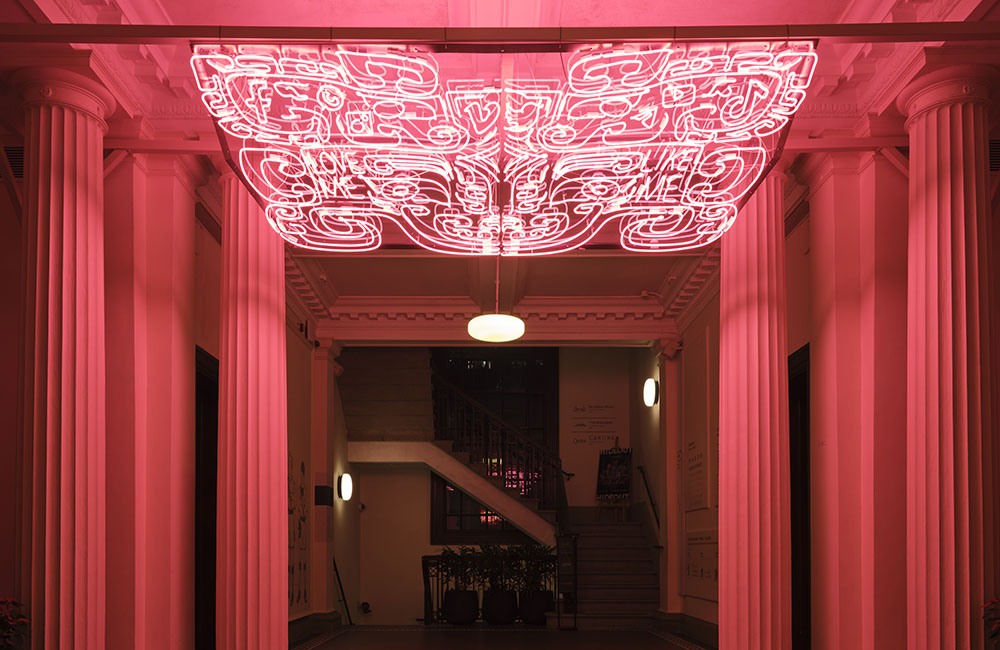
Naturally, it all starts with neon, a medium that’s as hip as ever, even though the trade behind it is on its last legs. Kongkee’s show at Tai Kwun begins with Taotie (2022), a pink lighting installation with a name drawn from one of four evil creatures in ancient Chinese myths. Playing off the beast’s gluttonous nature, Kongkee knits in the logos of familiar social media and messaging apps, with the phrases “Like Me” and “Love Me” meshed into a familiar form found on bronze artefacts. The piece is heavy-handed commentary on human connection in the 21st century, but works to prime the rest of the exhibition.
Past / Present / Future / Bleeding / Tearing / Drifting by Kongkee, Three-channel video installation on LED, dimensions variable, 2023. Courtesy the artist and Tai Kwun Contemporary.
Warring States Cyberpunk drips with references to Hong Kong and its past. Kongkee’s signature colour scheme – dramatic greens and subtle blues, bleeding into magenta tones, cast in hues of bright yellow – was common in the product designs of a previous generation. Scenes and settings in his animated films are lifted from the city’s streets and architecture. The characters in Kongkee’s animations – the poet Qu Yuan, his liege the Chu emperor, and Qin Shi Huang, who created a unified Chinese empire – are also familiar to any Hongkonger who wanders into the screening room.
The three animated shorts – Dragon’s Delusion: Preface (2020), Dragon’s Delusion: Assassination (2018) and Dragon’s Delusion: Departure (2017) – transplant those characters from ancient China into Kongkee’s imagined alternate history. Androids and cyborgs walk among us, cassette tapes are fragments of human souls, and Qin Shi Huang made his dream come true and found a way to live forever.
Dragon’s Delusion: Preface by Kongkee, Digital animation, 14min 49sec, colour. In Cantonese with Chinese and English subtitles, 2020. Dragon’s Delusion: Assassination by Kongkee, Digital animation, 10min 37sec, colour. In Cantonese with Chinese and English subtitles, 2018. Dragon’s Delusion: Departure by Kongkee, digital animation, 8min 2sec, colour. In Cantonese with Chinese and English subtitles, 2017. Courtesy the artist and Tai Kwun Contemporary.
The world portrayed in Kongkee’s animations is bleak. There isn’t much choice for people to remain fully biological; everyone is forced to fuse with machines so they too can extend their lifetimes without end. Meanwhile, the Qin empire persists for millennia, with one man at the top of the totem. The emperor survives an assassination attempt, then retreats to his private chambers, where he rewinds a cassette tape to mend his wounds. This appears to move his physical state back in time, then forward again as soon as he’s back to being in the pink of health.
It’s difficult to read into the animations and see much other than the compulsion to lash out against a centralised authority, particularly one that is obsessed with uniformity and decorum.
Kongkee and his collaborators didn’t just set out to create an animated trilogy. They set out to create a feature drawn specifically for the city – locally funded, then locally made. When the credits rolled, one could spot the names of Hong Kong artists who backed the project by pouring cash into it.
Call Warring States Cyberpunk a homecoming of sorts, with Kongkee’s work recast to connect with viewers more intimately than before, knit together using Hong Kong’s visual grammar. The works in the presentation had previously been exhibited at San Francisco’s Asian Art Museum and Wrightwood 659 in Chicago, but there’s deeper meaning in showing them in a city that Kongkee calls home.
Featured image: Taotie by Kongkee, Neon, site-specific installation, 300 cm × 121.5 cm, 2022. Courtesy the artist and Tai Kwun Contemporary.
Field Signs / David Zwirner / Hong Kong / Nov 16, 2023 – Feb 24, 2024 /
Throughout history, human beings have always sought signs: from zodiac signs that give meaning to what they believe in or do to literal signs that provide instructions during an election or protest. The pursuit of signs often reaches a climax at the end or beginning of the year, when we want to peer into a crystal ball and figure out what the new year has in store.
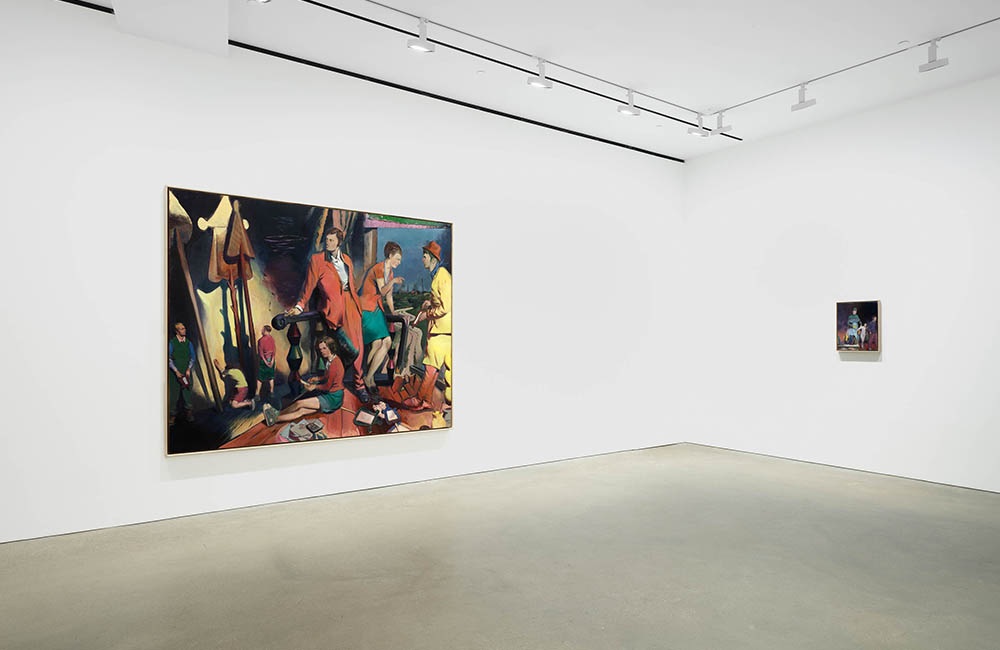
Field Signs, Neo Rauch’s latest exhibition at David Zwirner Hong Kong, also features plenty of signs. While anyone hoping to find easy meaning in Rauch’s art will be sorely disappointed, the exhibition feels as contemporary and relevant as the artist’s work always does.
The exhibition title has a double meaning, referring not only to signs farmers use to mark a crop variety but also to signs used by warring states or parties in the past. The exhibition trots out Rauch’s usual bevy of people at work or play, following socialist realist art traditions – until you realise they aren’t your usual humans and landscapes.
Shape shifters inhabit the scenes, with fins growing from shoulders, wings from backs, tails from behinds. Distinct but varying scenes converge in the same painting, giving the impression that they should be viewed as an unfolding story – but when we attempt to, we find they make little sense.
There is also an underlying violence that gives rise to unease: a man holding a sharp blade behind his back as he observes a woman marching down a field with a sign; a pool of blood that’s accumulated next to the head of a fish that’s being gutted.
There is a recurring image of crowds wielding signs and marching with them. In one painting, someone carries a burning torch, a house of cards has been set on fire and a woman appears to be comforting a man who is covering his face with his hands. Barely legible on a billboard is the German word “Reue” (“remorse”), calling to mind political events such as the march on the US Capitol on January 6, 2023 and the subsequent regret expressed by some of the protesters.
But the attitude towards these figures is ambiguous at best. We are made to wonder if the figures actually wield agency over their own actions and fate, or are merely pawns in a chess game. A painting featuring two men rolling a massive dice seems to explicitly point to the latter. The flagrant disregard for perspectives and proportions also means figures of various sizes are placed on the same plane, creating an uncanny effect where some of the smaller figures look like dolls rather than humans.
If they are puppets, it raises the question of who the puppet master is. The artist? Rauch might deny that.
One prominent motif in this body of works is moths – or “die Nachtfalter” (“the night butterflies”), as Rauch calls them. For the artist, the Nachtfalter symbolise inspiration and intuition – and, like the Nachtfalter, who come to you at night, these images and motifs come to him, eventually landing on his canvases.
But there is also a Rauch-like figure in Sonne (2023). He is decked out in a green coat and a cross-body satchel, a set of paint brushes next to him, and his hand is raised in an ambiguous gesture. Is he providing instruction to a girl who is balancing some coloured orbs or outlining the contours of the girl’s dress? Or is that the viewer’s wishful thinking? In a tumultuous world, we want a sign that somehow, everything that happens is governed by an invisible hand, rather than being the product of a serendipitous set of encounters.
In Stranger Lands: Cocoa’s Journeys to Asia / Mar 15 – Jul 31, 2024 /
The Nguyen Art Foundation EMASI Nam Long – Art Space 147 Street No.8, Nam Long Residential Area, District 7 Ho Chi Minh City, Vietnam Wednesday, Friday & Saturday 10am – 4pm (last visit 3.30pm)
EMASI Van Phuc – Art Space 2 Street No.5, Van Phuc Residential City Thu Duc CityHo Chi Minh City, Vietnam Tuesday, Thursday & Saturday10am – 4pm (last visit 3.30pm)
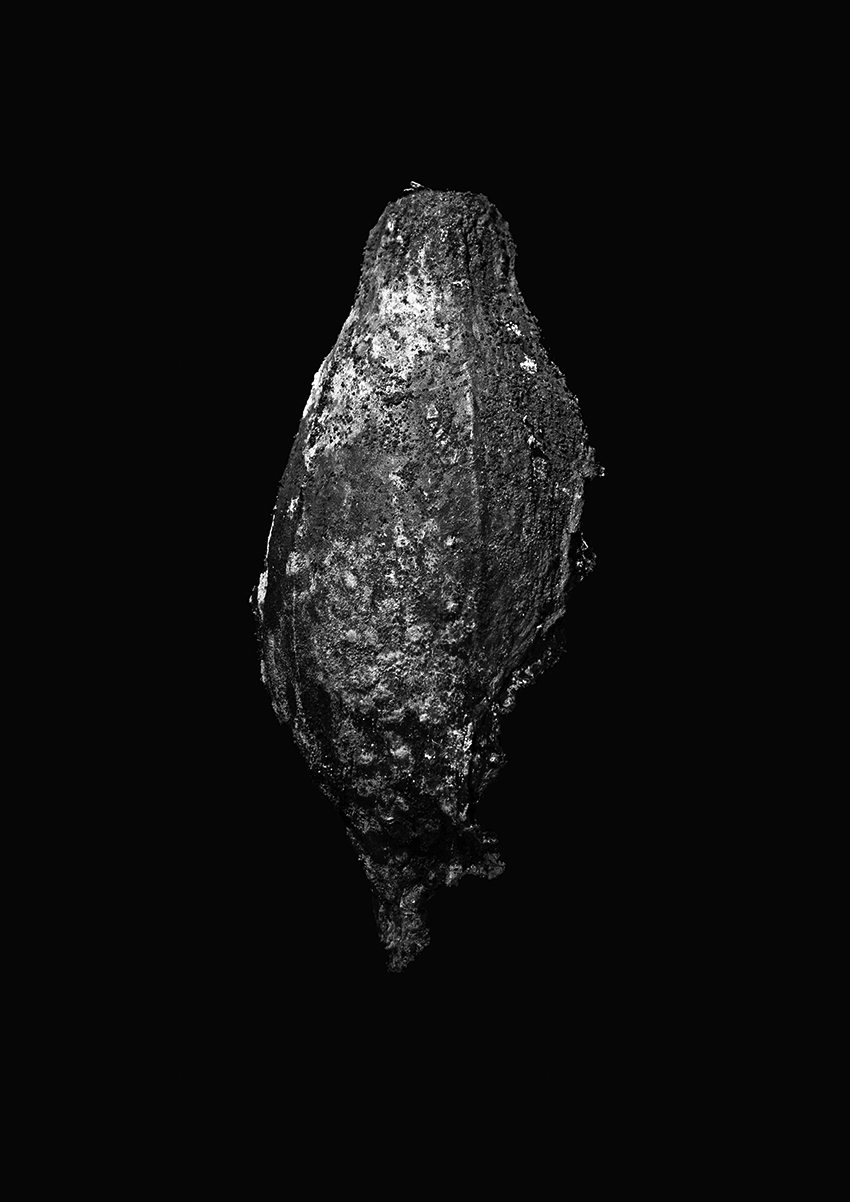
Nguyen Art Foundation (NAF) proudly presents In Stranger Lands: Cocoa’s Journeys To Asia – a two-part exhibition curated by Caroline Ha Thuc, featuring 17 newly commissioned artworks by established artists working across Asia. It is the first edition of the Asian Cocoa Project, a touring multidisciplinary project dedicated to the culture and history of cocoa in Asia.
For many of us, the taste of chocolate evokes childhood memories, sweetness, and the warmth of family. In Asia, chocolates were often brought back from visits to faraway countries and received as gifts with excitement and pleasure.
Today, chocolate is no longer considered an “exotic” luxury item. In addition to Western brands, many Asian countries have developed their own chocolate industries, incorporating flavors and ingredients that resonate with Asian palates. However, what lies behind the chocolate bars that we see daily on supermarket shelves remains, for many, unknown territory.
Is cocoa produced in Asia? Why has chocolate been absent for so long from the Asian culinary landscape, and can local producers meet today’s growing demand? Who are the farmers cultivating cocoa in the region, and what are the challenges they face when asked to scale up production in a sustainable way?
Conceived as a collective and creative research project, this exhibition invites us to delve into these issues, aiming to shed light on the many untold stories of Asian cocoa and chocolate through an array of embodied, emotional, imaginative, and conceptual artistic expressions. From the cocoa tree’s unique characteristics and its colonial history to the ecological challenges surrounding its current production and the intricate processes involved in turning beans into chocolate, the artistic diversity showcased in this exhibition unveils the extensive breadth, potential, and complexity of what is often perceived merely as a foreign delicacy.
Participating artists:
Ravi Agarwal (India), Timoteus Anggawan Kusno (Indonesia), Antariksa (Indonesia), Agung Firmanto Budiharto (Indonesia), Bui Cong Khanh (Vietnam), Cian Dayrit (Philippines), Cyril Delettre (Hong Kong), Veronica Emery (Hong Kong), Jiandyn Collective (Thailand), Jason Lim (Singapore), Pan Lu and Bo Wang (Hong Kong/Netherlands), Arin Rungjang (Thailand), Erika Tan (Singapore), Rodel Tapaya (Philippines), Ting Chaong-Wen (Taiwan), Robert Zhao Renhui (Singapore), Zheng Mahler (Hong Kong)
Collect – the leading international fair for contemporary craft and design presented by the Crafts Council, celebrates its 20th edition returns from 1 – 3 March, 2024 at the glorious and historic setting of Somerset House in London (previews on 28 and 29 February).
Representing the pinnacle of artistry and creativity, this milestone edition brings together a curated presentation of 40 international galleries representing over 400 living artist makers and designers at the top of their game for a one-stop showcase to explore the very best and newest works in today’s market across a range of handcrafted objects, furniture and art jewellery – all made within the last five years and often exclusively for the fair.
Prices range from £500 to £50,000+ providing an opportunity for collectors, art consultants, interior designers, curators and enthusiasts – new and established – to acquire contemporary craft.
Key Dates and Ticketing Information Private View Thursday 29 February, 2024 Private View Day 11am – 6pm (invitation holders and tickets available to purchase); £60.00 Private View Evening 6pm – 9pm (invitation holders and tickets available to purchase); £38.00
Public Opening Friday 1 – Sunday 3 March 2024 Open 11am – 6pm (tickets can be booked online in advance, or on the day either online or on site at the ticket desk) General Admission: £27.00 Concession*: £21.00 (*Concession ticket holders must present valid ID or upgrade to General admission ticket on the day)