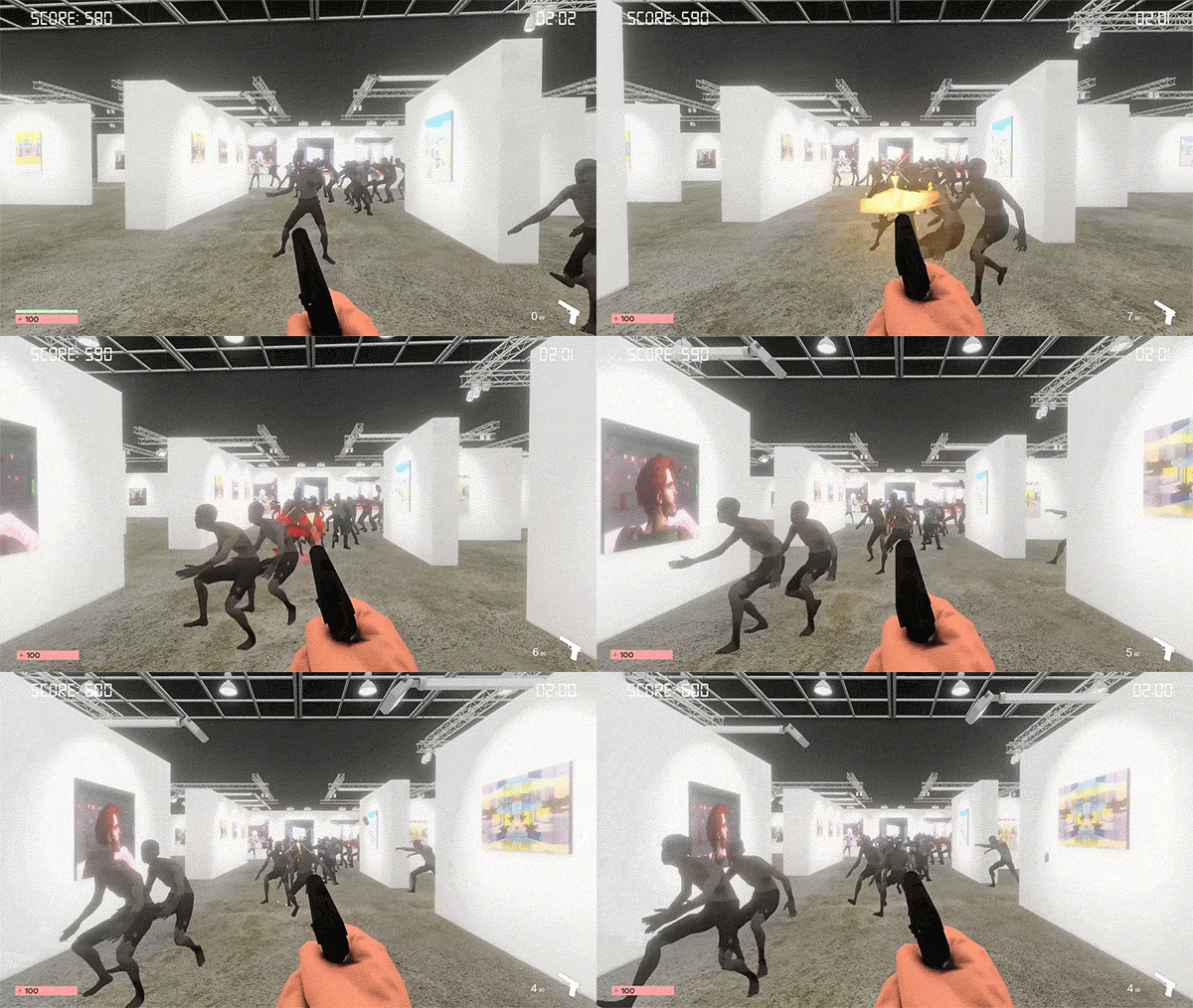
Do you experience art world fatigue? Are you looking to reignite that spark? A little over one month following a harrowing art week, Mak2 presents solo exhibition Art Survivors at DE SARTHE, featuring a first-person zombie shooting game set in an imaginary art fair as well as a new body of works on canvas titled Home From Home. The exhibitionhints facetiously at the undercurrents of the art world system, offering a chance for escape, where players of the art world may decompress via a detachment from tangible reality and a self-deprecating laugh. Beyond a humorous critique of the art market, the exhibition is also a congratulatory nod toward those who have been able to survive thus far.
Art Survivors is on view until June 22. All visitors are invited to play the game.
Much like gazing at the night sky during the new moon in minimal light, Ling Pui Sze’s works capture ever-evolving textures and organic forms, evoking a sense of tranquility and boundlessness. Inspired by her personal medical experiences and a deep connection to nature, Ling employs experimental ink techniques and collages to create videos, sculptural installations and works on paper. Her intuitive approach to arranging collected images of nature transfigures creatures and landscapes into abstract representations that recall both the familiar and distant. Ling embraces and reconstructs the incidental organic through an iterative process, reflecting on the interconnectedness of various life forms.
To further explore the interplay between biological traits and the evolution of human society, Ling has participated in several artist residencies, including ones supported by Haohaus in Taiwan in 2015 and Listhus Artspace in Iceland in 2018. From July to December 2023, she undertook an artist-in-residence programme at Robinson College, part of Cambridge University, with Artecal Foundation. Her latest work, White Mirror 2, is on view until 9 March at the group exhibition Living Paper at Galerie du Monde in Central. Curated by Olivia Wang, the show highlights innovative explorations by 10 different artists across generations and locations who engage with the materiality of paper.
Ling Pui Sze, Studio photo, 2023. Courtesy the artist.
Jessica Wan: How did you start your research at Cambridge? Ling Pui Sze: After arriving in the UK for the first time, I discovered a community of Hong Kong diaspora artists and scientists actively engaging in the art scene there. I started visiting them, sharing details about my project and proposing collaborative ideas. Their positive responses and willingness to connect me with diverse networks opened up new opportunities. Through these connections, I was introduced to friends who were either graduating in or studying biology at various universities. I had the chance to meet committee members and the president of the British Society for Cell Biology. Furthermore, I visited the Biology and Pharmacology departments at the University of Huddersfield, and the Zoology and Biochemistry departments at the University of Cambridge. This process allowed me to gradually broaden my network and engage with scientists across London, Huddersfield and Cambridge, facilitating my research development.
JW: Who else have you met? How have these interactions with curators and scientists influenced your practice? LPZ: I’ve had the privilege of meeting various museum curators, including Natasha McEnroe at the Science Museum and Janice Li at the Wellcome Collection. In Hong Kong, the development of art-science collaborations is rare. In the UK, however, I’ve visited exhibitions and collections centred around the intersection of biology and art. This exposure has been enlightening, providing me with valuable insights into the curatorial process and exhibition dynamics. I plan to continue the conversation with these professionals and develop future collaborations.
Moreover, I’ve had the opportunity to meet scientists in Cambridge who generously allowed me access to their laboratories. For the first time, I used an electron microscope to produce detailed surface images of various creatures. Before, my collection of microscopic images was based on online sources. Now that I’ve learned to operate microscopes first hand, this experience will provide a more original and hands-on approach to my artistic process.
JW: How have you recently developed your Reactionary series, a visual diary capturing your daily life since 2016? LPZ: I keep working on this series from time to time. The experimental nature of these images enables me to take bolder steps in selecting diverse materials and employing various collage techniques to express my sentiments about daily life. During my [Cambridge] residency, I explored different paper types and incorporated more watercolours. This series has no predefined concepts, affording me the freedom and openness to create several new works.
Research process. Courtesy the artist.
JW: Mirroring the multifaceted nature of your visual collages, the Experimental Ink workshop you hosted at Robinson College presented a continuously changing series of images gathered through an array of devices like microscopes, satellites and scanners. How does the convergence of art, biology and social development shape your creative process and influence your work? LPZ: I have conducted a few experimental ink workshops in Hong Kong, and this marks the second occasion when I have done so in another country. The workshop is open to the public, with no age restrictions. It brings me immense joy to witness participants using their creativity and discovering new approaches to making collage works with the techniques and materials I provide.
This process mirrors how I start my collage work, immersing myself in textures and imagination to capture emerging patterns, colours and sounds. Similar to playing jazz, there is no correct or standard method for creating freestyle collages. It involves continuous improvisation, shaping and forming on canvas, letting go of the need to control every aspect of your artwork, and allowing it to find its direction. This process of exploration and discovery, allowing the artwork to evolve organically, resembles forms in the natural world.
JW: Nature is core to your practice. How have you found Cambridge and the UK to be distinctive compared to Hong Kong? LPZ: One of the most noticeable differences I’ve observed between Hong Kong and the UK is the water. I became particularly fascinated by the variation in water in the UK. Initially, I wasn’t accustomed to drinking tap water in the UK. However, my perspective shifted when I visited Scotland. I discovered that the water’s colour changes based on the region and location. This colour variation is an intriguing aspect that I wish to incorporate into my ink-based work.
For example, I am interested in collecting limescale to develop a new series of works. Besides, I find the terminology used to describe water types, such as “hard water” and “soft water”, quite poetic. This has sparked my curiosity, and I want to delve deeper into understanding how these terms were coined and why they are associated with different types of water.
White Mirror 2 by Ling Pui Sze, Mixed media on paper, 57 x 133cm, 2023. Courtesy the artist.
JW: In what way does your latest work relate to your continuous exploration of organic forms and the progression of human society? LPZ: I am showcasing two works in the group exhibition Living Paper: Solaris and White Mirror 2, with the latter being a revised version [of White Mirror 1]. The inspiration for Solaris is rooted in my experiences of witnessing the unique challenges people face when dealing with memories: distortion and selective consolidation. This series draws parallels to the reproduction of barnacles on rails and sea tortoises that become inseparable from their surfaces over time, akin to the enduring nature of memories that persist if we dwell on them incessantly.The creation takes the visual form of something one wishes to tear apart but clings to stubbornly, much like a persistent gum [connecting] two worlds. This narrative delves into how specific memories become deeply ingrained and distorted in one’s mind. In collaboration with Olivia Wang, the curator for the exhibition, we envisioned a dedicated room, like a space inside one’s mind, to host Solaris.
White Mirror 2’s inception dates back to 2022, when I began collecting images of my cells. Under the microscope, magnifying minuscule details revealed a profound complexity that responded to the fragmented nature of self-perception and identity. So I decided to create a celestial galaxy using images of different parts of my body, as a self-reflection process. As I extract various elements from daily life, the loop signifies a continuous cycle of time, with the centre of it left in white. The white conveys my desire to empty my mind at the end of each day, inviting new perspectives into my life. Using washi paper, I engage in the deliberate act of tearing and repairing the fibres, which are tightly interwoven. This meticulous process demands considerable time. The act of tearing and sticking serves as both a meditative process and a means to solidify my thoughts.
These two works invite reflections on the intensified sense of the present and staying grounded amid the myriad uncertainties that impact our emotions and exert pressures in daily life. It’s a gentle nudge to recognise that there are more things to come, and we are merely a tiny fragment in the grandeur of the cosmos.
Featured image: Solaris by Ling Pui Sze, Bamboo sticks, plastic stick, steel wire, aluminum foil, paper, xuan paper, site-specific installation, 45-part work, dimensions variable, 2019-23.Courtesy the artist and Galerie du Monde.
Szelit Cheung’s paintings offer viewers open spaces in which to wander, escape or retreat. Neither abstract nor realistic, they feature imaginative architectural settings that are at the same time familiar and unknown. Fascinated by the concept of the void, the Hong Kong artist builds structural and poetic landscapes that attempt to embody the texture and complexity of emptiness expressed through a rich range of colours and contrasts. With no foreground or tangible objects to hold onto, the gaze plunges immediately into a geometrical world of light and shadows where time appears suspended. Light radiates and exceeds frames, including the canvas itself, while the void tends to echo the projection of our own selves.
Caroline Ha Thuc: Do you remember why you originally wanted to be an artist? Szelit Cheung: I love the process of making art; it is as simple as that. The only thing I can remember from childhood was drawing with a pencil for hours until the sun went down. There was nothing that made me happier than painting and drawing. Then, in high school, when I first began learning about the history of art and classical paintings, I became curious and passionate about the old master paintings and wanted to learn all the secrets and tricks. I didn’t really know what I wanted to be back then or have any idea what an artist actually does, but one thing I am sure of is that I love art. I just thought, “Why not have a go and figure out the rest along the way?” Turns out it was one of the best decisions I have ever made. I love what I do, and I was fortunate to have the opportunity to slowly develop into what I am now.
Hidden Form III by Szelit Cheung, Oil on linen, 160 x 120 cm, 2023. Courtesy the artist.
CHT: You work in different media, but recently it seems that painting has occupied an increasingly major place in your practice. Why? SC: Art can take many forms. Whenever an idea pops into my head, I like to test it out through different experiments with various techniques. It helps me think creatively and decide the best medium to express my idea. I love to paint, as I can express my emotions and thoughts in the flow of the colours and brushstrokes on canvas. The process of oil painting particularly brings me a great sense of peace. Every little step matters, from preparing the ground to gradually applying the oil paint layer by layer and finalising the details. It takes weeks and months to work on an oil painting, but it is very rewarding to see the overlapping of colours, different thicknesses of paint, strengths and emotions blend into a unique vision.
CHT: You have been exploring light and colour to create space, or rather to open spaces and depth. What is your working methodology? SC: Trying everything is the way I work. To be honest, I am not a planner, and I do not have a particular routine or method when developing an idea. I tend to just go with the flow, see where it takes me and be more spontaneous about the process of making art. Sometimes, I use different materials and simply build shapes and forms out of whatever I have, just like children playing with building blocks, and I remain curious about everything.
My inspirations come from everyday discoveries. Take the series Hidden Form (2023) as an example. I was inspired by a tree branch I found on my way back to the studio two or three years ago. I placed it in a corner, and one day the light from the window created an interesting composition with the branch and its shadow. I recorded the relationship between the object and the shadow on the wall in my sketchbook.
Above: Space I by Szelit Cheung, Oil on linen, 34 x 27 cm, 2020. Courtesy the artist.
CHT: How did you then work from this sketch? The outcome looks far from a tree branch. Instead, it reveals curves that open up invisible spaces. SC: The tree branch leaning against a wall formed a triangle. It wasn’t intentional at first but the result turned out to be unexpected and extraordinary. Shadows are incredibly special, and what interests me the most is how they play a significant role in defining an invisible yet present three-dimensional form. A cast shadow does much more than offer depth and layers to a painting. I wanted to emphasise the poetic interaction between the object, light and shadow, breaking the norm and changing the way we perceive.
I was captivated by the idea of invisible forms created by an object and its cast shadow. I experimented with different materials and placed them on the wall, floor or ceiling to shape invisible forms that could only be viewed from a specific angle. After countless trials with different combinations of materials, angles and intensities of light, I discovered that by bending a copper rod and placing the light at the right angle, it creates a fascinating invisible arch. That’s how this series gradually developed.
CHT: On your website, you say the “void is a transitional state between the moment of looking at the emptiness and the moment before reckoning and feeling it”. Where does your fascination for the void come from? And how did you come to define or interpret it in this way? SC: It all began with a question I asked myself years ago: how do I remember a space, particularly an empty one? Is it because of the paint on the walls, the footprints on the floor, the dust floating in the air, a fleeting moment of light or even just a passing glance? Whenever I observe these small details within a space, I unintentionally enter a contemplative state. Why do spaces evoke such wonderful imagination? What exactly is empty space? How can we present and sense the void? Thus, I wanted to explore the essence of the void and see how far it would take me.
Shimmer VI by Szelit Cheung, Oil on linen , 59.7 x 49.7 cm, 2020. Courtesy the artist.
CHT: We often associate the idea of the void with something formless. Are you creating structures as frames to capture it? SC: To me, the void is not something that can be easily defined. It is more like a philosophical reflection or a poetic journey of experiential existence that will endure. Bringing an idea to life is not an easy task. For me, the process of attempting to visualise and explore void or emptiness is more intriguing than anything else. There is more to be seen, beyond a mere image. The experience extends beyond the canvas. Space itself appears simple yet possesses immense power, with certain qualities within. I am curious and open to various methods, as long as they help me achieve what I want to convey. Creating structures, drawing or painting are just a few of the many ways to approach this grand concept. Two years ago, I created an installation titled Endless at Rossi & Rossi Gallery. It was a sculpture made of layers of Japanese washi paper on the ceiling, inviting the audience to engage with space and feel the void I sought to create.
CHT: In most of your work, the architectural components form a kind of stage. The interplay between positive and negative spaces creates a tension that suggests something might suddenly happen. In Dark I (2021), for example, the beam of light could be interpreted as an invitation to enter the painting and explore the unknown space behind the wall. Are there any hidden narratives behind these pieces? SC: A story tends to have an ending and I am not trying to tell any. Instead, I aim to create a state of mind that allows the audience to feel and experience the essence of the void I have discovered through various means. In the exhibition Dark (2023), my intention was to capture the essence of void through darkness. In contrast to previous attempts, I simplified the forms and focused more on the interplay of light and darkness to convey a state of nothingness.
CHT: However, I sense a strong presence in your paintings, probably as a counterpoint to emptiness. Even light is intensely embodied. SC: I believe the concepts of “emptiness” and “being” need to exist in a balanced state, as they are equally important and inseparable. They rely on each other to highlight their own existence. For instance, if we draw a circle on paper, we not only see the circle itself but also the line defining its boundaries.
CHT: This tension also emerges from the imbalance among the various forms you create. One typical example is Cut I (2023). A massive concrete block obscures the horizon, compelling the gaze to seek escape in the small open space you have created. How do you build your architectural spaces? SC: I develop architectural spaces through various means, such as drawing sketches or creating models. During the process of crafting Cut I (2023), I produced numerous models to examine how light permeates through a space. The ceiling is angled in different ways to draw the viewer’s attention to the beam of light, while also fostering a sense of intimacy within the space.
Dark I by Szelit Cheung, Oil on linen, 100 x 150 cm, 2023. Courtesy the artist.
CHT: Are you referring to building smaller paper structures to experiment with light? SC: Yes. Artists have their own visualisation tools and, for me, creating physical models is an effective way to swiftly explore and materialise my ideas. An idea remains abstract until it takes physical form. I have a multitude of imagined three-dimensional spaces that I wish to explore. Typically, I begin by sketching a few quick compositions and forms that I feel inclined to paint. Then I proceed to constructing models using various materials. This process helps me visualise how light interacts with the space and enables me to understand the relationship between spatial dimensions and materials, ultimately informing the optimal image for the painting.
CHT: Do you draw every day? SC: All the time. I am either sleeping or working. I paint and draw as long as I can every day. There are countless possibilities and avenues to explore, and I strive to experience and accomplish as much as I can.
CHT: Two years before Dark, the exhibition Space also explored the concepts of time and space through different architectural settings. However, the palette was different, featuring more pink and red tones. What happened in between these two exhibitions? SC: Colours have the ability to influence mood and evoke a sense of void. By integrating colour with form and space, a unique presence is created. The colour palette for each exhibition is deliberately chosen based on the underlying idea, inspiration, context and more. The Space exhibition revolved around the interplay between display spaces and artworks. I wanted the audience to feel a touch of warmth when they entered the exhibition, which aligned with the presence of a red entrance door. On the other hand, for Dark (2023), my aim was to depict a series of dark spaces with a focus on how warm light enters and interacts with the space itself. This series leans towards orange-reddish tones and encompasses a range of atmospheres and moods.
CHT: Do you believe that specific colours can better convey the idea of void that you strive to embody? SC: To me, colour is boundless and it can harmonise with any idea. One of my daily routines involves recording colours or shades I come across on paper and displaying them on the wall. This repetitive process helps me develop a deep understanding of colour. It’s fascinating how a colour can evoke entirely different emotions in diverse cultures, regions, age groups and eras. Typically, before starting a painting, I conduct a few quick studies to experiment with different colour schemes and determine which one best serves the intended purpose. This process aids me in selecting the most suitable colour to visualise the idea I wish to express.
For example, during my participation in a residency programme at The Shophouse in Tai Hang [in June and July 2023], where I had the opportunity to work in a three-storey historical building with a red terrazzo floor, I deliberately employed a classical green colour commonly found in western classical oil paintings. This choice created a strong contrast and completely transformed the overall experience.
CHT: Are you influenced by any artists such as Escher, who created endless spaces? SC: I am curious and interested in everything. I’ve fallen in love with a few artists, like James Turrell and Olafur Eliasson. Both artists are very good at altering our senses, turning something normal into something special and changing the way how we see and feel.
Door VII by Szelit Cheung, Oil on linen, 40.2 x 30.1 cm, 2023. Courtesy the artist.
CHT: Architecture holds a central position in your artistic world, with earlier paintings like Space (2020) featuring elements like Gothic church windows. Are you inspired by specific types of building? SC: Tadao Ando is one of my favourite architects but, in general, I enjoy visiting various types of architecture, ranging from churches to museums around the world. Travel plays a significant role in my life as an artist. It provides an excellent opportunity to learn by observing and understanding how different spaces affect our emotions and moods, as well as observing people’s reactions to various buildings. I take pleasure in observing the interplay of light and shadow within a structure and capturing the atmosphere in my memory. This process helps shape my imaginative perception of space.
CHT: You also play with scale, creating ambiguities. For example, Dark I (2023) is a large painting that showcases a basement window or a grid, which could be associated with narrow spaces. On the other hand, in the series Mado (2023), you use very small formats to depict larger spaces. How do you decide on these formats and how do you navigate these tensions? SC: Yes, I enjoy working with different scales, especially when creating pieces for specific exhibitions, as I try to respond to the exhibition space itself. The space I created in Dark I is actually quite spacious. The double-height ceiling provides a sense of openness, creating an expansive and visually striking interior. Full-height windows are positioned at the bottom, offering views beyond and enhancing the connection between the interior and exterior spaces. That’s why this piece is the largest among all the paintings, taking up the entire wall at the exhibition.
As for Mado (2023), the size of these paintings is determined by their placement. At Rossi & Rossi Gallery, there is a long, narrow corridor with a low ceiling. Instead of placing a large painting there, I wanted to have a series of small ones scattered on the wall, allowing the audience to freely wander around within these spaces.
CHT: There is also a sense of oppression in the spaces you describe. You push viewers into corners or spaces where they have no choice but to plunge into the unknown, hoping something more luminous can arise. Is there any spiritual aspect to your work? SC: I don’t intentionally seek to convey a specific form of spirituality or mysticism in my artwork. My goal is to encourage the audience to pause in front of my work, take a few seconds to contemplate, and experience the moods and atmosphere I have created. The unknown or uncertainty can be intimidating at times, but where is the excitement if we know everything in life?
CHT: Some of your paintings have enigmatic titles like Cut or Mado. What are you referring to? SC: Coming up with compelling titles is one of the most challenging tasks for me as a painter. I find it difficult to encapsulate my works in a few simple yet memorable words. I tend to keep the titles more conceptual rather than precise, allowing room for the audience to interpret and understand them in their own way. However, sometimes title ideas come naturally to me, offering a glimpse into my mindset during the art-making process.
The title Cut was inspired by an experiment with paper. I had the idea of creating slit-like openings to manipulate light. I prepared a pile of paper and experimented with different cutting techniques. Through this process, I observed how the changes in light and shadow were influenced by the size of the openings and the direction of the light source. It allowed me to quickly visualise the idea and space I wanted to paint.
Mado is named after the Japanese word for “window”. One of my favourite moments in the studio is observing the soft light that enters through the window. It is calming and soothing to witness the ever-changing play of light and shadow. Each moment is unique, creating atmosphere and evoking emotions. To me, it resembles a painting. This inspired me to create a series of small paintings on wood scattered on the wall, each capturing a different, distinct moment of light and shadow entering a space through a window, reshaping the way we see and feel.
CHT: Why use the title Dark twice? SC: Dark is an interesting perspective to explore light and space. I wanted to delve deeper into this theme. Without darkness, light loses its meaning and vice versa.
CHT: Lastly, would you inhabit the spaces that you create? SC: It would be a literal dream come true if I could live in the spaces I create.
Caroline Ha Thuc:你記得自己為什麼想成為藝術家嗎?張施烈: 我喜歡創作藝術的過程,就是這麼簡單。我唯一的童年回憶就是小時候會花上好幾個小時用鉛筆畫畫,一直畫到太陽下山為止,繪畫是最能讓我快樂的事情。高中時我第一次接觸藝術史和古典畫,對古典名畫產生了好奇和熱誠,很想學習當中所有秘密和技巧。那時我真的不知道自己想成為什麼,也不知道藝術家實際上是做什麼,我唯一知道的就是我熱愛藝術。所以我就想:「為什麼不先試試,再慢慢探索餘下的路?」事實證明這是我做過其中一個最好的決定,我熱愛我在做的事,也很幸運有機會慢慢發展成現在的樣子。
Concert Hall, Hong Kong Academy for Performing Arts / Hong Kong / Mar 15, 2024 / Ernest Wan /
In 2022, South Korean pianist Yunchan Lim shot to stardom when he became the youngest-ever winner of the Van Cliburn International Piano Competition at the age of 18. His success has understandably called increased attention to his teacher Minsoo Sohn, and the Hong Kong Arts Festival invited the latter to make his local debut in both concerto and solo performances. His programmes included Rachmaninoff’s Third Concerto and Liszt’s Études d’exécution transcendante, which Lim performed in the Cliburn final and semi-final respectively. Sohn’s Liszt recital was doubly interesting in that the Études figured prominently in the career of his own teacher, Russell Sherman, who died in September 2023.
The 47-year-old Sohn began his recital with Liszt’s Consolations, or Six pensées poétiques, intimate pieces that are mostly slow and soft. His playing of the initial chords of the first piece, more deliberate and meditative than usual, right away characterised his rendition of the entire set – these are serious, even pious works, and not the mere salon miniatures that they often sound like, their brevity and simplicity notwithstanding. The performance abounded in such felicities as subtle dynamic shading, delicious rubato and exquisite phrasing. This last was especially apparent in the second piece, in the middle of which the melodic line is distributed between both hands in octaves. Here Sohn made certain that the phrase grouping sounded markedly different than it previously has — a testimony to his command of and fidelity to the score.
These strengths were on display also in the 12 Transcendental Études, which are far more challenging works both technically and expressively. As expected, Sohn’s playing of the lyrical études, like “Paysage” and “Ricordanza”, was refined and beguiling. The opening “Preludio” didn’t just exhibit daredevil impetuosity like Lim’s but also radiated majesty and authority. The A-minor étude, which lacks a title, usually comes across as little more than a finger exercise, but in Sohn’s hands it seemed to have a serious, even tragic import. Likewise, the remaining brilliant études, such as the other untitled one in F minor, “Feux follets” and “Wilde Jagd”, were dispatched with great speed and accuracy yet sounded ever purposeful and never flamboyant. The sustain pedal was generously applied throughout the set, sometimes even when the score calls for leaner textures: neither the staccato accompaniment in “Eroica” nor the quasi arpaone in “Harmonies du soir” were played secco,as both Lim or Sherman did. More importantly, such pedalling was integral to Sohn’s powerful overall sonority; the massive chords in “Vision” and “Eroica”, as well as the relentless fortissimiin “Mazeppa”, were imposing, indeed overwhelming. Moreover, build-ups and let-ups were masterfully executed: the crescendoing chromatic quasi-cadenzapassage in “Chasse-neige” was terrifying, and the grandeur towards the serene conclusion of “Harmonies du soir” brought to mind the last pages, in the same key of D-flat major, of Wagner’s Götterdämmerung.
This fiery yet thoughtful performance showed Sohn to be a formidable artist deserving of just as much attention as his celebrity pupil has enjoyed.
White Cube is pleased to present Louise Giovanelli’s first solo exhibition in the city.
Louise Giovanelli’s (b.1993, London, UK) work considers the significance and history of painting as a system of representation. Titled Here on Earth, the exhibition debuts a new group of paintings in which the central female figure is doubled and repeated–frozen in a moment of ecstasy – exploring the tension between representation and materiality, figuration and abstraction.
Working from found imagery drawn from a wide range of sources, the artist seeks to isolate narratively ambiguous moments. As she explains, ‘a painting should be the beginning of something. The best paintings are those that endure in your mind – because there’s this sense of mystery to them.’
Giovanelli’s first museum exhibition in China takes place concurrently at He Art Museum (HEM) from 23 March until 16 June 2024.
Kurt Chan Yuk-keung, Chow Yiu-fai, Chui Pui-chee, Mak2, So Hing-keung, Phoebe Wong, Stephen Wong Chun-hei, David Chan, Kingston Lo, Frog King, Frog Queen, Virtue Village Beyond the Singularity Mar 16 – Apr 7, 2024
Curator: Isaac Leung
SHOWCASE UG/F, Landmark South 39 Yip Kan Street, Wong Chuk Hang Tuesday – Sunday, 12pm – 7pm
The Hong Kong Arts Development Council (HKADC) proudly presents Beyond the Singularity, the highly anticipated final exhibition of ARTS • TECH Exhibition 2.0. Curated by Isaac Leung, Beyond the Singularity is the first of its kind, Hong Kong’s premier AI-themed exhibition that delves into the profound impact of Artificial Intelligence (AI) on human existence and artistic expression, construction a journey through dynamic landscapes and dialogue to probe its ever-evolving potentiality.
Inspired by the metamorphic term “singularity” – which at its advent described the infinite density and gravity of the black hole’s centre – and expanded to denote a future where AI surpasses human cognition, Beyond the Singularityaspires to establish a benchmark in the use of AI technology while raising thought-provoking questions about the role and significance of humanity in the context of the advancing integration of intelligent machine within the realm of art.
The project adopted a process-oriented approach, encouraging artists to incorporate technology into their artworks and empowering artists to discover how AI technology can push artistic boundaries. The project aims to provoke thoughts about AI’s influence on culture, the blurring line between reality and artificiality, authorship, free will, human-machine collaboration, originality in art and AI’s inherent limitations.
Participating artists from different generations and arts genres include Kurt Chan Yuk-keung, Chow Yiu-fai, Chui Pui-chee, Mak2, So Hing-keung, Phoebe Wong, Stephen Wong Chun-hei, David Chan and Kingston Lo, Frog King & Frog Queen (Kwok Mang-ho & Cho Hyun-jae), and Virtue Village – showcased a variety of art objects crafted in collaboration with AI tools, spanning mediums including ink art, western painting, photography, music, lyric writing, performance and arts criticism.
Inspired by the 1960s art collective Fluxus, Hong Kong’s Rooftop Institute has published a new book, Event Scores 2: Ideas between Artist-Parents and Their Kids, exploring ‘instructional art’ between artist-parents and their children, contributed by 45 artist-parents from around the world. These alternative ways for parent-child interactions are suggestions for action open to the reader’s interpretation, ranging from helping parents and children co-create with anything around them, to reflecting on their relationship and getting along with each other.
Editors Yim Sui Fong and Joey Chung introduce the story behind the book and share examples, when as artists and young mothers they originally collected ideas from other artist-parents that all parents could use while their children were at home during COVID. Event Scores 2 is a new book, published in English and Chinese, of further alternative ideas by artist-parents from around the world.
When Howie Tsui and his family settled in Canada’s Thunder Bay, a sparsely populated, blue-collar corner of northern Ontario, his connection to Hong Kong was getting stretched. It was 1984, after a few years in Lagos. But like many members of the Hong Kong diaspora who were born in the 1970s and 80s, one medium dropped him back into the city’s orbit: its pop culture and entertainment.
It arrived on videocassettes, mailed from Hong Kong and flown across the Pacific Ocean before it landed in the city, situated by Lake Superior. For young Tsui, that connection had a particularly personal layer: to satisfy the requirements for being new immigrants, his father had started a videocassette manufacturing business in Canada. The tapes that his uncle used to record programmes in Hong Kong could have been products made by the family business.
On these tapes were slapstick comedies, wuxia action flicks and other output from a golden age of Hong Kong cinema, starring the likes of Andy Lau, Tony Leung, Stephen Chow and Michael Hui. There were also episodes of dubbed Japanese animated series that were popular among kids in the city, like Doraemon and Dr Slump. Some of the tapes were bought; others were bootlegged.
The Banquet by Howie Tsui, Paint pigment and ink on mulberry paper mounted on silk, 106.5 x 219 cm, 2023. Courtesy the artist and Hanart TZ Gallery.
In Thunder Bay, those tapes meant a lot to Tsui. He watched them in the basement of the house he lived in, over and over again, iconic scenes getting burned into his memory. Decades later, the visual grammar of that era’s films became an important source of inspiration in his artistic practice, but only after the artist found a sense of reassurance that allowed him to create work that stood out distinctly from the contemporary art canon that surrounded him.
Tsui studied art at the University of Waterloo in Canada in the late 1990s and early 2000s, and felt like the work that he wanted to create didn’t quite chime with the art that was being made by the people around him. It wasn’t clear to the artist-in-training that the style he was after—inspired by cartoons, anime and fantastical imagery—could find an audience. But that changed when Tsui discovered publications like Giant Robot, a zine that showcased popular culture, cinema, design and art with an Asian-American bent, as well as Juxtapoz, a magazine that focused on street art, illustration, and pop and urban art. Tsui also found resonance in superflat, the art movement defined by Takashi Murakami that picked up steam in the early 2000s.
Avatars of Entombment #2 (Offering) by Howie Tsui, 3 colour silkscreen on Crane Lettra cotton paper, 61 x 45.7 cm, 2022. Available edition: AP 3/5, AP 4/5 Courtesy the artist and Hanart TZ Gallery.
Indeed, Tsui’s early work had a distinct Japanese flair to it. In the series Of Manga and Mongrels (2006–08), he lifted elements from drawings by the Edo-period ukiyo-e artist Hokusai, then inked his own caricatures of anime characters over the forms. Many are a mess of limbs and bodies, perhaps with tusks or bat ears or extra sets of eyes. In his next body of work, Of Shunga & Monsters (2007–08), Tsui doubled down on using Japanese imagery as a base for his own characters, then upped the visual complexity. He used entangled bodies from erotic illustrations, merging and reworking them to make a new set of characters’ grotesque faces. On top of intertwined, mid-coitus bodies that were first printed in the 18th and 19th centuries, Tsui moulded facial shapes, adding hair or moustaches, scales or eyes, twisted horns or amphibian features, deforming and transmuting the figures in deliberate body horror that was far more freakish and organic than his Mongrels.
As Tsui’s practice progressed, he still mined a sinister mind space – but in a manner that was playful and characteristic of the Hong Kong entertainment that he enjoyed so much. His art gradually drew more from the culture of the city where he was born, flashes of it punctuating his images.
The artworks in his Horror Fables series – first presented in 2009 at the Carleton University Art Gallery in Ottawa, then in 2010 at MAI (Montréal, arts interculturels) – incorporated scenes from Chinese and Japanese folklore and legends, some of which he encountered through the taped TV shows and films that he watched in his family’s Thunder Bay basement.
Tsui found the drive to ramp up the intensity in this set of work, using ink and paint to put a chaotic mishmash of supernatural scenes on mulberry paper. Here, the cinematic hat-tips are more explicit. In Forest Romp (2009), for instance, we see a man bound to a tree, arrows protruding from his torso. It’s a scene from The Yang’s Saga, a 1985 six-episode fantasy action series that aired on Hong Kong television channel TVB Jade. The show was a stylised retelling of the story of one family’s defence against invaders across three generations during the Song dynasty. Tsui paints the figure with his face peeled off and hanging from his chin – a gruesome fate suffered by the reincarnated thunder deity, who was dispatched to the mortal realm to assist the Yang clan (and was played by Tony Leung in the TVB adaptation).
Parallax Chambers (Abyss) by Howie Tsui. Courtesy the artist.
Several hefty threads converged in Horror Fables. It was the first time Tsui had featured landscape in his work, and he drew inspiration from Ming dynasty scroll painters’ brushwork for this new layer. He depicts grisly scenes – the peeled face; a man severed in half and dragged on the ground nearby, leaving a trail of blood behind him; impalement; tongue-ripping; bodies cooked in a cauldron; sea monsters; ghosts; and a man whose eyes have been plucked out, his head and hands the only parts of his body protruding from a crate. These depictions highlight the terror woven into lore that’s handed down from one generation to the next, first as oral tradition, then recorded in text, and perhaps eventually in still or moving images. At the same time, they lampoon the fear that is pervasive in media, advertising and political messaging. Think of the bloody moments in Forest Romp lifted from The Yang’s Saga – they were aired on TV during prime time, as entertainment, with some of Hong Kong’s hottest actors starring.
Ahead of the opening of The Cradle Rocks Above an Abyss, an exhibition of Tsui’s work at Hanart and the artist’s long-overdue first solo show in Hong Kong, he recalled one vivid sensation that he experienced whenever he visited the city in his youth. The way the water hit his body when he showered in his uncle’s apartment in Hong Kong, Tsui said, felt different from his experience in Thunder Bay. Maybe it was variations in the water’s mineral content, or perhaps it was a visceral marker for home or something like it. Like many diasporic families, Tsui’s regularly returned to their roots. Hong Kong and its patchwork culture was not an abstract concept gleaned on a screen; it was something that Tsui had a chance to live and breathe. Every homecoming, if that’s the right word, was a gentle reintroduction to the city. As the artist said during a brief conversation at Hanart, he had to have spent time away from Hong Kong to develop his way of making art.
Retainers of Anarchy (2016) is a five-channel algorithmic animation work, first seeded as a concept in 2010, after Tsui saw a digitally animated version of a well-known Song dynasty scroll, Along the River During the Qingming Festival, produced for the Chinese Pavilion at the Shanghai World Expo. After the artist got over the initial sense of awe and wonder the installation was meant to evoke, he realised that its depiction of a harmonious, idealistic society mirrored a narrative that the state worked hard to propagate. Again, applying his own brand of wry humour, Tsui jacked the style of the original scroll painting, adding his own twist to depict a range of characters in the Kowloon Walled City, a lawless, cramped place that had its own way of life.
The artist folds scenes from wuxia novels, Cantonese films and real-life Hong Kong into the same universe. In one unit, a man makes bouncing bamboo noodles, riding a bamboo stick to press dough. In another, a rice cooker signals that it’s finished while men shuffle mahjong tiles, their game undisturbed. Outside the city’s walls, vampires controlled by a Taoist priest hop by a beggars’ gang, a martial arts clan that often appears in the novels of wuxia writers like Jin Yong (aka Louis Cha). The fact that wuxia fiction was banned in mainland China until 1980 adds to the irreverence of the work.
Ambitious single-channel animation sequence Parallax Chambers (2018-) was shown at Tai Kwun as part of the INK CITY exhibition in 2021, as well as at Hanart this year. The scenes are loaded with references to wuxia novels and films, but also visuals that Cantonese speakers and those who know Hong Kong might chuckle at – a wireless telephone cooking in a pot of congee refers to a local expression that means to chat incessantly on the phone, and a giant grouper in a glass tank looks like it could be found at one of the city’s seafood restaurants. An algorithm determines the combinations of animated segments that appear on screen, the lighting that goes with them, the sounds that play, and when and how fast laser beams ricochet across the screen (a motif from old wuxia films), as well as shifts between rooms and spaces. The generative work is immensely fun to watch, each section painstakingly drawn by the artist, while his collaborators assisted him with programming, sound design and animation.
Parallax Chambers (Winged Assassin) by Howie Tsui, Lenticular lightbox, 62.5 x 62.5 cm, edition of 8, 2018. Courtesy the artist and Burrad Arts Foundation, Vancouver.
That’s all to say that Tsui’s practice, like his algorithmic video works, is still evolving. In recent ink and paint drawings on mulberry paper, he warps scenes from the 1984 TVB adaptation of The Duke of Mount Deer, a series of novels penned by Jin Yong with a comedic take on the wuxia genre. Tsui manages to draw a line between nostalgia and novelty, giving people a fresh way to think about their roots in Hong Kong, no matter which shores they grew up on.
Featured image: Pyromancers (detail) by Howie Tsui, Paint pigment and ink on mulberry paper mounted on silk, 74.3 x 106 cm, 2023. Courtesy the artist and Hanart TZ Gallery.
Retainers of Anarchy (Tavern Havoc) by Howie Tsui, Ink and paint pigment on mulberry paper, 209 × 109 × 2 cm, 2015. Courtesy the artist and ART LABOR Gallery Shanghai and Vancouver.
事實上,徐氏的早期作品便散發著獨特的東洋風。在《Of Manga and Mongrels》 (2006–08年)系列中,他從江戶時代葛飾北齋的浮世繪畫作中提煉出元素,創作出自己的動畫人物形態,很多人物的四肢與身體亂作一團,有些長有獠牙、蝙蝠耳朵,甚至是多一雙眼睛。徐氏在後續的《Of Shunga & Monsters》(2007-08年)中,更強烈地以日式意境作為筆下角色的基調,再提升視覺複雜性。他把風月插圖中交纏的身體合併重組,拼湊出全新的怪誕面相。他所參考的作品最先刊於18、 19 世紀,當中畫有魚水之歡中交疊的身體。除了這些體形,徐氏也改造了畫作中的臉形,加上頭髮、鬍鬚、鱗片、眼睛、扭角甚或是兩棲動物的特徵,刻意地把人物體形扭曲變異,營造出的恐怖感和有機形成效果均遠遠超越前作。
David Zwirner is pleased to present The Point Is Matter, a solo exhibition of new and recent work by Wolfgang Tillmans at the gallery’s location in Hong Kong. The exhibition’s title stems from Tillmans’s long-term understanding of his work sitting between the physical reality and presence of the world he works and lives in and the conceptual, sociopolitical, sensual, and spiritual concerns that underpin his practice. Presented across both floors of the gallery, the works on view include depictions of changing forms of atmosphere and elusive natural phenomena; pictures that explore notions of time and temporality; and images that engage with the artist’s expansive conceptions of the still life and the portrait. Tillmans punctuates the exhibition with works made in Addis Ababa, Berlin, Lagos, and Mongolia, along with those taken in Hong Kong and Shenzhen, sensitively invoking resonant associations between the local and the world at large, while advocating for an experience of connectedness that is rooted in the process of looking.
This exhibition follows his 2023 solo exhibition Fold Me at David Zwirner New York and his major 2022–2023 traveling retrospective To look without fear at The Museum of Modern Art, New York, the Art Gallery of Ontario, Toronto, and the San Francisco Museum of Modern Art. This will be the artist’s fifth solo exhibition with the gallery and his second at David Zwirner Hong Kong.
Kiang Malingue presents anus whisper, an exhibition of recent installations, sculptures, and films by Wong Ping. Inspired by the experience of paracusia, Crumbling Earwax, Georges Bataille’s The Solar Anus, and a tête-à-tête with a stranger in bed in the afternoon, the sizeable artworks thematically and formally correspond to one another, exploring the aesthetic meaning(-lessness) of bullshit, expanding Wong’s curious body of art that revolves around circular narratives and motifs.