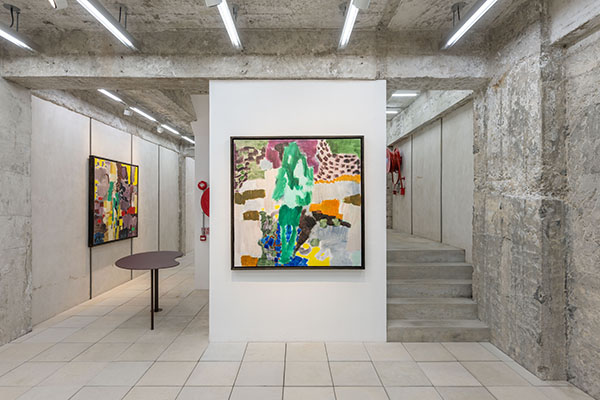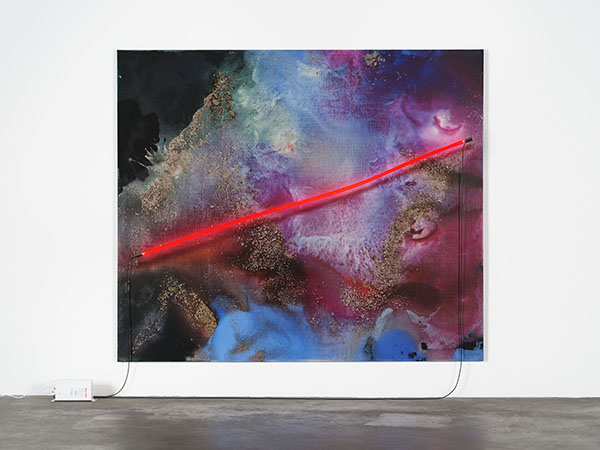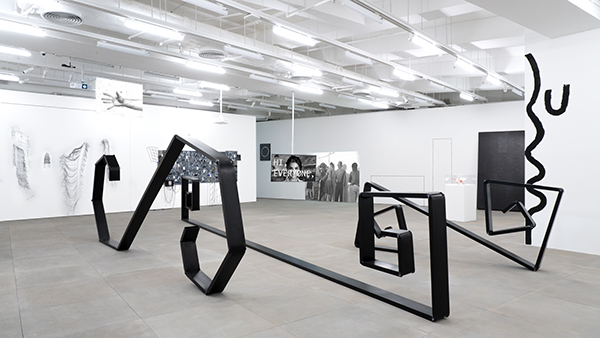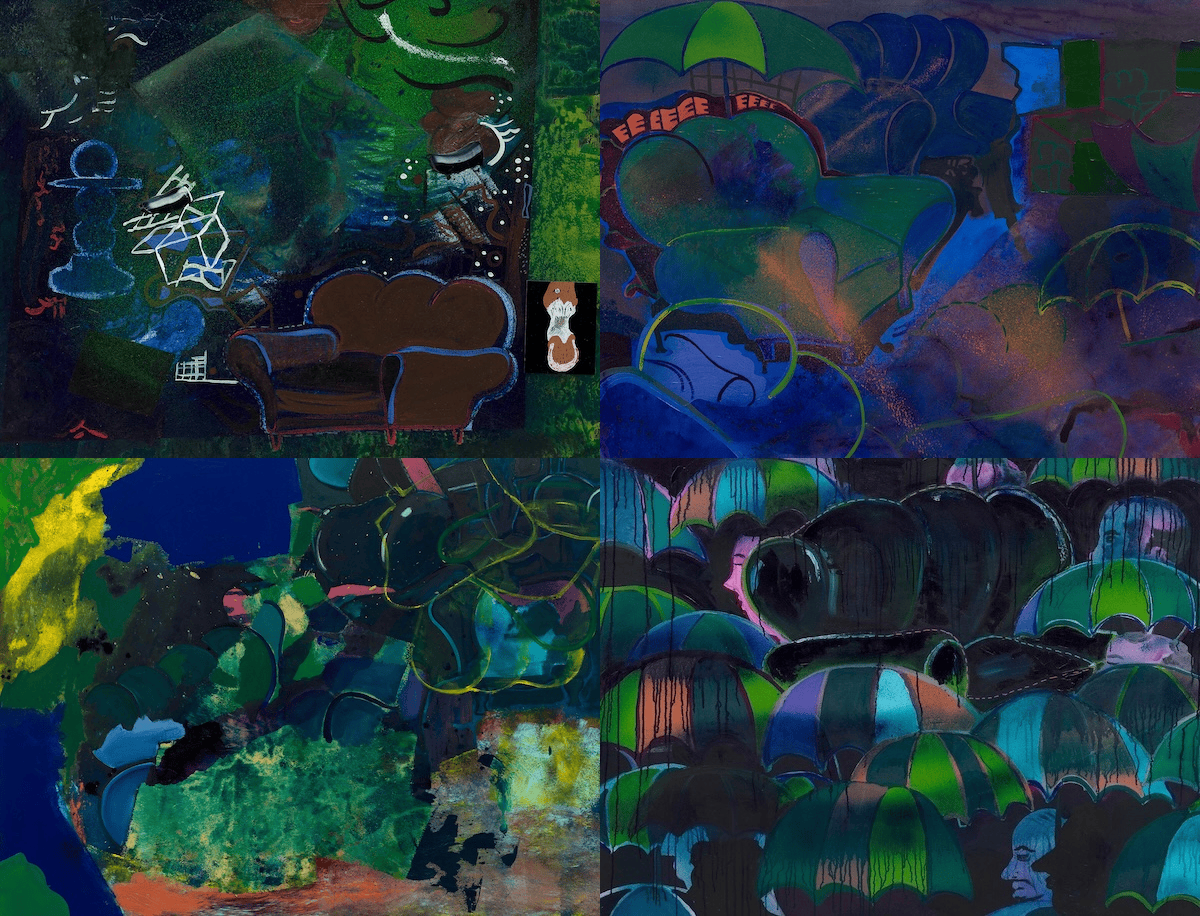
Gagosian is pleased to announce Persephone, Mary Weatherford’s first solo exhibition in Asia, opening at the gallery in Hong Kong on March 24, 2026. In the new paintings on view, Weatherford explores light and color, and pursues her interest in found materials, collage, and neon through a mythological theme that resonates with the changing seasons.
Persephone features luminous paintings in vinyl emulsion paint on linen. Some are augmented by colored neon tubes, seashells, or coral. In Greek mythology, Persephone is stolen from earth to become queen of the underworld; upon her return she presides over springtime renewal. As in the Chinese myth of Nian, a hibernating beast that emerges at year’s end, her story explains the cycle of seasons: when Persephone is abducted by Hades, her mother Demeter’s grief causes all plant life to cease. An eventual compromise requires Persephone to spend part of the year below ground, and the other part on earth, allowing spring flowers to bloom, bees to buzz, and blue summer skies to bring joy. Weatherford’s new series imagines the earthquake of Persephone’s disappearance and her journey into radiance, representing her achievement of new life.
The Hong Kong exhibition unfolds over a sequence of three spaces designed by acclaimed architectural firm Johnston Marklee, each of which can be glimpsed from the one that precedes it. The narrative’s themes of transformation and rebirth have been features of Weatherford’s work since her exhibition I’ve Seen Gray Whales Go By at Gagosian New York in 2018. Persephone finds Weatherford interweaving these preoccupations with an exploration of the hero’s journey and coming of age. In this, Weatherford also draws inspiration from early paintings by Robert Smithson that juxtapose above- and below-ground scenes, some of which come from a series inspired by Dante’s Inferno, possibly the most famous and influential depiction of the underworld.
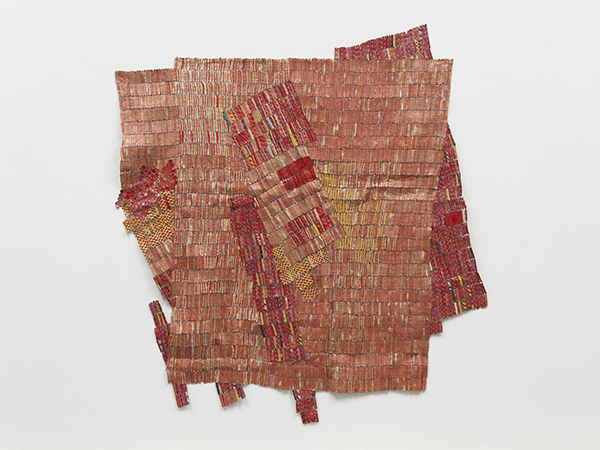
White Cube is delighted to present two concurrent exhibitions in Asia by renowned sculptor El Anatsui (b. 1944, Anyako, Ghana), marking his first collaboration with the gallery. Following his major presentation After the Red Moon at the Museum of Art Pudong in 2024—adapted from Behind the Red Moon for Tate Modern’s Hyundai Commission—a new body of work will be unveiled across White Cube’s galleries in Hong Kong and Seoul.
Since the late 1990s, Anatsui has transformed discarded bottle caps into monumental sculptural forms. Presented across both exhibitions, the new metal works expand this practice and, for the first time, are conceived as double-sided sculptures with no single front or back.
Suspended freely in space, the works reveal their intricate construction—thousands of caps cut, flattened and joined with copper wire—while contrasting shimmering silver surfaces with the earthy tones of the original branded metal.
White Cube at Art Basel Hong Kong Booth 1C23
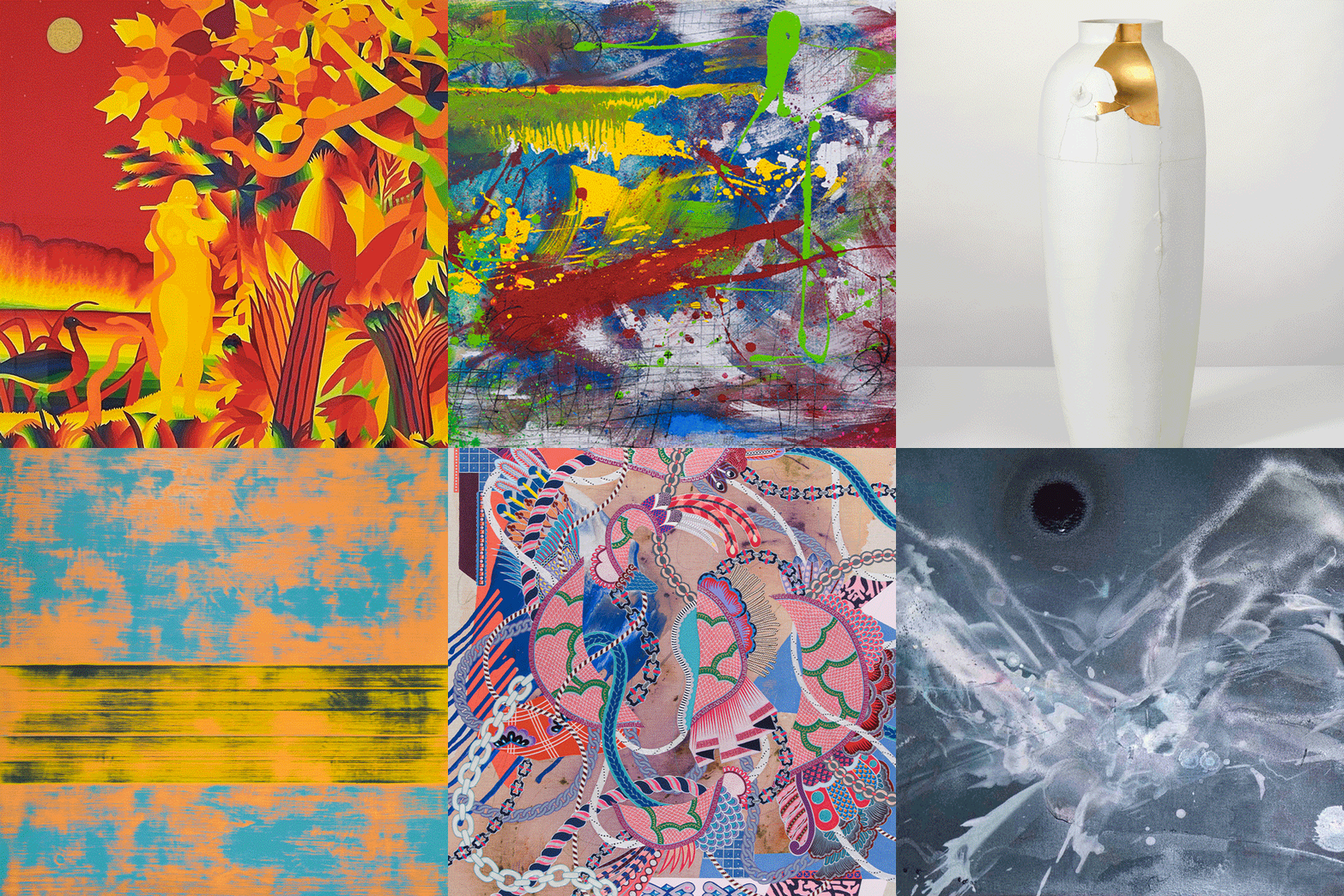
White Cube will present a work by El Anatsui from his new series at its stand for the 2026 edition of Art Basel Hong Kong. The presentation will also feature works by Antony Gormley, Cai Guo-Qiang, Beatriz Milhazes and Emmi Whitehorse, among others.
South Ho Siu Nam, Tith Kanitha, Lousy, Shinro Ohtake, Pak Sheung Chuen, Peter Robinson, Richard Serra, Santiago Sierra, Maria Taniguchi, Weng Io Wong,Young-Hae Chang Heavy Industries / CERTAINLY / Mar 20 – May 3, 2026 /
GOLD by Serakai Studio G/F Remex Centre 42 Wong Chuk Hang Road Hong Kong We – Su 12pm – 6pm
Special opening hours: Sat, Mar 21 – Sun, Mar 29, 2026 / 10am – 6pm daily Tue, Mar 24, 2026 / 10am – 11pm
“Draw a straight line and follow it.” This single directive in the artist-composer La Monte Young’s 1960 instructional work Composition 1960 # 10 is the source of inspiration for CERTAINLY, the opening exhibition of GOLD, a new Salon in Hong Kong by Serakai Studio. What appears deceptively simple quickly reveals itself as more complicated—the line wavers, resists, and deviates, exposing the friction and instability within even the clearest instruction.
La Monte Young—like his contemporaries John Cage, Nam June Paik, and Yoko Ono—blurred the boundaries between art, music, and daily life in the 1950s and 1960s, radically redefining what artistic practice could be. Their instruction-based works proposed that process, time, and lived experience were as significant as form or outcome. Over the ensuing decades, artists have taken this in different directions, opening the idea of an artwork to new forms of relationality and potentiality.
In CERTAINLY, this tension between process and outcome becomes a catalyst for experimentation, negotiating the space between structure and contingency, planning and improvisation. The exhibition brings together artists who respond—directly and obliquely—to this condition of uncertainty, treating deviation not as error but as method and as generative force.
From Richard Serra’s early experiments with molten lead and Pak Sheung Chuen’s open-ended Idea Frame (which echoes the spare logic of Fluxus instruction works), to South Ho Siu Nam’s cryptic photographs of underpasses, the exhibition gathers practices shaped by instruction, execution, and chance. Rooted in postwar artistic experiments with text-based scores and propositions, these works unfold through enactment rather than fixed form.
Across different media and approaches, yet restricted to black and white – each artist reflects on the impossibility of perfect predictions—and more generally on the creativity that emerges in the slack where systems and expectations begin to fracture. In an era increasingly shaped by algorithmic calculation, the exhibition reclaims uncertainty not as error, but as a site of agency.
CERTAINLY traces the many ways a straight line bends and falters. As the inaugural exhibition of GOLD, it establishes a curatorial trajectory committed to celebrating uncertain outcomes in the generative space between what is planned and what unexpectedly unfolds.
About GOLD
Situated in Wong Chuk Hang on the south side of Hong Kong Island, GOLD positions uncertainty not as a limitation, but as a necessary condition for cultural spaces of the future. Housed at street level in a former bank and jewellery shop, GOLD pays homage to its past while reimagining new possibilities for cultural spaces.
Combining the curatorial depth of an institution with the agility of an independent organisation, GOLD functions as a cultural test lab—part exhibition space, part concept incubator, and part gathering point for creative exchange. Through a programme that brings together surprising combinations of art, fashion, music, design, and technology, GOLD reflects Serakai Studio’s conviction that culture flourishes where creative disciplines collide.
Xyza Cruz Bacani, Chen Ronghui, Chen Ruofan, Chen Wei, Chen Xiaoyi, Gordon Cheung, Chu Yun, Mark Chung, Cui Jie, Dong Jinling, Foreign Investment, Han Qian, Joyce Ho, Ho Rui An, Hu Qingtai, Hu Yinping, Kwan Sheung Chi, Jaffa Lam, Lap-See Lam, Law Yuk Mui, Ocean Leung, Li Binyuan, Li Jinghu, Li Liao, Li Ming, Li Nu, Li Ran, Li Shuang, Li Yifan, Liao Guohe, Liu Sheng, Long Pan, Andrew Luk, Ma Qiusha, Musquiqui Chihying, Shi Qing, Sim Chi Yin, Samuel Swope, Tong Wenmin, Yang Guangnan, Zhang Ruyi, Zheng Yuan Stay Connected: Supplying the Globe Feb 27 – May 31, 2026
JC Contemporary and F Hall Tai Kwun 10 Hollywood Road Central, Hong Kong Mon – Sun, 11am – 7pm
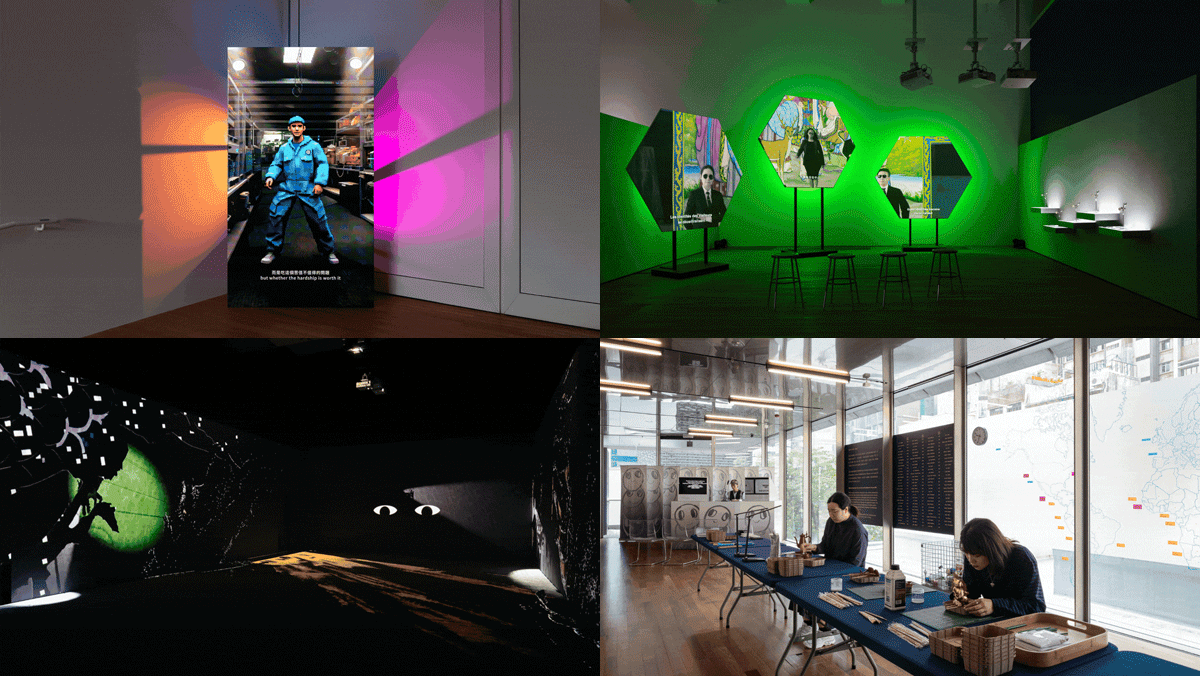
Tai Kwun Contemporary presents Stay Connected: Supplying the Globe (Feb 28 to May 31, 2026), on view across three floors of the JC Contemporary and F Hall galleries. Curated by Dr Pi Li and Ying Kwok, the second chapter of the panoramic exhibition Stay Connected: Art and China Since 2008 shifts our attention from the digital world to the material one. Anchored in the new realities created by China’s unprecedented economic growth in the last four decades, artists re-examine the country’s role as the world’s centre for the production and logistics that sustain modern life. They give insight into the individual stories, family histories and lesser- seen places impacted by globalisation and economic transformation.
Supplying the Globe showcases 40 contemporary artists working across China and internationally in a variety of nontraditional media – from installations to performance and participatory projects – to reflect on how we can overcome boundaries and divisions among dispersed people to “stay connected” in the era of rapid economic transformation. More than 70 artworks, including three commissioned works, are presented in four thematic sections that highlight subjects such as ecological footprints, depictions of labourers (including artists at work), networks of exchange and the global realignments brought by the transnational flows of people, materials and ideas.
Stay Connected: Art and China Since 2008
Beginning with Stay Connected: Navigating the Cloud (Sep 26, 2025 to Jan 4, 2026) and continuing in Stay Connected: Supplying the Globe (Feb 28 to May 31, 2026), the two chapters of Stay Connected: Art and China Since 2008 are framed through the lenses of digital technology and the manufacturing supply chain, respectively, to portray the diversity of current artistic practices. In addition to the exhibitions at JC Contemporary, the forthcoming publication Stay Connected: Art and China Since 2008was produced by Tai Kwun Contemporary and Asia Art Archive to map artistic responses to the profound social, economic and technological shifts of the twenty-first century.
As an extension of the exhibition, international forum and screening programme will take place from May 1 – 3 at Tai Kwun, with participants presenting on topics around labour, migration and history.
Learning and Engagement Programmes
Over the course of the exhibition, Tai Kwun Contemporary is organising learning and engagement programmes. Held on weekends, Guided Tours: Who’s Next? offer thoughtfully led perspectives on the exhibition by art professionals and guest contributors. Tai Kwun Family Day programmes offer tours and activities for participants aged eight and above. The Hi! & Seek corner on 2/F offers a space of dialogue and exploration about the exhibition’s themes.
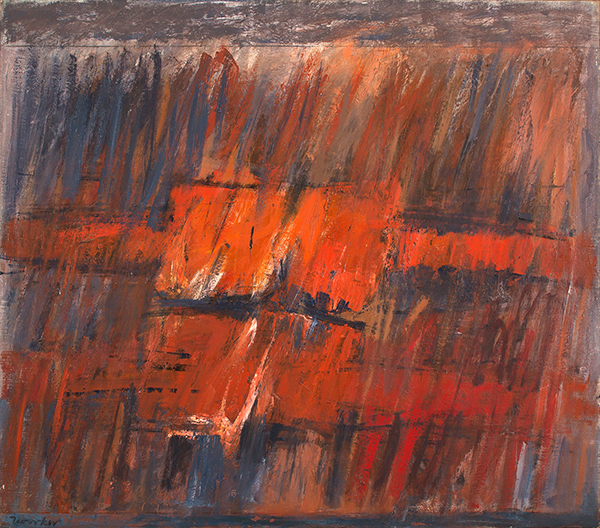
DE SARTHE is pleased to announce Jack Tworkov 1900-1982: Pioneer of Abstract Expressionism – A Survey, an exhibition of key works by the influential American painter from 1951 to 1982, organized with the support of the Estate of Jack Tworkov, Van Doren Waxter, and major US and Asian collectors. Marking this historically significant artist’s first major retrospective in Asia, the exhibition follows the evolution of his practice, characterized by the artist’s disposition toward creative fluidity and shifting identities, with a focus on the years in which he played a pioneering role in the Abstract Expressionist movement alongside peers including Willem de Kooning, Jackson Pollock, and Mark Rothko. On view from March 21st to May 9th, the exhibition offers a journey through history made via the eyes and hands of its maker.
Born in 1900 in Biała Podlaska, Russia (now Poland), Tworkov immigrated with his family to the United States in 1913. Tworkov’s oeuvre saw various transitions under the artist’s steady resolute and unique sensibility. Rooted in his diasporic upbringing, his every evolving work spanned five-decades from the early 1920s to the early 1980s and was positioned at the forefront of historic movements in American art, notably Abstract Expressionism. The late 1940s marked an important turning point in the artist’s career, as he returned to the studio after supporting the US war effort in World War II as a tool designer. The art scene in New York to which he returned had been renewed after the disruption of war. American artists broke from European influences establishing a complete creative independence emphasizing spontaneity, emotion, and universal themes. Tworkov was a leading member of this group, which has been known as the New York School of Abstract Expressionism.
Tworkov was receptive to a wide range of influences from the works of French Impressionist Paul Cézanne to the Fauves, to Homer’s Odyssey (800 B.C.E.), and much later, his own mathematical interests, Tworkov’s liberal and inquisitive visual language enriched his gestural approach to painting which would define the Abstract Expressionist movement in America.
Tworkov has an established presence in museums worldwide, including in the permanent collections of the Art Institute of Chicago (IL), The Metropolitan Museum of Art (NY), The Museum of Modern Art (NY), Solomon R. Guggenheim Museum (NY), Neue Nationalgalerie (Berlin), Tate Modern (London), and Whitney Museum of American Art (NY) among many more. Jack Tworkov’s early gallery affiliations trace the rise of post-war American art. He first exhibited at New York’s Charles Egan Gallery in 1947 and again in 1954—a space known for championing pioneers like de Kooning, Rothko, Noguchi, Bourgeois, and Rauschenberg. In the late 1950s, he showed with the influential Stable Gallery, which helped define the Abstract Expressionist movement. Beginning in 1961, Tworkov’s work was represented by the legendary Leo Castelli Gallery, cementing his place within the canon of 20th-century art. He has also been included in other major exhibitions of abstract expressionists, most notably Founders and Heirs of the New York School , a travelling exhibition that showed at the Museum of Contemporary Art, Tokyo; Miyagi Museum of Art, Sendai; and Museum of Art, Ibaraki in Japan (1997); American Vanguard for Paris, organized by the Sidney Janis for Galerie de France exhibition with artists including de Kooning, Gorky, and Pollock (1962); The Osaka Festival: International Art of a New Era: U.S.A., Japan, Europe, Osaka, Japan (1958) and New American Painting, organized by Dorothy Miller for the International Program of the Museum of Modern Art (1958) which toured to eight European venues including Kunsthalle, Basel, Museo Nacional de Arte Contemporaneo, Madrid, Stedelijk Museum, Amsterdam, Musee National d’Art Moderne, Paris, and Tate Gallery, London.
Ay-O, Soonik Kwon, Bao Pei, Ronald Ventura, Philip Colbert, Julie & Jesse, Jiang Miao, Kim Deok Han, Dai Ying, Miwa Komatsu, Kohei Kyomori, Lee Chae, Chen Yingjie / Resonance / Mar 21 – May 9, 2026 / Opening: Saturday, Mar 21, 3pm – 6pm /
Whitestone Gallery 7/F, M Place 54 Wong Chuk Hang Road Hong Kong+852 2523 8001 Tuesday – Saturday, 11am – 6pm
This March, Whitestone Gallery is proud to announce the upcoming exhibition, Resonance, featuring an exceptional lineup of contemporary artists whose distinctive styles reflect their recent achievements in the art world. The artists showcased in this exhibition are renowned for their innovative approaches and have garnered notable recognition through various institutional exhibitions, prestigious awards, and commercial collaborations.
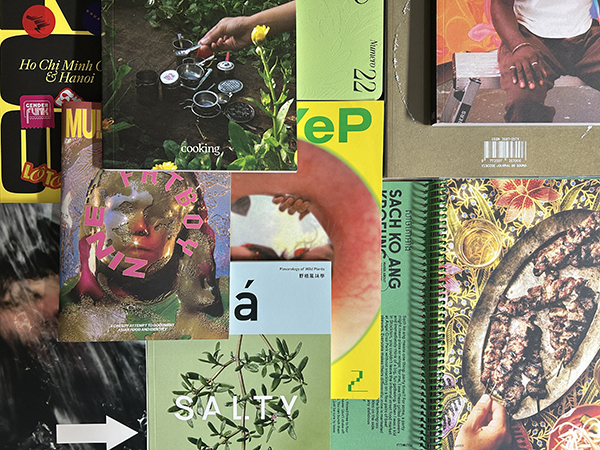
Fresh Spread is the first pop-up by Hot Source, a new shop selling and celebrating print magazines in Hong Kong. It offers a neat selection of titles from across the globe that present new perspectives on contemporary culture. The exciting line-up—including FatBoy Zine, MacGuffin, Pleasant Place, Viscose Journal, and other magazines rarely seen in Hong Kong—explores art, design, fashion, food, gardening, sound, and more.
Fresh Spread will be hosted at Noii Arthouse, Sham Shui Po in collaboration with artist and photographer Kary Kwok, who will display a selection of 70s and 80s Hong Kong fashion magazines from his personal collection. These include Hong Kong Fashions, Ladies and Home Pictorial Fortnightly, Image, Style, The Companion Pictorial, and Sister’s Pictorial. The selection highlights the archival value of print for looking at a specific moment in time.
A packed programme of cultural events including talks, life drawing, and zine-making, will bring people together and the magazines to life through the week. See the full schedule below.
Hot Source celebrates print magazines as unique sources of creativity, inspiration, and knowledge at the intersection of art and design. Well-researched, design-led, and community-driven, the titles stocked create space for multiple voices, with the intention of forging meaningful connections between readers and the world beyond our screens.
A cosy reading area will be set up for browsing, chatting, and listening to a hand-picked selection of vinyl records. You can also get your mitts on a bottle of Flagrant Yuzu Koji Hot Sauce—a Hong Kong-made condiment for your kitchen or bar.
More than a pop-up shop, Fresh Spread by Hot Source is a place for discovery and connection. It’s open for five days only so don’t miss your moment.
Fresh Spread is open by appointment; prior registration is required for opening times and events:
See below for a full schedule of opening times and events. Please note that some events require a ticket.
25 Mar 4pm – 8pm Soft Opening 7pm Introduction by Ruby Weatherall & Kary Kwok Register
26 Mar 2pm – 7pm Open 7.30pm – 9.30pm Life Drawing Class by NuDD FULLY BOOKED
27 Mar 11am – 7pm Open 4pm – 5pm Zine Launch: In conversation with HK Alien Trophy Wive$$$ Zoë Marden & Sonia Wong
Register 28 Mar 11am – 4pm Open 4–6:30pm Spreading Sauce: Recipe Sharing & Zine-making Workshop by Michelle Chan & Ruby Weatherall FULLY BOOKED
Sarah Meyohas, William Mapan, Emi Kusano, ThankYouX, Philipp Frank, Fahad Karim, Justin Aversano, Adam Martinakis, Sofia Crespo, Rebecca Allen, Ivona Tau, Defaced, Jang Yeonjeong (Forside), Aiminath Sulthana, Irem Bugdayci, Nicolas Sassoon, Mario Klingemann, Sasha Stiles, Genesis Kai, Krista Kim, Niceaunties, Vladinsky, Claire Silver, Chiara Passa, Erick Calderon (Snowfro), Operator, Botto, Stanza, Quayola, Mia Forrest, Stephan Breuer, Miguel Ripoll
Digital Art Awards 2026 Awards Ceremony: Mar 24, 2026 Private Sale Exhibition: Mar 25 – 28, 2026
Phillips Asia Headquarters GF, WKCDA Tower West Kowloon Cultural District 8 Austin Road West, Kowloon
HOFA Announces the Second Edition of the Digital Art Awards, in Collaboration with Exhibition Partner PhillipsX in Hong Kong, proudly backed by Lightyear.
Celebrating a new generation of digital artists working across generative systems, AI, immersive media and experimental formats, with winners selected by a panel of leading experts and exhibited at Phillips’ Asia headquarters in the West Kowloon Cultural District during Hong Kong Art Basel Week 2026.
The awards ceremony will take place on 24 March 2026, featuring the four key categories of Still Image, Moving Image, Innovation and Experiential and followed by a private sale exhibition hosted by Phillips in Hong Kong, from 25–28 March 2026.
As a highlight of Hong Kong’s spring art calendar, the awards celebrate the growing cultural significance of digital art and spotlights the visionary artists redefining visual culture through cutting-edge technologies.
Thirty two international finalists will be selected for their work pushing the boundaries of digital creativity. Each of the four category winners will receive a $10,000 USDC commission towards a new artwork.
The thirty two finalists include several prominent figures in digital and generative art, such as Erick Calderon (Snowfro) Founder of Art Blocks, Botto, Sarah Meyohas, William Mapan, Sasha Stiles and Mario Klingemann – underscoring the calibre of talent the awards are already attracting with over two hundred applications across more than fifty countries.
Refik Anadol is nominated for the Honorary Career Award for Sense of Healing, an AI Data Sculpture that emerges from Refik Anadol Studio’s long-term research into creating meditative art based on neurological data.
Finalists and winners will be selected by a panel of leading experts in art, hospitality and technology, including Irini Mirena Papadimitriou, Exhibitions Director at Diriyah Art Futures, Thomas Heyne, Co-Founder and CEO at Scorpios, Dorothy di Stefano, Art Curator and Creative Strategist at Molten Immersive Art, Danielle So, Hong Kong Head of Auction, Modern & Contemporary Art, Phillips, Sebastien Borget, Co-Founder & Global of The Sandbox, SANDchain, President of Blockchain Game Alliance and Co-Founder of Artverse, Jean-Michel Pailhon, Co-Founder and Chief Investment Officer at Grailcapital, Simonida Pavicevic, Co-Founder and Curator at HOFA, Justin Gilanyi, Founder of WhereArt.Works and Curator at SILK, and Matt Zhang, Founder and Managing Partner at Hivemind Capital.
The Digital Art Awards are proudly backed by Lightyear, a subsidiary of Hivemind Digital Group. A full-stack digital culture partner, Lightyear provides infrastructure, liquidity and market expertise, and hands-on delivery for digital ownership and engagement across physical and digital experiences. Lightyear is committed to championing artists and organisations pushing the boundaries of digital culture.
Caravaggio / Hong Kong Arts Festival / March 7 – 9 2026 / Grand Cultural Theatre, Hong Kong Cultural Centre /
Roberto Bolle shows no signs of slowing down. The widely celebrated Italian ballet maestro has a packed schedule this year, from performing McGregor / Maillot / Naharin at Milan’s La Scala Theatre to showcasing his contemporary ballet fusion Roberto Bolle and Friends at Verona’s iconic Arena, where he just performed as a part of the Winter Olympics closing ceremony. Next up, he’s coming to Hong Kong, where local audiences will see him essaying the titular role of the Baroque Master in Mauro Bigonzetti’s Caravaggio.
Roberto Bolle. Courtesy Hong Kong Arts Festival.
Growing up in Italy, Bolle was no stranger to Caravaggio’s art. “He’s always been one of my favourite painters and I was always fascinated and moved by his work,” says the dancer. He adds that he was particularly amazed by the three paintings on display in Rome’s Church of St Louis of the French, The Calling of Saint Matthew (1599-1600), The Inspiration of Saint Matthew (1602) and The Martyrdom of Saint Matthew (1599-1600).
Bolle was particularly fascinated by the artist’s legacy. “He influenced everyone who painted after him, and his use of light to create shadows and beauty changed the course of art history.” Caravaggio’s mark is unmistakable; the canvases reflect his patented diagonal composition, use of chiaroscuro– further pronounced through tenebrism, creating a spotlit effect– and powerful sense of drama.
The signifiers of Caravaggio’s paintings become the supporting characters in Bigonzetti’s eponymous ballet, with the roles of Light, Dark and Beauty performed by Maria Khoreva, Anastasia Matvienko and Ekaterine Surmava respectively. For Bigonzetti, the canvas spills out onto stage; Caravaggio’s theatricality is visible in the show’s sets and production, courtesy of Carlo Cerri, who is responsible for the lighting and sceneography. A large wooden frame hangs in the background, while the lighting is used not only to highlight the dancers but also to replicate the impact of Caravaggio’s paintings.
The Italian painter was also known for his tormented, at times grotesque depiction of saintly figures and heavenly beings, conveying humanity’s darker side. Bolle saw one such example at Rome’s Palazzo Barberini last year, in an exhibition featuring 24 of the baroque legend’s masterpieces. In Caravaggio’s iconic Judith Beheading Holofernes (1599), the artist paints a scene from the biblical story of Judith, who seduced and beheaded the Assyrian general Holofernes in order to save her people. While the story has been interpreted by many masters throughout art history, from Botticelli to Gentileschi, Caravaggio’s version is unusual, in that he fixated on the beheading. He astutely captures the moment when the protagonist’s knife slashes the general’s throat, blood visibly gushes out of his neck and his face squirms with anguish.
Roberto Bolle. Courtesy Hong Kong Arts Festival.
Caravaggio’s own life was as turbulent as his paintings: he was notorious for over-indulgence, anger and violence. In a particularly scandalous encounter, he apparently murdered one Ranuccio Tommasoni over a dispute and had to escape Rome in order to avoid a death sentence.
For Bolle, it was refreshing to enact a part that harnessed such violence. “There aren’t many roles that allow you to access the darkest part of yourself. Usually [I’m] always portraying very positive characters, so it’s been both interesting and challenging to play a character like him, especially because he’s so different from me.”
He adds that more than any other factor, it’s the choreography that reveals the darkest facets of the character. The tension-filled textures of his paintings, made visible by furious gestures inflicted on the canvas, translate into powerful, expressive moves that also embody much of the torment, pain and angst Caravaggio seemed to hold.
Roberto Bolle. Courtesy Hong Kong Arts Festival.
Yet it’s the softer moments in the show that are the dancer’s favourites. The first is “a very calm, tender sequence” between Caravaggio and Beauty. The second part is a male duet between Caravaggio and a man who is possibly his lover. “It’s extremely intimate and sensual, an aspect of his life that’s lesser known,” Bolle says.
The score by Bruno Moretti complements the choreography’s theatrical crescendos and decrescendos. It also sonically recreates the baroque era, with Moretti adapting the melodies of composer Claudio Monteverdi, Caravaggio’s contemporary, including excerpts from his operas L’Orfeo and The Coronation of Poppea.
Through theatrical storytelling, heightened drama and visceral tension, Bigonzetti and Bollepromise to deliver a spectacle as captivating as the canvases their Italian predecessor produced almost five centuries ago.
Pavilion / New Taipei City Art Museum / Taipei / Sep 9, 2025 – Jan 4, 2026 /
György Ligeti’s Lux Aeterna, a piece for 16-part mixed choir, is notoriously difficult for musicians and vocalists to perform. Its rhythmic subdivisions and complexities melt away the performers’ sense of traditional bar lines. Entrances are subtle, so much so that listeners aren’t meant to consciously perceive them, which means members of the choir need to maintain perfect control over pitch at extremely soft levels, gradually finding their way into micropolyphonic composition. Each of the 16 singers has a unique part, so there’s no space for error in intonation, no room for someone else to pick up the slack.
The result is a piece of music that feels alien to ears more accustomed to conventional tastes. It’s downright hallucinatory. Most people know Lux Aeterna through Stanley Kubrick’s cinematic treatment of it in 2001: A Space Odyssey, in which the track sculpts an air of mystery around a monolith – a rectangular black slab of non-human origin.
Archive zone of THINK. Photo: Chu Chi-hung. Courtesy Kiang Malingue and NTCAM.
That’s precisely what walking into Samson Young’s Pavilion (2025) feels like. A new commission made by the artist for the New Taipei City Art Museum, Pavilion was a 28-minute-long, multi-channel sound and video installation that occupied a cavernous gallery. Young drew inspiration from Kubrick’s film as well as THINK, a multi-screen film produced by Charles and Ray Eames for IBM at the 1964-65 New York World’s Fair.
It’s easy to get lost in the spectacle of Pavilion. Seven massive screens overhead play a mishmash of news archive footage, clips from sports matches (maybe football, maybe something else) and automotive races, scenes from US President Lyndon B Johnson’s inauguration in 1965 and the 1964 Olympics, images of lenses, smart streetlamps and cabinets of curiosities, shots from the New York World’s Fair itself and more. All of this is heavily edited or generated using artificial intelligence tools, with glimpses of the Taipei Male Choir spliced in. The singers perform new choral arrangements devised by Young, who drew on classical requiems.
Installation view of Pavilion by Samson Young at New Taipei City Art Museum, 2025. Photo: Chu Chi-hung. Courtesy Kiang Malingue and NTCAM.
THINK was shown to the public at a time of techno-optimism. The Space Race, for instance, was in full swing, fuelling a sense of limitless human ingenuity that could take us to new frontiers. Here on Earth, Nobel laureate and AI pioneer Herbert A Simon declared in 1965 that “machines will be capable, in 20 years, of doing any work a man can do.” The Eameses’ film was a 10-minute production that captured similar themes. It needed 22 screens for its full presentation about how computers could be used to process information and solve problems. The purpose was to demystify this new piece of technology and make it feel accessible.
That’s hardly the mood in 2025. Pavilion is a gorgeous piece of work, never risking detours into the sloppish imagery that so many of us have developed an aversion to over the past year or two. Young’s use of AI-generated imagery makes his message cryptic but the result is instinctively coherent. Layer in the choir’s arrangement and the experience of Pavilion initially feels like something to be revered, even in awe of. The pair of spherical 3D-printed speakers that emit the choir’s skilful intoning – one in all black, the other a motley of purple, green and orange panels, both with tiny LCD screens embedded and running custom software – even become easy to miss amid the splendour.
Despite the veneer of sanctified beauty that envelops the viewer, contemporary techno-pessimism is a constant undercurrent. Archival footage only serves as a reminder that the bright future once envisioned by the Eameses and their patrons never came to fruition, and current developments point to inequality, loss of agency, even decline. Perhaps that’s what we’re meant to mourn in this requiem – a radiant vision shaped by brilliant minds that was never truly meant to be.
Installation view of Pavilion by Samson Young at New Taipei City Art Museum, 2025. Photo: Chu Chi-hung. Courtesy Kiang Malingue and NTCAM.
Young presented a second work in the show, with Variations of 96 Chords in Space (2023/25) reworked as a companion to Pavilion. Spread across six screens, the installation is an exploration in probability expressed in audiovisual form. Every “variation” is associated with a specific Pantone, its chord expressed through a viola, a self-playing piano, crotales – tuned metal discs – and the trickling and splashing of water from a small fountain within a Tibetan singing bowl. Some or all of these elements are activated in each clip, and a computer program arranges them to finally form the “colour chords”.
This work didn’t have the same currency or heft as Pavilion, and felt like an addendum or afterthought. But it was intricate, well-designed and again gorgeous. A few moments spent with Young’s colour chords might just be the right transition before we are dislodged back into New Taipei.
展亭 新北市美術館 台北 2025年9月9日至2026年1月4日
György Ligeti 的《Lux Aeterna》是一首由16聲部混聲合唱的作品,以其極高演奏難度聞名。其節奏的分節和複雜性打破了演奏者對傳統小節線的認知。聲部的進入時機非常微妙,讓聽眾難以察覺。這意味著合唱團成員必須在極為輕柔的音量下保持完美的音準,逐步融入這首多聲部作品。16位歌手有各自獨特的部分,因此表演不能有任何失誤,也沒有讓其他人可以挽救的空間。
這正是走進楊嘉輝的《展亭》(2025年)時的感覺。這件由楊嘉輝為新北市美術館創作的新作品《展亭》,是一個28分鐘的多頻道影像聲音裝置,放置在一個巨大的展廳中展出。楊嘉輝的創作靈感來自於寇比力克的電影,以及Charles Eames和Ray Eames為 IBM 在1964-65年紐約世界博覽會製作的多螢幕影像作品《THINK》。
《THINK》這部影片在科技樂觀主義盛行的時代面世。當時的太空競賽競爭激烈,激發了大眾對人類無窮創意的信心,相信我們可以突破極限。在1965年,諾貝爾獎得主、人工智能先驅Herbert A Simon曾說:「20年內,機器能做任何人類能夠做的工作。」Eames夫婦製作的這部10分鐘的影片也表達了相似的主旨。這部影片用了22個螢幕完整呈現電腦如何處理資訊和解決問題,目的是為撇開這種新技術的神秘感,使其更易於被大眾理解和使用。