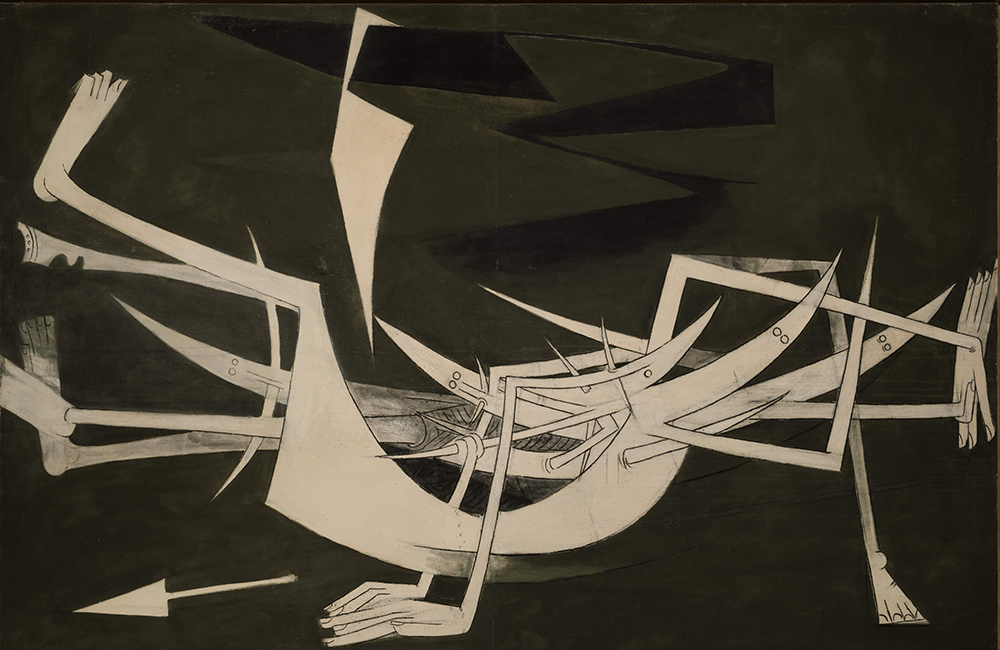
Wifredo Lam, the modernist Cuban painter of Cantonese and African descent, has finally got his first ever retrospective in Hong Kong, a beautiful exhibition at the Asia Society by the name of Homecoming.
Faced with such an interesting, deeply original artist, it may seem slightly reductive to start from his biography – but his practice is so deeply rooted in it, and the cultural background he draws from is so unusual, that it is impossible to start from anywhere else. Lam’s complex personal history is given its rightful space in the Asia Society exhibition, with detailed descriptions of his parents and their heritage, supported by a vast archive of photographic material. His paintings and drawings are on view, from his early works of portraiture as a young art student to large oil or tempera canvases featuring his signature mythical figures, taken from African religious traditions and his own imagination, with a lingering, subtle Chinese aesthetic; along with his later works, dedicated to printing and etching, in which his distinctive vision is stripped down to its most essential elements.

Collection of Daniel Boulakia. Courtesy Asia Society Hong Kong.
The show is called Homecoming precisely because of Lam’s rare cultural background: born in Cuba on December 8, 1902, he owed his Cantonese family name to his father Yam Lam, a carpenter from Guangdong who had emigrated to Cuba. His African roots came from his mother, Ana Serafina Castilla, of Spanish and Congolese origins. They lived in Sagua La Grande, where Wifredo was born (his full name is Wifredo Óscar de la Concepción Lam y Castilla: he should have been Wilfredo but a transcription error meant he had a unique name). Sagua La Grande is on the north coast of Cuba, a sugar-producing province that hosted a lot of immigrant labourers, some from China.
As Yam Lam was one of the few literate people in the Chinese community, he used this skill to write letters for others, who could then send news of their lives back home to China. It is a detail that is not without consequence in Wifredo Lam’s aesthetics: his later work, in particular, when he started to dedicate a lot of time to prints and engravings, shows a strong awareness of the empty space, one of the pillars of Chinese paintings, and brushstrokes that hint at Chinese calligraphy and its strong emotional expressiveness.

Collection of Cynthia Hang.
Former collection of Gabriel Garcia Marquez. Courtesy Asia Society Hong Kong.
His African heritage side is also prominent, as he consistently explores images of figures inspired by traditional West-Central African religions, which were brought over to the Americas by enslaved people. This tradition is expressed in a wide range of beliefs and practices, linked by a common ancestry. They include the Brazilian cult of the orixas – divine spirits linked to the forces of nature, mostly from the Yoruba tradition in today’s Nigeria, which have merged with Catholic holy figures – in the Candomblé religion; the Haitian cult of Voodoo, or Vodun, which also unites the Catholic pantheon of saints with spiritual and magical practices from Benin, Ghana, Togo and Nigeria; and the Cuban Santería, again fusing Yoruba ancestry and Christian elements. They are also deeply informed by the animistic beliefs of the Bakongo people, from the pre-colonial Congo basin, who venerated Nzambi Mpungu, the creator of the universe, and his female counterpart, Nzambici, while practising an ancestor cult. The list of African beliefs that were transported to the Americas by those taken there by force is too long to list here, but it is one of the main components spurring a vast and pervasive spiritual creativity – an ancestral inspiration that influenced Lam in a profound way.
In 1916, he enrolled in the Escuela Professional de Pintura y Escultura (Professional School of Painting and Sculpture) in Havana, and his first paintings were shown in the Fine Arts Salon of Havana. Some of his early portraits were on display at the Asia Society, showing a very delicate pencil, capable of conveying his subjects’ personalities with great sensitivity, like in the sketch of his father Portrait of Yam Lam (1922) and his Autoportrait (1923 and 1944).

Private Collection. Courtesy Asia Society Hong Kong.
In 1923, he was the beneficiary of a grant that took him to the Royal Academy of Fine Arts in Madrid, where he was guided by Fernando Álvarez de Sotomayor, the director of the Prado Museum. Looking for a more modern approach to art, he also followed Julio Moisés at the Escuela Libre de Paisaje (Free School of Landscape). He stayed in Spain for more than 10 years, at a highly volatile political time, which made him choose to join the armed struggle on the Republican side, picking up arms against fascism in 1936. Poisoned by the chemicals he was handling as a fighter, he found himself recovering in a clinic near Barcelona, where his life changed: introduced by another artist to Picasso through a letter, Lam decided to leave for Paris upon recovering, where he became part of the circle of artists featuring Matisse, Braque, Miró and Picasso himself, together with poets such as Tristan Tzara and Paul Éluard. From statements from both Lam and Picasso, the connection was immediate and intense.
The African heritage that Picasso was exploring, not without a strong attraction for the exotic other, was also part of Lam’s aesthetic quest, but seeing photos of Lam surrounded by African masks and sculptures does indeed feel very different from similar photos of Picasso surrounded by the same objects. It was a personal trajectory in search of his own roots and influences for Lam, but an omnivorous curiosity for Picasso.

Collection of Daniel Boulakia Courtesy Asia Society Hong Kong.
It was during his stay in Paris (1938-40) that Lam shifted his artistic production significantly, moving from a more realistic approach to his drawings and paintings to a full-blown modernist study of the human body – visible in paintings such as La Lettre III (1939), depicting a naked Black woman crying with a letter folded over one of her breasts, her face similar to an African mask, her arms contorted in a painful gesture. A pale azure background, with very visible brushstrokes, makes the naked figure’s pain even more eternal and immobile, like that of a statue. Or there’s Jeune Fille Sur Fond Vert Foncé (Young Woman on a Dark Green Background, 1940), in which a woman with an African mask-like face, painted in dark grey, is staring ahead, with square shoulders and small black breasts, a fixed expression that nearly melts into the dark background, forcing us to stare at her more intently, as if trying to rescue her from being absorbed into it.
After the German invasion of France make him decide to move back to Cuba, his own unique style gradually emerged. In Cuba, his practice met head on the syncretic religion of those who, like his own mother, had to reconcile their own spirituality with the forced physical and psychological displacement caused by the brutality of enslavement. And it is here that the character of the Woman Horse started to appear, in paintings and engravings that combine a descriptive element, where we can identify some unusual creatures, mythological beings that meet on the canvas in mysterious and mesmerising dances, and a semi-abstract quality to the body shapes Lam chose to give his creatures.
Once back in his home country, immersed in both the lush, abundant tropical nature and the unjustifiable poverty in which so many of his countryfolk are shackled, his more political side once again came to the fore. The exhibition quotes him from this time, saying: “I wanted with all my heart to paint the drama of my country but by thoroughly expressing the Negro spirit, the beauty of the plastic art of the blacks. In this way I could act as a Trojan horse that would spew forth hallucinating figures with the power to surprise, to disturb the dreams of the exploiters.”
The painting The Jungle (1942) depicts a host of tightly packed, elongated figures, hybrid beings half human and half supernatural, some with African masks, some with large breasts or protruding bottoms, in a green, dark yellow and orange palette. It is arguably his best-known work and the one from which all his successive esoteric figures are born. Some of the more striking examples from this time at the show are Femme avec Oiseau (Woman with Bird, 1949), an oil-on-canvas painting in which a seated woman painted in white and grey, with a head resembling that of a stylised horse mixed with a warrior helmet, long black hair floating over the back of the chair, holds a white bird with her open hand, long fingers spreading out, emphasising the lightness of her grip. Or Untitiled (1950), another oil-on-canvas in shades of grey, in which a surreal figure, made feminine by two perky breasts, is sitting majestically on a bench. Both images draw in the viewer with a slight sense of disquiet and incantation: these are clearly supernatural, probably divine women or mediums that have entered into contact with the other world, and that reflect back to us the all too limited possibility of us even getting close to understanding the world of the gods.
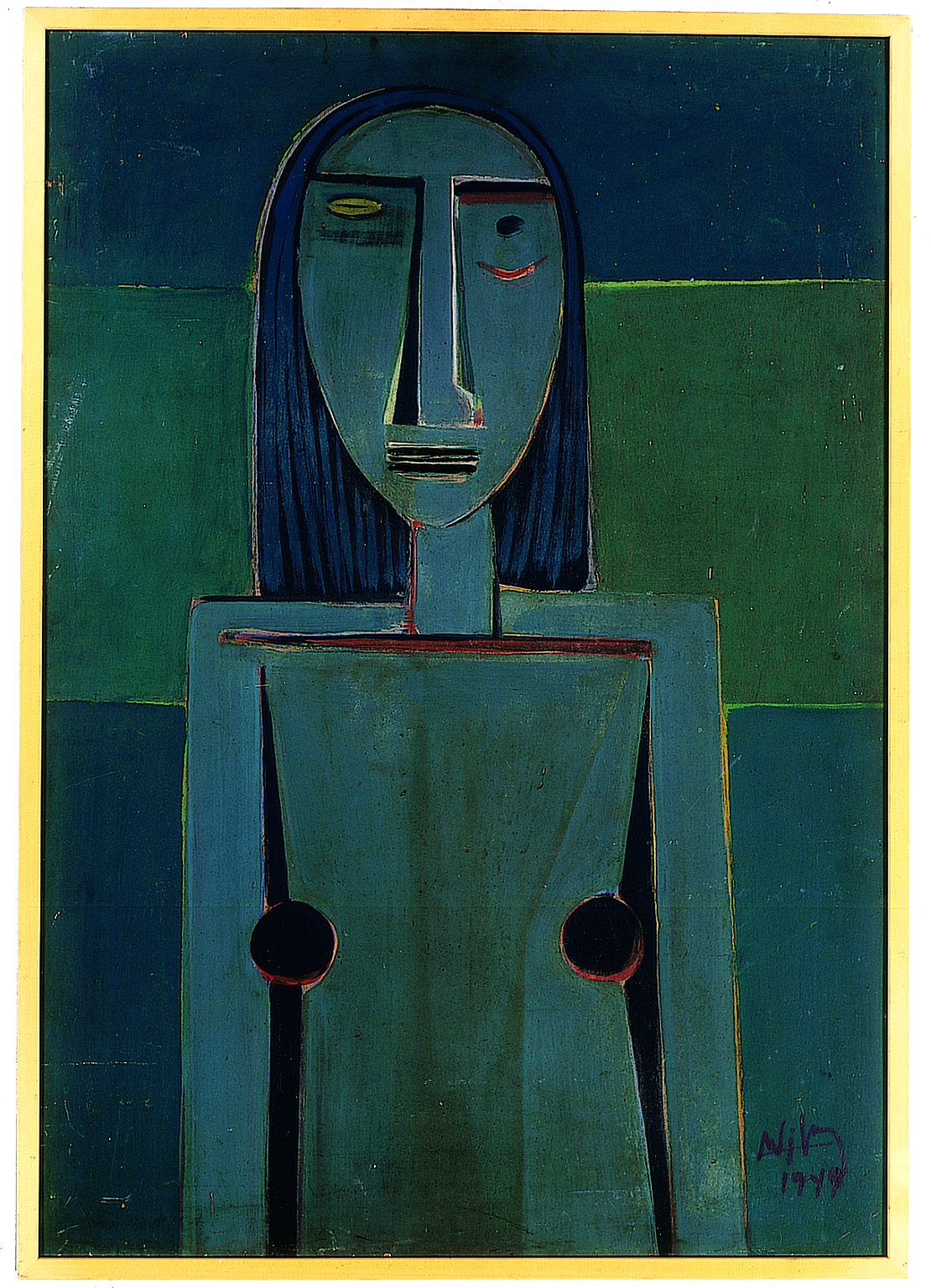
Private Collection. Courtesy Asia Society Hong Kong.
From this time onward, Lam found his own artistic footing, one in which he pursued a close relationship with African divinities and poetry, engagement in local politics and solo shows through Latin America, the United States and, after the war, also Europe. In 1946, while holding a solo show in Port au Prince, Haiti, he also attended a Voodoo ceremony, together with the French surrealist poet André Breton and French writer and surgeon Pierre Mabille. Meanwhile, his collection of African art kept expanding and his understanding of African mystical traditions deepened. He moved back to Europe in 1952 and, while travelling frequently, spent the rest of his life based there.
Lam kept painting mythical creatures, like the bird in Coq Caraïbe (Caribbean Chicken, 1970), which is once more in his go-to grey palette, interrupted by details in red and just a hint of yellow. Here, what could be a rooster is represented with the characteristic stylised horse head. There is no tension in the painting showing any kind of movement. Seemingly a connecting presence between this world and the supernatural, it is indifferent to its surroundings and, most of all, the viewer. It’s like a strange totem whose gaze we cannot intercept, painted in that synthesis between abstraction and figurative representation that makes Lam’s works so recognisable.
In 1957, Lam established a connection to Italy, which was to last the rest of his life, by becoming attached to the small coastal town of Albissola, Liguria, where he bought a house and established a studio, collaborating with Giorgio Upiglio (1932-2013), an art printer and publisher with whom he published the book Apostroph’Apocalypse (1966), with poetic text by poet Gherasim Luca and etchings by Lam. Many examples of this collaboration are on show at the Asia Society, like the series Contre Une Maison Sèche (Against a Dry House, 1974), in which the mesmerising creatures, part human and part bird, horse, snake and other, unidentifiable animals, float against an empty background – dark grey, black and reddish figures traced with very sharp contours over pale-yellow paper. Sometimes the contrast is made just a little softer by a spray of colour around the mythological creatures, in red, yellow or orange, enhancing the feeling of a dreamlike vision.
Lam died in Paris in 1982, having held more than 100 personal exhibitions. This, his first in Hong Kong, places the Chinese diaspora and their descendants in a seductive loop of global interconnectedness and unexpected continuity.
Featured image: À trois centimètres de la terre by Wifredo Lam, Oil on canvas, 1962. Private Collection. Courtesy of Rosaline Wong and HomeArt. Courtesy Asia Society Hong Kong.
香港終於展出具廣東和非洲血統的古巴現代主義畫家林飛龍的首個回顧展。這個美麗的展覽「歸徒」假亞洲協會舉辦。
從簡歷開始介紹一位如此有趣和獨具創意的藝術家,也許有點平凡,但是他的風格與其個人經歷息息相關,而且他創作的文化背景如此特別,實在不可能從其他地方入手介紹。亞洲協會的這次展覽充分介紹了林飛龍複雜的個人經歷,包括他的父母的詳細資料和他們的血脈和背景,並有大量相片。展出的畫作既有他早期還是年輕藝術學生時畫的畫像,亦有大型油畫或蛋彩畫,展示他所繪畫的代表性神話人物,作品取材自非洲宗教傳統及他的個人想像,融入了若隱若現的中式美學。展覽也展示了他後期的作品,主要是印刷畫和刻版畫,作品簡約至只用重點元素表達他獨特的觀點。
這次展覽命名為「歸徒」是因為林飛龍罕見的文化背景:他在1902年12 月8日生於古巴,他的中文名字來自他的父親林顏。林顏是一名來自廣東的木匠,後來移民古巴。林飛龍的非洲血統則來自他西班牙與剛果混血的母親Ana Serafina Castilla。他們住在大薩瓜,這裡也是林飛龍出生的地方 (他的全名是Wifredo Óscar de la Concepción Lam y Castilla:他本來應叫Wilfredo但是轉錄錯誤讓他得了一個特別的名字)。大薩瓜位於古巴的北岸,是一個有很多移民勞工主要製糖的省,有些移民勞工來自中國。
由於林顏是當地華僑社群中少數識字的人,他運用自己的能力幫人代筆寫信回中國。這細節對林飛龍的美學並非毫無影響:在他後期的作品,尤其是當他開始集中創作印刷畫和刻版畫時,他對空白空間有很強烈的意識,而這亦是中國畫中其中一樣重要元素。他的筆觸亦有中國書法的影子和情感表達。
林飛龍的非洲血統也很突出,因為他持續探索受傳統中西部非洲宗教影響的人物圖像,這些圖像由被奴役的非洲人帶到美洲。這種傳統受共同祖先連繫著,可以透過各種信仰和習俗看到,包括崇尚orixas的巴西宗教。Orixas是指與大自然力量有關的神靈,大多來自當今為尼日利亞的約魯巴傳統文化,祂們與羅馬天主教中的聖者融合;還有海地宗教巫毒教或巫毒,他們把天主教的聖人與貝寧、加納多哥和尼日利亞的靈性和魔法習俗結合;古巴的薩泰裡阿教也一樣是融合約魯巴文化和基督教元素。他們也深受來自殖民前的剛果盆地的巴孔戈人的萬物有靈論影響,在追崇祖先的宗教的同時,他們崇拜宇宙的創造者Nzambi Mpungu和他的女性伴侶 Nzambici。被暴力帶走的非洲人帶到美洲的信仰太多,無法在此一一列舉,但它是激發巨大而擴散的精神創造力的主要元素之一──這種祖傳的靈感對林飛龍產生了深遠的影響。
在1916年,林飛龍註冊入讀夏灣拿的繪畫及雕塑專業學院,他的首批畫掛在夏灣拿的Fine Arts Salon。是次亞洲協會展覽展出其他部份早期的畫像,展現了他精細的筆觸,非常細膩地表現出主角的性格,就像他父親的畫像《Portrait of Yam Lam》(1922年) 和他的自畫像《Autoportrait》(1923 及1944年)。
在1923年,他獲補助金資助到馬德里的皇家美術學院學習。他在那裡得到普拉多博物館的總監Fernando Álvarez de Sotomayor的指導。為了學習更現代的藝術技巧,他也有拜師景觀自由學院的Julio Moisés。他在西班牙政局非常動盪時在當地居住逾10年,因此他選擇加入共和軍的武裝鬥爭組織,在1936年對抗法西斯主義。在抗爭時他因為自己負責的化學物質而中毒,被送到巴塞隆納的一間診所醫治。他的人生從此改變:另一位藝術家寫信把他介紹給畢卡索,所以林飛龍決定康復後就決定到巴黎,成為了馬蒂斯、布拉克、米羅和畢卡索這群藝術家的一份子,還認識了一些詩人如Tristan Tzara 和Paul Éluard。從林飛龍和畢卡索的文件中可見他們的友誼建立得快速且緊密。
畢卡索當時探討的非洲傳統,固然與他被異類他者吸引不無關係,但是該傳統亦是林飛龍的其中一項美學追求。可是看著林飛龍被非洲面具和雕像包圍的感覺與畢卡索置身於類似的環境十分不同。林飛龍是在尋找自己的根和影響,但畢卡索則是出自其通殺一切的好奇心。
生活在巴黎時(1938-40年),林飛龍明顯地轉移了他的藝術創作重心,從比較現實的繪畫風格完全轉移到對人體的現代主義研究,。此轉變可見於《La Lettre III》(1939年),畫中一名裸體黑人女子在哭,胸前有一封摺疊起的信,她的臉恍似非洲面具,雙臂扭曲成疼痛的姿勢。背景是一片淺藍色,可以看到明顯的筆觸,令那裸體人物的痛楚顯得更綿長靜寂,就像一個雕像。在另一幅作品《Jeune Fille Sur Fond Vert Foncé》(深綠色背景中的年輕女子, 1940年)中,一個有著類似非洲面具面容的女子,滿臉塗成了深灰色,凝視著前方。她有方肩和細小的黑色乳房,幾乎要融入深色的背景之中,逼使我們盯著她看,就好像在嘗試拯救她不要被吸入背景之中。
法國被德國入侵後,林飛龍決定搬回古巴,他獨特的個人風格亦開始慢慢展現。在古巴,很多人要透過宗教的融合去修復因殘忍的奴隸制而受創的身體和心靈,而林飛龍的風格與這種文化相撞。這亦是Woman Horse的角色開始出現在畫和雕塑中的時候,加上描述性元素,我們可以發現一些不常見的生物和神話人物在畫布上跳著神秘而令人著迷的舞蹈,還有林飛龍賦予它們的半抽象身軀。
回國後,他就沉浸在青蔥富饒的熱帶自然和束縛著他同鄉的不公貧窮之中。他政治的一面又浮上了水面。這次展覽引用了他當時的一句話:「我全心想把我的國家的故事畫出來,但是我想用黑人的精神把它們徹徹底底地表達出來,黑人塑膠藝術的美。這樣,我就可以扮成特洛伊木馬製造出虛幻的人物去突襲和干擾剝削者的夢。」
畫作《The Jungle》(1942年)描繪了一群擠逼、拉長的人物,他們半是人半是超自然生物,有些戴著非洲面具,有些有大乳房或者突出的屁股,作品的色調是綠、深黃和橙色。這可以說是他最著名的作品和一系列奇特角色的起始。展覽上在這個時期創作的作品中更衝擊的例子有《Femme avec Oiseau》(女子與鳥,1949年)。這幅油畫中用白灰色畫了一名坐著的女子,非寫實的馬頭上戴著戰士的頭盔,黑色的長髮披在椅背上,她打開的手掌上有一隻白鳥,長指張開,顯示了她輕柔的握力。或是在另一幅灰色油畫《Untitiled》(1950年)中描繪了一名超現實的人物,兩個堅挺的乳房說明她是女性,她莊嚴地坐在一張長椅上。兩幅作品微微的不安和靈異感吸引著觀眾:這些明顯屬於超自然,也許是神聖的女子和媒介進入了另一個世界,然後反映出我們對神的世界的認識是多麼的有限。
從這個時期開始,林飛龍就找到了他的藝術立足點,他追求與非洲神明和詩詞更接近的關係,參與拉丁美洲、美國和戰後的歐洲的本地政治和個人展。在1946年,當他在海地的太子港舉辦個展時,他與法國超現實主義詩人André Breton和法國作家及外醫生Pierre Mabille參與了一場巫毒教慶典。與此同時,他的非洲藝術品收藏持續增加,他對非洲神秘傳統的了解也加深了。他在1952年搬回歐洲,雖然其間頻繁地旅遊,他餘生都是住在歐洲。
林飛龍一直在畫神秘生物,像是《Coq Caraïbe》中的鳥(加勒比海的雞, 1970年)。這幅畫又一次是以灰色為基調,穿插著紅色的細節和一點點的黃色。這裡,公雞的頭是一個非寫實的馬頭。畫中沒有任何張力顯示任何動作。恍似連起了這個世界和超自然的世界,它對身邊的一切甚或是觀眾都漠然以對。這就像是一個奇怪的圖騰而我們不能打斷它的凝視,它介乎抽象和比喻之間,這亦是林飛龍的作品與別不同的地方。
1957年,林飛龍在意大利海邊小鎮利古里亞大區的阿爾比索拉馬里納落地,此後在當地生根。他在該處買房子和建立了一間工作室,與藝術印刷師及出版商Giorgio Upiglio (1932-2013年)合作發表了他的書《Apostroph’Apocalypse》(1966年)。書中的詩詞是詩人Gherasim Luca的作品,刻版畫則是林飛龍的作品。該次合作中多項作品都於亞洲協會的展覽上展出,例如《Contre Une Maison Sèche》(對抗一間乾房子, 1974年)系列,畫中迷人的生物一半是人,另一半是鳥、是馬、是蛇或其他不明生物,在空洞的背景中飄浮──深綠、黑和紅色的人物在淡黃色的紙上都有非常銳利的輪廓。有時候又會在神話生物的周圍噴灑上一點紅、黃或橙色讓對比顯得柔和一點,營造出夢幻的感覺。
林飛龍1982年於巴黎逝世,生前在當地舉辦了逾100次個人展覽。這次在香港的首個展覽,把華僑和他們的後代放置在一個引人入勝的循環,在世界互聯性和意想不到的延續中周而復始。