Park Solo /
Hong Kong Visual Arts Centre /
Mar 13 – Sep 16, 2024 /
Debe Sham’s exhibition Park Solo, at the Hong Kong Visual Arts Centre, is spread throughout all five floors of this singularly shaped venue, and is best viewed by going down the stairs from the fifth floor all the way to the first – which opens onto Hong Kong Park’s children games precinct, a charming echo of some of the sculptures on display.
The first works the visitor encounters on entering the building are Windmills (xx),a series of gold-plated, spiky, stainless-steel circles. “My inspiration for these comes from the colourful paper windmills people buy at temples during Lunar New Year for good fortune, called fongche. I find that this is a traditional Hong Kong shape that is quite overlooked. They are very characteristic and very beautiful,” says Sham. Like windmills, these golden, minimalistic fongche spin when touched or when the wind coming through the door is strong enough.
As this first encounter makes clear, Sham’s practice is highly informed by play and the shape it takes in Hong Kong. The sculptures she is most recognised for involve the soldering of golden metal around little dolls, animals, whistles or the white and red plastic balls that used to be a common children’s toy when Hong Kong was the leader in production of plastic products.
She has expanded on the idea of play for this show, and on the idea of the rules of the games we play: “These rules are restrictions, of course, and they force our creativity to develop in spite of them, so it can be an interesting exercise,” she says. That play has multiple forms is also explicitly stated in the caption to the Windmills, where Sham observes that “play involves real objects which fantasy transforms into playthings”.
Sham, Hong Kong born and educated, then goes further in this play-quest, restaging the urban street games that we can see in most Hong Kong housing estates and public parks: the sculptural installation called See-Saw (xx) allows the viewer to sit on one half of a classic see-saw, but instead of having another person sitting on the opposite seat, here the viewer is in front of a mirror. From the handle comes a recording, with greetings and short sentences left by people who have previously played with this self-mirroring toy.

Courtesy the artist and Hong Kong Visual Arts Centre.
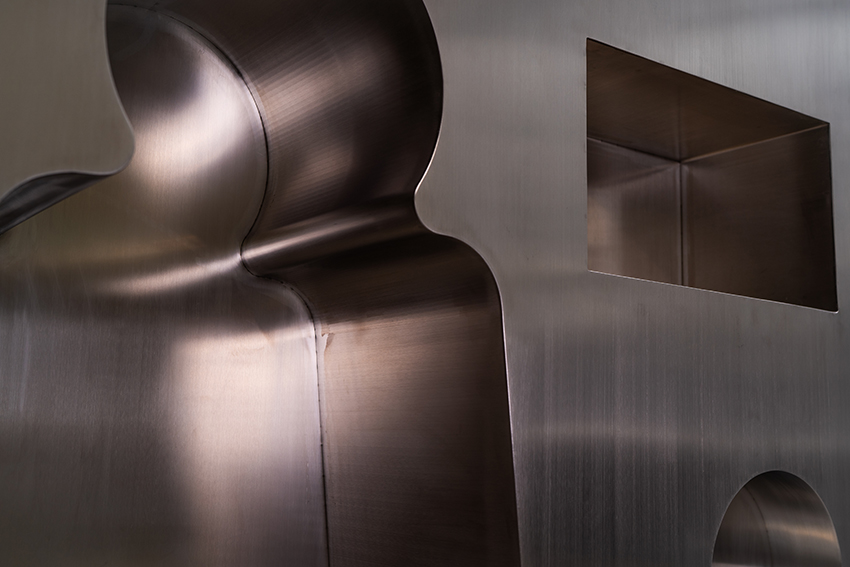
In this show, the soldering and metalwork that Sham engages in are heavier than her signature ethereal sculptures with plastic toys: in her piece If X Is Not A Perfect Player (xx), she has created a kind of noughts-and-crosses tool by installing two long metal handles on a sand bed, one ending with an X and the other with an O, so those letters can easily be stamped on the sand. In Case (xx) literally consists of a large metal case in which visitors can encase themselves and their possessions: the metal form comprises several nooks, one in the shape and size of a human, and others in those of bags, umbrella and other belongings.
In order to create the larger metal pieces, Sham has befriended welders in Hong Kong and Shenzhen, and taught herself how to solder and weld through observation and experimentation. Interactivity has an important role in this show, partially as a response to the inaccessibility of most public art in Hong Kong, but also thanks to the particular structure of the exhibition space at the HKVAC, where Sham has used the walls and the small openings and crannies along the stairs.
This curiosity about playfulness, toys, games and their rules is also addressed in more intimate ways. Once Sham started working within the venue and planning which works to produce and exhibit, she decided to ask the staff and students at HKVAC for their personal stories, through three questions: do you believe in magic? What is your most memorable toy? What is play to you? She turned the 15 sets of answers she obtained into pictures – featuring a teddy bear, a heart-shaped lucky charm, a toy kitchen and so on – and into a recording that can be listened to under headphones.
Play is looked at from every possible angle: the restricted one of imposed rules, the lightweight joy given by the whimsical windmills, the heavy reproduction of common playground pastimes – all of them turned into questioning objects that reflect the player and their memories.
Featured image: In Case by Debe Sham, 2024. Courtesy the artist and Hong Kong Visual Arts Centre.
自在公園
香港視覺藝術中心
2024年3月13日至9月16日
岑愷怡的展覽「自在公園」假香港視覺藝術中心舉行。展覽在這幢外型獨樹一幟的建築物的一樓至五樓展出,建議從五樓沿著樓梯一層一層走到一樓觀賞,與一樓連接的香港公園兒童遊樂場亦與展覽中的部份展品相互呼應。
觀眾進入大樓後第一件看到的作品是《風車》(xx年),是一系列滿是尖刺的渡金不鏽鋼圓圈。岑愷怡說;「我的靈感來自人們在農曆新年時為了求好運在廟裡買的彩色紙風車。它們就是叫『風車』。我發現這是一個常被忽視的香港傳統圖形。它們非常有特色和漂亮。」如果觸碰這些簡約的金色「風車」或是有大風從門口吹進來,這些「風車」便會像真正的風車一樣轉動。
這件觀眾第一眼便會看到的作品說明了岑愷怡的風格與遊戲和香港的代表圖形密切相關。她最為人熟悉的雕塑作品就是用金色的金屬焊接小人偶、動物、哨子或曾在香港領先塑膠製品時代時深受孩童歡迎的玩具紅白塑膠球。
岑愷怡在展覽中擴展了玩樂的定義和遊戲的規則,她指出:「這些規則當然是限制,它們迫使我們在框架下發展我們的創意,這是一個一項十分有趣的活動。」遊戲有多種形式,就如作品《風車》的介紹文字中所寫,岑愷怡認為「玩樂包括將幻想轉換成實質玩具。」
岑愷怡在香港出生和受教育,她之後探索遊戲,重現常見於香港屋邨和公共公園的本土街道遊戲:雕塑裝置《See-Saw》(xx年)讓觀眾可以坐在一個經典蹺蹺板的一邊,但另一邊卻不是讓另一人坐,而是一面面向觀眾的鏡。把手位置是一個錄音裝置,錄下了之前曾玩過這個照出自己的玩具的人留下的問候和短句。
在是次展覽中,岑愷怡所用的焊料和金屬比她代表性的塑膠玩具製輕雕塑更重:在她的作品《如果X不是個完美的選手》(xx年)中,她創作了一個類似井字過三關遊戲的工具,她在一張沙床上安裝了兩支長金屬把手,一支的尾端是一個X字,另一支是O字,兩個字母可以輕易印在沙子上。作品《In Case》(xx年)就如名字般是一個大型金屬殼,觀眾和他們的物品可以嵌入其中:金屬殼中有幾個凹陷位置,其中一個是人的形狀和大小,其他則是手袋、雨傘和其他物品的形狀。
為了製作大型金屬作品,岑愷怡結識香港和深圳焊工,她亦透過觀察和試驗學會了焊接。互動是這次展覽一個重要的元素,某程度上也是對香港公共藝術難以接觸的回應。多虧了香港視覺藝術中心的特殊設計,岑愷怡可以利用牆、窄小的入口和樓梯的縫隙創作。
岑愷怡用更親密的方式表達她對玩樂、玩具、遊戲和它們的規則的好奇。當她開始在場地工作和計劃製作及展出什麼作品時,她決定問香港視覺藝術中心的員工和學生三個關於他們個人故事的問題:你是否相信魔法?你印象最深刻的玩具是什麼?對你來說玩樂是什麼?她之後將收集到的15組答案轉化為圖像──展示了一隻泰迪熊、一個心型幸運符、一個玩具廚房等等──和一段可以用耳機聆聽的錄音。
展覽從多個不同角度探討玩樂:受規則限制的遊戲、奇幻的風車帶來的簡單歡樂、經繁複工序重製的舊時遊樂場設施──它們反映出了玩家和他們的回憶,引發觀眾思考。