I Am a 70-Year-Old British Sculptor /
PHD Group /
Sep 14 – Nov 30, 2024 /
Christopher K Ho isn’t a septuagenarian; he’s a couple of decades years younger than that. Ho isn’t British either; he was born in Hong Kong, and his upbringing and education were primarily in the United States. He’s an artist who splits his time between Hong Kong and the US, and an arts administrator who is the executive director of Asia Art Archive.
For his show at PHD Group, I Am a 70-Year-Old British Sculptor, Ho made 30 brass and aluminium sculptures forming one series, Return to Order, over the past three years. The full set was shown alongside 10 new drawings, each of which corresponds to one of the hefty three-dimensional works.

Ho’s creative process behind the artworks was anchored by an architectural exercise that starts with nine squares in a grid. By beginning with an arrangement of three rows or columns of three squares, architects make adjustments to introduce complexity to a space. The squares can be resized, reshaped or moved, and are then filled in with structural elements to create a final design. The technique prompts architects to focus on the formation of space—before considering style—and has been used to devise the drafts of modern residences, centuries-old temples and even the layouts of cities. American architect John Hejduk turned the nine-square grid into a formal exercise in the 1950s, and the process is still introduced to first-year students in many architecture schools around the world.
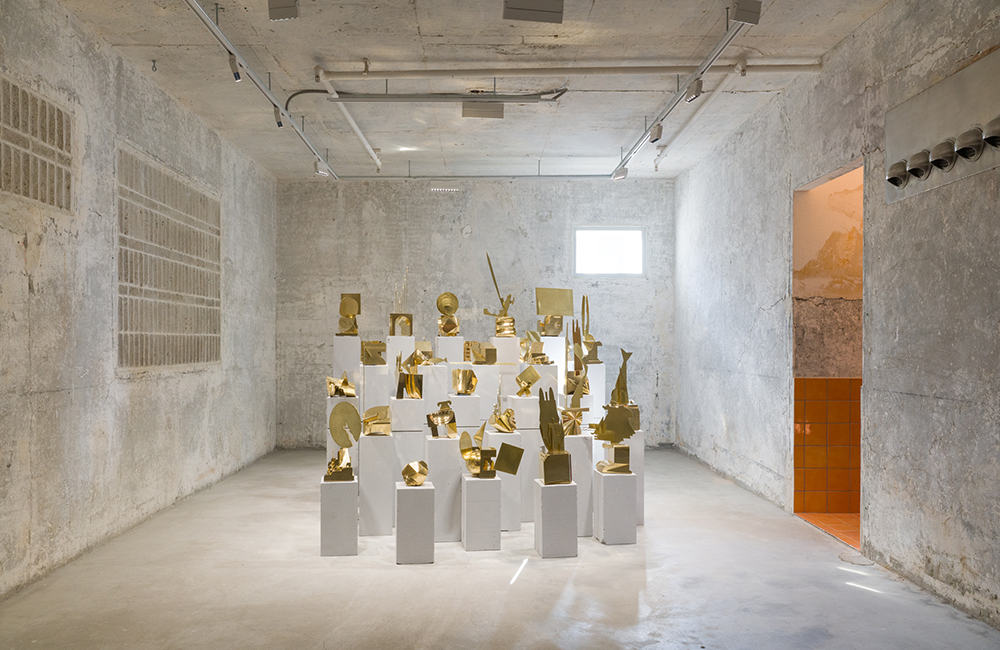
Presented in one cluster on cinder block plinths of varying heights, the sculptures of Return to Order involve a cornucopia of forms—tails of marine creatures, an animal that could be a cat or a cow, steps and terraces that could be parts of ziggurats, a rotary-dial telephone, figures that could be humans, mirror-like discs, rectangles, squares, the side-profile silhouette of a Canadian actor’s head, what could be the sail of a ship, a couple of unevenly shaped dice, and surfaces of different curvatures that elegantly intersect with other facets of the sculptures.
Ho applied the nine-square grid method to 16.5cm blank planes that were eventually merged, shaping each sculpture’s final form as a CAD drawing. In many instances, viewing different sides of the same sculpture led to the feeling of seeing different artworks.
The titles of Ho’s 10 drawings offer hints at the forms that the artist had in mind when creating his brass and aluminium works. The mustard, umber and artichoke green watercolour lines in Cross (2024) form an undulating grid framing a staircase, a nod at a sculpture that looks like steps cutting into a jack from the game knucklebones. The Big Cheese (2024) is made from two sheets of etching paper, cut and interwoven into a single image. A cinnabar and jasper lattice gives the impression of trusses and battens, embedded in a midnight-blue field. This drawing was the 90-degree axonometric representation of a sculpture that included archways, steps of varying sizes and orientations, a triangular prism, and a curved base resting on what looked like an aluminium teardrop.

The same technique, which was favoured by Hejduk, was applied to a brass piece that resembled a throne, with one small disc balanced atop a bulge emerging from the centre of its seat. The result was a glyph-like impression in Chair (2024), a white path cutting through coloured pencil and inkjet print markings, simultaneously presenting the sculpture’s top view (plan) and side views (elevations).
When asked about the declaration in the exhibition’s title, the artist had two answers. First, a cynical one: only an ageing, presumably white, male artist could get away with presenting a set of purely formal works in this day and age. Given the character of the Return to Order sculptures and their 10 accompanying drawings, why not lean in and name the show in a cheeky way?

Courtesy the artist and PHD Group, Hong Kong. Photo by Felix SC Wong.
Then, there was a more sincere reason: Ho wanted to demonstrate his art practice. While he is known for his artistic career in New York, Ho is chiefly associated with his role as an arts administrator in Hong Kong. That’s why he embarked on a rigorous, labour-intensive process to make these artworks over three years. Ho’s design process and choice of materials require precision and technique that could only be developed by spending decades honing his craft.
Return to Order leaves a powerful impression when seen in its entirety, with the sculptures reflecting warm, golden hues onto PHD Group’s bare concrete walls. The show was the first time all 30 sculptures had been shown in the same room, and it was hard to imagine another occasion when this could happen again.
Featured image: Installation view of Christopher K. Ho’s solo exhibition I Am a 70-Year-Old British Sculptor at PHD Group, Hong Kong, 2024. Courtesy the artist and PHD Group, Hong Kong. Photo by Felix SC Wong.
何恩懷
我是一位70歲的英國雕塑家
PHD Group
2024年9月14日 至 11月30日
何恩懷並不是一位七旬老人,實際上比那要年輕二十多歲。他也不是英國人,而是生於香港,在美國長大、念書。他是一位分居於香港和美國兩地的藝術家,同時也是一位藝術行政人員,目前擔任亞洲藝術文獻庫的執行總監。
為籌備此次在PHD Group的個展「我是一位70歲的英國雕塑家」,何恩懷在過去三年創作了30件黃銅和鋁制雕塑,構成系列《Return to Order》。是次整個系列與10幅新的畫作同時展出,每幅繪畫對應一件高大的三維作品。
何氏的創作過程基於建築練習中的九宮格。建築師從三行三列的九宮格開始,通過調整讓空間變的複雜多樣。先改動方格的大小、形狀或位置,然後用結構元素填充,形成最終設計。這種技術能幫助建築師在考慮風格之前先關注空間的構成,並已被應用於現代住宅設計、百年古剎甚至是城市佈局中。20 世紀 50 年代,美國建築師約翰·海杜克(John Hejduk)將九宮格變為正式練習,現在世界上眾多建築學校的新生仍在學習這種方法。
《Return to Order》系列中的雕塑作品集中擺放在高低不一的煤渣磚基座上,造型豐富多樣,有海洋生物的尾巴、某種疑似貓或牛的動物、像是金字塔中的台階和梯田、一台旋轉式撥號電話、 貌似人類的形象、鏡面圓盤、長方形、正方形、某位加拿大演員頭部的側面輪廓、船帆、幾個形狀不規則的骰子,以及與雕塑其他部分優雅交錯的不同弧度的曲面。
何氏在多個16.5釐米的空白平面區域內應用了九宮格方法,最後將這些平面合併,用CAD圖紙將每件雕塑的最終形態展現出來。很多時候,從同一雕塑的不同面觀賞會讓人感覺看到了不一樣的作品。
10幅畫作的名字暗示了何氏在創作黃銅和鋁製作品時所想到的形式。作品《Cross》(2024年)中由芥末色、黃褐色和苔蘚綠水彩線條構成的波狀網格,框住了樓梯,向拋接子遊戲中一格格樓梯被切割的雕塑致敬。《The Big Cheese》(2024年)由兩張蝕刻紙剪裁而成,交織成一幅圖。朱紅和碧綠色的格子給人一種桁架和板條的印象,鑲嵌在午夜般幽藍的田野中。這幅畫是某件雕塑的 90 度軸測圖,其中包括拱門、大小和方向不一的台階、一個三角形稜柱和一個相似鋁制水滴樣的弧形底座。
一件黃銅作品採用了海杜克所青睞的技術。該作品類似於一個寶座,一個小圓盤被平衡地置於寶座中心的隆起處。最終呈現的作品《Chair》(2024年)仿若圖像字符——一條白色路徑切開了彩色鉛筆和噴墨打印構成的標記,同時展現雕塑俯視圖(平面圖)和側視圖(立面圖)。
當被問及展覽標題中的宣言有何緣故時,這位藝術家有兩個答案。首先是憤世嫉俗的答案:在這個時代,或許只有年老的、白人男性藝術家才能僥倖展出一組純粹形式主義的作品。再顧及是次展覽中的雕塑及其10幅配套畫作的特點,為何不再激進一點,以一種厚臉皮的方式來命名這個展覽呢?
還有一個更真誠的原因:他想展示自己的藝術。儘管在紐約他以藝術生涯而為人所知,但在香港的主要身份還只是藝術行政人員。正因如此,他歷時三年以嚴謹、密集的勞作來創作出這些藝術品。何氏的設計過程和對材料的把控,需要一定到精準性和技術,而這只有通過數十年的磨練才能形成。
《Return to Order》整體讓人印象深刻,各個雕塑在 PHD Group光禿禿的混凝土牆上折射出溫暖的金色。是次展覽是首次將所有30件雕塑在同一展廳展出,很難想象以後還會有這樣的機會。