Respirare /
Empty Gallery /
Hong Kong /
Dec 8, 2024 – Mar 1, 2025 /
Everyone experienced the Covid pandemic on different terms. There were forced lockdowns for some and productive isolation for others, social pods and cautious public encounters, with a constant reminder of strained medical systems and an immense loss of life. For Tokyo-based painter Reina Sugihara, that era provided an opportunity to slow down and start a new hobby. Like many millennials around the world, she picked up bird watching.
That was one of the kernels for Respirare, an exhibition of paintings by Sugihara at Empty Gallery. After a bout of sickness that affected her breathing, the artist came across an article about a bar-tailed godwit that set a world record by flying nonstop for 11 days, covering 13,559 kilometres between Alaska and Tasmania. Sugihara began to consider how birds breathe. Unlike human lungs, which move air in and out through the same pathway, avian respiration enables a one-way air flow, making it an efficient system that enhances oxygen uptake. This is crucial for flight, an activity with high metabolic demands.
Sugihara specifically developed a fascination with the air sacs in birds that are essential to this process. Her set of paintings at Empty Gallery expressed facets of that interest in this mode of breathing.

Courtesy the artist and Empty Gallery.
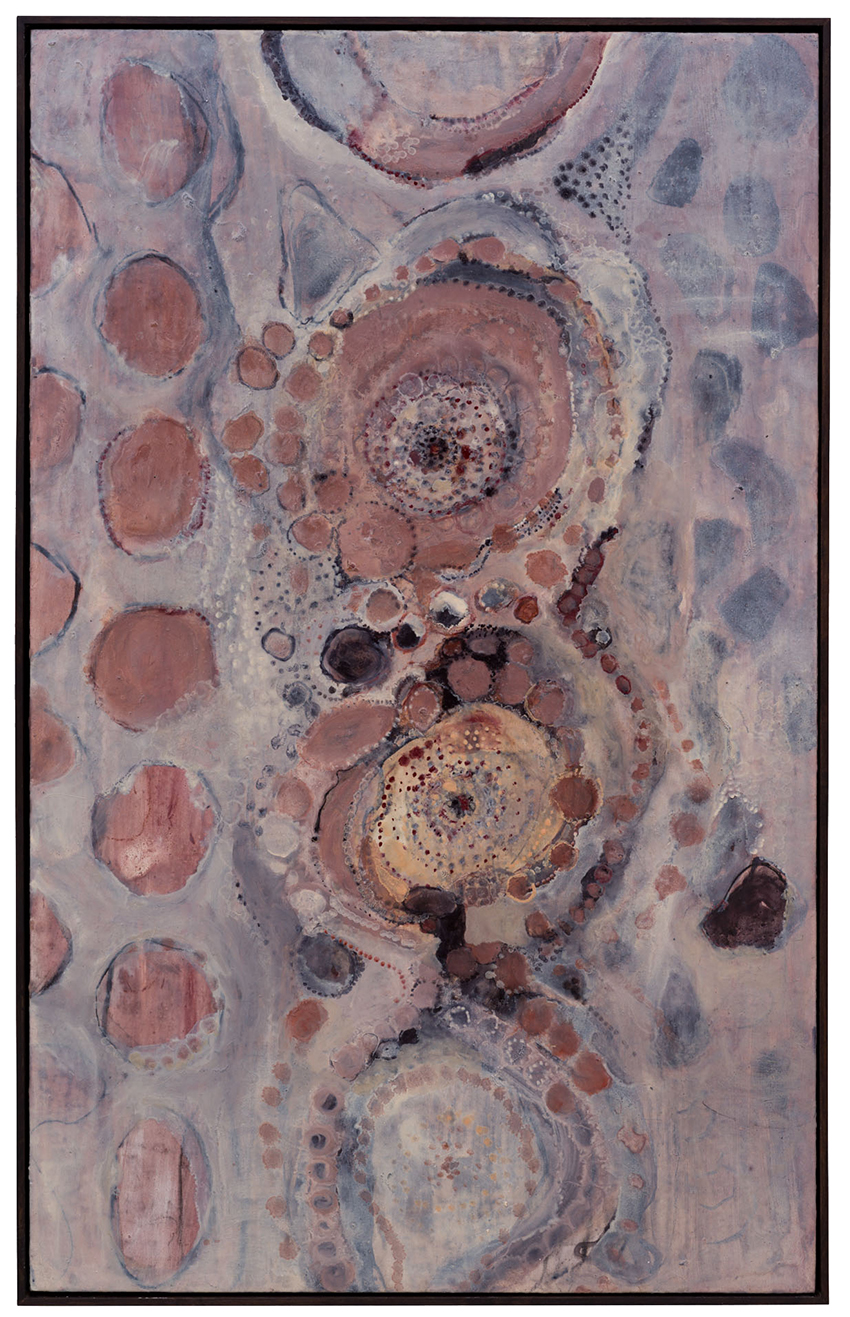
The experience of viewing Sugihara’s paintings in Respirare was akin to encountering enlarged images of organs or cells—difficult to make out at first, even though there’s a lingering feeling of familiarity, a sense that there’s a bit of ourselves in the visuals before us. Canvases like Molt and Brood (all works 2024) have a biological sensibility to them, as if we are examining the cross-sections of internal organs, yet they are abstract enough to avoid immediate associations with entrails and the strata of tissue within human and animal bodies.
Shades of brown, red and cream tinted the paintings throughout Respirare, as if they were organic matter visible only through gashes on the gallery’s black walls, magnified under spotlight. Fleshy and lush, there was warmth in the thick layers of gesso, oils, pigment and binder.
Sugihara began painting the small, dark Quiet Ending in 2016, when she was pursuing an MA at the Royal College of Art in London. Over time, the painter added fresh coats to the work, grafting new meaning onto the painting until its essence coagulated. The work was only completed eight years later, shortly before the show opened.
The imposing Digestion, meanwhile, has a more regular—and less organic—arrangement of dots that spiral inward. Meant to evoke the digestive tract, which could be understood as a lengthy path that is mostly folded into the compact space of the abdomen, this tight pattern was created by Sugihara by making moment-to-moment decisions at an instinctual level, maintaining a creative connection with the structures within our bodies.
The germinating theme of Respirare was a slight departure from Sugihara’s practice of mining the emotions and memories embedded in human viscera. A set of paintings shown in 2022 at Tokyo’s Misako & Rosen were based on human bones that the artist saw in anatomical drawings. Another batch of canvases created with a lighter palette and presented at London’s Arcadia Missa in early 2024 referenced a model of the human pancreas and a 17th-century drawing of digestive organs. Sugihara’s artworks at Empty Gallery were noticeably darker, even though the birds that inspired them are by any measure freer than most living beings.
It may feel gauche to mount an exhibition in 2024 that holds such a strong association with the Covid pandemic but Sugihara channelled her personal experience in a way that gave Respirare a singular bent. The artist has demonstrated a consistent practice of examining the stories and emotions held within organic bodies, and brought forth an emotive, thoughtful presentation that was accidentally timely: a new bat-transmitted coronavirus that could infect humans was discovered in early 2025. Memories of the pandemic and respiratory complications remain difficult to escape.
Featured image: Molt (winter) by Reina Sugihara, Oil on canvas, artist’s frame, 119.1 x 75.2 x 4.4 cm, 2024. Courtesy the artist and Empty Gallery.
杉原玲那
《呼吸》
Empty Gallery
香港
2024年12月8日至2025年3月1日
每個人渡過新冠疫情的經歷都不盡相同:有人經歷強制封城,也有人在隔離中更具創造力,還有社交人數限制、接觸人群時格外小心,更有各方不斷重覆提示醫療系統受壓、人命傷亡慘重。對於居於東京的畫家杉原玲那而言,該段時期令她有機會放慢腳步和開始新嗜好。她像世界各地許多千禧一代一樣,開始觀鳥。
杉原在Empty Gallery 舉辦的「呼吸」畫展中,觀鳥正是其中一個核心主題。這位藝術家染病後呼吸受損,休養期間讀到一篇關於斑尾塍鷸的文章,這種雀鳥無間斷飛行 11 天,跨越了阿拉斯加和塔斯曼尼亞之間共13,559 千米,創造了世界紀錄。杉原開始思考鳥類的呼吸方法。人類以肺部呼吸,空氣經同一途徑進出,但鳥類的呼吸系統則是單向氣流,能有效增強攝氧量,對於新陳代謝需求極高的飛行來說尤為重要。
杉原特別對鳥類的氣囊情有獨鍾,氣囊是鳥類呼吸的關鍵。她在Empty Gallery展出的作品呈現了她對禽鳥呼吸形式的興趣。
觀賞「呼吸」中杉原的畫作,就如看著器官或細胞的放大圖像——即使感覺莫名熟悉,但驟眼看去卻認不出為何物,眼前所見就如自己身體的一部分。《Molt》和《Brood》這兩幅2024 年的油畫作品便流露出生物學的感性,彷彿我們正在細看體內器官的橫截面,然而,圖像的抽象度足以令人不會直接聯想到人類和動物的內臟和組織層。
「呼吸」裡有著各種深淺的棕色、紅色和米黃色,儼如只能透過畫廊黑色牆壁上的裂縫看到的有機物質,在聚光燈映照下被放大。作品有血有肉、質感豐富,在厚厚的石膏、油彩、顏料和粘合劑層次之間,充滿溫暖。
杉原於 2016 年開始創作小型和陰沉的《Quiet Ending》,當時她正在倫敦皇家藝術學院攻讀碩士。隨著時間過去,這位畫家為作品添上新的油彩層,賦予新的含義,直到精粹凝為一體。這幅作品要到整整八年後,即這次展覽開幕前不久才完成。
與此同時,氣勢磅礴的《Digestion》則選以較具規律(沒那麼有機)的方式,在作品上鋪陳著向內螺旋的點,原意是要令人想到消化道;這條長長的通道位於腹腔內,大部分緊湊摺疊。杉原以直觀的當下感實踐藝術,筆風與人體結構緊扣相連、充滿創意。
「呼吸」展裡的初衷主題,有別於杉原從人體內贓發崛情感與記憶的實踐。2022年在東京Misako & Rosen展出的一組畫作,是基於杉原在解剖圖中看到的人骨。另一組油畫以較淺色調創作,於 2024 年初在倫敦的 Arcadia Missa 展出,這組作品參考了人類胰藏模型和 17 世紀的消化器官圖。杉原在 Empty Gallery 展出的作品明顯更加陰沉,儘管引發這個最終主題的鳥類在任何方面都比大多數生物更自由。
在2024 年舉辦一場與新冠疫情相關的展覽或許不是明智之舉,但杉原把自身體驗令「呼吸」別樹一幟。這位藝術家素來都在窺探有機體中的故事和感受,再展現出深厚的情感和想法。意外地合時宜的是,畫展開展的2025 年初剛巧碰上一個新發現:一種由蝙蝠傳播並可能感染人類的新型冠狀病毒。疫情的記憶和呼吸問題始終揮之不去。