Auditorium, Tsuen Wan Town Hall /
Hong Kong /
Jan 11, 2025 /
Ernest Wan /
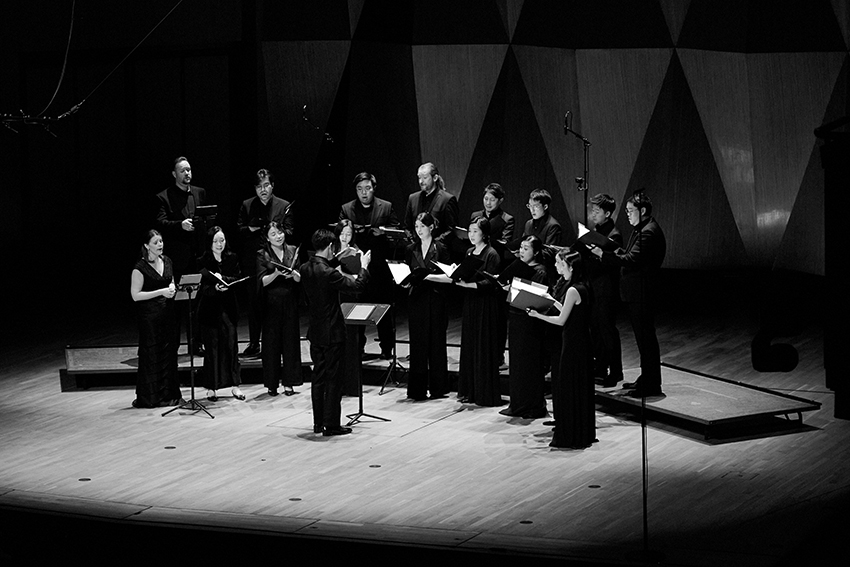
Founded by Sanders Lau as recently as 2022, NOĒMA has already taken to calling itself “Hong Kong’s leading chamber choir” – and indeed, with its programmes in this 2024/25 season of numerous serious and challenging works, it puts other local choral groups in the shade. It had a slightly different line-up of singers for each of its past concerts, and for its recent performance at Tsuen Wan Town Hall, it comprised four sopranos and three each of altos, tenors and basses. Among them were four members of the renowned British choir Tenebrae — one of each voice type — who in the days before the concert had shared with the other performers their expertise in the British 20th-century a cappella music that constituted that evening’s programme.
The evening opened with John Tavener’s The Lamb (1982), a simple setting of William Blake’s famous Songs of Innocence. This served as a gentle warm-up for the choir, producing a sense of rapt wonderment. In the Hymn to St Cecilia (1942) by Benjamin Britten, the choir sang from the outset with a lilting fluency befitting the patron saint of music. The important lengthy soprano solo was sung by Tenebrae’s Katie Trethewey, whose fluttering vibrato was a letdown, while the same group’s Tom Robson, in his brief tenor solo near the end (“O wear your tribulation like a rose”), made an unforgettable contribution, with a voice sweet and clarion.

Photo by Calvin Sit. Courtesy of NOĒMA.
The rest of the works all deal with death and the beyond. Lau led the singers in a moving rendition of Herbert Howells’s Requiem (1932), its emotional power deriving from the ably sustained slow chords and the many attendant dissonances, especially in the two sombre Latin-text movements. The ensuing Lux aeterna by John Cameron (1996) fits a similar text to Nimrod from Edward Elgar’s orchestral Enigma Variations (1899). The performance of this miniature, riddled with swoops of sevenths, was a rushed affair little suggestive of celestial peace, and was at any rate superfluous and anticlimactic, so luminous already was NOĒMA’s pianississimo delivery of the words “Et lux perpetua” in the Howells.
After the intermission, the choir was divided into two for an echo effect in William H Harris’s Faire is the Heaven (1925), and this time fine pacing and vocal control evoked serenity and brought out the harmonic surprises towards the concluding “endlesse perfectnesse”. This was followed by Hubert Parry’s Songs of Farewell (1918), a set of six motets of increasing textural complexity, a welcome choice inasmuch as the programme had thus far been dominated by homophony. The male singers now came to prominence, as their cries of “Thy God, thy life, thy cure” in the opening motet forcefully demonstrated. Imitative passages proved effective, and the lines “Eternal be the sleep” in the fourth motet and “But let them sleep” in the fifth were either chordally or contrapuntally hypnotic. The encore, Richard Rodney Bennett’s A Good-Night (1999), gave further comfort and closed what was indeed a good night of choral balm.
荃灣大會堂演奏廳
香港
2025年1月11日
尹莫違
NOĒMA由劉卓熙於2022年創辦,短短數年已開始被稱為「香港領先室樂合唱團」,而事實上,其2024/25樂季的表演曲目已納入不少認真而頗具難度的作品,令其他本地合唱團體相形失色。NOĒMA過往一直以不同陣容舉辦演唱會,最近的荃灣大會堂演出便派出了四位女高音,同場獻藝的還有女低音、男高音和男低音各三人。表演者中有四位為英國著名合唱團Tenebrae的成員,他們分別是高、中、低音的代表,並在開演前數天率先與其他表演者切磋唱功,為當晚選曲中的英國20世紀無伴奏合唱做好準備。
是夜表演以泰雲納的《羔羊》(1982年)揭開序幕,該曲為英國詩人布雷克名作《天真之歌》譜出簡約的合唱作品,是合唱團的熱身表演,營造出令人欣喜和投入的氣氛。在布烈頓的《聖西西利讚歌》(1942年)中,合唱團由初段開始便輕快流暢地演唱,恰如其分地歌頌了作品所描寫的音樂守護神。較長的重要女高音獨唱部份由Tenebrae的Katie Trethewey演唱,然而她飄搖的顫音令人失望;篇幅較短的男高音作品由來自同一合唱團的Tom Robson主唱,他以甜美清脆的嗓音在曲末唱出「O wear your tribulation like a rose」(苦困就像玫瑰配飾一樣),令人一聽難忘。
其餘作品都圍繞著死亡與死後的主題。演唱者在劉氏指揮下演繹了賀維士的《安魂曲》(1932年),精湛彈奏的慢和弦令聽眾縈迴在耳,配上不和諧音後令情感力量更見豐富,效果在兩段陰沉的拉丁文樂章尤其明顯。緊接其後是金馬倫編曲的《Lux aeterna》(永恆之光,1996年),把題材相近的歌詞配上艾爾加管弦樂作品《Enigma Variations》(謎語變奏曲,1899年)中的Nimrod樂段。這首小品在演出中有不少七度起伏,匆匆完成而未能引起聽眾對平靜天國的共鳴,可以說是反高潮的多餘枝節,尤其是NOĒMA方才已亮眼地演繹了賀維士的作品,以極小聲唱出一句「Et lux perpetua」同樣是永恆之光的意思。
中場休息後,合唱團為哈里斯的《美哉天庭》(1925年)分成兩組來呈現回音效果,優美的節奏和聲音控制塑造出寧靜安謐,更以令人驚喜的和聲完成尾聲的「無盡完美」。接下來是柏利的《離別之歌》(1918年),這首合唱組曲由六首贊歌組成,曲式質感層層遞進,為至今僅以主線旋律為主的選曲一新耳目。男歌唱家主導了這首作品,在首段贊歌中高呼 「Thy God, thy life, thy cure」(你的上帝、你的生命、你的療藥 ),有力地展現曲式的層次感。多個模仿段表達出更深的感染力,而第四首贊歌的歌詞「Eternal be the sleep」(從此長眠)和第五首贊歌的 「But let them sleep」(且讓他們睡去)在和弦或伴奏上都展現出懾人魅力。合唱團在安歌環節帶來貝納特的暖心作品《良宵》(1999年),為美好的合唱之夜作結。