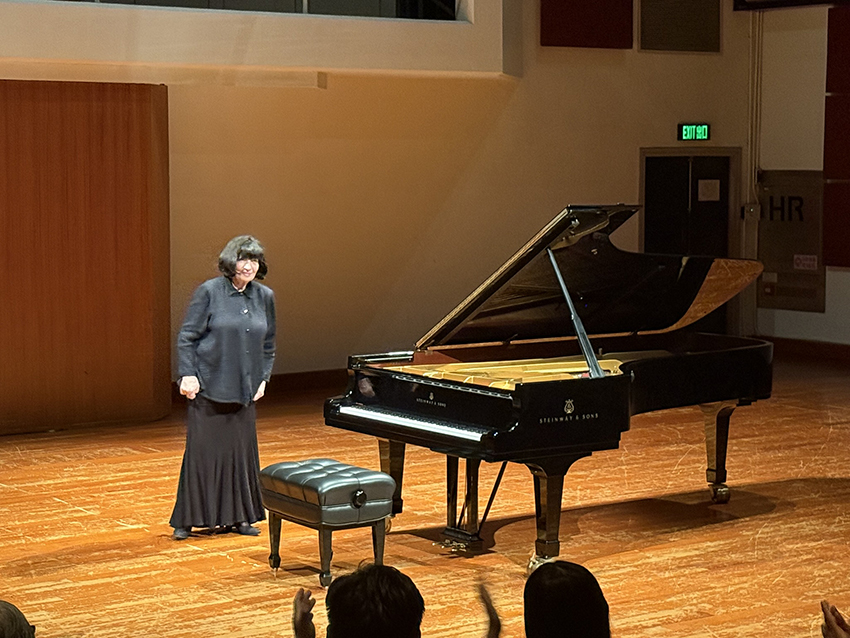
Concert Hall, Hong Kong Academy for Performing Arts /
Hong Kong /
Mar 2, 2025 /
Ernest Wan /
The great Georgian pianist Eliso Virsaladze made her Hong Kong debut in 2017 at the age of 74, playing both solo and chamber music, and returned two years later for a concerto performance. Now 82, she was back at this year’s Hong Kong Arts Festival for a solo recital, one in which her powers proved largely undiminished.
The recital began with Schubert’s Moments musicaux, the middle four of which were played in a straightforward fashion. In the C-major opening piece, Virsaladze’s left and right hands at times went slightly out of sync so as to clarify the interaction of two imitative voices, a rare practice among today’s pianists. In the outer sections of the sixth and last piece, in A-flat major, such was the extreme flexibility of her tempo – it changed almost every bar and the music slowed down massively upon settling into F-flat major (notated as E major) – that the triple metre was often difficult to discern.
Next was Brahms’s Op 1 Sonata, a youthful work often criticised as bombastic and ignored by most pianists. The remarkable fluency of Virsaladze’s rendition, as manifested in the Andante by the seamlessness with which she moved from one variation to the next, proclaimed her belief in this music, for decades a part of her repertoire. The subtle tempo changes in the course of the beginning Allegro were masterfully effected, while the propulsion of the third and final movements, both marked con fuoco, suited the fiery temperament of the pianist, who would much rather hit a few wrong notes than slow down and impede the music’s momentum.
After an expressive account of Liszt’s nocturne-like Consolation No 3 came the first of the same composer’s Trois études de concert. The title the latter later acquired, Il lamento, is a misnomer; as the markings on the score’s first page (a capriccio, dolce, appassionato con tenerezza, allegro cantabile) make plain, there is nothing mournful about it. This étude, the longest and by far the least popular in the set, found a most persuasive champion in Virsaladze, in whose hands it was a great outpouring of emotion that sounded compelling rather than rambling, as is typically the case with lesser artists.
Throughout her recital, the octogenarian displayed boundless energy, even when she was not playing: she didn’t pause between movements of a work and didn’t need much of a break between works either. She plunged into the last work on her demanding programme, Prokofiev’s wartime Sonata No 7, the very moment she sat down, if not before. Her accents and secco, detaché playing added to the sinister quality of the opening march. The slow movement started liltingly with a gentle rubato but built up to a climax, with peals of bell-like repeated chords that remained haunting to the end. In the final Precipitato, notwithstanding a memory lapse that resulted in a strange cut in an already short movement, Virsaladze demonstrated full control of the obsessive motoric rhythm essential to the success of the performance.
香港演藝學院音樂廳
香港
2025年3月2日
尹莫違
卓越的格魯吉亞鋼琴家艾莉索.薇莎拉茲於2017年以74歲之齡首次登上香港舞台,參與獨奏和室樂演出。兩年後,她再度來港帶來協奏曲演出。年屆82歲的她今年再度於香港藝術節亮相,以鋼琴獨奏會證明她的力量並未退減。
演奏會以舒伯特的《六首音樂瞬間》揭開序幕,中間四首樂曲以樸實直接的方式演繹。在第一首的C大調樂曲中,薇莎拉茲的左右手偶爾略為錯開,凸顯兩把模仿聲音之間的互動,這種處理手法在現今鋼琴家中已屬罕見。而在第六首(全曲最後一首)降A大調樂曲的開首和尾段中,她對速度的處理極為靈活,幾乎每小節都出現轉速。轉調至降F大調(譜面標記為E大調)時,音樂更大幅放慢,以致三拍子的規律有時難以識別。
接下來是布拉姆斯的《第一鋼琴奏鳴曲》,他這首年少時期的作品常被批評浮誇,因此鮮有鋼琴家問津。然而,薇莎拉茲的演繹非常流暢,特別在行板樂章中,她自然無縫地銜接每一個變奏,展現出對樂曲的堅定信心,畢竟這首樂曲是她過去數十年其中一首一直演奏的樂曲。在開首快板中,她對微妙的速度變化處理得游刃有餘,而第三、四樂章均標示「火熱的」,正好契合這位鋼琴家的熱情性格。她寧可彈錯幾個音符,也不願放慢速度而削弱音樂的推進力。
在深情演奏李斯特類似夜曲的《第三安慰曲》後,她隨即帶來同一位作曲家的《第一演奏會練習曲》。這首作品後來被冠以「悲嘆」之名,但實際上並不哀傷,從樂譜首頁的標示(任性地、甜美地、熱情而溫柔地、抒情快板)即可見端倪。這首練習曲篇幅最長,卻是三首中最不受歡迎的一首。不過在薇莎拉茲手中,樂曲卻成為了一種強烈的情感釋放,不像造詣稍遜的演奏者的演奏來得雜亂無章。
整場獨奏會中,這位八旬鋼琴家展現了不竭的能量,即使在非演奏時亦然。她幾乎不會在樂曲的樂章之間停頓,曲目之間亦沒有太多休息。她甚至在剛坐下(或者說在落座之前),便直接投入節目最後一首作品——普羅科菲耶夫戰時創作的《第七鋼琴奏鳴曲》。她以尖銳的重音及乾脆分離的觸鍵,加強了開首進行曲的陰鬱氣質。第二樂章由輕柔的自由速度起始,旋律搖曳,逐步推向高潮,鐘聲般的重複和弦迴響至尾聲,縈繞不散。在終章的「極急板」中,她因一時記錯而造成一次奇怪的跳接,令這本已短小的樂章更為突兀,但她仍能完全掌握那股動力節奏,對演出成功功不可沒。