When Columbian-Belgian choreographer Annabelle Lopez Ochoa was a child, she thought pantings could come to life and that at night, the objects and figures in them would walk out of frame. “I would look at the painting, look away, and then look back and it felt like they moved. I thought they had a soul,” Lopez Ochoa recalls. “The artist made a decision and froze a certain moment in time [in the painting], so I know they have a present and future. My process is to reverse the freezing and ask: but how did we get to that moment and what happened after that moment?”
The paintings Lopez Ochoa has been ruminating on are those of Frida Kahlo. The Mexican artist is the subject of her ballet Frida, which is premiering in Asia this April, performed by the Hong Kong Ballet. “What really fascinated and inspired me [about Kahlo] was how this artist was unashamed about expressing her emotions, the pain she felt and the tragedy that she lived,” the choreographer tells Artomity a month before the show opened, allowing a glimpse into the studio rehearsals at Hong Kong Cultural Centre’s backstage theatre.
An urgent but excitable energy was palpable as the dancers attempted to harness Kahlo’s intense passion, enacting a particularly dramatic scene when Kahlo catches her husband, famed artist Diego Rivera, cheating on her with her sister, Christina. Xuan Cheng and Feifei Ye, both Hong Kong Ballet’s principal ballerinas, are essaying Kahlo’s role. While practising this particular scene, Ye storms onto the floor (gracefully) in a blaze of fury. “I needed someone who was powerful but very vulnerable at the same time,” Lopez Ochoa says of selecting the dancers for the role of the artist.

Photo: SWKit. Courtesy of Hong Kong Ballet.
The ballet will focus on Kahlo’s inner world, portraying her emotions and thoughts through episodes from her life. From suffering a traumatic bus accident in her teens to having medical problems including a miscarriage, and from projecting bold post-colonial and feminist ideals and experiencing success in her artistic practice to her tumultuous relationship with Rivera, Kahlo felt the extremes of both pain and passion in her short but eventful life.
The painter’s body of work is known for being largely autobiographical; many of her best-known paintings are self-portraits and showcase her feelings about various episodes of her life. It is widely believed that Christina and Rivera’s betrayal inspired Kahlo’s 1935 painting A Few Small Nips, which portrays Kahlo with freshly chopped hair (Rivera was known to love her long hair), lying nude on a bed with what appear to be multiple bleeding stab wounds. Rivera appears in another work, The Wounded Table (1940), which famously disappeared in the 1950s but exists in photographic records. Kahlo began the painting in 1939, the year she finalised her divorce with Rivera. A bleeding table representing her broken family foregrounds her work, with the artist depicted sitting in the centre, A papier-mâché skeleton and her pet deer Grazina are on Kahlo’s left, and Christina’s children, and a pre-Columbian figurine are portrayed on the artist’s right.
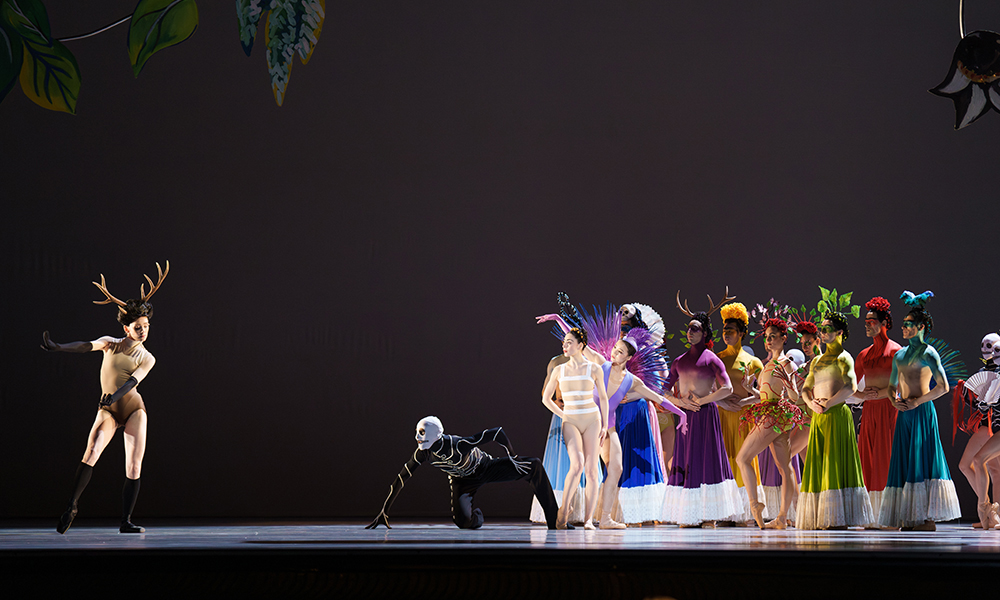
Butterflies, deers and skeletons are among the motifs Lopez Ochoa has incorporated into her ballet from the vivid imagery in Kahlo’s work. Red vines or cords are also present as large props and parts of dancers’ costumes, referencing bloodlines, as seen in Kahlo’s My Grandparents, My Parents, and I (1936), which depicts Kahlo’s kin in the style of a family tree, and in The Flying Bed (1932), which the artist painted after having a miscarriage, in which the red lines coming out of her body are in fact umbilical cords. Describing the raw emotion the works emit and their confrontational nature, Lopez Ochoa says, “It’s extremely shocking and unapologetic, and that’s what makes her a feminist. She really painted how women were and not how they appear through the male gaze.”
Lopez Ochoa began Frida as a 46-minute presentation for the English National Ballet. After realising she couldn’t fit the artist’s life into that short time span, she created a fully fledged production for the Dutch National Ballet in 2020, following which it was performed by Ballet Arizona. “As a young choreographer, I would always try to tell other stories, those that you wouldn’t normally see in ballet, because it’s just more exciting to reinvent stories from the perspective of a woman,” she says.

Courtesy Nationale Opera & Ballet.
Septime Weber, artistic director of the Hong Kong Ballet, invited Lopez Ochoa to bring Frida to Hong Kong. He had previously collaborated with her on Coco Chanel in 2024 and is on a mission to tell stories with strong female characters.
“One of the goals for me [with Coco Chanel] was to quietly begin to dismantle the myth of how women are depicted in classical ballet and ensure women were depicted in complex, modern and realistic ways, as strong and independent women who were in charge of their own destiny,” says Webre. “And so Frida Kahlo seemed like an interesting next step. The whole world has changed their approach towards how they see gender roles and ballet has followed suit, but we’re late to market. It’s important as a director to fast forward the process and present these strong women.”

Courtesy Nationale Opera & Ballet.
Webre has galvanised Hong Kong’s ballet scene by prioritising engaging local audiences in creative ways, including adapting and contextualising his productions to reflect the city’s sensibilities. This is exemplified by his production of Butterfly Lovers, an adaption of the epic Chinese legend of humble scholar Liang Shanbo and aristocratic heiress Zhu Yingtai, which will visit New York’s Lincoln Centre this autumn as part of a tour. “I want to ensure that while developing a strong Hong Kong identity, we also remained international. And Frida Kahlo’s work represents Latin culture and a different point of view, which has appeal.”
Lopez Ochoa has bought Mexican and other Latin elements into the production. She insisted that musical director Peter Salem include the late Costa Rican singer Chavela Vargas’s music in the score. Vargas was known for her interpretation of Mexican rancherasongs and was rumoured to be Kahlo’s lover.

Photo: SWKit. Courtesy of Hong Kong Ballet.
Elements of traditional folkloric dance forms are also alluded to and incorporated in the choreography. “There’s also a lot of stamping,” says Lopez Ochoa of her routines. “It’s effective in expressing strong emotion, and I drew a lot from my background in flamenco.”
Set and costume designer Dieuweke van Reij has channelled Kahlo’s distinctive style into the consumes, which feature bold colours, floral motifs and dramatic silhouettes, all of which enhances the effect of Lopez Ochoa’s heightened, fusion choreography. “She gets the dancers to really move in a contemporary way, breaking the bunhead mould,” says Webre of Ochoa’s ability to shake up even the most dedicated dancers deeply ingrained classical ballet training. “but she still allows for ballet to remain as the main language.”
Ballet has always been an expressive medium rather than a narrative-driven one, which lends itself to showcasing Kahlo’s emotional journey but also to surrealism, with its highlighting of the subconscious and absurd. Sergei Diaghilev, founder of the Ballets Russes, invited surrealists Joan Miró and Max Ernst to design costumes for his 1926 production of Romeo and Juliet; the radical results astounded audiences. Salvador Dalí designed nine ballets for its successor company Ballet Russes de Monte Carlo, starting with Bacchanale in 1939.

Courtesy Nationale Opera & Ballet.
“The ballet is really about describing social atmosphere, ideas about the human experience and character – it excels at giving life to symbolic figures, of which there are plenty of in surrealist paintings,” says Webre, using the deer, blood and butterflies in Kahlo’s works as examples.
“The vast majority of her life was spent in bed, thinking and reflecting,” says Lopez Ochoa of Kahlo. “There was so much going in there.” She cites an example in Frida, where nine male dancers represent her inner emotions and thoughts as nine characters – nine Fridas, amplifying the effect of what Kahlo experiences.
The choreographer has created works about Dalí and other surrealist artists, and is a big fan of the movement. “Theatrical production lends itself well to it; we can have 50 people on stage depicting one emotion. We really can create a multiplication of an emotion.”
Timely and topical, Frida opens right after Hong Kong’s bustling art week. Its depiction of Kahlo’s life through the medium of dance merges the best of the visual and performing arts.
哥倫比亞裔比利時籍編舞家奧喬亞小時候曾以為畫能夠變真,一到晚上畫中的物件和人物就會走出畫框。奧喬亞回憶道:「我會盯著畫看,移開視線然後再次回望就覺得它們動了。我以為它們有靈魂。藝術家做了決定,將某一瞬間凝結在畫中,所以我知道它們有現在和未來。而我的創作就是要逆轉這種凝結,去探問我們是怎樣來到這一刻?而這一刻之後又發生了什麼事?」
奧喬亞一直沉思的畫作正是芙烈達・卡蘿的作品。這位已故的墨西哥藝術家是她芭蕾舞劇《芙烈達》的靈感來源,該劇將於今年四月由香港芭蕾舞團在亞洲首演。編舞家在首演前一個月接受《藝源》採訪,並讓我們一窺香港文化中心後台劇場的排練。她表示:「我對芙烈達最著迷和受啟發的是,她從不掩飾自己的情感,還有她所經歷的痛苦和悲劇。」
當舞者嘗試捕捉卡蘿極致的激情時,現場的能量明顯既緊張又興奮。在一場特別戲劇化的場景中,卡蘿撞見丈夫兼著名藝術家迪亞哥•里韋拉與她的妹妹姬絲汀娜偷情。香港芭蕾舞團的首席舞者成萱與葉飛飛共同飾演卡蘿的角色。在這場排練中,葉飛飛帶著怒火(優雅地)衝上舞台。奧喬亞談及《芙烈達》的選角時表示:「我需要一些既強大又脆弱的舞者。」。
這部芭蕾舞劇主要著眼於卡蘿的內心世界,以她人生一些關鍵時刻來展現她的情感與思想。從她年少時遭遇嚴重的巴士意外,到其他病痛與流產的折磨,再到她對勇敢地表達後殖民主義和女權主義,後來藝術事業的成功,以及與里韋拉轟烈的愛情。卡蘿在短暫卻豐富的一生中,體驗了極致的痛苦與激情。
芙烈達・卡蘿的作品多為自傳式,許多名畫均為自畫像,呈現她對生命各階段的感受。很多人認為是姬絲汀娜與里韋拉的出軌背叛,令她在1935年創作了《一些小刺痛》。畫中的她剪短了頭髮(里韋拉最愛她的長髮),赤裸地躺在床上,身上滿是鮮血淋漓的刀傷。里韋拉也出現在另一幅作品《受傷的桌子》(1940年)中,作品在1950年代失蹤,僅存攝影記錄。卡蘿於1939年開始創作這幅畫,亦即她與里韋拉正式離婚的一年。畫面前景是一張象徵破碎家庭的流血桌子,她的左邊是紙骷髏和她的寵物鹿子Granizo、右邊是姬絲汀娜的孩子和一尊前哥倫布時期的雕像。
奧喬亞從卡蘿的作品中汲取鮮明的視覺意象,將蝴蝶、鹿、骷髏等元素融入芭蕾舞劇之中。大型的舞台道具和舞者服裝也有紅色藤蔓和繩索的元素,象徵著血緣的聯繫,如卡蘿的《我的祖父母、我的父母和我》(1936年)中的家譜。在她因流產而創作的《亨利福特醫院》(1932年)中,從她身體伸出的紅線其實是臍帶。奧喬亞描述作品所散發出的自然情感和對抗性:「她的畫作極具震撼力,毫不向現實妥協,這正是她成為女權主義象徵的原因。她畫出的是真正的女性,而非從男性視角出發的女性形象。」
《芙烈達》起初是奧喬亞為英國國家芭蕾舞團創作的46分鐘作品,但她發現無法在如此短的時間內講述芙烈達・卡蘿的一生,於是在2020年為荷蘭國家芭蕾舞團製作了完整版本,隨後由亞利桑那芭蕾舞團演出。她表示:「作為一位年輕的編舞家,我總想嘗試講一些其他故事,一些通常不會在芭蕾舞劇中看到的故事,因為能夠從女性的角度重新創作故事令我更加興奮。」
香港芭蕾舞團藝術總監衛承天邀請奧喬亞將《芙烈達》帶到香港,他曾與她在2024年合作芭蕾舞劇《香奈兒》,致力講述女強人的故事。
衛承天表示:「我希望透過《香奈兒》逐步拆解古典芭蕾對女性的刻板描繪,讓女性角色更具複雜性、現代感與現實感,描繪出能掌控自身命運、堅強獨立的女性。因此,《芙烈達》是一個很好的延續。全世界對性別角色的觀念已經改變,芭蕾舞界也隨之,但我們還落後於時代。因此作為藝術總監,我希望加速這個進程,展現這些女強人的故事。」
衛承天透過創新的方式積極吸引本地觀眾,振興香港的芭蕾舞界,包括改編與本土化作品,以貼近這座城市的文化特色。他改編了中國經典傳奇《梁山伯與祝英台》,講述書生梁山伯與貴族千金祝英台動人的愛情故事。這部作品將於今年秋季巡演,並在紐約林肯中心上演。衛承天表示:「我希望在加強香港特色的同時,仍能保持國際視野。而芙烈達・卡蘿的作品代表了拉丁文化與不同視角,甚具吸引力。」
奧喬亞在這部作品中融入了墨西哥與拉丁元素,堅持要求音樂總監彼得.沙林將已故哥斯達黎加歌手查維拉・瓦爾加斯的音樂納入配樂中。查維拉・瓦爾加斯以演繹墨西哥「瑪利亞奇」歌曲聞名,傳聞是芙烈達・卡蘿的戀人。
傳統民間舞蹈的元素也出現在編舞當中。奧喬亞解釋:「你會發現這部作品有很多跺腳的動作。這種舞步能夠有效表達強烈的情感,我從我的佛蘭明高背景中汲取了不少靈感。」
佈景及服裝設計師迪厄韋克.梵賴傑將卡蘿獨特的風格轉化為服裝設計,透過鮮明的色彩、花卉圖案與戲劇化的輪廓,進一步加強奧喬亞融合風格的舞蹈效果。衛承天認為:「奧喬亞讓舞者真正以現代的方式舞動,打破傳統芭蕾舞的刻板印象,同時仍然保留芭蕾舞作為主要的表達語言。」
芭蕾舞向來是極具表現力的藝術形式,而非以敘事為主的媒介,特別適合展現卡蘿的情感歷程,也與超現實主義相契合,著重其潛意識與荒誕。俄羅斯芭蕾舞團的創辦人謝爾蓋・達基列夫曾邀請超現實主義畫家胡安・米羅和馬克斯・恩斯特為1926年的《羅密歐與茱麗葉》設計服裝,創新的風格當時帶來極大的迴響。達利也曾為蒙地卡羅俄羅斯芭蕾舞團設計九部芭蕾舞作品的服裝,其中首部《酒神節》於1939年面世。
衛承天舉例芙烈達・卡蘿畫中的鹿、血與蝴蝶說道:「芭蕾舞主要是描繪社會氣氛、人類經驗與角色塑造,擅長為象徵性人物賦予生命,而這正是超現實主義畫作中常見的元素。」
奧喬亞補充:「卡蘿的大部分人生都在病榻上思考和反思,〔她的內心世界〕極其豐富。」她舉例在《芙烈達》這部作品中,九位男性舞者分別扮演卡蘿的內在情感與思想,化為九個不同的卡蘿,放大她經歷的內心起伏。
奧喬亞本身曾創作與達利及其他超現實藝術家相關的作品,對這個藝術運動情有獨鍾。她說:「舞台製作非常適合詮釋這種風格,我們可以用五十位舞者來表達一種情感,讓這種情緒無限放大。」
既合時宜亦具話題性,《芙烈達》的首演緊隨香港年度盛事藝術週後登場,以舞蹈的形式將卡蘿的一生搬上舞台,將視覺與表演藝術完美融合。