By Joyce Hei Ting Wong 黃熙婷
Although Gaylord Chan might not be a household name, anyone who regularly commutes on the Hong Kong MTR is likely no stranger to his artwork. On the walls of the passageway connecting Central and Hong Kong stations is a metal plate relief mural titled Swift and Safe that Chan completed in 1998. Vibrant and childlike, the work displays a bold use of colour and vital simplicity that are at the core of Chan’s artistic language.
Born in Hong Kong in 1925, Chan was one of the most original painters in the post-war period, and also served as a dedicated arts educator to generations of students and enthusiasts. Although he only made his first serious foray into painting at the age of 42, he quickly garnered attention as a promising artist in the 1970s after graduating from an extramural art and design course at The University of Hong Kong. Thereafter, he steadily developed a repertoire of abstract paintings and digital drawings over the span of five decades that continues to resonate with life in a rapidly globalising, increasingly technological world.

Collection of Peter Lau.
Courtesy Asia Society Hong Kong Center.
Chan grew up in a modest family as the elder of two children. His father passed away when he was very young, and he lived with his mother and sister on Lion Rock Road in Kowloon City. For a time, he attended a traditional Chinese private school (sishu) that focused on classical Confucian teaching. As soon as he was old enough to work, he joined the British telecoms company Cable & Wireless as a junior operator. Under the company’s training, he not only acquired fluent English but also rose through the ranks to become a certified engineer. One of his most significant achievements was serving as deputy manager for the construction of the Hong Kong section of the Okinawa to Luzon submarine cable in 1977. In 1985, he was made an MBE by Queen Elizabeth II for his contributions to telecoms.
Although Chan had always had an interest in art, he never had the leisure or means to pursue it in his youth. What finally motivated him to learn painting seriously was a mid-life tribulation – he enrolled in HKU’s extramural art classes in 1968 to alleviate a deep depression stemming from his first wife’s battle with throat cancer. He decided to enrol for certificate qualification, which required him to study a robust, three-year syllabus that included practical training as well as art history. The tutors were a star-studded cast that included the Austrian graphic designer Henry Steiner (b.1934); British curator John Warner (1929-2024), who was then also the curator of the City Museum and Art Gallery; and famed local artists such as Wucius Wong (b.1936), sculptor Cheung Yee (1936-2019) and Hon Chi-fun (1922-2019). According to Chan’s recollection, the most demanding classes were taught by the architect Tao Ho (1936-2019), and many eventually dropped out of them: he was one of only three students who managed to graduate in a cohort of 75.
Two years after graduating, Chan held his first major solo exhibition at The Excelsior hotel in 1973, debuting a naive style of painting featuring totemic forms. He coined this style “phylosym”, a term that he created by combining “phylosophical” [sic] and “symbolic.” If this was an emerging artist’s ambition to distinguish himself by coining a new style, he made little mention of it thereafter. He was never one to believe in labels, and “phylosym” seems more a word that he made up to appease a quizzical journalist than a new aesthetic that he wanted to leave in the art history books. As he once said:
“A lot of people confuse visual arts as a cognitive activity. When they see a painting, they ask, ‘What does this picture look like?’ But a painting doesn’t have to ‘look like’ anything, just as how we don’t listen to a piece of music and say it sounds like a cow or a bird. The sensations achieved by a mellifluous cadence make a piece of music. So why do we have to say what a painting looks like? This already means that we are not directly experiencing it.”

Private collection.
Courtesy Asia Society Hong Kong Center.
Painting was a medium to express his feelings, and he gravitated towards abstraction because he considered it entirely emotional: “What I understand as ‘abstraction’ is the taking away of mimetic representation. What will remain in a painting after that? I think only feelings.”
Chan was fond of using symbolism to express emotions and convey ideas, and the forms that he relied on often recall indigenous art and ancient artefacts. He was always open about his fascination for Inuit cultural objects, and that because he was studying them so often, they found their way into his paintings subconsciously. The recurring motifs in his paintings, such as tines, circular and elliptical shapes that are often nucleated, and spurred lines are all prominent features in prehistoric Inuit objects. At the same time, he took inspiration from sources as varied as ancient Chinese bronzes, paper cutting, shadow puppetry, traditional Indian textiles, Tarot cards, festive Cantonese flower plaques and trinkets from all over the world. He was invested in understanding how all kinds of form convey meaning, and he assimilated the logic of those that he considered most evocative, which was often the essential geometry that structures our world.
For all the references to folk and indigenous motifs, he painted many more pictures based on his daily observations. He had a habit of using a camera to capture inspiration; unassuming objects, from stationery to vegetables, all became vessels into which he channelled his thoughts and feelings if he saw fit. The art critic Nigel Cameron once likened Chan’s paintings to “fetish objects” because they are often larger-than-life portraits of a single motif. But when these works are considered in context with each other, certain thematic threads begin to surface.
Chan tended to transform mundane objects into unstable, often threatening instruments that betray anxiety about life’s uncertainties. For instance, A Scarecrow (1979) transforms something usually only frightening to birds into a gargantuan creature with thrashing tentacles that threatens to transgress the canvas. The anxiety that often underscores his paintings is unsurprising when we consider how he lived through some of Hong Kong’s most tumultuous, gruelling times. He came of age during the Second World War Japanese occupation of Hong Kong. At a time when locals in the city struggled to survive, he took up the mantle of the family and made dangerous treks over mountains to Yuen Long in the New Territories to source rice with a carrying pole. In the post-war period, he experienced Hong Kong’s rapid modernisation, alongside waves of refugees flooding into the city, rampant corruption and stark labour inequalities. Although he never expressed any social commentary in his paintings, the humble objects that come to life in strange contortions under his brush convey an overwhelming sense that life can grow sinister out of the blue. His lament for the folly of humankind is more subtly expressed in Monument for Those Still Alive (1983), a rare work in his career that directly alludes to warfare and death, after witnessing and surviving over half a century of social upheaval and loss.
Another related and perhaps more personal thematic thread that emerges from Chan’s oeuvre is confrontation with mortality. Growing up, he was an athletic thrill-seeker who loved hiking up Lion Rock mountain, camping in Sai Kung with his friends and swimming for hours on end in open waters, with a small blade strapped to him in case of sharks. Yet he was also afflicted by many ailments, including a case of appendicitis that required surgery without modern anaesthetic. Later in his adult life, he suffered from a series of major health problems, including a stroke that impaired his motor skills in 1998 and lung cancer in 2001 that made it impossible for him to continue painting. His personal struggles with his corporeal “cage” come through in many works that represent the body as fragmented or grotesque. For instance, Hang (1995) depicts some sort of broken alabaster statue missing its head and arms, but subtle shading on the figure gives it a dejected sense of life that is magnified by a seeming pair of leaden dumbbells weighing down on the decrepit body. Still, he was anything but a pessimist. As he proved resilient in every health battle, many of his paintings also resist mortality – Never End (1995) portrays a pair of cheeky buttocks being propelled by hurdling limbs that show no sign of stopping.

Collection of the artist estate (Chow Suk Fan).
Courtesy Asia Society Hong Kong Center.
After Chan retired from permanent duties at Cable & Wireless, he became a full-time artist and founded the Culture Corner Art Academy (CCAA) in 1989 with fellow painter Josephine Chow. Located inside a shopping arcade in Tai Po, CCAA mainly catered to neighbourhood children and teenagers in the urbanising new town. But shortly after opening its doors, Chan also initiated a nine-month weekly acrylic painting course for adults. He was motivated by a simple question: is it possible to devise a single syllabus that can successfully teach students of varying capabilities how to paint? To this end, he recruited an inaugural class of six students with different backgrounds, including some who had no prior experience of painting. His instruction was largely distilled from what he himself was taught on HKU’s certificate course, but he also integrated his own experience and insight over the years to develop a pedagogy that aimed to help students discover their own interests and potential rather than training them in particular skills or styles. He summarised his teaching into a simple rule of thumb: “Fifteen-word truth: front and back, void and solid, light and dark, form, colour, texture” – a grammar of painting that he both preached and practised.
Throughout his career, he was particularly fond of using acrylic paint. The self-taught artist Ha Bik Chuen (1925-2009), a dear friend of Chan, once mentioned the latter’s growing reputation for acrylic:
“[Chan] has been playing with acrylic for over 20 years; word has it that he is now thought of as the ‘king of acrylic’. He is able to manifest the unique characteristics of acrylic in layers that are very thin and nuanced; his impressive technique comes through effortlessly. I’ve seen many who’ve used acrylic for a long time but only treat it as oil paint – they can’t demonstrate its quality. Acrylic can create different transparencies, some translucent, some opaque. He exploits this to vivid extremes.”
Chan was drawn to acrylic paint for its versatile range of viscosities and transparencies, starting when he was studying at HKU. As painting materials were too costly and storage space limited, he would sometimes paint over a work to create a new painting or do over a canvas when he was unhappy with the results. It was likely through recycling canvases that he discovered the charm of layering acrylic.

Collection of the artist estate (Chow Suk Fan).
Courtesy Asia Society Hong Kong Center.
As the artist developed his practice, some of his most intriguing works are those that make use of layering to explore the ambiguity of visual perception. 2022 (1992) is his most painstaking such achievement, putting his mastery of acrylic and colour on full display. Commissioned by the Hong Kong Museum of Art, this painting was part of the exhibition Hong Kong 2022, which commemorated the 30th anniversary of City Hall by asking artists to create an artwork that imagined 30 years ahead. Through careful short strokes of translucent colour, he depicts a subtle force swirling towards the centre of the canvas, as if into an intangible future. Compared to his paintings of symbolic glyphs, his abstract canvases exploring pictorial depth feature much more open and atmospheric compositions and a stronger reliance on brushwork. While some paintings use striking contrasts to suggest spatial narratives between different pictorial forms, others forefront the meticulous layering of colour to evoke mysterious expanses. Chan believed that colours could speak on their own, as more than just “adjectives” to forms.
In April of 1998, he suffered a stroke that severely impaired his motor skills. After he was able to return home from the hospital, he took to playing Microsoft Solitaire on a computer as a form of therapy, to retrain his eye-hand coordination. He eventually got so skilled at defeating the program that he grew tired of the game and turned his sights onto another application: Microsoft Paint. After he was diagnosed with cancer in 2001 and lost a quarter of his lungs, he turned to using MS Paint entirely to make art, as he could no longer sustain standing for long periods of time to paint on canvas. Despite its basic functions, MS Paint proved a rigorous medium that challenged him to think about form and colour in a new light. In older versions of the software that he worked with, the undo function could only retract a limited number of changes, and the eraser tool removed both figure and ground indiscriminately, as the same layer. These constraints meant that he not only had to construct a picture carefully but also think through the order in which he drew.

Collection of the artist estate (Chow Suk Fan).
Courtesy Asia Society Hong Kong Center.
MS Paint also encouraged Chan to extend his ideas on the relationship between form and time. Whereas his canvas paintings may have a rustic quality, from paring forms down to the essential, he intentionally created an anachronistic aesthetic in many digital drawings. He often simulated the effect of woodcut prints that recall the German Expressionist work of the early 20th century, which also inspired modern Chinese woodcuts of the 1930s and 40s. But the subjects depicted in these digital “woodcuts” are often still more archaic – an ancient Chinese ding vessel, beasts that evoke the Paleolithic cave paintings of Lascaux, and A tile from Dun Huang (2011). Throughout his career, one of the questions that engrossed him the most was how we are able to tell whether an object is from the present or the past just by looking at it. If his digital woodcuts conflating different eras into one image are his final attempts at tackling this conundrum, the answer is that we are never able to tell for certain. In his heart, he believed:
“A lot of what we now refer to as abstract painting, ancient Chinese splash ink had already done it before. There’s not much point in saying whether a work is abstract or not. What we need to think about is how to convey something very real, an actual feeling, through form, colour and texture – that is what we should do.”
Between this conviction and a lifelong interest in probing the temporality of forms lies Chan’s ambition to create works of art that are timeless. The artist’s legacy shows that art with the power to rouse visceral emotions has the best chance against the tides of time.
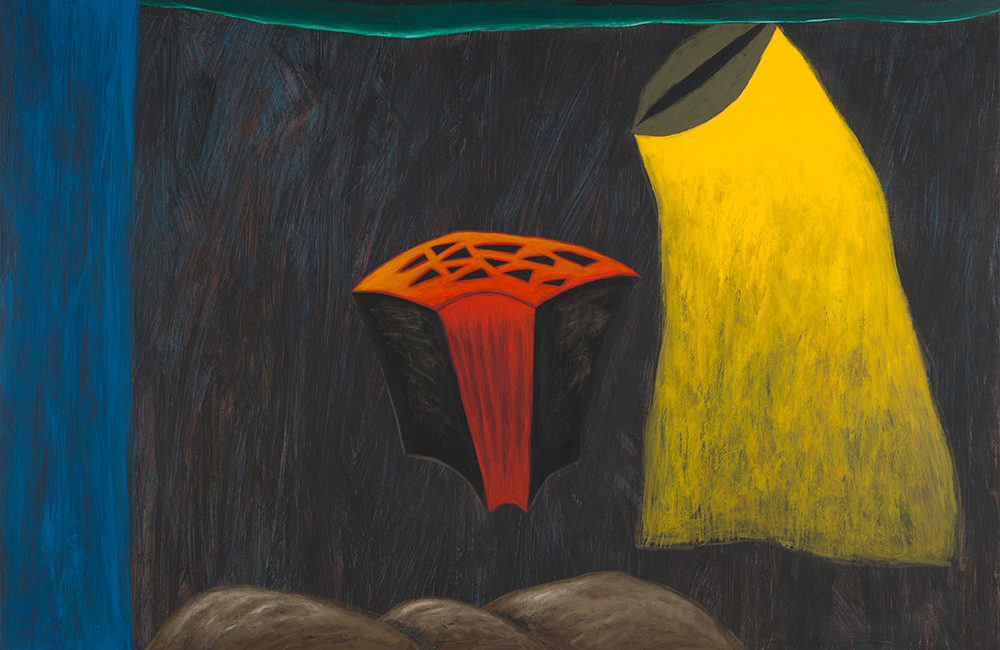
Featured image: SR III by Gaylord Chan, Acrylic on canvas, 122 x 184 cm, 1991. Collection of Hong Kong Museum of Art, AC1993.0026. Courtesy Asia Society Hong Kong Center.
陳餘生的名字並非家傳戶曉,但所有日常會坐地鐵的人對他的作品都不會陌生。在連接中環和香港站行人隧道的牆壁上,有一幅名為《快而安》的金屬切片壁畫,正正就是陳餘生1998年的作品。作品色彩鮮明,充滿童趣,展現了陳餘生藝術實踐的重點,就是用色大膽和生動簡潔。
陳餘生1925年生於香港,是其中一位最具創意的戰後畫家,亦是幾代學生和藝術發燒友的老師。雖然到42歲才首次正式涉足繪畫,但到了70年代,他從香港大學的校外藝術與設計課程畢業後很快就引起關注,被譽為一位有前途的藝術家。其後半世紀,他穩步創作了一系列抽象畫和數碼繪畫,至今在快速全球化和日益技術主導的世界中仍然能夠與我們的生活產生共鳴。
陳餘生出生於一個普通家庭,是家中長子。父親在他小時候離世,他和母親、妹妹一起住在九龍城獅子山道。他曾在一間傳統儒家私塾上學,達工作年齡後就加入了英國電訊公司大東電報局成為初級接線生。在公司的培訓下,他不僅說得一口流利的英語,還晉升為註冊工程師,其中一個最重要的成就就是於1977年擔任沖繩至呂宋島的香港段海底電纜副工程經理。1985年,他因為在電訊領域的貢獻,獲英女王伊莉莎白二世授予大英帝國最優秀勳章。
陳餘生對藝術早感興趣,但年輕時沒有閒暇和機會習畫,最終促使他認真習畫是中年的一次困境。1968年,他因為第一任妻子患上喉癌而受抑鬱困擾,他為調節心情報讀了香港大學的校外藝術課程。他報讀的資格證書有三年豐富的課程,包括實踐培訓和藝術史。導師陣容星光熠熠,包括奧地利平面設計師石漢瑞(1934年生)、英國時任香港博物美術館館長兼策展人約翰.溫訥(1929-2024年),以及著名本地藝術家黃無邪(1936年生)、雕塑家張義(1936-2019年)和韓志勳(1922-2019年)等。陳餘生回憶最困難的就是建築師何弢(1936-2019年)的課程,許多人都中途退出,而他就是75名學生中成功畢業的三名之一。
畢業兩年後,陳餘生於1973年在怡東酒店舉辦首次大型個展,天真畫風的圖騰初次亮相。他將這種風格稱為「phylosym」,即「哲學性(philosophical)」和「象徵性(symbolic)」的結合。如果說這反映了他作為新晉藝術家展示新風格的雄心,那麼他之後也未免太少提起這個詞了。他從不相信標籤,「phylosym」比較像是為了滿足記者的好奇心而編造的詞語,而非他想留在藝術史的新美學。正如他曾說過:
「很多人混淆視覺藝術是一種認知活動。當他們看到一幅畫時,他們會問『這幅畫像什麼?』。但一幅畫不需要『像』任何東西,好比我們不會聽到一段音樂然後說它聽起來像牛聲或鳥聲一樣。甜蜜的旋律所引起的感覺會構成音樂,那麼為什麼我們要問一幅畫像什麼呢?這已經意味我們沒有真正感受到它。」
繪畫是他表達情感的媒介,他傾向於抽象手法,因為他認為抽象是完全由情感主導的:「我認為抽象即是將畫中的『像』抽去,剩下個人感覺。」
陳餘生喜歡運用符號表達情感和傳達思想,他的作畫方式經常會讓人聯想起原住民藝術和古物。他一直坦言自己很喜歡研究反映因紐特文化的物件,因此畫作中會無意中出現這些主題。畫中常見的尖刺、有核心的圓形和橢圓形圖案,以及鋸齒等都是因紐特古物的明顯特徵。另一方面,他亦會從中國古代青銅器、剪紙、皮影戲、傳統印度紡織品、塔羅牌、廣東節慶花牌和世界各地的小裝飾品等汲取靈感。他熱衷於理解不同形式的表達方式,並滲透他認為最具啟發性的邏輯,那就是構建世界的基本幾何形狀。
雖然他的畫作有參考民族和原住民的主題,但大部分都是基於對日常的觀察而創作。他習慣使用相機捕捉靈感,無論是文具或是蔬菜等的平凡物件,都可以成為他思想和情感的載體。藝評家金馬倫曾將陳餘生的畫作比作「偶像」,因為它們通常都是單一概念的傳奇肖像。當作品連結起來時,主題才會開始浮現。
陳餘生喜歡將平凡的物件轉化為不穩定和恐嚇的工具,從而表達對未知的焦慮。在《稻草人》(1979年)中,他將平常只嚇唬雀鳥的稻草人,變成了有拍打觸手的巨大生物,恐嚇要穿過畫布。他經歷過香港最動蕩艱苦的時期,因此不難在他的畫中找到焦慮的痕跡。他在二戰日佔時期的香港長大,在市民掙扎求存之時,他肩負家庭重擔,背著擔架危險地越過山脈前往新界元朗採購大米。戰後,他見證了香港的快速現代化、湧入城市的難民潮、猖獗的貪污問題,以及殘酷的勞動不平等。雖然他的畫作從未發表過任何社會評論,但在他的筆下,平凡的物件以奇異的扭曲方式活現,有一種生活可能會突然變得險惡的強大感覺。《倖存者紀念碑》(1983年)是他職業生涯中罕有直接提及戰爭和死亡的作品,在見證並活了超過半世紀的社會動盪和失敗後,隱誨地哀歎人類的愚昧。
陳餘生的作品還有另一個與他個人更相關的主題——與死亡的對抗。年少時他是一個愛冒險的運動健兒,喜歡攀獅子山、與朋友在西貢露營,會在外海游上數小時。他身上總帶著一把小刀,以防受到鯊魚襲擊。不過他亦飽受疾病困擾,曾經有一次盲腸炎需要在沒有麻醉藥的情況下進行手術,晚年時更患有一些嚴重的疾病。1998年他罹患中風,影響了活動能力。2001年他確診肺癌,因而無法繼續繪畫。他許多作品都將身體描繪成支離破碎或怪誕異樣,呈現自己與軀體監獄的鬥爭。《吊》(1995年)描繪一個缺了頭和手臂的雪花石膏雕像,人物隱約的陰影帶出一種對生命的沮喪,一對沉重的啞鈴壓在殘缺的身軀上,將這種感覺放大。然而,他絕對不是一個悲觀主義者。他在每場抗病戰役中都表現出無比的堅韌,許多畫作亦有奮力抵抗死亡的主題。在《明天會再來》(1995年)中,奔馳的四肢推動著頑皮的臀部,沒有任何停下的跡象。
陳餘生卸任大東電報局的職務後,退休成了一名全職藝術家,於1989年與畫家周淑芬創立了文苑畫院。文苑畫院位於大埔一個購物商場內,主要面向城市化新市鎮內的兒童和青少年。但開業不久後,陳餘生就發起了一個為期九個月的成人每週塑膠彩課程。他的測試目的很簡單:有沒有一個課程,可以教導不同能力的學生繪畫?他招募了六名背景不同的學生,其中一些從來沒有任何繪畫經驗。他主要以自己在香港大學證書課程所學的知識,再整合多年的經驗和洞察力,開發出一種旨在幫助學生發掘自己的興趣和潛能,而非訓練他們特定技能和風格的教學方式。他將自己的教學總結為一套簡單的繪畫法則,將「前後虛實明暗形色質感十五字真言」言傳身教。
在他的職業生涯中,他特別喜歡使用塑膠彩顏料。陳餘生的摯友兼自學成才的藝術家夏碧泉(1925-2009年),就曾提到陳餘生在使用塑膠彩方面日益增長的名望:
「[陳餘生]玩塑膠彩已經超過20年了,據說他現在被稱為『塑膠彩之王』。他能夠在非常輕薄且細膩的層次中突顯出塑膠彩的獨特特質,輕易地展現出卓越的技巧。我見過很多人都會長期使用塑膠彩,但他們會把它當作油畫使用,無法展示出它的特質。塑膠彩可以創造不同的透明度,有些半透明,有些實色。他巧妙地利用這一點,達到生動的極致。」
陳餘生自在香港大學的學習時期起,便對塑膠彩顏料多功能的黏度和透明度非常感興趣。由於繪畫材料費用高且儲存空間有限,當他對成品不滿意時,有時會直接在畫上重繪新的作品,或者在畫布上重新作畫,很可能是重用畫布令他發現塑膠彩的層次魅力。
隨著陳餘生的藝術實踐一直發展,其中一些最有趣的作品利用層次探索視覺感知的模糊。《2022》(1992年)是他其中一件最下苦功的作品,展示了自己對塑膠彩和色彩的精湛技術。畫作是受香港藝術館委託創作,於慶祝大會堂成立30週年的展覽「香港2022」展出,當時一眾藝術家需要創作一件展望30年後的作品。他以輕輕的半透明彩色筆觸,描繪一股朝畫布中心盤旋的微妙力量,彷彿進入一個無形的未來。與他那些象徵符號的畫作相比,探索圖像深度的的抽象畫布構圖更加開放和有氣氛,亦對筆觸更加依賴。有些畫作會利用鮮明對比暗示不同圖像形式之間的空間敘事,有些則突出精心編排的色彩層次,喚起神秘的廣闊感。陳餘生相信顏色可以說話,不僅僅是形式的「形容詞」。
1998年4月,他罹患中風,嚴重損害了他的活動能力。從醫院回家後,他開始以電腦的接龍遊戲作為治療,重新訓練手眼協調能力。很快,他就玩得非常純熟,開始對遊戲感到厭倦,將目光轉而至另一個應用程式小畫家。2001年,他確診癌症,切除了四分之一的肺部。由於他無法再長時間站在畫布前作畫,因此他完全轉用了小畫家進行創作。雖然小畫家的功能簡單,但亦成為了一種苛刻的媒介,挑戰他以新的方式思考形式和顏色。他使用的舊版小畫家撤銷動作次數有限,而橡皮擦工具會無差別地刪除同一層的圖案和背景。這些限制意味他不僅必須仔細構圖,還需要考慮繪圖的順序。
小畫家也鼓勵陳餘生擴闊對形式和時間關係的想法。雖然他的畫布作品可能比較粗糙,將形式削減到必要,但在許多數碼繪畫中,他卻是故意創造出一種過時的美學。他經常模擬木刻版畫,讓人想起20世紀初期德國表現主義的作品,這也激發了30和40年代的中國現代木刻。這些數碼「木刻」描繪的主題通常更古老,包括中國古代的鼎器,讓人想起拉斯科洛洞穴壁畫的野獸,和《敦煌的一塊瓷磚》(2011年)。在整個職業生涯中,他其中一個最感興趣的問題就是,人如何能夠單憑外觀判斷一件物件屬於當下還是過去。如果將不同時代融合成一幅圖像的數碼木刻,就是他解題的最後嘗試,那麼答案就是我們永遠都無法確定。他相信:
「很多我們現在稱為抽象繪畫的,中國古代的水墨畫已經做過了。說一幅作品是否抽象沒什麼意義,我們要思考的是如何透過形式、色彩和質感傳達一些非常現實的、真實的感覺,這才是我們應該做的。」
在這種信念和探索形式的時間性的畢生興趣之間,是陳餘生想創作永恆作品的抱負。藝術家的遺產讓我們知道,只有可以喚起內在情感的藝術作品,最能在時間的洪流中逆流而上。