Concert Hall, Hong Kong City Hall /
Hong Kong /
May 17, 2025 /
Ernest Wan /
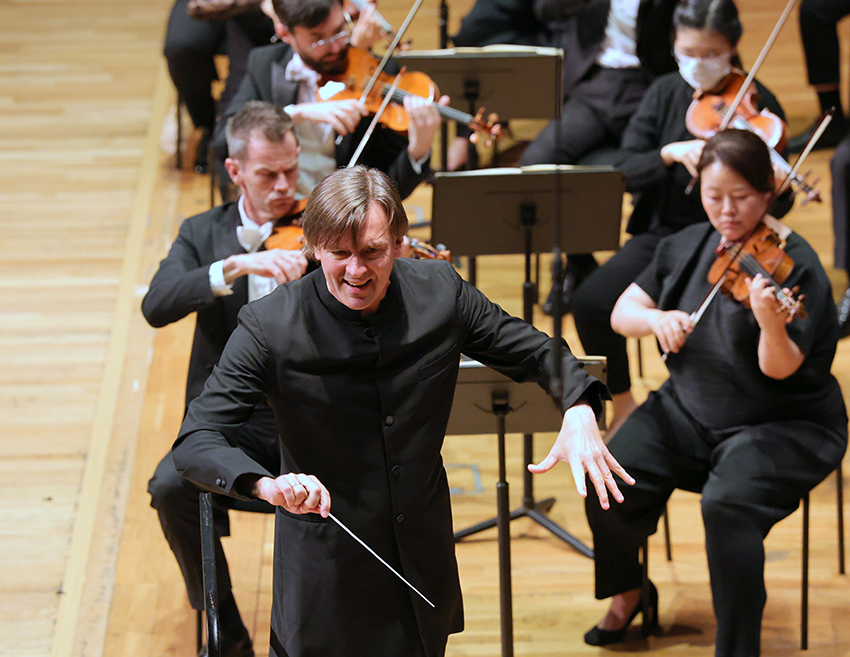
Among the offerings of this year’s French May Arts Festival was a concert from the Hong Kong Sinfonietta, Trio Wanderer Plays Beethoven Triple Concerto. It was memorable, however, neither for the acclaimed chamber ensemble from France nor for the great German composer’s work but for the Czech guest conductor Tomáš Netopil’s rendition of the other, equally buoyant works on the programme, both written by his countrymen.
Like the Beethoven work it preceded, Bohuslav Martinů’s seven-minute Overture H 345 (1953) is in bright C major and is sometimes redolent of a baroque concerto grosso. Under Netopil’s assured baton, the orchestra filled the auditorium with a warm glow of sound from the first bars, and the music, with its insistent succession of 16th notes and chains of syncopated string figures, chugged its way at a healthy clip to a firm conclusion.

The Sinfonietta was joined in the Beethoven concerto (1804) by Trio Wanderer, whose members, says the official bio, are known for their “almost telepathic understanding of each other”. The absolute absence of eye contact among them throughout the performance, however, might have contributed to the impression that each member of the threesome was playing as if he were a soloist rather than interacting synergistically. Indeed, despite violinist Jean-Marc Phillips-Varjabédian’s beautiful tone, cellist Raphaël Pidoux’s nimbleness and pianist Vincent Coq’s precision, the collaborative effort was less than gripping and seemed emotionally detached, a situation not helped by Phillips-Varjabédian’s air of nonchalance, the inaccurate intonation at his entries apparently not bothering him at all. Perhaps these seasoned performers sounded somewhat uninterested and hence uninteresting simply because this concerto, not the composer’s most inspired, is the only one in the standard repertoire for piano trio and orchestra, and they have done it to death.
The focus shifted back to conductor and orchestra after the intermission, and it made a world of difference when the former had evidently convinced the latter of the worth of a relatively unfamiliar work and inspired the players to give him their all. Thus, the fortissimo statement of the opening theme of Dvořák’s Sixth Symphony (1880) was truly grandioso,as the score instructs, and although Netopil adopted a moderate tempo for this first movement, the vigorous orchestral playing prevented it from sounding ponderous, even in the climactic pesante passages. While the string phrases in the lyrical music of the Adagio were lovingly moulded, none of the startling outbursts elsewhere in the movement were smoothed over. The Furiant beguiled with not just the expected metric ambiguity characteristic of this dance but also the playful changes in dynamics, whether gradual or sudden. Near the start of the Finale, the exhilarating accelerando to the main tempo showed great promise. The remainder of the movement lived up to it, with the presto coda, which sports breathless string runs and a proud brass chorale, whipping the audience up into a joyous frenzy. Under the charismatic leadership of a conductor with the music in his blood, the Sinfonietta surpassed itself.
香港大會堂音樂廳
香港
2025年5月17日
尹莫違
香港小交響樂團於今年法國五月藝術節帶來了《貝多芬三重協奏曲》音樂會。不過,令人留下最深刻印象的,不是享譽國際的法國室內樂組合流浪者三重奏,亦不是偉大的德國作曲家貝多芬的作品,而是來自捷克的客席指揮尼托皮爾,以及他對兩首輕快的捷克作品的詮釋。
馬天奈於1953年創作的七分鐘《序曲,H345》,與節目中緊隨其後的貝多芬作品一樣是明亮的C大調,有時甚至會讓人想起巴洛克時期的大協奏曲。樂團在尼托皮爾沉著而自信的指揮下,首小節起便為音樂廳注滿溫暖的音樂光輝。作品以不斷湧現的十六分音符及層層錯落的弦樂切分音推進,保持活潑的節奏,堅定而有力地結尾。
小交響樂團與流浪者三重奏合奏貝多芬的《三重協奏曲》(1804年)。根據官方簡介,三位成員以「近乎心靈感應的默契」見稱。然而,他們在整個演出中幾乎沒有任何眼神交流,反而給人一種各自獨奏而非合奏的感覺。小提琴家瓦菲利普音色優美,大提琴家畢杜手巧靈活,鋼琴家葛克精準細膩,但整體演出卻欠缺張力,情感表達亦顯得疏離。瓦菲利普的冷漠,加上數次開始演奏時對音準的不在意,更讓這種感覺加劇。幾位演奏家演出無數,或許他們之所以顯得沒趣,而令演出略顯乏味,是因為這首樂曲並非貝多芬最著名的作品,卻是唯一一首鋼琴三重奏與樂隊可以合作的標準樂曲,因此他們早已演奏過無數次。
中場休息後,焦點重新落在指揮與樂團身上,這種轉變帶來了明顯的不同。指揮令樂團信服於一首相對陌生的樂曲,並激勵演奏者全情投入。樂團演奏德伏札克的《第六交響曲》(1880年)時以強音開場,真正展現出樂譜中標註的「宏偉」氣勢。雖然尼托皮爾在第一樂章採用中板速度,但樂團充沛的能量令音樂不至沉悶,即使在高潮的沉重段落亦然。第二樂章慢板中的弦樂線條柔情細膩,但卻沒有削弱樂章其他地方鮮明的爆發。第三樂章的富利安特舞曲不僅呈現了舞蹈獨有的節奏錯置特色,還伴隨著漸進和突然的玩味力度變化。終章一開始的急速推進,為主速度帶來振奮的動力,而後續亦不負所望。終章的急板中,疾馳的弦樂與昂揚的銅管交織,把觀眾推向一片喜悅的狂熱。在這位充滿魅力、血液注滿音樂的指揮帶領下,香港小交響樂團的演出可謂突破自己。