The Seventies /
White Cube /
Hong Kong /
Mar 26 – May 17, 2025 /
Few things can prepare you for what a chromatic explosion on canvas is really like. You might have seen pictures of Lynne Drexler works on a screen and thought that she uses colour in an extraordinary way, but her work is one of the many demonstrations that nothing compares to being able to stand in front of a painting and stare into it for as long as possible.
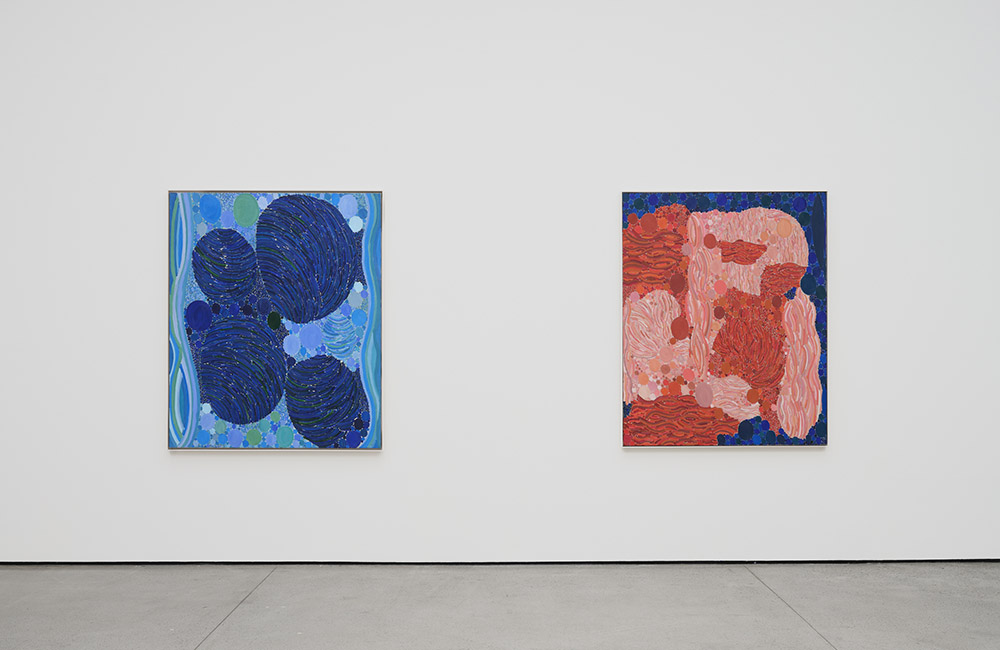
Drexler (1928-1999) is often described as an abstract expressionist and, later, a representational landscape and still life painter, who kept on applying her distinctive way with colour to render backgrounds – walls, skies, mountains or seas – creating something between abstraction and representation. Drexler herself used to say that she was a “colourist”, something she started developing during her years in college, in New York, where she was taught by Hans Hofmann – who had already developed his “push and pull” theory of colour, in which he would put together contrasting blocks of colour to form abstract images – and Robert Motherwell, also engaged in contrasting colour-block experimentation. These masters only confirmed to the young Drexler the importance of what had been a constant in her aesthetic landscape since childhood – she started painting when she was eight – but it took a violent personal crisis to make colour the all-encompassing force that it is in the series of paintings she produced in the 1970s: rich, high-chroma compositions that are truly striking. A selection of these have been brought to Hong Kong by White Cube, in a show called The Seventies, which introduces Drexler’s work through large oil-on-canvases and wax crayon-on-paper works. It’s the first time pieces from this period have been put on show in Asia.

Blupe by Lynne Drexler, Oil on canvas, 152.1 x 126.1 cm, 1973.
Signed, titled and dated on the reverse: Lynne Drexler / Blupe 1973
© The Lynne Drexler Archive. Photo © White Cube (Frankie Tyska)
From a distance, works such as Titan/Titan Remembered (1975), Winter Reflections (Siberian Song) (1975) and Blupe (1973) are studies in yellow, grey-black and blue. Up close, the tessellated brush strokes that compose her abstract, organic shapes, mostly circles, wavy curves and short lines, are an eye-fooling mixture of a rather large palette, in which greens, purples and oranges are all called in to help create an overall effect. A sense of chromatic uniformity comes to the fore only through the union of countless shades.
These works, in their meticulous celebration of colour, were the product of what must have been a deeply traumatic occurrence: after a particularly grim time in her personal life that involved a mental breakdown, Drexler developed an inability to differentiate colour that lasted for a few months. It would have been scary for someone so devoted to chroma to turn colour-blind, even for a relatively short span of time, but her reaction once this challenge was over was to dwell with even more abandon on all the subtleties and interplay of different tints and shades, producing mesmerising mosaics of pigment.
Some of her artistic inspirations can be detected in her works: in Titan/Titan Remembered and Burst Blossoms (1971), a revisited memory of Gustav Klimt’s mosaic-like backgrounds is clear to see, while Drexler’s lifelong admiration for Matisse lingers in all her paintings, especially the later still lifes. In the paintings on show, it is visible in particular in pieces like Blupe, Foam (1971) and Gossomer (1972). These are explorations in blue and turquoise; green, azure, aquamarine and orange; and yellow, sienna and acid green, characterised by abstract forms painted in small, thick brushstrokes, with one colour and one texture added at a time, in a painstaking, patient process. The rhythm we see in these works, however, is not purely pictorial: in particular during her colour-blind months, Drexler dedicated herself even more to her passion for classical music and opera, exploring Kandinsky’s intuition that music could be visual transposed in abstract painting. In the same way that we imagine notes being able to float into the air, so do these abstract shapes that wave and circle on the canvas as if in a sensual, floating motion.

Foam by Lynne Drexler, Oil on canvas, 50 x 30 in. (127.0 x 76.2 cm), 1971.
© The Lynne Drexler Archive. Photo © White Cube (Frankie Tyska)
She was particularly fond of grandiose, 19th century composers such as Richard Wagner, and during her years in New York she was an assiduous opera goer – she used to take a sketchbook with her, in order to draw the sensations the music inspired. All of her paintings from the 1970s are strongly affected by this interest in music. The repetitive layers of vivid colours that Drexler put on canvas, when seen in this light, challenge the perception of chromatic and aural interplay in a very novel manner.
If it comes as a surprise that such an interesting artist is not more commonly known, the reason is anything but surprising. Drexler was a very talented abstract expressionist who married a more famous painter, John Hultberg, and nursed him through his bouts of alcoholism, while trying to nurse herself out of the pain of his infidelities and abusive temper. After struggling in New York, the couple moved to Monhegan, an island off the coast of Maine, to look for an elusive calmer life. Drexler remained on the island even after they separated. If that reminds you of Lee Krasner (married to the highly abusive Jackson Pollock) or Elaine de Kooning (who married Willem de Kooning in spite of his alcohol issues, which she eventually also suffered from herself), it is because this is a common story, in this artistic movement as in many others. And like Krasner, De Kooning and many other female artists, Drexler’s work is now being given the visibility it always deserved. During her lifetime, she only had one major solo exhibition, in 1961, at the legendary Tanager Gallery (1952-62), one of the co-op galleries of New York’s 10th Street collective.
Luckily for us, chances to see her work on display are now only likely to become more numerous.
70年代
白立方畫廊
香港
2025年3月26日至5月17日
幾乎沒有什麼能讓你準備站在畫布前親眼目睹色彩爆發的震撼。你可能曾經在螢幕上看過琳恩.德雷克斯勒的作品,讚歎過她對色彩的極致運用,但絕對比不上親身面對畫作、凝視箇中細節的體驗來得精采絕倫。
外界常形容琳恩.德雷克斯勒(1928–1999年)為抽象表現主義畫家,後期她亦發展出具象風景畫與靜物畫風格。她以獨特的用色方式描繪牆壁、天空、山巒和海洋等的背景,在抽象與具象之間創作出獨有的風格。在紐約求學時期,她師從漢斯.霍夫曼和羅伯特・馬瑟韋爾,從那時起她便開始自稱為「色彩主義者」。漢斯.霍夫曼提出著名的色彩「推拉理論」,利用對比色塊建構抽象圖像;而羅伯特・馬瑟韋爾則致力探索色塊對比。這些大師的教導讓年少的琳恩.德雷克斯勒更加堅信自己自八歲習畫以來就鍾愛的審美方向,然而真正令她將色彩推向極致的是一次個人的低潮。她於70年代創作出一系列豐富鮮艷的震撼作品,包括多幅大型油畫與蠟筆紙本作,現於香港白立方畫廊的「70年代」展覽展出,也是她首次在亞洲展出這一時期的作品。
遠觀之下,《Titan/Titian Remembered》(1975年)、《Winter Reflections (Siberian Song)》(1975年)及《Blupe》(1973年)等作品分別以黃、灰黑及藍為主色。但當走近後,你便會發現畫面是由圓圈、波紋與短線等的棋盤狀筆觸構成的抽象有機形狀所組成。她的調色盤極其豐富,透過將綠、紫、橙等顏色層層堆疊,營造出一致的錯視效果。這種色彩的統一來自無數色調的融合。
這些用色細膩的作品背後,源自藝術家的一段創傷。經歷一段低潮與精神崩潰的時期後,琳恩.德雷克斯勒曾持續數月喪失辨色能力。對一位畢生以色彩為生的藝術家而言,即使是短暫的色盲,都足以成為一場噩夢。但康復後的她並沒有逃避,反而是更深入地探索色彩的細節與層次,創作出令人著迷的色彩馬賽克。
她的作品反映出不少她的藝術靈感。《Titan/Titian Remembered》及《Burst Blossoms》(1971年)讓人清晰想起古斯塔夫.克林姆的馬賽克式背景,而她畢生對馬蒂斯的敬仰也貫穿在她的畫風中,尤其在後期的靜物畫中更為明顯。此次展出的畫作中,《Blupe》、《Foam》(1971年)及《Gossomer》(1972年)分別以藍與藍綠;綠、天藍、碧綠與橙;黃、土黃與檸檬青等色調為主,藝術家小心翼翼地以短促粗獷的筆觸,一筆一畫堆砌出色彩與質感。這些畫作所呈現的節奏不僅以畫面構成,同時也受到音樂所影響。尤其在琳恩.德雷克斯勒短暫色盲的時期,她更專注於自己熱愛的古典音樂與歌劇,並深受康丁斯基「視覺音樂」的理念啟發,將音樂帶到抽象畫中。正如我們會想像旋律能在空中飄動,她筆下的抽象形狀亦能在畫布上流動、旋轉,如同音符般帶有感性律動。
她特別喜歡十九世紀的大型交響樂,例如華格納的作品。居於紐約期間,她更成為了歌劇院的常客,甚至會帶著速寫簿入場,描繪音樂帶來的感受。她在70年代創作的所有作品都深受她對音樂的興趣所影響。從這個角度欣賞她在畫布上層層堆疊的鮮豔色彩構圖時,會發現這些畫作以一種非常新穎的方式,打破了人們對色彩與聽覺既有互動的認知。
你或許會好奇這位才華洋溢的藝術家為何沒有更多人認識,答案非常簡單。琳恩.德雷克斯勒雖然是位極具才華的抽象表現主義藝術家,但她下嫁的是更有名的畫家約翰.赫爾特伯格。除了要一邊照顧反覆酗酒的丈夫,她亦要一邊努力從對方的不忠與情緒暴力中療傷。為追尋平靜的生活,夫婦二人離開紐約,搬到緬因州沿岸的蒙希根島上定居。直到二人分開後,琳恩.德雷克斯勒仍獨自留在島上生活。這段經歷可能會讓你想起李.克拉斯納(丈夫傑克遜.波洛克對其肆意虐待)或伊萊恩.德.庫寧(丈夫威廉.德庫寧酒癮纏身,後來自己也染上酒癮),因為這是常見於女性藝術家的故事。與李.克拉斯納、伊萊恩.德.庫寧和其他女性藝術家一樣,琳恩.德雷克斯勒的作品多年後終於獲得應有的重視。她一生僅在1961年於紐約「第十街畫廊」之一著名的譚納傑畫廊(1952–1962年)舉行過一次大型個展。
幸好,現在我們終於有越來越多的機會親身欣賞她的作品。