Take Turns
Para Site
Hong Kong
Mar 15 – May 25, 2025
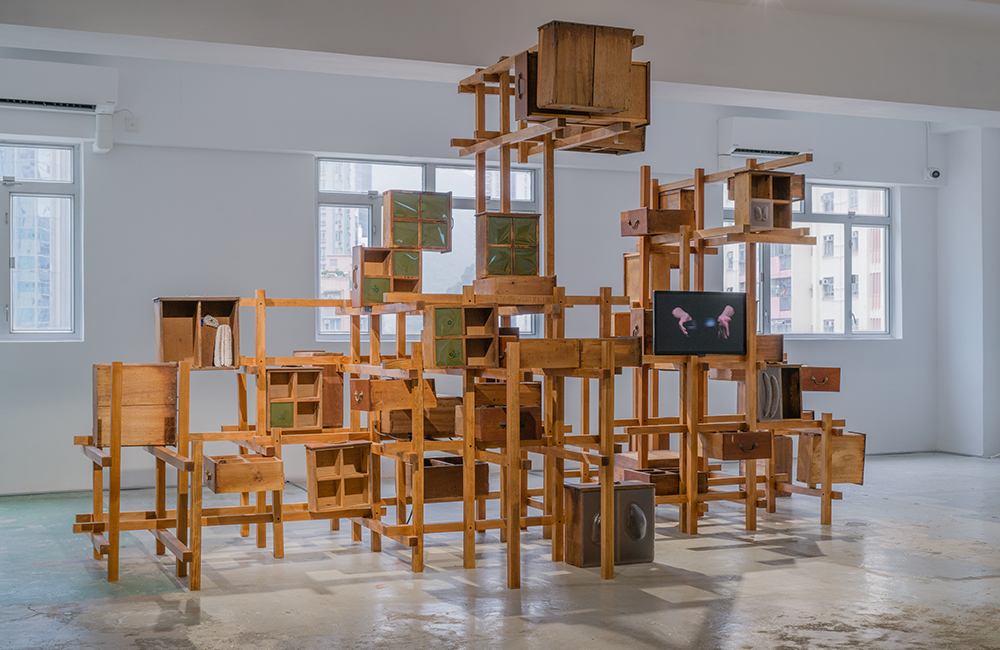
Wing Po So’s new installation presents itself as a constellation of three sculptural compositions – or “islands”, as the artist refers to them – constructed from old drawers once used in traditional Chinese medicine shops. These drawers, stacked and assembled in varying configurations, give rise to angular structures that appear simultaneously orderly and illogical. Some are positioned vertically, others inverted, open or shut, interlocked with precarious balance, ultimately producing a sense of organised chaos. Within the cold, stark environment of the gallery, the installation emerges as a living enclave – warm wood tones, the subtle scent of earth or dried herbs and a nearly recognisable soundscape evoking rhythmic breaths or pulses, all contributing to a multisensory experience.
So seeks to recreate the dynamic choreography characteristic of traditional Chinese pharmacies. Having grown up in her parents’ shop, she experienced the daily rituals first-hand: opening and closing drawers, climbing stools to reach higher levels, bending towards lower compartments, crushing dried plants, grinding powders and blending ingredients. In this installation, the drawers seem nearly animate, as if poised to resume their habitual motions. Each sculptural unit contains a video depicting hands working against a black background – grinding preparations with a mortar, sifting powders and sorting plant specimens. These are the hands of the artist’s father and mother, as well as her own, filmed by her brother.

The inclusion of drawers from her family’s pharmacy – originally acquired over 80 years ago by her grandparents – imbues the work with the qualities of a familial portrait. Additional drawers, however, were collected from other Hong Kong pharmacies forced to close, and they too carry the identity and history of their respective establishments. For So, these objects also mark a pivotal moment in her artistic trajectory: the transition from drawing to installation. While she was completing her master’s degree, her parents decided to retire but were reluctant to part with the furniture from their store. As a result, the drawers were stored in the family’s small apartment. This intimate cohabitation likely served as the catalyst for So’s shift toward installation art, inspiring her to incorporate personal and culturally resonant materials into her practice.
Beyond its evocation of cultural heritage, So’s work engages with the epistemological question of how we organise and classify reality. The human impulse to categorise the world around us has long been a defining feature of knowledge production, with each discipline constructing its own taxonomies. Within the compartments of the installation’s drawers, we find an eclectic assemblage: seeds, stones, projected images and small plastic objects produced through 3D printing. In this way, elements of the natural world, technological artefacts and human-made objects coexist and intermingle. Identification is not always straightforward: imprints of seeds are fossilised in plastic sheets; real coral sits alongside its artificial replica; stems resemble anatomical organs. Moreover, some items protrude from their compartments or straddle multiple drawers, disrupting expectations of containment. The system of storage here clearly follows a logic unique to the artist.

Inspired by the principles of Game of Life, which started life as a board game and is now also available online, So proposes an open, modular system capable of recombination and the generation of new configurations. In contrast to the rigid structures typical of classification systems, her installation offers a dynamic mode of understanding – one that embraces provisionality and transformation. Still, the artist grounds her practice in the mechanics of the living and in scientific observation. She frequently incorporates physical laws into her work, for example embedding magnets into the drawers and using small mechanisms to activate or stabilise components. This is how her oyster shells open and shut with a sharp sound, as if alive. As such, each drawer functions as a surprise container, also evoking notions of secrecy or mystery, as some may conceal hidden compartments or false bottoms.
Overall, there is a communicative joy in So’s engagement with the living world – a sense of wonder at its diverse properties and potentialities. Like an apprentice alchemist, she draws inspiration from cellular reproduction to replicate or reconfigure life forms. For instance, she creates artificial seeds and explores the material potential of her surroundings. How can we learn from nature, she asks. How might we approach it with an awareness of its ongoing evolution, its perpetual transformations and the invisible networks that animate it?

The disorder she introduces is not merely aesthetic – it is generative. It opens up alternative approaches to the living, emphasising symbiosis and mutual interaction over control and closure.
迭步
Para Site藝術空間
2025年3月15日至5月25日
蘇詠寶的全新裝置作品由一組三件的雕塑組成,她形容這些雕塑為「島嶼」。作品由藥材舖的舊百子櫃組成,經過堆疊與重組,透過不同的配置形成有角的結構,既有系統又雜亂無常。有些百子櫃豎立而放,有些則上下顛倒;有些開著,有些關上。它們交錯連接,微妙平衡,營造出一種「亂中有序」感。在簡潔冰冷的畫廊空間中,裝置成為了富有生命力的集中地。暖色調的木材、微微的泥土和藥材氣味,加上彷似呼吸和脈搏的聲景,構建出一場多感官體驗。
蘇詠寶希望透過作品,重現藥材舖的動態。她自小在父母的藥材舖中長大,親身經歷店舖的日常運作:開關百子櫃、爬上小櫈拿取高處的藥材、彎身取藥、搗藥、磨粉、調配藥方等。在這個裝置中,百子櫃好比有生命,隨時準備重拾例行的日常。每個雕塑單元都內嵌一段錄像,在黑色的背景下,手部動作模擬中藥製作過程的「搗、篩、揀」。這些手來自藝術家的父母和她本人,錄像由她的兄長拍攝。
作品中部分百子櫃來自其家族的藥材舖在,約八十年前由她的祖父母購入,為整件作品增添濃厚的家族色彩。其他百子櫃則是從香港其他倒閉藥材舖收集所得,同樣承載各間店舖的身份與歷史。對蘇詠寶而言,這些物件亦標誌著她在創作路上由繪畫轉向裝置藝術的轉捩點。在她攻讀碩士期間,父母決定退休,然而由於他們對店內家具難以割捨,最終將百子櫃搬回狹小的家中收藏。這種與舊物的相處很可能就是驅使她創作轉型的原因,令她開始將個人及文化記憶融入作品之中。
蘇詠寶的作品探討的不止文化傳承,更關乎我們如何整理與分類現實這一類知識論的命題。人類對世界進行分類的衝動,自古以來都是知識建構的基礎,而每個領域都有其獨特的分類系統。百子櫃內放有形形式式的物件:種子、石頭、影像投影、以及以3D打印的小型塑膠物。如此編排,自然物、科技產物與人造物混合共存。辨識這些物件的種類並非直接了當:封存於膠片的種子、與人造珊瑚並列的真珊瑚、形似人體器官的植物根莖。此外,部分物件從百子櫃伸出,甚至橫跨多格,挑戰觀眾對「容納」的理解,構建出一個完全根據藝術家個人邏輯而建的儲物系統。
蘇詠寶的靈感源自於原為桌上遊戲、現可於網上互動的「生命遊戲」,她嘗試提出一種開放、可組合、可再組織的系統,與傳統分類系統的嚴格結構形成對比,呈現一種圍繞暫時性與變化的動態理解方式。儘管如此,她的創作植根於對生命現象與科學觀察的關注,經常將物理定律融入作品當中。例如她會將磁石嵌入百子櫃中,設計小型機械裝置啟動和穩定某些部分。作品中的鮑魚殼亦因此可以發出清脆聲響,自動開合,猶如活生生。每個百子櫃如同一個寶盒,有時更暗藏機關和假底,喚起觀眾對秘密和神秘的想像。
整體而言,蘇詠寶的作品展現出一種與生命世界對話的喜悅,一種對萬物特性與可能性的驚嘆。她如同一位煉金術學徒,從細胞再生中獲得啟發,重新複製和配置出生命形態,透過她創造的人造種子,探索身邊物料的變化可能。她提出我們可以如何向大自然學習,又該如何應對它的持續進化與推動它的無形網絡的疑問。作品的混亂並非單純美學,而是愆生性的混亂,展開對生命的另類理解,強調共生與互動,而非控制與封閉。