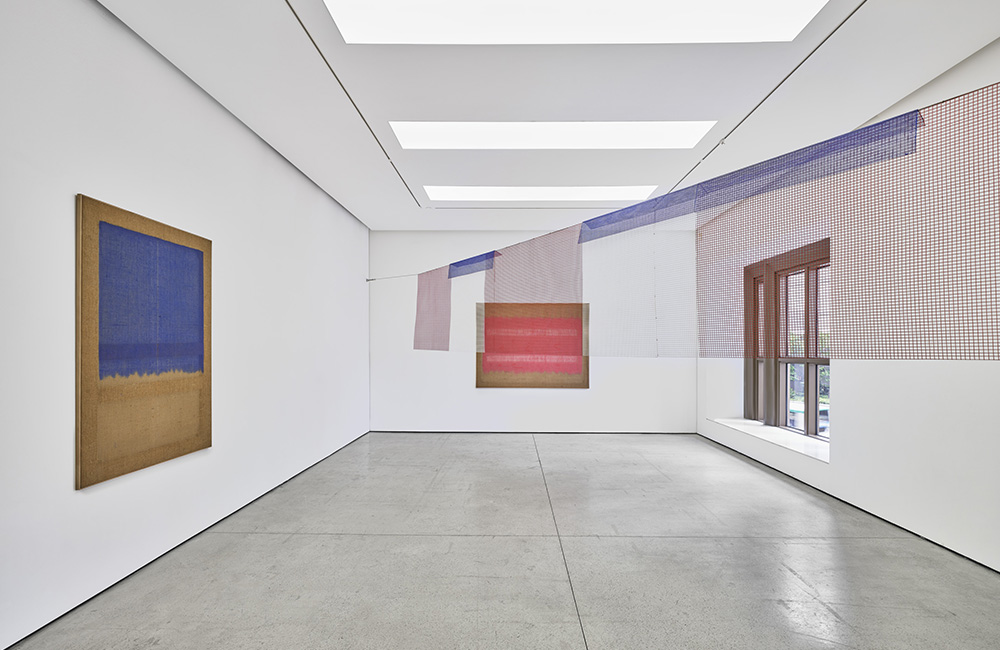
Born in Terzigno, near Naples, Salvatore Emblema (1929-2006) initially pursued a rather traditional artistic education, going to art school, training as a cameo jewellery carver (a practice that has a distinct Neapolitan declension, in the Torre del Greco school, which specialised in corals) and then enrolling in a degree in Fine Arts at the University of Naples. He didn’t finish university but instead dedicated time to travelling – going to France, the UK, and the Netherlands, and to New York for a year – after which he returned to Italy and started his career as an artist. In the 1950s, he worked for the Cinecittà movie studios in Rome, the largest in Europe, where he collaborated with Federico Fellini on films like La Strada (The Road, 1953-54), making the sets.
His artistic practice bears little resemblance to old-school academic training involving even meticulous jewellery-making skills: the modernity of his approach to painting and sculpture is striking even more than half a century later. In his hands, the unprimed jute and sackcloth canvases he uses have become objects, which he stripped of their threads until they revealed a three-dimensional vulnerability, producing ineffable and profoundly moving works, as if Emblema wanted to put us in the presence of total bareness, exposed in front of our eyes without any protection. On this manipulated, de-threaded, revealed and undressed jute and sackcloth canvas, he applied pigments produced by grinding stones and volcanic sand that he collected from the nearby Mount Vesuvius. Colour is spread on the semi-transparent surfaces in matt layers that add a feeling of earthly stillness and evoke the way in which paint adheres to a wall.

© Salvatore Emblema. Photo: © White Cube (Kitmin Lee).
Maybe his time spent as a cameo carver awoke a desire to explore the layers underlying every surface. Maybe the 2,000-year-old Pompeian frescoes, just four kilometres from Emblema’s birthplace, instilled a sensitivity for the way in which colour embraces the rough surface of a wall. And maybe a sense of theatricality might have been fostered by his time spent producing film sets in Rome. But even if we want to look for possible sparks that inspired Emblema’s work, the way in which he stripped down the canvases, exposing their vulnerability and physicality, is deeply original and very powerful: troubling, in a gentle but impudent way. Something unexpectedly sensual, even sexual, is aroused by these distressed, exposed threads, stirring up in the viewer a potent bond with his works, as if we are watching a lover taking off their clothes, exposing themselves in their most vulnerable state. Or as if we were watching ourselves, peeling off our external layers to reveal what we are underneath it all. In an autobiographical note, Emblema even quotes Leonardo da Vinci saying that “to get to the essence of things, you must remove, not add”.
The works on display at White Cube, all untitled, offer a panoramic view of Emblema’s trajectory, curated in a way that brings us from the most openly sensual works to his tall, metallic, open net sculptures – where his guiding statement on his own art, “I belong to the light”, seems to be taken to its furthest limit – to a return to painting.
A red, threadbare canvas from 1975, with four bands where the jute’s threads have been painstakingly removed, so as to produce small overtures in the areas where both weft and warp have been de-threaded, feels strangely intimate, as if we were looking at a pair of nylon stockings with an accidental ladder, an unexpected transparency that evokes close connection with partially clothed bodies. Elsewhere, the pink-bordered, doubly de-threaded lines (Untitled, 1970) interrogate us from the frame like a strange, lingering equation.

But this is not a loud, in-your-face sensuality. Rather, it is a pull of which we become slowly aware, as if taken aback by the possibility that a material as rough as jute could evoke such tender emotions. As his choice of the Leonardo quote reveals, Emblema’s pursuit of nakedness and of a stripped-down materiality has been a lifelong quest. This is confirmed by Emanuele Leone Emblema, grandson of the artist and director of the Museum Emblema in Terzigno:
“His canvases were denuded, de-woven. The transparency you see is not a precondition of the material, of the fabric, but a signature practice that differentiates his work from that of others: the transparency, the veiling and unveiling of the canvas itself.”
The subversion of the canvas-as-surface becomes even more pronounced in works such as Untitled/Diagonal (1975), where the jute has been de-threaded so thoroughly as to make it completely transparent, allowing us to see a diagonal blue band of jute attached to the back of the canvas. Through this transparency, the wall on which the work is hung also becomes part of the painting.
“Emblema’s canvases become an interruption in the spatial continuum, and the transparencies play with the wall behind them: it is the painting that becomes a wall, relating itself with the other wall, the one made with bricks that is visible behind it,” says Emanuele Leone Emblema.

© Salvatore Emblema. Photo: © White Cube (Kitmin Lee).
Through this structural decomposition, the canvas is both space and object, conveying a static atmosphere with architectural echoes – something that would emerge further in his sculptures. Here, too, materiality has been totally stripped of its substance, revealing a pared-down essence. An untitled structure from this period (1972) is made of a series of metallic nets, of the type used to reinforce concrete, coated in organic pigments – mostly blue, red and white – and left, as naked as the de-threaded canvases, hanging from a suspended cord. Emblema’s lifelong concern and search for light, which he said he was “chasing like a lover”, finds in his sculptures a total material subversion, making the essence of reinforced concrete as see-through and weightless as minimalist embroidery.
After this exploration, Emblema returned to painting. “Having erased everything and having placed sculpture into the landscape, he goes back to painting, this time imitating the movement of the landscape itself – through very stylised and abstract landscapes, [but] still recognisable as such,” says his grandson. “The colours he uses are earth pigments taken from Pozzuoli [a small port city near Naples and Vesuvius], meaning he chooses to paint the landscape with the landscape itself.”
The Pozzuoli pigments, when left undyed, have a red-earth hue, linking his works even more solidly with the land of his birth, as this is the same colour we can see in the many Neapolitan noble palazzos that used Pozzuoli’s earth for their surface painting, creating what is known as Neapolitan red. One example from these years is a beautiful untitled canvas from 1980, where the jute is not de-threaded, even if this type of fabric is not as compact as a primed cotton canvas. On it, an abstract mountain, maybe a volcano, sits behind a large black and blue-green form, suggestive of a hill with houses in the middle. The black pigment comes from volcanic lava, while the turquoise green is copper oxide, used in local agriculture to stimulate plant growth and as a pesticide. The canvas is no longer stripped of its materiality yet the search for light and transparency remains anchored in the large patches of colour, evocative of the materiality of a landscape seen in memory or in a heartfelt longing.
Thus, the arc of Emblema’s art goes from the revelation, near impudicity, of an undressed canvas, through the search for the most transparent essence of what is contained inside concrete to a place where we once again long for what we can’t hold in our hands. A memory. A light. The sight of our vulnerability.
薩爾瓦托雷・恩布勒馬(1929年-2006年)出生於那不勒斯附近的泰爾齊尼奧(Terzigno),他最初接受的是頗為傳統的藝術教育。他先就讀藝術學校,學習成為浮雕珠寶雕刻師(該技術帶有獨特的那不勒斯風格,屬於專攻珊瑚雕刻的Torre del Greco流派),之後在那不勒斯大學修讀美術學位。他沒有完成大學學業,反而選擇了到處旅遊——他去了法國、英國和荷蘭,並在紐約待了一年——之後回到意大利,展開他的藝術生涯。在 1950年代,他在位於羅馬、歐洲最大的電影製片廠奇內奇塔(Cinecittà)工作,與費德里柯・費里尼合作為《大路》(1953年-54年)等電影製作佈景。
他的藝術實踐跟牽涉細緻珠寶製作技藝的傳統學院派截然不同:即使過了半個多世紀,他對繪畫和雕塑的現代化詮釋依然令人震驚。他把原生黃麻畫布和粗紡麻布變成作品中的元素。他拆去畫布上的線頭讓它們展現出立體的脆弱性,創作出讓人深深震憾的作品,彷彿想要向我們赤裸裸毫無保留地展示自己。在經過處理、拆去線頭、原始的黃麻和麻布畫布上,恩布勒馬塗抹上從附近的維蘇威火山收集到的石頭和火山砂製成的顏料。霧面的顏料一層層地被塗抹在半透明的畫布上,增添了一種塵世的寧靜感,並讓人聯想到油漆在牆上的感覺。

© Museo Emblema and Emblema Estate Archive.
Photo: © White Cube (Kitmin Lee).
或許他作為浮雕雕刻師的經歷激發了他探索表層之下的層次的渴望,或許是有二千年歷史、 距離恩布勒馬出生地僅四公里的龐貝壁畫讓他對塗抹了色彩的粗糙牆面更為敏感,又或許是他在羅馬製作電影場景的經歷培養了他的戲劇藝術感。即使我們想尋找恩布勒馬創作的靈感來源,他拆卸畫布以展現其脆弱和結構的方式也極具原創性和力量:是一種溫柔卻又肆意的混亂。這些紛亂暴露的線意外地喚起了一種感性,甚至性慾,在觀者心中勾起了與作品的強烈聯結,彷彿我們正看著戀人脫去衣服,展露出自己最脆弱的一面。又彷彿我們正看著自己,剝去層層外衣展現出埋藏其中的真我。在一篇自傳中,恩布勒馬甚至引用了達文西的話:「要了解事物的本質,你必須去除,而不是添加」。
白立方畫廊展出的作品均無標題,為觀眾呈現了恩布勒馬的全方位創作軌跡。展覽的策展方式帶領我們從最感性開放的作品,到高大的金屬網狀雕塑——這些雕塑極致地體現了他對於自己的作品的引導性宣言「我屬於光明」——然後再回到繪畫。
在一幅創作於1975年的紅色拆線畫布上,四道帶狀的黃麻線被仔細拆除,被拆除的區域形成細小疏落的孔洞,給人一種奇異的親密感,彷彿看著一雙不意勾紗的尼龍絲襪,出乎意料的透明感讓人聯想到半裸的身體。此外,另一幅有粉紅色邊框和兩道被拆線的寬帶的作品(《無題》,1970年)就像一道奇怪而又未完成的公式,從畫框中向我們發出質問。
但是這並非一種強烈、直面的感官感受。相反,我們會慢慢感受到其中的情緒,並訝異於黃麻這樣粗糙的材料也能喚起溫柔的情感。正如他所引用的達文西名言所言,赤裸和極簡物質是恩布勒馬的畢生追求。恩布勒馬的孫子、泰爾齊尼奧的恩布勒馬美術館的館長Emanuele Leone Emblema的證實了這一點。
「他的畫布被剝開、被拆線。你所看到的透明感並不是材料或布料本身的狀態,而是他的作品的一種標誌,使他的作品不同於其他人的作品:透明度,畫布本身的編織與拆解。」
在《無題/對角線》(1975年)等作品中,以畫布為主體的運用更為明顯。黃麻布被徹底拆解以達至完全透明,讓我們能夠看到畫布背面的那條對角藍色黃麻帶。這種透明感令懸掛作品的牆壁也成為了作品的一部分。
Emanuele Leone Emblema說:「恩布勒馬的畫布打斷了空間的連續性,作品的透明感又與背後的牆壁互動:繪畫本身是一面牆,而且與背後那另一面磚牆相聯繫。」
透過這種結構的拆解,畫布既是空間也是物品,營造出帶有建築性的靜態氛圍——這種特質更體現在他的雕塑中。在這裡,物品的物質性也被徹底剝離,展現出簡約的本質。這段時期(1972年)創作的一件無題作品是由一系列金屬網構成,這些金屬網常用於加固混凝土,塗有有機顏料——主要為藍、紅和白色——然後作品被懸掛在半空中的一條繩子上,像被拆線的畫布段赤裸。恩布勒馬用畢生關注並追尋著光,他曾說自己「像追逐情人一樣追逐著光」。他的雕塑作品徹底顛覆了材質,使鋼筋混凝土如同極簡主義刺繡般透明、輕盈。
經歷過這些探索後,恩布勒馬回歸繪畫。他的孫子說;「他在抹去一切,將雕塑放置在風景中之後,又回歸繪畫。這次他透過非常個人的風格和抽象的風景來模仿風景本身的律動,但仍然能辨認出其原本的樣子。」他續指:「他使用的顏料是從波佐利(那不勒斯和維蘇威火山附近的一個小港口城市)採集的土質顏料,他選擇用風景本身來描繪風景。」
波佐利顏料未經染色時呈現紅土色調,讓他的作品與其出生地更加緊密地聯繫在一起,因為在許多那不勒斯貴族宮殿中,我們都可以看到同樣的顏色。他們使用波佐利的泥土繪畫牆壁,創造出所謂的那不勒斯紅。其中一個例子就是 1980 年的一幅美麗的無題畫,其中的黃麻布沒有被拆線,即使這種布料不像塗過底漆的棉質畫布那樣緊實。這幅畫中有一座抽象的山,也許是一座火山,坐落在一塊巨大的黑色和藍綠色色塊後面,這片色塊也許是一座中間有房子的小山坡。黑色顏料來自火山熔岩,而綠松石色是氧化銅,在當地農業中用於刺激植物生長和用作殺蟲劑。畫布不再被拆解,但他對光與透明感的探索依然隱藏在大片的色塊之中,令人聯想到記憶中或理想中的風景地貌。
因此,恩布勒馬的藝術生涯從對未經修飾的畫布肆意拆卸開始,通過探索實體中最透明的本質,最終到達了一個有我們想要的卻又無法緊握在手中的地方。一段回憶。一道光。目睹我們的脆弱。