Courtyard of Attachments /
M+ /
Jun 14 – Oct 12, 2025 /
Caroline Ha Thuc /
Courtyard of Attachments, Trevor Yeung’s exhibition at M+, constitutes the Hong Kong iteration of the artist’s presentation for the 2025 Venice Biennale. Distributed across three rooms, one of which is devoted to video documentation, the exhibition has been reconfigured to suit the institutional context of the museum. The original installation featured four site-specific works that incorporated two distinct bodies of water: seawater outdoors and freshwater sourced from the Venice canal indoors.
Central to the project is the notion of relationships explored through absence, mostly articulated through the presentation of 74 uninhabited fish tanks. At M+, this absence is intensified: not only are the fish missing but the water itself has also been removed. The exhibition thus distances visitors even further from the living ecosystems that once animated the installation. Consequently, issues such as water quality, ecological interdependence and human-aquatic relationships are displaced. Instead, questions of care and attachment are replaced by an encounter with their impossibility. The exhibition ultimately stages a dystopian vision of humanity, locked within an isolated, anthropocentric cultural framework.

Photo: Dan Leung. Courtesy M+, Hong Kong.
From a curatorial standpoint, the show engages with the complexities and limitations inherent in transposing site-specific installations into a radically different spatial and cultural context. It raises the issue of what remains of the original Venice iteration once it has been relocated to Hong Kong, and conversely, what elements have been altered, damaged or proven impossible to transport – such as the presence of running water from the Venetian canal. Most importantly, it questions how a curatorial narrative and spatial design might be rearticulated in order to accommodate these transformations and to establish meaningful resonance within the new exhibition environment.
Some of the newly constructed narratives appear somewhat tenuous. For instance, the curatorial text accompanying the first installation foregrounds the accumulation of salt deposits and clusters of fungi on the artworks, framing these material by-products as indicators of “survival against the odds” and as an invitation to “imagine alternative modes of existence”. While evocative, the first claim could be applied to any artwork transported from one place to another – and it seems almost comical to think about what it could mean to engage in a so-called alternative mode of existence as fungi.
Whereas the Venice edition evoked the atmosphere of a cultivation centre or industrial facility, the Hong Kong presentation resembles an abandoned scientific laboratory. The first gallery space is immersed in ultraviolet lighting and populated with empty fish tanks, discarded chairs, cabinets, fragments of broken glass and bare desks. At the entrance, a large photograph – Couple in Bubbles (2021) – depicts people in front of a fish shop, holding each other and apparently looking at the fish. It looks like an old souvenir of bygone days when people could buy fish in plastic bags. Highly cinematic, the setting prompts imagination: one might imagine a revolt in which the fish reclaimed their freedom by destroying both their tanks and their human captors. Some works cannot be seen from too close, such as Little Comfy Tornado (2025), previously a complex aquatic system supported by seven filters generating a powerful current. It remains in the dark at M+, out of reach and half broken.

Photo: Dan Leung. Courtesy M+, Hong Kong.
The malfunctioning of these systems renders the social allegory of the installation less explicit than in Venice. Without the circulation of water or the bubbling mechanisms that once suggested a stratified, interdependent society, the metaphor of collective functioning collapses. The horizontal reconfiguration of the display further diminishes analogies to social structures. About 20 years ago, duo Map Office exhibited Crab Island (2010), an installation made of 24 aquariums displayed like four towers of social housing units, yet each one was inhabited by real crabs, all living under a purple UV light. Here, it is harder to project the idea of a society, even in ruins, as each piece seems very isolated from the others. The only form of vitality present is that of the audience themselves.
This reflexive dimension is reinforced through Yeung’s use of mirrors. Along the corridor, the wall is covered with distorting mirrors and, within the fish tanks, mirrors also return the viewer’s gaze. In the second room, this motif is developed further with Mx. Tried-My-Best (2025), a work commissioned by M+ consisting of plastic buckets filled with mirrors.

Photo: Dan Leung. Courtesy M+, Hong Kong.
Yeung is passionate about fish and has kept them from an early age. A central question guiding his work is whether, when we gaze into a fish tank, we are truly looking at the fish – or merely at ourselves. Which kind of relationships can we build with a pet, especially when it’s confined to a small fish tank? These relationships are inherently asymmetrical: pets exist in conditions of dependence, subject to the authority and care – or neglect and abuse – of their human caretakers. The notion of care, or attachment, can also be questioned. Do we care about the fish we feed themselves or because such care offers us a sense of purpose and self-validation? According to Euromonitor, there were a total of 1.19 million pets in Hong Kong in 2022, with the number of fish expected to increase. What shall we do with these figures and mode of interactions with the living?
The last gallery space presents video documentation that amplifies these questions through testimonial accounts. Exhibition staff from the Venice Biennale describe the daily maintenance tasks required by Yeung’s installations, such as cleaning the tanks to counteract humidity and salt residue. Their reflections suggest that repetitive, utilitarian gestures can foster a form of attachment, even towards an inanimate object. Caring for pets is often an attempt to give purpose to a solitary life. We all remember Tamagotchi, the popular pet simulation game from the 1990s that pushed millions of people into raising and taking care of an egg-shaped device. It revealed clearly how much the idea of pets is a social and cultural construct.
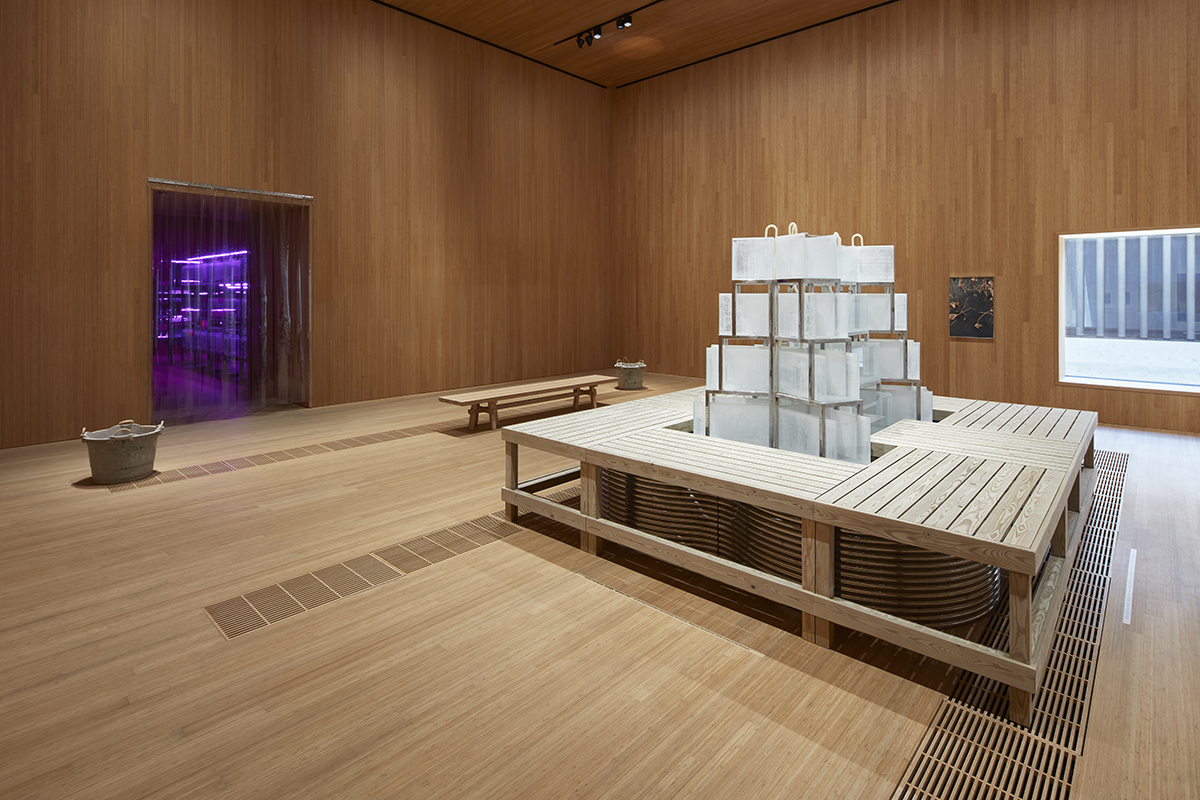
The second room of the exhibition further accentuates this artificiality. With its bright light and empty spaces, it evokes a setting that is at once deserted and absurd. Again, what was shown running in Venice is now out of order and the artworks look like abandoned props. While the exhibition text frames the courtyard as a site for contemplation, the atmosphere it produces is instead one of estrangement and unease. The artworks appear disconnected from one another, resisting a coherent relational structure. At the centre stands a dry fountain, stripped of aesthetic or symbolic vitality. At the back, Gate of Instant Love (2024), once conceived as an entryway, is displayed flat against a wall, stripped of its function and reduced to an inert architectural fragment.

Photo: Dan Leung. Courtesy M+, Hong Kong.
Similarly, Rolling Gold Fountain (2024) does not roll any more, since there’s no water to make it do so. The installation was already mysterious in Venice, and here it seems even more strange. The artwork consists of five spheres of a stone resembling citrine, a variety of quartz associated in Chinese culture with prosperity. Whereas such installations typically serve as ornamental displays of prestige in domestic or corporate reception areas, Yeung replaced the expected marble supports with synthetic resin. In their present state, the motionless spheres evoke not vitality but suspension, as though the gallery had been transformed into a waiting room or, more unsettling still, an aquarium designed for human beings.
In his famous novel Axolotl (1956), Argentinian writer Julio Cortázar describes a man so captivated by the amphibians he observes in an aquarium that he ultimately crosses the glass barrier, transforming into one of them. During my own encounter with Yeung’s installation, I found myself drawn to the large windows of the gallery, where birds fluttered among plants growing along the museum’s exterior wall. In contrast to the sterile and reflective interior, the outside world appeared vibrant, animated by non-human life. At least, I thought, Cortázar’s character enjoyed a real encounter with the axolotl. With Courtyard of Attachments, Yeung denies us this possibility. We are directly and constantly sent back within our narrow, anthropocentric vision of the world, alone.
信离庭
M+
2025年6月14日至10月12日
Caroline Ha Thuc
楊沛鏗的M+展覽「雙附院」,是其2025年威尼斯雙年展的香港回應展。為配合博物館的機構環境,展覽已作重新佈局和分佈在三個房間,其中一個專責播放錄像紀實。原裝裝置包括四組場域特定作品,它們融合了兩種截然不同的水體:海水在室外,而室內則是來自威尼斯運河的淡水。
作品的核心是從缺席中探索關係的概念,以74 個沒有魚的魚缸按表達。這種缺失在M+更有力地呈現:魚缸中除了不見魚兒,連水也被拿走。裝置中本來以水來呈現富動感的生態,這次沒有水的安排,令觀眾與此便有著更遠距離。因此,水質、生態相互依存和人與水關係等議題被移開。照顧和依附等問題被換走,取而代之的是無法提問該些問題的場景。展覽最終呈現了一種人類反烏托邦願景,鎖定於孤立、以人類為中心的文化框架內。
從策展的角度來看,展覽探討了將場域特定裝置移至完全不同的空間和文化背景中所存在的複雜性和限制,也反問,將原裝威尼斯版本移師香港後還剩下什麼,然後再問哪些元素已改變、損壞或證明無法運送——威尼斯運河的自來水正是一例。最重要的是,回應展質疑應如何重整策展論述和空間設計來適應這些轉變,再在新展覽環境中產生有意義的共鳴。
部份新建敘事略顯脆弱。例如,第一組裝置的策展文字帶出了作品上有沉積鹽和菇 群,並將這些物料的副產品表述為「逆境生存」的跡象,還邀請觀眾「想像另類的存在模式」。雖然引人深思,但第一個說法適用於任何從一個地方運往另一個地方的藝術品,再想一想,以真菌為所謂的替代存在方式意味著什麼,幾乎是滑稽的講法。
威尼斯的展覽散發著培植中心或工業設施的氣氛,而香港版則像已遭廢棄的科學實驗室。第一個展廳沉浸在紫外線照明中,裡面擺滿了空無一物的魚缸、被丟棄的椅子、櫥櫃、玻璃碎片和光禿禿的書桌。入口處的《泡中情人》(2021年)是一幀大型照片,描繪路人在金魚店前依偎賞魚,這件古舊的紀念品捕捉金魚還裝在塑膠袋出售的日子。充滿電影感的場景激發想像:觀眾或會聯想一場叛亂,金魚為了討回自由而摧毀魚缸和俘虜牠們的人類。部分作品只宜遠觀,例如《小小安逸龍捲風》(2025年),此前是複雜的水生系統,在七個過濾器支撐下產生強大的水流。裝置移師M+後,半破地設在黑暗之中,變得遙不可及。
裝置在威尼斯展出時的社會寓言效果,因為本地版的上述系統故障而變得隱晦。水流循環和冒泡機制本來暗示社會上的階級和相互依存現象,回應展中的裝置欠了這些元素,群策群力的隱喻便無法成立。顯示屏以水平重新排列,亦削弱了社會結構的類比。大約 20 年前,雙人藝術家組合Map Office 展出了《蟹島》(2010年),這是一個由 24 個水族館組成的裝置,展示得像四座公屋大樓,但每個水族館都棲息著真正的螃蟹,活在紫色紫外線下。在這裡,更難投射一個社會的概念,即使是在廢墟中,因為每件作品似乎都與其他作品非常孤立。存在的唯一活力形式是觀眾本身。
這種反身的維度通過楊氏對鏡子的使用為之強化。沿著走廊,牆壁上佈滿了哈哈鏡,在魚缸內,鏡子也反映觀眾的目光。在第二個房間,M+委託創作的《已盡力先生》(2025年)進一步發展了這一主題,該作品由裝滿鏡子的塑膠桶組成。
楊氏對魚充滿熱情,從小就養魚。指導他作品的一個核心問題是,當我們凝視魚缸時,我們是否真的在看魚——或者只是在看我們自己。我們可以與寵物建立什麼樣的關係,尤其是當它被限制在一個小魚缸裡時?這些關係本質上是不對稱的:寵物存在於依賴的條件下,受到人類照顧者的權威和照顧——或忽視和虐待。關懷或依附的概念也可以受到質疑。我們是在乎我們自己餵養的魚,還是因為這種照顧為我們提供了一種使命感和自我驗證?根據歐睿的數據,2022年香港共有一百一十九萬隻寵物,預計魚類數量將會增加。我們該如何處理這些人物以及與生者互動的方式?
最後一個畫廊空間展示了錄像紀實,通過推薦敘述放大了這些問題。威尼斯雙年展的展覽工作人員描述了楊氏裝置所需的日常維護工作,例如清潔水箱以抵消濕氣和鹽殘留。他們的反思表明,重複的、功利主義的行為可以培養一種依附,甚至是對無生命物體的依戀。照顧寵物通常是為了為孤單生活賦予目標。我們都記得電子寵物Tamagotchi,這是 1990 年代流行的寵物模擬遊戲,它促使數百萬人飼養和照顧蛋形裝置。它清楚地揭示了寵物的概念在多大程度上是一種社會和文化建構。
展覽的第二個房間進一步強調了這種人為性。明亮的光線和空曠的空間,讓人聯想到一種既荒蕪又荒謬的環境。同樣,在威尼斯運行的內容現在已經失序,藝術品看起來像是廢棄的道具。雖然展覽文字將庭院框定為沉思的場所,但它所營造的氣氛卻是一種疏遠和不安。這些藝術品似乎彼此脫節,抗拒連貫的關係結構。中心矗立著一個乾涸的噴泉,失去了美學或象徵性的活力。在後面,曾經被設想為入口通道的《秒愛之門》(2024 年)被平放在牆上展示,剝奪了其功能,淪為惰性的建築碎片。
同樣,《財源滾滾泉》(2024 年)不再滾動,因為沒有水可以讓它滾動。這個裝置在威尼斯已經很神秘了,在這裡顯得更加奇怪。這件藝術品由五個類似黃水晶的石頭球體組成,黃水晶是一種在中國文化中與繁榮聯繫在一起的石英。雖然此類裝置通常是家庭或企業接待區代表的威望的裝飾,但楊氏用合成樹脂取代了預期的大理石支架。在目前的狀態下,一動不動的球體喚起的不是活力,而是懸浮,就好像畫廊被改造成一個候診室,或者更令人不安的是,一個為人類設計的水族館。
阿根廷作家胡里奧.科塔薩爾的名著《蠑螈》(1956 年)描述了一個男人對水族館中觀察到的兩棲動物非常著迷,最終越過玻璃屏障變身成為其中一員。在我接觸楊氏的裝置作品時,展廳的大型窗戶把我吸引,讓我看到鳥兒在博物館外牆長出的植物之間翩翩起舞。非人類生物令室外世界顯得充滿活力,與全無生氣和反光的室內佈局形成鮮明對比。我認為,科塔薩爾筆下的角色至少能享受到與蠑螈接觸。楊氏在「雙附院」剝奪了這種可能性,直接和不斷地令觀眾單獨回到以人類為中心的狹隘世界觀裡。