They always look from an imagined above
Radvila Palace Museum of Art
Vilnius, Lithuania
Nov 27, 2025 – Mar 15, 2026
Tautvydas Petrauskas
Where are all the colours? The question is of course a bit silly, but it follows the visitor around Oscar Chan’s exhibition They always look from an imagined above, just like the synaesthesia of images and the smell of Chinese ink that settles over the exhibition rooms. Maybe the colours were there before and then evaporated, little by little, and maybe they’re now releasing that smell? Perhaps all those thorny, threatening, self-contained beings flying around absorbed all the colours, or they were devoured by the King of Ghosts from the work of the same name in the fourth room?
I visited the exhibition at the Radvila Palace Museum of Art in January, one of the least colourful months in Lithuania. It could be described as naked or even skinless, like many of Chan’s drawn or painted beings – because why would these dream images of skeletons and personifications of quasi-mythological characters need clothes? Clothes and costumes are primarily meant for people, so the category of nakedness almost loses its meaning in the worlds conjured up by Chan. Yet it makes little sense to rationalise or logically structure the artist’s images and the connections between them. The exhibition is certainly not about this. His priority is not stable historical or theoretical systems but rather intuition and hunches, the subconscious, Dionysus, myth and mystery. On the level of ideas, and perhaps also of forms, there are even connections to the symbolists of the late 19th century. They were also concerned with subjective expression, irrationality and turning the inner gaze beyond material, sensory reality to a place where there is almost no need for our eyes.

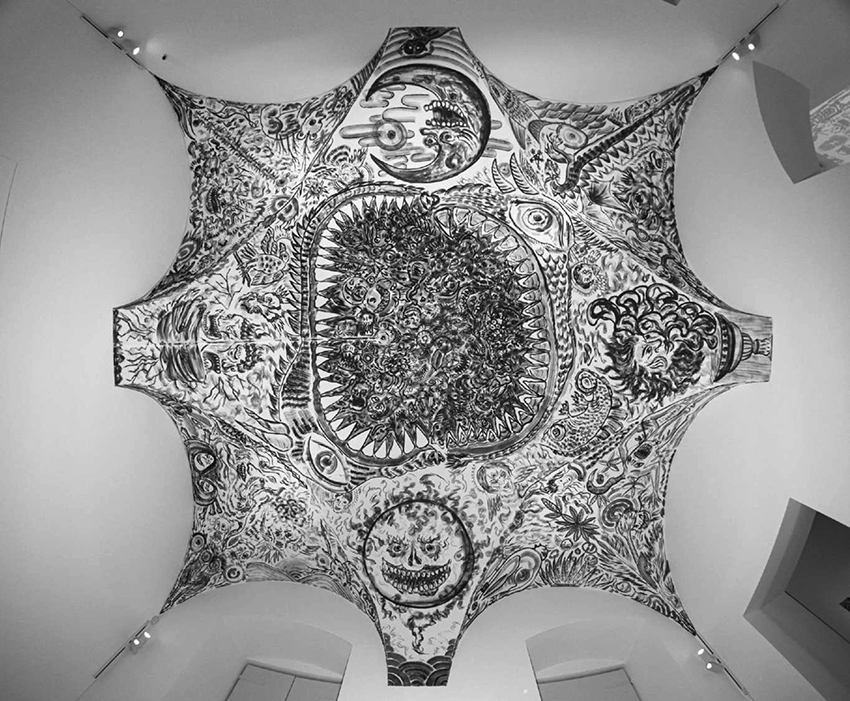
2x 6 parts, each 180 × 65 cm, 2025. Courtesy the artist and Radvila Palace Museum of Art, Vilnius.
Certainly the symbolists, unlike Chan, attached great significance to colour, and their works contain fewer elements of tension or unease. Chan confronts irrational, intangible themes and phenomena eye to eye, using artistic creation to grant the “they” from the exhibition title a place in our reality. Moreover, by forgoing colour, the artist makes the confrontation with them even more direct – most probably the origin of the nakedness mentioned above. In this exhibition, Chan’s work demonstrates a rather clear dichotomy between here and there, distinguishing between what can be grasped and what can only be sensed – between clearly delineated structure and fleeting sensation. The most interesting aspect of this exhibition is the artist’s ability to transform one into the other and vice versa, as if this distinction never existed. He lends a clear form and image to intuitive assumptions.
Chan knows how to include and connect various contexts in his visual expression: in this exhibition, it includes elements from manga and comics, and references to ancient Asian painting and the decoration of vaulted chapels during the Renaissance. This whole principle – one of quotes, paraphrases, appropriation – is in itself an indication of our times and an imperative of contemporary global art.
Perhaps the exhibition’s strongest element is a group of ink drawings in the building’s vault, executed in one go, without advance planning. Less successful is the show’s third room, with its video projections of drawings. There is also quite a lot of empty space, presumably to balance out the dense, vital and sometimes furious imagery, but if the exhibition spaces had been just a bit smaller, everything would have come together and harmonised even better.
The exhibition delivers on its title. In fact, walking around and looking at the works, the visitor has the distinct feeling of being half-secretly watched by someone. Perhaps it’s this, and not the absence of colour, that adds a small nuance of anxiety. With rather minimal means, Chan has created a remarkable, effective but not particularly pleasant atmosphere for the viewer, one that is full of sources of anxiety and doubt – a state of uncertainty or lack of clarity that pushes them out of their comfort zone. An exhibition like this one is like a visit to the dentist – hardly pleasant, but a necessary precaution.
They always look from an imagined above
拉齊維烏宮美術館
立陶宛維爾紐斯
2025年11月27日至2026年3月15日
顏色在哪裡?這個問題當然有些傻,但卻縈繞著參觀陳翊朗展覽「They always look from an imagined above」的觀眾,如同圖像與墨香交織的通感體驗一樣,瀰漫在整個展場之中。也許顏色曾經存在,但後來一點一滴蒸發,如今已化作氣味釋放。又或者顏色已被那些帶刺、威脅性十足而又自成一體的飛行物所吸收,甚至已被第四展室作品《鬼王》中的角色吞噬。
我到拉齊維烏宮美術館參觀這個展覽的時候是一月,亦是立陶宛全年其中一個最缺色彩的月份。那種狀態可以說是赤裸,甚至沒有皮膚一樣,如同陳翊朗筆下的形體。畢竟這些夢境般的骷髏和神話式的擬人形體,又何須衣裝?衣物本屬於人類,所以在陳翊朗所召喚的世界裡,「裸體」這個概念幾乎沒有意義。然而,試圖以理性或邏輯梳理藝術家的圖像和關聯,反倒顯得徒勞,因為這場展覽顯然不在於此。他關注的不是穩定的歷史或理論體系,而是直覺與預感、潛意識、酒神精神、神話與神祕。在思想甚至形式的層面上,都隱約可見十九世紀末象徵主義者的影子。他們同樣強調主觀表達、非理性,以及將內在目光轉向物質與感官現實以外的領域,一個幾乎無需肉眼的所在。
當然,象徵主義者與陳翊朗不同,他們極度重視色彩,作品中的緊張與不安也較少。陳翊朗則直面那些非理性與難捉摸的主題與現象,透過藝術創作,為展題中的「他們」在我們的現實中騰出位置。而他對色彩的放棄,令這種對峙更加直接,或許這正是那種「裸露感」的來源。在這場展覽中,陳翊朗的作品呈現出相當清晰的二元結構:此處與彼方、可把握之物與僅能感知之物、清晰結構與流動感受。展覽最引人入勝之處,在於藝術家能夠在兩者之間來回轉換,彷彿這道界線從不存在。他為直覺的假設賦予清晰的形態與圖像。
陳翊朗擅長在視覺語言中納入並串聯多重語境:展覽的漫畫與日本漫畫元素、亞洲古代繪畫的意象,以及文藝復興時期拱頂禮拜堂裝飾的痕跡。這種引用、轉述與挪用的原則,本身就映照我們身處的時代,也是當代全球藝術的一種必然。
展覽最強而有力之處,或許是一組在建築拱頂上的水墨繪畫,一氣呵成而沒有預先規劃。相較之下,第三展室的繪畫錄像投影則略顯薄弱。展場亦保留了大量留白空間,似為平衡那些濃密、旺盛甚至狂暴的圖像。然而若展場空間稍為縮小,整體或許會更加凝聚與和諧。
展覽確實回應了它的標題。漫步其間,觀眾會清楚感到自己彷彿被人在半隱蔽下暗中凝視。也許真正帶來不安的,並非色彩的缺席,而是這種被注視的感覺。陳翊朗以相對簡約的手法,為觀眾營造出一種鮮明有效、卻不討喜的氣氛。充滿焦慮與懷疑的源頭,使人處於不確定與模糊之中,被迫離開舒適圈。這樣的展覽就像看牙醫一樣,難言愉悅,卻是一種必要的預防。