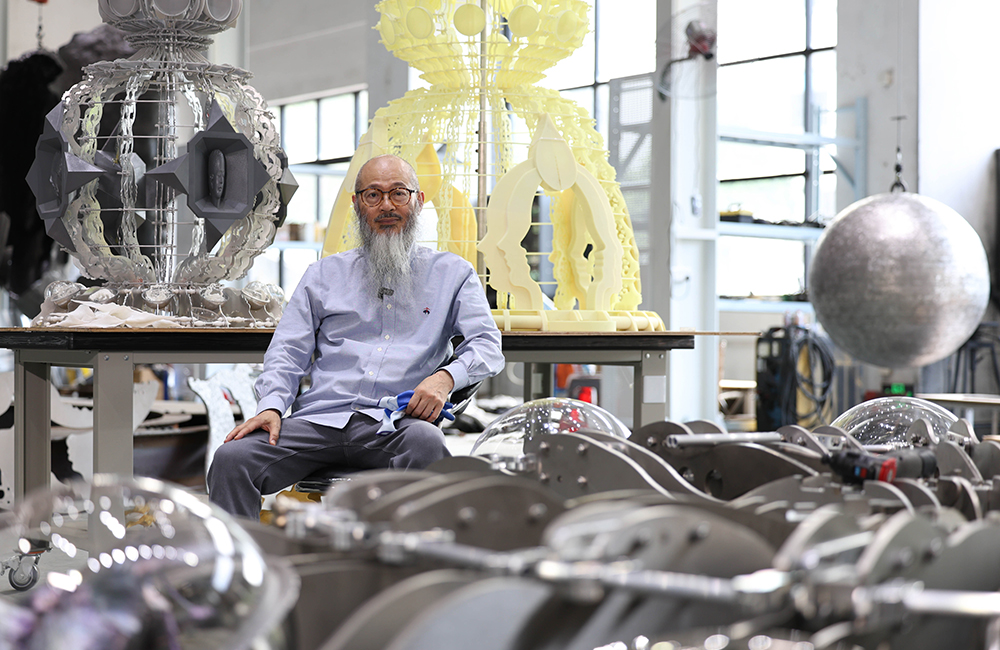
In 2026, as he turns 70, the Hong Kong-based artist Wallace Chan presents Vessels of Other Worlds, a dual-site exhibition unfolding between Venice and Shanghai. The show opens at the Chapel of Santa Maria della Pietà during the 61st Venice Biennale in May and at the Long Museum in Shanghai’s West Bund in July. Venice drifts on water, dense with memory, while Shanghai flourishes from river and sea, charged with contemporary velocity. Between them, the new works shift in scale, in atmosphere, in the very texture of looking.
The exhibition revolves around three monumental sculptures – Birth, Growth and Death. Working in titanium – unyielding yet unexpectedly lightweight, industrial yet capable of catching and bending light – Chan situates the pieces somewhere between sculpture, architecture and instrument. Each is several metres tall and composed of thousands of components, within which smaller, almost cellular elements suggest hidden systems at work.
For Chan, material is not inert but has an existence with its internal logic. Titanium resists, reflects, recalibrates. Making, in this context, becomes a prolonged negotiation, an oscillation between intention and response. Installed across two cities with distinct cultural climates, the works do not simply travel; they alter. What emerges is not a statement about an elsewhere but a sustained meditation on passage itself. Vessels of Other Worlds is an invitation to question – about origin, about return and about how matter might carry the weight of metaphysical inquiry.

Courtesy the artist.
Jessica Wan: Vessels of Other Worlds is an invitation to a journey. Could you describe the core vision or philosophy behind it? What themes or ideas are you most excited to explore? Wallace Chan: Vessels of Other Worlds explores the distance between certain dimensions and us. In my view, the “this world” we can perceive is only one part of life; the other part concerns the meaning before birth and after death. That realm, yet to be captured by language, is what we call “other worlds”. The works in Vessels of Other Worlds allow me to converge and refocus on the ideas that have lingered in my mind throughout 50 years of creative work.
Among them are the fundamental questions: who am I? Why am I here? Where does life come from and where is it going? Therefore, this set of three works – Birth, Growth and Death – constitutes a triptych about life. They point towards the unknown and serve as a passage between oneself and others. Because of this, the works attempt to establish a connection between individual experience and a broader existence.
The puzzle each person sees in the works is not exactly the same, and it is precisely this difference that constitutes the integrity of the work.
In the context of Chinese culture, there are sayings such as “vessels carry the Way” and “objects pass on heritage”. A vessel is not just a physical form existing in the world; it also carries memories and souls. In the English-speaking world, the word “vessel” refers to both a container and a ship, while simultaneously symbolising a dwelling for the body and soul. As I travel between eastern and western cultures, from the Chinese “qi” (器) to the English “vessel”, I see the intersection of this shore and the other shore, and I see the resonance between the self and the other worlds.
JW: Could you tell us more about Birth, the sculpture installed outside the Long Museum? As it’s the first work visitors encounter, how did you approach its colour, spiritual expression and use of materials? WC: Birth is like a blank sheet of paper, containing infinite possibilities and symbolising the various transformations life will manifest as it grows. Consequently, the colours presented in the work are relatively rich, with yellow as the primary tone.
In Chinese mythology, humanity was created by Nüwa moulding clay; the clay itself is yellowish in colour. Therefore, I chose yellow as the main tone, to signify that life originates from the earth. At the same time, I added blue and red. Blue represents the sky and unknown space, while red symbolises blood and vitality. Life begins at the intersection of these colours.
In the sculpture, I used 12 small elements to depict the primal state of life, such as sunflowers, seeds, pigeons and swallows. Sunflowers always face the sun, representing the pursuit of light and energy; seeds symbolise latent potential; pigeons and swallows symbolise flight and freedom, showcasing the spiritual agility and upward posture of life at its inception.
In addition, the work incorporates a gear structure. The gears mesh and rotate, symbolising the activation of life’s mechanisms, as well as the beginning of time and consciousness. Much like a watch, when the central gears engage, the second, minute and hour hands follow suit, calculating the time of a day, a year and even a lifetime. From this point, life enters into a state of order and regularity.
In terms of form, I also used curves and spheres. The sphere symbolises circulation and wholeness, as well as the movement of all things within the cosmic order. It suggests that all matter is composed of multiple elements, generating life through constant movement and transformation. Therefore, Birth is not merely a single moment but a cosmic beginning.
JW: This exhibition is presented through a collaboration between Venice and Shanghai, opening a dialogue between two cities with very different characters and cultural contexts. How do you view the impact of these two locations on the exhibition experience? And what significance do they hold for you personally? WC: Venice possesses a unique spatial quality, history and spiritual context. Shanghai, meanwhile, is brimming with urban energy, openness and a sense of the contemporary.
In the chapel in Venice, the viewers see smaller-scale oil paintings, sculptures and video installations. In Shanghai, they can directly face giant sculptural forms standing seven, eight, even 10 metres tall. This difference in spatial scale between the two locations creates completely different viewing experiences.
Yet these two exhibitions do not exist in isolation. They are interconnected through images. When the Shanghai viewers enter the Long Museum, it is as if they have also entered the chapel in Venice; when the Venice viewers step into the chapel, they feel as though they have entered the Shanghai museum. This alternation between presence and absence creates a unique proportional relationship and state of existence. I often interpret this as similar to quantum entanglement – a ghostly interaction between the works, where they are neither truly close nor truly far.
Why chose Venice and Shanghai? Because both cities are inextricably linked to water. Venice was born upon the water, a floating city. Shanghai flourished because of water, with the Huangpu River and the ocean jointly shaping its soul. Water is the gentlest force yet also the most powerful. It can nourish all things but also swallow the earth. Water is formless yet capable of containing all forms; it appears soft yet can pierce the hardest rock. To me, water symbolises flow, change and the continuation of life.
Venice and Shanghai, one in the west and the other in the east, are like two facing mirrors made of water. Amid light, shadows and ripples, they reflect each other and reveal an entrance to the other worlds. Just as water can connect two shores, art can allow time and space to communicate with one another. In this dual-city exhibition, I hope the works flow like water between the east and the west, traversing the visible and the invisible, allowing the viewers to perceive the mirror image within the flow and find this shore within the other shore.
When works enter different cultural contexts, they naturally present different states of life. Every exhibition site is a small window to other worlds. What constitutes a complete viewing experience? Must one see it from beginning to end? Must one read every passage? Must one have a conversation with the artist for it to be complete? In my past experience as a viewer, curators and artists can never fully control whether the viewers gain a “complete” experience. Perhaps the completeness of an exhibition lies not in formal omnividence but in whether the viewer, at a certain moment, establishes a true connection with the work.

Birth sculpture at Long Museum Shanghai. Courtesy the artist.
JW: The two cities feel like parallel worlds that can interpenetrate each other, a relationship that also echoes the themes of being “otherworldly” and “shadowless” in your exhibition. Titanium is particularly a distinctive material in your work, and this time you used 4.6 tons of it. In the process of working with it, were there any surprising or unexpected discoveries? Has it led you to rethink its potential? WC: These works posed unprecedented challenges in terms of volume, structure and material. The creative process was like walking in the dark; I had no idea whether I would ultimately succeed but it was clear to me that, bit by bit, I would carve out these three “vessels of the other worlds” concerning life and death.
In the early stages, immense faith was required. Materials would resist, engineering would fail and both weather and weight would test me. But it is precisely these uncertainties that allowed the works to gradually reveal their own character. The process of creation was, in fact, me accompanying them as they were born from the unknown – and, in doing so, I also found my own rebirth.
This continues my creative work of the past half-century – exploring light, matter, time and space. However, it also breaks through the boundaries of scale and language. Standing seven metres tall and weighing 64.6 tons, composed of nearly 10,000 components, it approaches the frontier where sculpture, architecture and installation meet. For the first time, I have integrated a vast number of microscopic elements symbolising life into a giant vessel, moving from the individual to the collective, from the cell to the universe, as if constructing a spiritual system for other worlds.
JW: Could you elaborate on its connections or similarities with AI and other technologies? WC: Creative potential often resides within uncertainty and interaction, rather than simple physical manipulation. Titanium itself possesses a unique logic and order; it is hard yet lightweight, highly malleable and able to reflect light. To me, its mode of expression is somewhat like an AI system – highly precise and rational yet capable of displaying unpredictable changes under specific conditions. This has led me to rethink the potential of materials: they are not just physical existences but can also carry thought and spirit.
I have always paid close attention to technology, including AI, autostereoscopic displays [which offer 3D viewing without requiring special equipment such as glasses or headsets] and drones. At expos, I have experienced demonstrations of drones and autostereoscopic screens, seeing how technology allows objects and movement to demonstrate autonomous behaviours and reactions. This reminds me that titanium in sculpture also has similar qualities: the material will resist, manifesting unexpected states depending on light, angle and environment. In my creative process, I do not fully control it; instead, I am collaborating with it, much like interacting with an AI system, requiring constant adjustment, exploration and learning.
Although I have not collaborated directly with tech companies, I attempt to bridge creativity and technology, allowing concepts to be realised through materials and structures. This has also influenced my understanding of sculpture: the relationship between matter, technology, light and space is no longer just a set of tools but a system that can grow and collaborate together.

Birth sculpture at Long Museum Shanghai. Courtesy the artist.
JW: You’ve often mentioned the importance of spirituality and nature in your work. In this new series, do these influences manifest themselves in subtle or unexpected ways? How does Vessels of Other Worlds reflect your evolving artistic journey? WC: You and I spoke about “paramita” in Buddhism – delivering sentient beings, deliverance from suffering and deliverance from the cycle of birth and death. Here, paramita is not about providing an answer but rather guiding you from this shore towards the other shore. There can be many methods but the method itself is not the answer. I also view creation as a form of paramita. It is not about solving a mystery for the world but about opening a door for it. The artwork is merely the means, not the ultimate end; it allows a person to arrive at another place but it does not tell you what that place actually is.
Thus, art gives us the opportunity to traverse the fog of life, to gain strength within that fog and to continue moving forward. Creation is not an act of solving puzzles but a form of guidance – leading you from one moment to another, from confusion and desire towards clarity and from this shore towards your own other shore.
Looking back at my creative journey, from the gemstone carving of my youth to the large-scale sculptures of today, on the surface, it is a dialogue with matter. But on a deeper level, it is a dialogue with the self. Each work is a question I pose to the world: what is eternity? What is the soul? What are the other worlds? I question the future.
Although I have not found the answers, I know deeply that the value of art lies in allowing these questions to persist. Because there is nothing within emptiness, it can encompass all things; an artistic realm is vast because it is ethereal. Art invites the viewer to explore another dimension – a dimension that is neither a bottomless black hole nor a distant planet but a sanctuary reachable by the soul. I have always hoped to use my life to fulfil art and to let art bear witness to eternity; this is the dream and belief I have always held.
2026年,年屆七十歲的香港藝術家陳世英於威尼斯與上海兩地推出新展《他界之器》,以雙城並置的方式展開一次關於生命與存在維度的思考。展覽先於五月第六十一屆威尼斯雙年展期間在聖母小教堂呈現,之後七月在上海西岸龍美術館開幕。一座漂浮於水上的歷史之城,一座因江海而興的當代都會,在尺度與氣質的差異中,使作品在兩種光線與空氣裡獲得不同的觀看經驗。
展覽圍繞《誕生》、《成長》和《死亡》三件大型雕塑展開。作品以鈦金屬為媒介:這種材質看似剛硬難馴,卻出乎意料地輕盈;帶有強烈的工業氣息,同時又能捕捉並折射光線。在這樣的張力之中,作品遊走在雕塑、建築與器具的邊界。高達數米的作品結構內部嵌入象徵生命機制的微觀元素,使個體與系統、細胞與宇宙之間產生回響。
在陳世英的創作實踐中,材料並非被動媒介,而是一種具有自身邏輯的存在。鈦金屬會抗拒、會反射,也會影响這場互動。在這樣的脈絡中,創作成為與物質持續對話的過程,在控制與失控之間尋找平衡。雙城的並置,使作品在不同文化語境中顯現出不同的重量與節奏,也讓「他界」不再只是遠方的想像,而是一種關於存在本身的追問。
Jessica Wan:你曾說過,創作是一種「度」,而《他界之器》也象徵著一場旅程。能否談談,這次新的展覽最核心的理念或精神指向是什麼?在這個實踐過程中,哪些主題或思想是你最渴望深入探索的? 陳世英:「他界之器」探索的是我們與某些維度之間的距離。在我看來,我們所能感知的「此界」只是生命的一部分,而另一部分,則關乎誕生之前與死亡之後的意義。那尚未被語言捕捉的領域,正是所謂的「他界」。這一次「他界之器」的創作,讓我將過去五十年創作中始終縈繞心中的思考重新聚焦在一起。
其中有一串根本性問題:我是誰?我為什麼在這裡?生命從何處來,又將往何處去?因此,這餿三件作品——《誕生》、《成長》、《死亡》——構成了關於生命的「三聯畫」。它們既指向未知,也指向自身與他者之間的通道,正因如此,作品試圖在個體經驗與更廣闊的存在之間建立聯繫。
每個人在作品中看到的「拼圖」都不盡相同,而正是這種差異,構成了作品的完整性。
在中國文化語境中,有「器以載道」,「物以傳承」的說法。器物不僅是存在於世的形體,更承載著記憶與靈魂。在英語世界中,「vessel」一詞既指容器,也指船隻,同時象徵身體與靈魂的居所。當我在東方與西方文化之間往返時,從中文的「器」到英文的「vessel」,我看到的是此岸與彼岸的交匯,也看見了自我與他界之間的呼應。
JW:可否多談談《誕生》這件雕塑作品?它是放置在龍美術館外的第一件作品。在色彩、精神表達以及材料運用上,您是如何構思與創作的?陳世英: 《誕生》就像一張白紙,蘊含著無限可能,象徵生命在未來成長中會展現的各種變化。因此,作品的呈現色彩較為豐富,整體以黃色為主。
在中國神話中,人類由女媧以泥土捏造而成,而泥土本身的顏色偏黃。所以我以黃色為主調,寓意生命最初源自大地。同時,我也加入了藍色與紅色:藍色代表天空與未知的空間,紅色象徵血液與生命力。生命,就從這種色彩的交匯開始。
雕塑中,我運用了十二個小型元素,描繪生命的初始狀態。例如向日葵、種子、鴿子與燕子等。向日葵始終朝向太陽,代表對光明與能量的追求;種子象徵潛能;鴿子與燕子則象徵飛翔與自由,展現生命剛開始時的靈動與向上姿態。這些元素共同構築了《誕生》的精神圖景。
此外,作品中還融入齒輪結構。齒輪相互咬合、轉動,象徵生命機制的啟動,也象徵時間與意識的開始。就像手錶,當中心齒輪啟動,秒針、分針、時針便隨之運行,計算一天、一年乃至一生的時間。生命從此進入秩序與規律之中。
在形式上,我還使用了弧線與球體。球體象徵循環與整體,也象徵萬物在宇宙秩序中的運行,暗示萬物由多種元素構成,並在不斷運動與轉化中生成生命。因此,《誕生》不只是單一瞬間,而是一個宇宙性的開始。
JW:這次展覽以威尼斯與上海雙城聯動的方式呈現,為兩座氣質迥異的城市與文化之間開啟了一場獨特對話。你如何看待這兩個地點對整體觀展體驗的影響?對你個人而言,又具有怎樣的意義? 陳世英: 威尼斯有其獨特的空間氣質、歷史與精神語境;上海則充滿城市能量、開放性與當代感。
在威尼斯的小教堂裡,觀眾看到的是尺度較小的油畫、雕塑與影像裝置;而在上海,觀眾可以直接面對七米、八米甚至十米高的巨型雕塑本體。兩地在空間尺度上的差異,形成了完全不同的觀展體驗。
但這兩個展覽並非孤立存在。它們透過影像互相連結:上海觀眾走進龍美術館時,彷彿也走進了威尼斯的小教堂;而威尼斯觀眾步入教堂時,也會產生一種進入上海龍美術館的感受。這種「在場」與「缺席」的交替,形成一種特殊的比例關係與存在狀態。我常將其理解為類似「量子糾纏」——作品之間存在幽靈般的互動,既非真正的近,也非真正的遠。
為什麼選擇威尼斯與上海?因為這兩座城市都與水緊密相連。威尼斯誕生於水之上,是漂浮的城市;上海因水而興,黃浦江與海洋共同塑造了它的靈魂。水是最溫柔的力量,也是最強大的力量。它能滋養萬物,也能吞沒大地。水無形卻能容納一切形態,看似柔軟卻能穿透最堅硬的石頭。對我而言,水象徵流動、變化與生命的延續。
威尼斯與上海,一西一東,宛如兩面相對的水鏡。在光影與波紋間,它們彼此映照,也映照出通向他界的入口。正如水可以連接兩岸,藝術也能讓時間與空間彼此交流。在這場「雙城展覽」中,我希望作品如水般,在東西之間流動,在可見與不可見之間穿行,讓觀眾在流動中感受鏡像,在彼岸中找到此岸。
作品進入不同文化語境時,自然呈現不同的生命狀態。每一個展覽現場,都是通向他界的一個小窗口。而什麼才算完整的觀展體驗呢?一定要從頭看到尾嗎?一定要讀完每一段文字嗎?一定要與藝術家對話才算完整嗎?以我過去的觀展經驗,策展人和藝術家永遠無法完全控制觀眾是否真正獲得「完整」的體驗。也許,展覽的完整性不在於形式的全覽,而在於觀眾是否在某一瞬間,與作品發生了真實的連結。
JW:雙城之間如同兩個可以彼此穿融的平行世界,這種關係也呼應了「他界」與「無影」等展覽主題。作品材料上,鈦金屬在你的創作中非常獨特,這次你一共使用了4.6噸。在與它合作的過程中,有沒有讓你意外或驚喜的發現?它是否讓你重新思考材料的潛能? 陳世英: 這些作品在體量、結構與材料上都是前所未有的挑戰。創作過程就像在黑暗中前行,我完全不知道最終是否能成功,但內心非常清楚,我要把這三台關於生死的「他界之器」一點一滴雕刻出來。
在前期,需要極大的信念。材料會反抗,工程會出錯,天氣與重量也會考驗我。但正是這些不確定性,讓作品逐漸顯露出自己的性格。創作的過程,其實是我陪伴它從未知中誕生的過程,同時也讓我自己獲得重生。
這台「機器」延續了我過去半個世紀的創作——關於光、物質、時間與空間。但它也突破了尺度與語言的界限:高七米、重64.6噸,由近一萬件組件組成,已經接近雕塑、建築與裝置的邊界。我也首次將大量象徵生命的微觀元素融入巨型器物中,從個體到群體、從細胞到宇宙,彷彿在建構一個「他界」的精神系統。
JW:可以進一步談談它與 AI 和高科技的某種相通之處嗎? 陳世英:創作的潛能往往存在於不確定性與互動之中,而不只是單純的物理操作。鈦金屬本身有獨特的邏輯與秩序,它堅硬卻輕盈,可塑性強,又能反射光線。在我看來,它的表現方式有點像 AI 系統——高度精密、理性,但又能在特定條件下展現出不可預測的變化。這讓我重新思考材料的潛能:它不僅是物理存在,也能承載思想與精神。
我一直關注科技,包括 AI、裸眼 3D 顯示、無人機等。我曾在博覽會上體驗過無人機與裸眼屏幕的演示,看到科技如何讓物體和運動擁有自主的「行為」與反應。這讓我想到,鈦金屬在雕塑中也有類似特質:材料會「反抗」,會隨光線、角度和環境展現意想不到的狀態。在創作中,我不是完全控制它,而是在與它協作,就像與 AI 系統互動,需要不斷調整、探索與學習。
雖然我沒有與科技企業直接合作,但我嘗試將創意與技術溝通,讓理念透過材料與結構實現。這也影響了我對雕塑的理解:物質、技術、光線與空間的關係,不再只是工具,而是一個可以共同生長、協作的系統。
JW:你常談及靈性與自然在創作中的重要地位。在這一全新系列裡,這些影響是否以更隱秘或意想不到的方式顯現?《他界之器》又如何折射出你不斷演進的藝術軌跡與思考? 陳世英:我們剛才談到佛學裡的「度」:一度眾生、度苦難、度生死。這裡的「度」不是給出答案,而是引導你從此岸走向彼岸。方法可以有很多種,但方法本身並非答案。我也將創作視作一種「度」:不是替世界解謎,而是為世界開一道門。作品只是方法,而非終極;它讓人抵達另一個地方,但不告訴你那個地方究竟是什麼。
藝術因此給我們機會穿越生命的迷霧,在迷霧中獲得力量,繼續前行。創造不是解謎,而是一種引領——帶你從某個時刻走向另一個時刻,從困惑與欲望走向清明,從此岸走向自己的彼岸。
回顧我的創作歷程,從年少時的寶石雕刻到如今的大型雕塑,表面上看,是與物質對話,但更深層次,是與自我對話。每一件作品,都是我對世界的一次提問:什麼是永恆?什麼是靈魂?什麼是他界?我在燈下問明天,雖沒有找到答案,但我深知,藝術的價值正是在於讓這些問題持續存在。
空因無中而包容萬物,意境因虛而無邊。藝術邀請觀者探索另一個維度——那個維度既不是無底的黑洞,也不是遙遠的星球,而是心靈可抵達的聖域。我始終希望用生命成就藝術,讓藝術見證永恆,這是我始終堅持的夢想與信念。