Author: Aaina Bhargava

The Moon is Leaving Us 月逝無聲

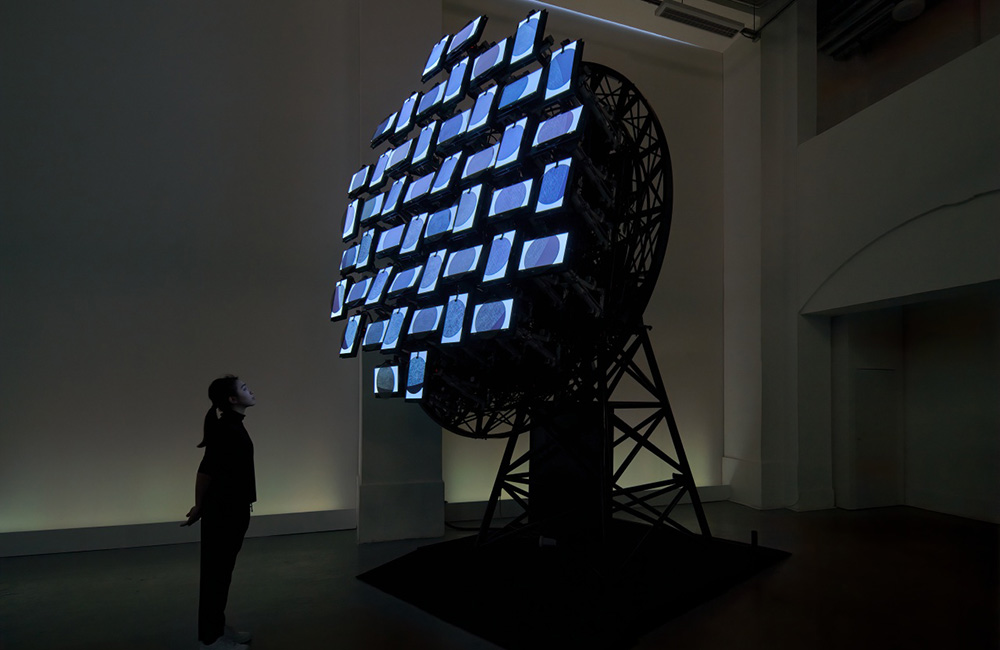
Roughly 300 years ago, after studying ancient records of eclipses, British astronomer Edmond Halley conceived of a theory that the moon was in fact physically moving away from the Earth. The moon’s recession was later confirmed in the 1970s by laser beams bouncing off mirrors placed on the moon by American and Soviet astronauts. Caused by drags in ocean tides, which slow the Earth’s spin rate, the accelerated rate compensates for the loss of angular momentum, and the moon gradually pulls away at a rate of 3.78 cm a year – about the rate at which our fingernails grow.  Upon learning this, Hong Kong artist Phoebe Hui’s existing fascination with the celestial body gained newfound urgency. “For some reason, this matters to me, despite the fact it doesn’t affect us during our lifetime,” she says. Initial inspiration struck when the artist’s visited Le Brassus in Switzerland, home to Audemars Piguet’s headquarters, just after she was selected to fulfil the Fifth Audemars Piguet Art Commission, the first to be exhibited in Asia. During a nighttime stroll, an encounter …

Kung Chi Shing 龔志成

The first part of Kung Chi Shing’s haunting video City Inside a Broken Sky, Deep Night alternates black-and-white imagery of a construction site amid debris and scaffolding, the colonial-era building of the Oil Street Art Space, and a young boy. Familiar construction noises are interspersed with occasional wailing, an eerie, melancholic sound conveying despair. “Dark in every sense,” in the artist’s own words, the video is the first of four in a series called Soundscape, a meditation on the implications of construction, the use of public space and the city itself. “Construction involves destruction,” he says. “When you destroy something, you’re erasing something that came before it, and Hong Kong is famous for erasing. Every few months an old building is gone, an old space is destroyed to build a new one.” Soundscape was created to mark Oil Street Art Space’s expansion. With two galleries housed in a complex of historical significance, its expansion will include an indoor gallery, and an outdoor venue that will be open to the public. The space has served over …

「阿輝」A’fair

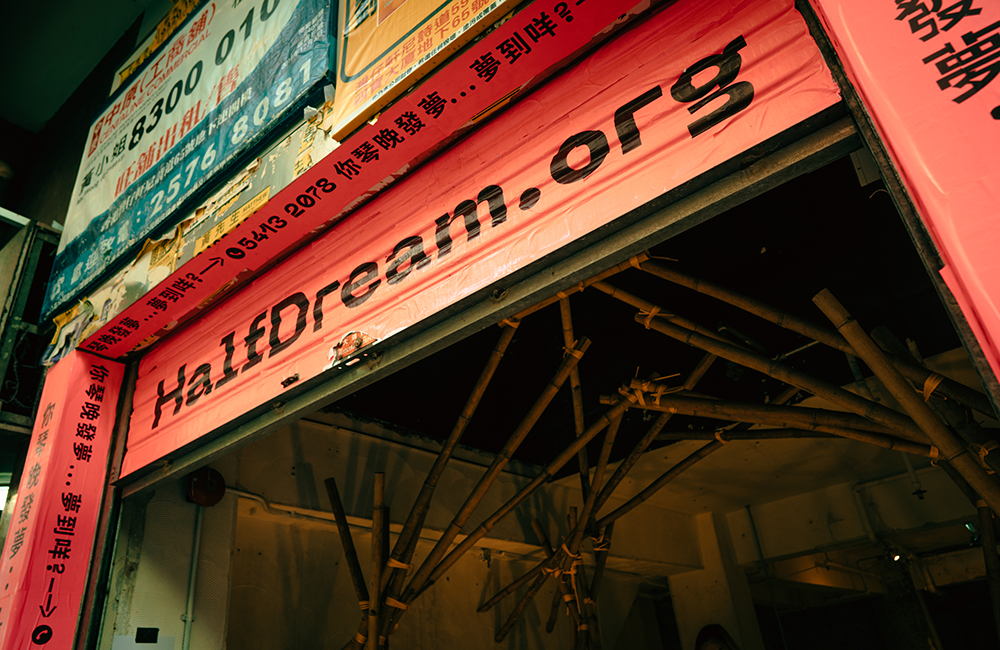
In the midst of Wan Chai, a neon pink roller shutter poses a seemingly innocent question: “What did you dream of last night?” Reading like an ad, a phone number and website, halfdream.org, are listed above and beneath the question. Surrounded by an eclectic mix of shops plastered with flyers and notices, bustling Hennessy Road might be the last place you’d expect to see Chicago-based Hong Kong artist Doreen Chan’s ongoing project Half Dream (Promotion 1, Hong Kong) (2020). She invites people to recall their dreams and subsequently transforms them into an art work. Surreal in spirit and content, the work marks the beginning of an equally unexpected occurrence. What once was a Japanese restaurant became, for a fleeting moment, a pop-up exhibition, A’fair. Outfitted with jagged edges, dirt, partly pulled-out floor tiles and exposed brick walls, the space’s former function was only hinted at by remnants of white, ceramic-like, fan-patterned tiles. The gritty impact of the unfinished, rough-hewn interiors was intensified by a series of sculptural installations. Raw, visceral and fleeting – it lasted just four days – A’fair took …

Household Gods 「駐家寧神」

Protests and pandemics have relegated us to the domestic sphere, where we’ve been forced to confront the anxiety and fear induced by the past year’s events. In addition to political, economic and social disruptions of unprecedented proportions, we’re experiencing emotional and psychological upheavals specifically reactive to this point in time. Articulating and reflecting on this complex state of being, Hong Kong artists Shane Aspegren, Nadim Abbas, Tap Chan and Wu Jiaru have come together to stage Household Gods, an exhibition curated by Ying Kwok, on view at Hart Hall in H Queens. Lifted from writer and occultist Aleister Crowley’s early 20th-century play Household Gods, the title of the show explicitly outlines its objective: to question our relationship with the supernatural through our “most intimate setting”, the home.  The four artists conceived of the exhibition while working alongside each other at Hart Haus’ sprawling 10,000 sq ft Hart Social Studio in November 2019, before the advent of Covid-19. Despite their seemingly disparate practices, the artists find common ground in using domestic objects, exploring how they serve as channels to activate the unknown or uncanny. Kwok describes this …

Sculpture Parks and Street Art: Curating Hong Kong’s Public Art Agenda

Hong Kong, renowned for its booming art market, is widely regarded as Asia’s art hub. While commercial success has unquestionably been essential in validating this rising status, so has been the provision of proper education and exposure of the public to a diverse range of artistic practices. To fulfil its potential as an art capital, Hong Kong needs more of the latter. There are still sectors of the art community that are severely under-represented, from local art initiatives to experimental art spaces and, in particular, public-art projects. Public-art programmes are vital to cultural development in cities, due to the easy accessibility to art they provide. Hong Kong has suffered from a lack of quality programmes, but two recent initiatives seek to change this. One is Hong Kong’s first sculpture park, and the other is the formation of HKwalls, a non-profit organisation facilitating street-art projects citywide. Harbour Arts Sculpture Park opened in late February, altering an iconic space on the harbour front between Central and Wan Chai. Co-curators Tim Marlow and Fumio Nanjo have emphasised the significance of the park in developing public arts …