Perrotin /
Hong Kong /
Mar 24 – May 18, 2024 /
Model figures offer a surprisingly satisfying unboxing experience. First, images on the cardboard box spark the imagination – how could the model within fit into one’s collection? Then there’s the sense of anticipation during the ride home, followed by care when the box is finally opened. Loose pieces of plastic might be found in sealed, see-through bags, or the parts might need to be snipped from sprues, a “new toy smell” released after being sealed in at the factory. The figure will require assembly and there could be no instructions. Some models need to be painted, a process that could take days or weeks. Finally, decals add a touch of realism or personalisation. The model joins an army or fleet or menagerie, and then the collector starts the process all over again.
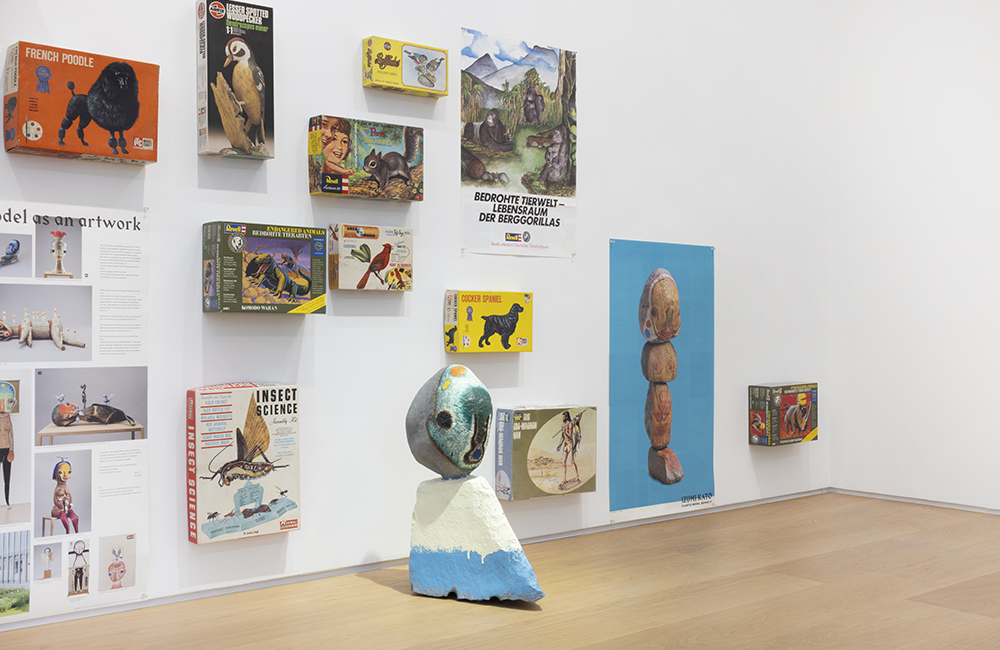
Izumi Kato loves vintage toys. As a youngster, he particularly liked models of fauna from around the world, perhaps using them to connect with creatures that he couldn’t encounter in his hometown in Shimane Prefecture, on the northwestern coast of Japan’s Honshu Island. Even now, that appreciation persists, and Kato has taken to collecting figure models made in the 1960s and 70s, placing bids for them in online auctions to grow his collection. These objects, along with a series of sculptures made by Kato for a 2023 exhibition at Perrotin Paris, framed his latest show in Hong Kong.

©2023 Izumi Kato. Courtesy the artist and Perrotin.
For the presentation at Perrotin’s gallery in K11 Atelier Victoria Dockside, the artist included the boxes of more than 30 vintage models that he has acquired over the years, including iconic items such as the Visible Woman and Visible Man, each with a see-through plastic body, a skeleton and vital organs that fit together in anatomically accurate ways, so that the models could once function as instruction tools.
Kato’s decades-long fascination seems to play a part in informing the trademark figures that are in all of his paintings and sculptures – the expressionless, spectral boy and girl whose forms have come to define his artistic practice.
It’s no wonder, then, that Kato has returned to these objects, blending them into recently made paintings and sculptures. The walls of one room in Perrotin’s gallery were lined with canvases depicting the artist’s figures seated, lying on the ground, standing, or seemingly in flight or swimming, each accompanied by an animal with translucent skin, showing the innards and skeletons of a horse, a fish, a cow, a dog, a bird.
Kato’s practice has been described as otherworldly and mysterious. No doubt he taps into veiled mysticism inspired by an upbringing in a location steeped in folklore and supernatural tales. At the same time, his works presented at Perrotin could be read as a playful look back at a pastime and collection that he loves, the artist revealing a bit more of himself, letting quiet vulnerability seep through.
The exhibition traced roots that inform Kato’s artmaking, connecting his recent paintings and sculptures with an old hobby. To drive the point home, model figures of birds, a rhinoceros and a Visible Man were incorporated into three sculptural works. Also, the artist made boxed kits of miniature stones—like those he casts for his painted “stone” sculptures—their forms chosen based on how he sees the crooks and contours of body parts in the rocks he encounters in nature.

©2023 Izumi Kato. Courtesy the artist and Perrotin.
Kato’s show glued his past to the present in a deeply personal way. Others often load complex notions onto his work, spanning post-Second World War expression, Shinto polytheism, apocalyptic undertones and other weighty themes. But the experience of viewing the artist’s work doesn’t need to be so dense and over-intellectualised. After all, Kato is merely showing his works’ viewers how much he appreciates the objects that expanded his world when he was a boy, where pieces of plastic seeded inspiration for decades to come.
Featured image: View of Izumi Kato’s exhibition at Perrotin Hong Kong, 2024. © Izumi Kato Photo: Ringo Cheung. Courtesy the artist and Perrotin.
貝浩登畫廊
香港
2024 年 3 月 24 日至 5 月 18 日
模型玩具可以為人帶來意外地滿足的開箱體驗。首先,紙箱上的圖像可以激發想像力——這跟其他收藏品一致嗎?然後你會帶著期待乘車回家,之後小心翼翼地打開盒子。塑膠零件可能會放在密封的透明膠袋內,又或者要從模具上剪下來,這些玩具於工廠內封存,打開時會散發出一陣「新玩具的氣味」。模型需要組裝,但未必附有指示。有些模型需要上色,過程可能需時數日甚至數星期。最後,收藏家可以為模型貼上貼紙,增添真實感和個人色彩。模型可以組合成軍隊、艦隊或動物園展示,而收藏家就會不斷重複整個過程。
加藤泉熱愛古舊玩具。年輕時,他特別喜歡來自世界各地的動物模型,也許是想認識在故鄉日本本州西北海岸的島根縣無法遇到的生物。直到現在,他仍然很喜歡動物模型。加藤泉開始收集60和70年代製造的模型,透過網上拍賣競投擴闊他的收藏。這些模型連同他2023年為巴黎貝浩登畫廊展覽製作的一系列雕塑作品,成為他在香港最新展覽的框架。
在貝浩登畫廊位於維港文化匯K11辦公大樓的展覽中,藝術家展示了他多年來收藏的30多個復古模型盒子,包括「Visible Woman」和「Visible Man」等經典模型。兩個模型的身體以透明塑膠製成,骨骼和重要器官的結構精準,所以這些模型曾作教材之用。
長達數十年的興趣對加藤泉的繪畫和雕塑有著一定影響。目無表情的詭異男女孩成為他所有作品的題材,亦是他藝術實踐的標誌。
因此,難怪加藤泉會重新研究這些模型,將它們融入最近創作的繪畫和雕塑中。貝浩登畫廊其中一個房間的牆上掛滿畫布,描繪正坐著、躺著、站著,或看起來正在飛行和游泳的人物,每個人物旁邊都有一隻動物,包括馬、魚、牛、狗和鳥等,牠們的皮膚透明,露出內臟和骨骼。
加藤泉的藝術實踐被譽為超脫神秘。於充滿民間傳說和超自然故事的地方成長,無疑為他打開了神秘主義的大門。同時,貝浩登畫廊展出的作品可以說是幽默地回顧了他心愛的娛樂和收藏。他揭露了自己的內心世界,滲透出靜謐的脆弱感。
這次展覽追溯加藤泉藝術創作的根源,將他的舊興趣與最近的繪畫和雕塑結合。為了強調這一點,他將雀鳥、犀牛和「Visible Man」的模型融入三個雕塑作品中。此外,藝術家還為他的微型石頭製作了盒子套裝,例如其繪畫石頭雕塑,盒子的形狀根據他從大自然中所接觸的岩石中所看到有如身體部位的曲線和輪廓而選擇。
加藤泉的展覽以一種深具個人特色的方式將他的過去與現在連結在一起。人們常常將複雜的概念加諸於他的作品上,例如戰後表現主義、神道多神論、世界末日暗示等沉重主題,但我們不需以如此深奧和過度理性的目光觀看他的作品,畢竟加藤泉只是想向觀眾展示自己對童年時為他打開世界大門的模型的熱愛。他小時候遇到的那些塑膠模型,為未來數十年的創作靈感埋下了種子。