Doing Is Living /
Once in a Blue Moon /
David Zwirner /
Hong Kong /
Nov 19, 2024 – Feb 22, 2025 /
David Zwirner Hong Kong’s double show, with ethereal sculptures by Ruth Asawa (1926-2013) on the lower floor and the moon paintings of Scott Kahn (b. 1946) on the upper one, pairs two very different artists, allowing the viewer to find unexpected connections between their works.
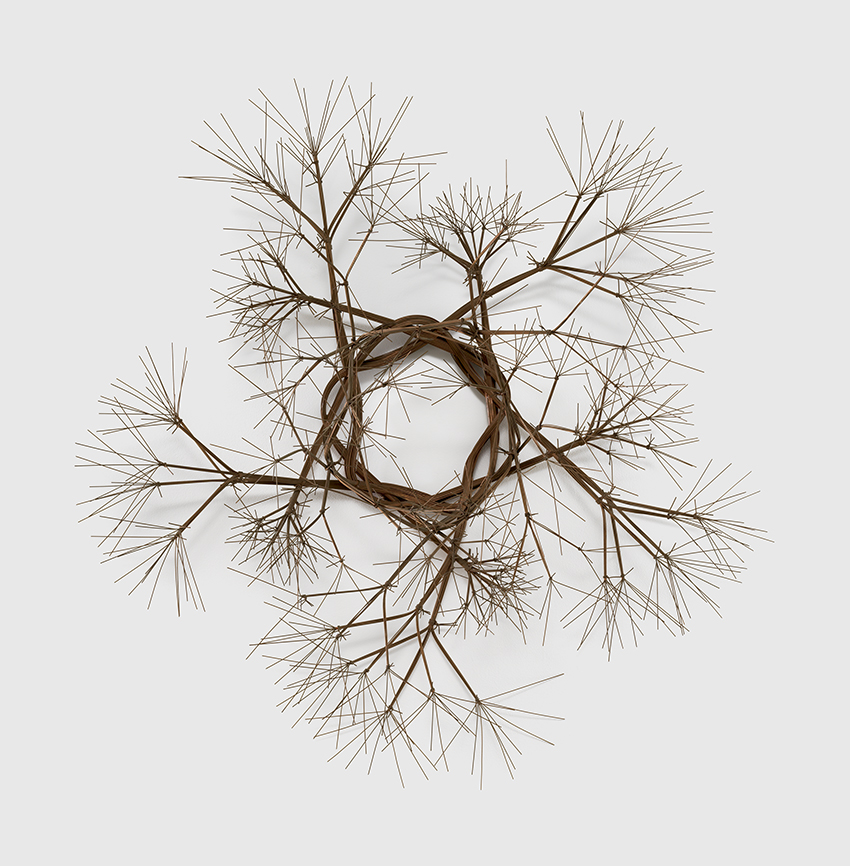
In Asawa’s first solo show in Greater China, Doing is Living, her mesmerisingly beautiful sculptures float in the air with magical, perfectly mathematical rhythms. Born in California, Asawa created these, as she has said in a past interview, “by observing plants” and then taking “a wire line and [going] into the air and [defining] the air without stealing it from anyone”. In this show, complementing the sculptures hanging from the ceiling, we can also admire a series of lesser-seen preparatory works, mostly watercolours of roses and irises but also meticulous renderings of leaves and their veins, and initial transpositions of these into patterns of lines and curves, both in ink: geometrical diagrams that will eventually take on a 3D volume. Also on the walls are some sepia and black-and-white photographs of Asawa herself, gently holding her see-through creations as they hang from the ceiling. The longer we look at these seemingly floating sculptures, the more images they conjure: imaginary sea-creatures, unlikely trees, even body organs of unknown lifeforms that rock gently in front of our eyes as they double up in their own different layers – many sculptures are made like Russian dolls, semi-transparent shapes containing further semi-transparent shapes – which multiply further in the shadows they project in the floors and walls. Sensuous, undulating and semi-transparent, these sculptures offer the impression of smooth simplicity, belying the intensive work they required, and presenting a sharp contrast between their aerial softness and the metallic material of which they are composed.

Artwork © 2025 Ruth Asawa Lanier, Inc./Artists Rights Society (ARS), New York. Courtesy David Zwirner.
Kahn’s sharp moon edges and spacious landscapes, on the other hand, show the significance he accords to emptiness and to what in the 3D world would simply be air. He does so in a way that is diametrically opposed to Asawa’s: her mobile structures are interested in the aerial lightness drawn by her coiled wires, while he achieves the same aim through very compact surfaces, covered by thick layers of oil paint.
This is Kahn’s first solo show in Asia and takes its title from one of the works on display, Once in a Blue Moon. The full moon, represented in various colours in the different paintings, has a static, imposing presence devoid of any moongazing romanticism but more akin to an interrogating Sybill: it looks at us looking at it, as if questioning our presence. In the painting Blue Moon (2023), the moon is doubled up, a pale azure moon superimposed on a darker turquoise one – echoing the astronomical phenomenon of a “blue moon” or two full moons in one single calendar month – against black nighttime skies. Channel Sky (2007), meanwhile, presents open views in which the sky is framed in between the earth and a thick layer of clouds. Kahn’s colour palette is decisive, if always slightly surreal – with red trees (in Blue Moon) and orange hills under a sky of floating pink and white clouds (Sunset Behind the Privet Hedge, 2023) – and hyper-realistic. The stillness of his scenes gives no easy clue to his intended underlying narrative, leaving the viewer to interrogate these paintings in a subjective manner. Colours contrast sharply with one another, with very precisely delimited contours, acting as one of the most constant signifiers in his practice: whether it is a strong green in a hedge or a bush, a flashy magenta used for the trees or a marbleised blue and green sea (in The Cliffs at Stoke Fleming IV, 1987), Kahn gives the impression of working in a colour-coded universe, for which he doesn’t give us the key. We are left to wander into these landscapes, accepting their bursts of chromatic assertion and choosing for ourselves the precise meanings we wish to assign to each hue. All of the eight paintings on show at David Zwirner emanate a very static presence, looking like wordless landscapes that have never had any sound in them but where everything is characterised by flatness. The images we see are disconcerting, mostly because of their chromatic inventiveness but also because their flatness suggests something else, something more, taking place behind the still hills, trees and rocks, to which we have no access unless, once again, we search in our own imagination.

© Scott Kahn. Courtesy the artist and David Zwirner.
The two shows surprisingly complement each other thanks to the high degree of poetic vision that characterises both artists. Asawa’s with imaginary shapes play with light and media, pulling strings that we never knew our hearts had, while Kahn’s chromatic scenery offers the possibility of a different natural environment, without really granting us access to it.
Featured image: Untitled by Ruth Asawa, S.862, Wall-mounted tied-wire, open-center, five-pointed star with five branches, c. 1969. Artwork © 2025 Ruth Asawa Lanier, Inc./Artists Rights Society (ARS), New York. Courtesy David Zwirner.
向手作而生
藍月難逢
David Zwirner
香港 2024年11月19日-2025年2月22日
卓納畫廊最近於香港為兩位藝術家舉辦個展,低層展出魯斯.阿薩瓦(1926-2013)的空靈雕塑,上層則展出斯科特.卡恩(生於1946年)的月亮畫作。儘管兩位藝術家截然不同,觀眾卻可以在作品中找到意想不到的聯繫。
「向手作生」是阿薩瓦首個大中華區個展,她的雕塑漂浮在空中,蘊藏奇妙而完美的數學節奏,美麗迷人。阿薩瓦出生於加州,曾在採訪中談及創作理念:「觀察植物後,手中的線在半空中為空氣賦予定義,卻不會從任何人身上偷走空氣」。觀眾除了可以在展覽中看到自天花板懸浮的雕塑作品,還可以欣賞到較少展出的三維雕塑準備工作,主要包括玫瑰和鳶尾花的水彩畫,也有一些水墨作品,包括細緻描繪葉子和葉脈的渲染圖,以及將主題化身線條和曲線的圖案。牆上還有一些棕褐色和黑白照片,相中可看到阿薩瓦輕輕地拿著懸掛在天花板的透視作品。看似漂浮的雕塑令人聯想到更多畫面:虛構的海洋生物、不可能的樹木,甚至是不知名生物的器官紛紛在眼前搖曳,形成不同層次;部分雕塑更做成俄羅斯娃娃一樣,一層層半透明形狀互相套疊,加上投射到地上和牆上的影子,令視覺層次不斷繁衍。這些感性、上下搖動和半透明的雕塑洋溢流暢簡潔,掩蓋了創作背後的密集工序,與半空中的輕柔感和作品所採用的金屬材料形成了鮮明對比。
另一邊廂,卡恩的作品以鮮明的月亮邊緣和廣闊風景來表達他重視空洞,也看重立體世界裡的空氣。阿薩瓦採用盤繞的金屬線來為移動構件呈現半空中的輕盈感,卡恩的創作風格則剛好相反:以厚厚的油畫顏料層畫出緊湊的平面,可說工妙雖異,曲調則同。
「藍月難逢」是卡恩在亞洲的首次個展,選題來自同名展品。滿月在多幅畫作中以不同顏色表現,靜態但氣勢磅礴,不帶半點望月的浪漫,但更像提出審問的西比爾:月亮看著我們看著它,彷彿在質疑我們的存在。《Blue Moon》(2023 年)的黑色夜空中有兩個月亮,淡藍色的一個疊於深綠松石色的月亮上,與「藍月亮」 或一個曆月中出現兩次滿月的天文現象互相呼應。另一方面,《Channel Sky》 (2007) 是開闊的視野,天空框在地球和厚厚的雲層之間。儘管卡恩的筆風總是略帶超現實主義,選色卻毫不含糊,《Blue Moon》裡有紅色的樹,而《Sunset Behind the Privet Hedge》(2023)則在天空畫出紛紅色和白色的雲,下面是橙色的山,並且超級寫實。他筆下的靜止的畫面也未有為要訴說的故事提供多少線索,觀眾不得不主觀地提出質疑。顏色彼此對比鮮明,輪廓高度精確,都是卡恩作品中不變的特色:無論是樹籬或灌木叢中的鮮綠、樹木上的艷洋紅,還是呈大理石紋的藍海碧洋(《The Cliffs at Stoke Fleming IV》,1987),卡恩都好像以顏色編碼來作畫,但卻未有為觀眾留下解密匙。我們只能在這些風景中徜徉,接受當中的色彩主張,選擇希望賦予每種色調的確切含義。在卓納畫廊展出的八幅畫作都流露出靜態存在感,看似無言的風景,聲音從不存在其中,一切都以平面為特徵。觀眾看到的畫面有點令人不安,主要是因為選色大膽,也因為平面表達有著許多暗示,令人想到靜止的山丘、樹木和岩石後面發生了什麼事,我們無法進入,只能在想像中尋找。
這兩位藝術家的視野都饒富詩意,令兩個展覽意外地相得益彰。阿薩瓦的想像形狀滿載光線和媒介的玩味,拉動我們連自己也不一定知道的心弦,而卡恩的彩色風景雖然是行人止步,但卻為各種自然環境提供了不一樣的可能性。