Fionnuala McHugh
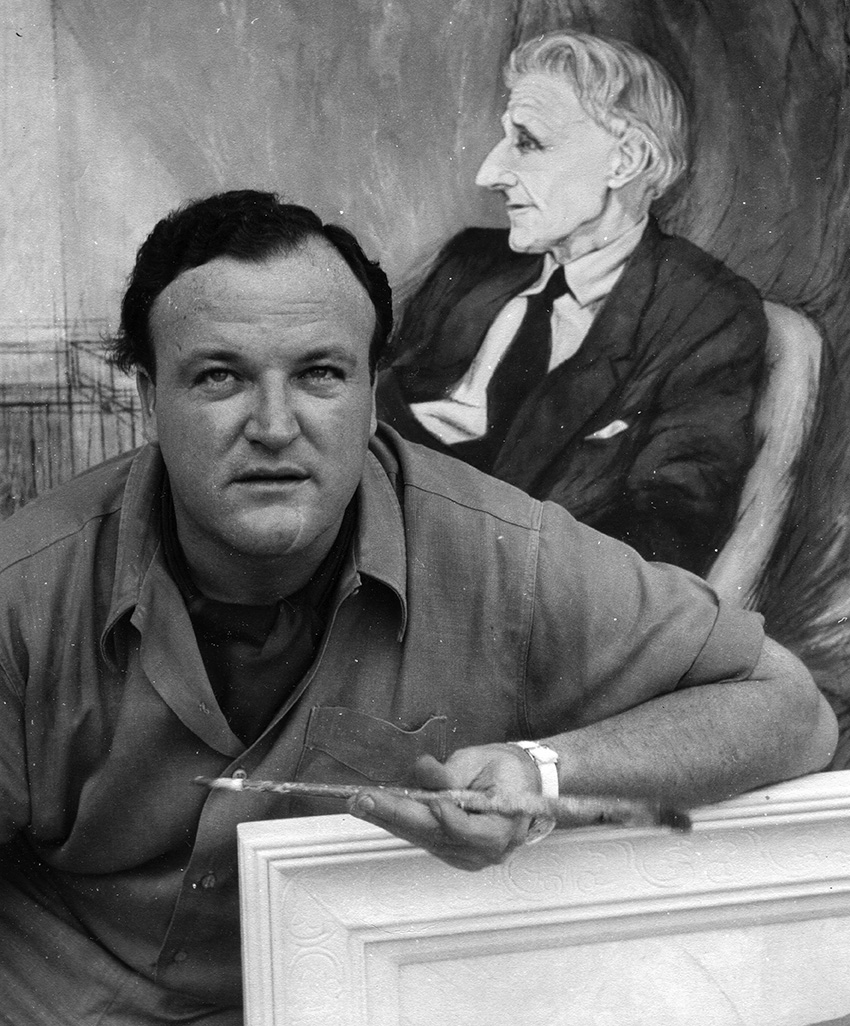
In 1976, the Hong Kong Museum of Art held an exhibition called The World of Douglas Bland. Nigel Cameron, the South China Morning Post’s respected art critic, gave the show a stellar review. He praised Bland’s “astonishing energy”, “emotional intensity”, profoundly imaginative quality” and “great estuarine areas of lucid paint”. He believed that Bland had finally discovered what he wanted to do with paint in 1971 and he particularly referred to his “great” Reflections series, in which he was “trying to compose forms which contain ideas about places and things reflected in spaces”. Cameron, who could be annihilating in his opinions, described Bland as “the most accomplished western painter to work in the Orient since George Chinnery died in Macau”.
By then, Bland himself was dead: he’d never regained consciousness after stomach surgery the previous year, at the age of 52. For almost three decades, he’d been striving to express his artistic response to China – its landscape, its culture, its mystic energies. He’d found inspiration in Chinese seals, calligraphy and, ultimately, oracle bones. He was determined to fuse west with east and, unusually for the colonial era, he’d shown his work alongside such Hong Kong artists as Lui Shou-kwan and Kwong Yeu Ting. Nowadays, critics might call that cultural appropriation but then it was more of a mutually beneficial mind-meld for all concerned. At the time, Chinese artists were influenced by western painting. Bland wanted to travel in the opposite direction.
He pursued his task with a concentration so intense, it became a form of meditation. He exhibited frequently. He was commissioned for prestigious projects and purchased by such collectors as Peggy Guggenheim, Hong Kong’s movie mogul Run Run Shaw and Mapie de Toulouse-Lautrec. When he died, the prevailing sense was that he had been unjustly snatched away just as he was approaching his prime. For the Hong Kong Museum of Art to dedicate a solo show to his memory within a year is evidence of how highly Bland, now almost forgotten, was once regarded.
The desire to create had been present since at least his early teens. In Hong Kong interviews, he liked to give the impression he was Irish by birth and had studied at Oxford’s Ruskin School of Art. Neither claim was true (and he wouldn’t be the first person to exercise artistic licence with his background in a far-flung colony). In fact, he’d been born in Derbyshire, England in 1923 and had grown up in Sheffield in a working-class household. He’d studied art at a local college, then progressed to designing windows for a local department store.
When the Second World War began in 1939, he was just 16. By the time he was 20, he’d been called up and, having been identified as officer-class material and finished his training in South Africa, he’d become a lieutenant in the Royal Navy. On two occasions, he was on board ships that were sunk beneath him. Years later, he needed surgery in Hong Kong to have shrapnel removed from his shoulder. In a different man, being twice torpedoed might have left a horror of the sea but all his life Bland loved being on or near water.
After the war, he was demobbed in Southeast Asia, spent some time in Bali and then, in May 1947, according to its archived lists of former British staff, joined the Chinese Maritime Customs Service as acting first officer. The work had its own dangers – there were various adventures involving pirates – but as a cartographer, he had unparalleled access to China’s waterways. He always said observing and then charting those sinuous paths made him an artist.
It was also preparation for a life in which art and a salaried job would have to flow in parallel. In 1948, he joined the Hongkong and Kowloon Wharf and Godown Company; by the following year, he was exhibiting 44 watercolours and oil paintings in the Hong Kong government’s Public Relations Office in Statue Square. According to the South China Morning Post, he was the only British painter to hold one-man shows in the postwar colony. Those early titles (The Erecting of the Government Flats, View of Tai Tam, Wong Nei Chong Gap) suggest a newly arrived observer. The newspaper’s reviewer thought Bland’s need for self-expression hadn’t yet the “complex urgency of a man who has found his very own medium”.
Yet an urgency seized him. Bland was then 26 and, although he didn’t know it, he’d already lived half his life. Later, some people wondered if he’d anticipated the sudden scythe and that was why he relentlessly juggled Wharf and art. He could be ruthless about destroying his creations but he worked on several canvases at a time and, despite the lack of ideal exhibition space in Hong Kong, there were always regular shows. He was brave enough, or driven enough, to present his experimental output continually in public. One critic in 1955 described his work as “very likeable … if a little sugary”; by 1957, he’d executed 17 black-and-white illustrations for Oscar Wilde’s The Ballad of Reading Gaol that appeared, somewhat unpredictably, in Elixir, the journal of the Hong Kong University Medical Society, and later in a limited-edition book. Their anguished forcefulness evokes Francis Bacon, while one upside-down nude male anticipates the German painter Georg Baselitz, who would not begin painting his upside-down figures until 1969.
It was the abstract, however, that came to fascinate him. In 1958, Bland met the Chinese painter Zao Wou-Ki, who had moved to France in 1948 and a decade later was a visiting professor at the School of Fine Arts in New Asia College, now part of The Chinese University of Hong Kong. Zao, who was teaching western oil painting, exemplified the artistic combination of east and west. Bland was his mirror image. “We found we were thinking along the same lines,” Bland said later of their encounter. “We both had an appreciation of ancient Chinese painting and the marvellous expression of space that you often find in it. We were both conscious that this tradition was lost and felt, in rather a romantic way, that the spirit of it should be revived using the western medium of oil paint.”
It was the turning-point of his artistic life. He had never studied calligraphy but he was familiar with Chinese seals from his days in the Chinese Maritime Customs Service and he could create abstract designs and collages based on Chinese ideograms. Raymond Tang Man-leung, deputy director of The Chinese University of Hong Kong’s art museum, says, “In the 1960s Douglas, as someone who devoted himself to abstract painting and the style of abstract expressionism, was … a pioneer for a younger generation who knew him or had a close relationship with his circle – artists like Wucius Wong, Hon Chi-fun and even, later, Irene Chou. It was a very small circle but it was important.”
Petra Hinterthür, in her 1985 book Modern Art in Hong Kong, also classifiesBland as a pioneer. He’s the only westerner she lists as tackling new artistic frontiers in the city’s post-war era. Along with ink painter Lui Shou-kwan and Kuang Yaoding, who’d trained as a landscape architect, he became a founding member of the Society of Hong Kong Artists.
In the early 1960s, the Hong Kong Hilton hotel asked him to do a series of large murals – 2m high and 10m long – that would dominate its lobby when it opened in 1963. It was a prestigious commission at a time when high-end hotels were suddenly blooming in the city. Bland decided that his theme would be the rivers of China but, perhaps in the spirit of east-meets-west, the water that inspired him to work was in Italy, in a rented house on the shores of Lake Maggiore. His position at Wharf had its marine advantages: Douglas, his wife Ronnie and their three children Siobhan, Diarmuid and Clodagh (all aged under 10), plus the family car, travelled over on a Lloyd Triestino liner. Then they sailed back to Hong Kong with the huge, completed panels.
The venture was such a success that, with the help of the generous Hilton fee, Bland bought an old farmhouse in Italy’s Veneto region. There he built a studio for his annual summer leaves. The rest of the year, creativity had to be squeezed into a smaller space at home in Kowloon, and it was strictly timetabled: Bland’s life at Wharf, where he eventually became commercial manager, was demanding. What his children remember now is the self-discipline. Every day, unless there were inescapable social obligations, he returned from the office, changed into what Diarmuid calls “his paint-splattered kit”, had a cup of tea, then went to his studio, which was a converted bedroom. (The girls shared another bedroom and Diarmuid slept in the TV room.) There he worked for several hours before dinner. His artistic practice pervaded all their lives. The Bland family dined later than other expatriate families; their father wore his painting kit at the table; and, upstairs, their house always smelt of oil paint. “He was just our dad and that was what he did,” says Siobhan. “Other kids’ dads went and played golf. He painted.”

Private collection. Photo: Studio8ight.
At the Italian farmhouse, he was less frenzied. “When he was spending summers in Italy, he had all the time in the world to paint,” says Siobhan. “But he didn’t paint any more than when he was working. Sometimes we used to think he needed the pressure of work to have that need to release it by painting.” He represented Hong Kong in Saigon’s first international art salon in 1962 (winning a bronze medal) and in a 1963 exhibition of Commonwealth art in London and Edinburgh. He exhibited in New York, England and Brazil. Still, he strove for more. He liked to quote the 11th-century Chinese painter Guo Xi, who thought that “a poem is a painting without forms and that a painting is a poem with forms”. His body of work made a cartographer of the viewer too: it was possible to map the influences in his prolific artistic life through to the final depths of the Reflections series.
After his death, the Hong Kong Museum of Art held its 1976 tribute show. In 1979, there was an exhibition at the Hong Kong Arts Centre of 87 Bland works that the family had either kept in storage or discovered in the Italian farmhouse and decided to sell. Since then, there has been nothing. In 1995, the Hong Kong Hilton was demolished and the fate of the huge riverine murals is unknown. Much of his other work has disappeared. His paintings held by the Hong Kong Museum of Art have never gone back on display.
Tang, who first heard of Bland when he was a researcher at the Hong Kong Museum of Art in the 1990s, says he is not popular among collectors. “Irene Chou, Hon Chi-fun and Cheung Yee are still remembered because the galleries think they have good market value and so they continue promoting them. But who will do that for Douglas?” His exhibitions were covered in Hong Kong’s English-language press but many of those readers who bought his work have long since left the city; and Tang hasn’t found a single reference to Bland in the Chinese newspapers of the time. His influence was significant but it was limited; it did not extend to the next generation of artists, who, as Tang remarks, would not have been museum-goers. And so his formative place in history, like those of old underground tributaries that once flowed through major cities, has – almost – been lost.

Private collection. Photo: Studio8ight.
1976年,香港藝術館舉辦了一場名為《道格拉斯·布蘭德的世界》的展覽。當時《南華早報》備受尊敬的藝術評論家奈傑爾·卡梅倫(Nigel Cameron)給予了這場展覽極高的評價。他稱讚布蘭德「能量驚人」、「情感濃烈」,有著「深刻的想像力」以及「如河口般清澈的繪畫」。卡梅倫認為,布蘭德終於在1971年找到了他想通過繪畫表達的內涵,並特別提到他「偉大」的《倒影》系列,稱布蘭德在這些作品中「試圖構建一些形式,來蘊含關於在空間中被映照出的地點和事物的理念」。卡梅倫在評論中毫不吝嗇讚美之詞,形容布蘭德為「自喬治·錢納利」(George Chinnery)在澳門去世後,東方創作中最有造詣的西方畫家」。
當時,布蘭德已經離世:他在前一年接受胃部手術後,就再沒甦醒,享年52歲。近三十年來,他一直致力表達他對中國的藝術回應——中國的山水風光、文化以及神秘的力量。他從中國的印章、書法,乃至從甲骨文中汲取創作靈感。他決心將東西方藝術融合。此外,他還曾與呂壽琨、鄺耀鼎等香港藝術家一同展出作品,這在殖民時代是很不尋常的。如今,評論家們可能會稱之為文化挪用,但在當時,這對各方參與者來說,更像是種互惠的思想交融。那時,中國藝術家正受到西方繪畫的影響,而布蘭德卻想反其道而行之。
他極其專注的投身創作,以至於變成一種冥想。他頻繁舉辦個展,接受知名藝術專案委約,作品獲佩姬·古根海姆(Peggy Guggenheim)、香港電影大亨邵逸夫及土魯茲·羅特列克(Toulouse-Lautrec)家族成員等重要藏家購藏。他離世時,正值創作巔峰,世人皆認為這是天妒英才。香港藝術館在其逝世翌年即舉辦紀念個展,足見這位如今近乎被遺忘的藝術家,當年有多備受推崇。
至少從少年時期他便萌發了創作欲望。在香港接受訪問時,他總喜歡給人留下這樣的印象:出生於愛爾蘭,並且曾在牛津大學拉斯金美術學院就學。這兩個說法均不屬實(在這遙遠的殖民地,他也不是第一個創意詮釋個人背景的人)。事實上,他1923年出生於英格蘭德比郡,在謝菲爾德一個工人階級家庭長大。他先在當地院校學習藝術,之後進入當地百貨公司為其設計櫥窗。
1939年第二次世界大戰爆發時,布蘭德年僅16歲。到了20歲,他應徵入伍,因被認定為有軍官潛質,他在南非完成訓練後,成為一名皇家海軍上尉。他曾兩度親歷所在船隻被擊沉。多年後,他在香港接受手術,取出肩膀中的彈片。換作他人,兩次遭遇魚雷襲擊可能會對大海心生恐懼,但布蘭德一生都愛待在水上或靠近水的地方。
戰後,他在東南亞退伍,隨後在峇里島待了一段時間。根據英國前雇員的存檔名單,他於1947年5月加入了中國海關,擔任代理一級關員。這份工作有其自帶的危險性——他經歷了多次與海盜有關的驚險事件——但作為一名製圖員,他獲得前所未有的機會來探索中國的水路航道。他總說,正是觀察和繪製那些蜿蜒曲折的水路讓他成為了一名藝術家。

Photo: Studio8ight.
這也是為他日後藝術與受薪工作並行的生活做準備。1948年,他加入了香港九龍碼頭及貨倉公司;到了第二年,他已在香港政府位於皇后像廣場的公共關係辦公室展出了44幅水彩畫和油畫。根據《南華早報》的報導,他是在戰後殖民地中唯一一位舉辦個人畫展的英國畫家。這些早期作品的標題(如《政府公寓的興建》、《大潭景色》、《黃泥湧峽》)暗示了一位初來乍到的觀察者。該報評論者認為,布蘭德的自我表達需求尚未達到「那種已找到自己獨特媒介後所展現的複雜緊迫感」。
然而,一種緊迫感卻拽住了他。那時布蘭德26歲,儘管他不知道,自己的人生已過半程。後來,有人猜測他或許是預感到死神突如其來的鐮刀,所以才不停奔忙於碼頭工作和藝術創作間。他會毫不留情毀掉自己的作品,但又會在同一時間創作好幾幅畫作。儘管當時香港缺乏理想的展覽空間,他卻仍堅持定期舉辦展覽。他足夠勇敢,或者足夠熱忱,不斷地向公眾展示自己的實驗性作品。1955年,一位藝評家這樣評價他的作品:「很討人喜歡…… 只是有些甜膩。」 到了1957年,他為奧斯卡・王爾德的《雷丁監獄之歌》創作了17幅黑白插圖。令人意想不到的是,這些插圖先是刊登在了香港大學醫學會的期刊《Elixir》上,後來又被收錄進一本限量版書籍中。插圖中的痛苦與力量讓人聯想到法蘭西斯·培根。其中有一幅倒置的男性裸體畫則預示了德國畫家喬治·巴塞里茲的創作方向,而後者直到 1969年才開始創作倒置人物畫。
然而,真正讓他著迷的是抽象藝術。1958年,布蘭德遇到了中國畫家趙無極。趙無極1948年移居法國,十年後成為新亞書院(現併入香港中文大學)藝術系的訪問教授。當時教授西方油畫的趙無極,正是東西方藝術融合的典範。而布蘭德則是他的鏡像。「我們發現彼此想法想通,」布蘭德之後談到他們的相遇時說,「我們都欣賞中國古代繪畫及其對空間的精妙表達。同時也都意識到這一傳統已經失傳,懷著某種浪漫情懷,應該通過西方油畫媒介來復興這種精神。」
這是他藝術生涯的轉捩點。他從未學習過書法,但在中國海關工作時接觸過中國印章,因此他能夠基於漢字創作抽象設計和拼貼畫。香港中文大學藝術博物館副館長鄧民亮表示:「在1960年代,道格拉斯作為一位致力於抽象繪畫和抽象表現主義風格的藝術家,對於認識他或與他圈子關係密切的年輕一代來說,是一位先驅——比如王無邪、韓志勳,甚至後來的周綠雲。這個圈子雖不大卻很重要。」
Petra Hinterthür在她1985年出版的《香港現代藝術》(Modern Art in Hong Kong)一書中也將布蘭德歸類為先鋒藝術家。她所列出的在戰後香港探索新藝術前沿的人中,他是唯一的西方人。他與水墨畫家呂壽琨以及曾接受景觀設計師培訓的鄺耀鼎一同,成為香港藝術家協會(Society of Hong Kong Artists)的創始成員。
1960年代初,香港希爾頓酒店邀請他創作一系列大型壁畫——每幅高2米、長10米——這些壁畫將在1963年酒店開業時用以裝點大堂。這是一項極其顯赫的委託,當時香港的高尚酒店正迅速湧現。布蘭德決定以中國的河流為主題,但或許出於東西方交融的精神,激發他創作靈感的水卻位於意大利,來自馬焦雷湖畔的一所租住房屋中。他在九龍倉的職位帶來了航海便利:道格拉斯、妻子羅尼(Ronnie)以及他們的三個孩子西沃恩(Siobhan)、迪爾梅德(Diarmuid)和克洛達(Clodagh)(均未滿10歲),加上家裡的汽車,一起搭乘Lloyd Triestino航運公司的班輪前往意大利。隨後,他們帶著完成的巨幅畫板乘船返回香港。

Courtsey Lydia Dorfman. Photo: Studio8ight.
此舉非常成功,在希爾頓的豐厚費用幫助下,布蘭德在意大利威尼托買下了一座老農舍。在那裡,他為自己建了一個工作室,供每年暑假使用。其餘的時間,創作只能擠在九龍家中的較小空間內,並且時間安排得非常嚴格:布蘭德在九龍倉的工作非常繁忙,他最終成了商業經理。如今,他的孩子們記起的便是他的自律。除非有無法推脫的社交應酬,每一天,他從辦公室回家後,便會換上被迪爾梅德稱作「沾滿顏料的裝備」,喝杯茶,然後走進他的工作室,那是由臥室改造而成的房間。(女兒們共用另一間臥室,迪爾梅德則睡在電視房裡。)他會在晚餐前作畫幾個小時。他的藝術創作融入了全家人的生活中。布蘭德一家的晚餐時間比其他外籍家庭要晚;他們的父親會穿著他的繪畫裝備就餐;而他們家樓上,總是彌漫著油畫顏料的氣味。「他就是我們的爸爸,那就是他所做的事,」西沃恩說。「其他孩子的爸爸去打高爾夫球,而他則在畫畫。」
在意大利的農舍裡,他變得不那麼急躁了。「當他在意大利避暑時,他有的是時間來畫畫,」西沃恩說,「但他畫的並沒有比工作時多。有時候我們會覺得,他需要工作的壓力來激發那種得通過畫畫釋放的需求。」他在1962年代表香港參加了西貢的首屆國際藝術沙龍(並贏得了銅獎),1963年參加了在倫敦和愛丁堡舉辦的英聯邦藝術展。他還在紐約、英國和巴西展出過作品。儘管如此,他依然追求更多。他喜歡引用11世紀中國畫家郭熙的話,郭熙認為「詩是無形畫,畫是有形詩」。他的畫讓觀者也成為了一名地圖製作者:通過他多產的藝術生涯,追溯和描繪出各種影響,一直到最終的《倒影》系列深處。
在他去世後,香港藝術館於1976年舉辦一場致敬展。1979 年,香港藝術中心舉辦了一場展覽,展出了87件布蘭德的作品。這些作品或是家人保存著,或是從意大利的農舍裡發現並決定出售的。從此之後,便再無展覽了。1995年,香港希爾頓酒店被拆除,那些巨幅河流壁畫的命運也無從知曉。他的許多其他作品也都消失了。香港藝術館所收藏的他的畫作也再未重新展出過。
鄧民亮在90年代擔任香港藝術館的研究員時第一次聽說布蘭德。他表示布蘭德在收藏家中並不受歡迎。「周綠雲、韓志勳和張義至今仍被人們銘記,因為畫廊認為他們有不錯的市場價值,所以持續在推廣他們。但有誰會為道格拉斯做這些呢?」香港的英文媒體曾報導過布蘭德的展覽,但許多當時購買過他作品的讀者早已離開了這座城市;並且鄧民亮在當時的中文報紙上也沒有找到任何一篇關於布蘭德的報導。他的影響雖然重要,但卻有限;它沒有延續到下一代藝術家身上。正如鄧民亮所說,那些藝術家當時可能都不太去美術館。因此,他在藝術史上的重要地位,就如同曾經流經大城市的古地下支流一樣,幾乎已消失了。