T REE O GO D EVIL /
gdm /
Hong Kong /
Mar 19 – May 24, 2025 /
Tsang Kin-Wah’s latest solo exhibition, T REE O GO D EVIL, is conceived as a total installation – an immersive visual and auditory environment that blends the artist’s characteristic use of textual quotations with edited video excerpts, including films or online clips depicting scenes of violence. The work revisits the artist’s enduring thematic concerns, drawing inspiration from the Bible, prophetic imagery of the apocalypse and current events to interrogate the contemporary meaning of moral values such as good and evil, the human capacity for judgement and humanity’s place within what Tsang frequently describes as an illusory world.
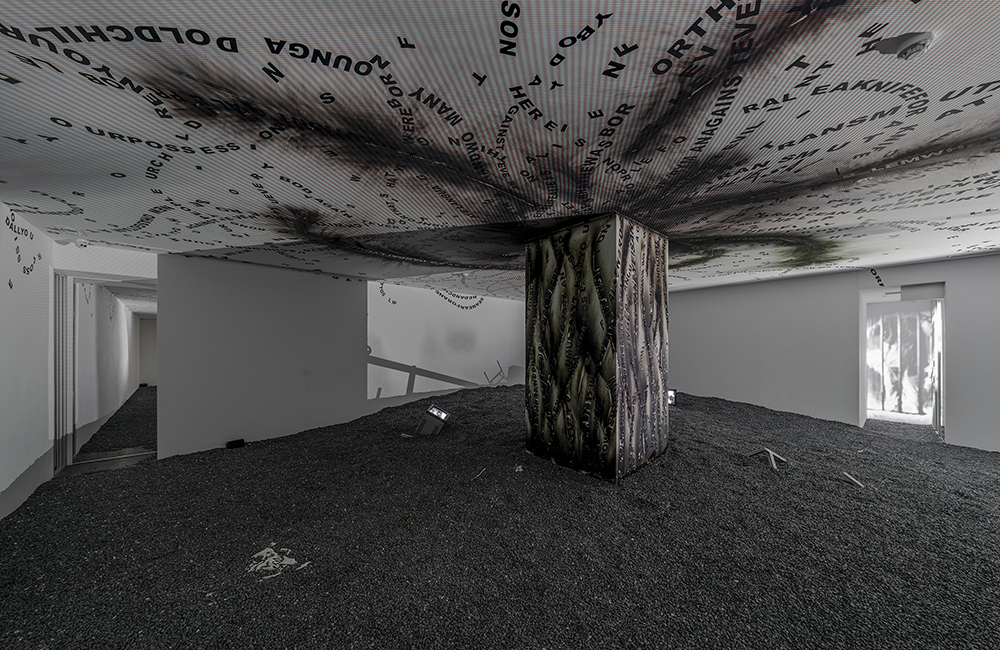
Visitors enter the gallery through a narrow corridor, crossing metal grilles almost imperceptibly before arriving in the main exhibition space. At its centre stands a large pillar, a massive tree whose trunk is covered in letters and phrases. Its branches extend across the ceiling, made of coiled and uncoiled text, as well as suspended words and letters. While the formal language is consistent with Tsang’s typical visual vocabulary, this iteration introduces a significant transformation: the inscriptions appear to have been scorched; they are covered in soot. The letters affixed to the trunk are not projected but physically glued and the artist has set them alight before scraping them with a utility knife. For the first time, Tsang engages physically with the material, enacting and even completing what can be interpreted as a gesture of total destruction. The gallery’s central pillar lends a new materiality to the projections: whereas previous works were characterised by their immateriality, these video elements now take tangible form and appear to take root – only to be immediately reduced to ash.
This tree is the Tree of Knowledge. In the Book of Genesis, it marks the pivotal moment in which morality emerges: once Eve bites into the fruit, she and Adam acquire knowledge of good and evil. From that moment on, they must live with these oppositional concepts, bear the burden of guilt and establish a moral framework or normative system to navigate the world. The tree is a recurring motif in Tsang’s oeuvre. In the video installation 6 + 1 Days (2020), for instance, it is the sole stable element amid the daily surge of catastrophe. Depicting it in flames constitutes a radical gesture – the destruction of what little remained intact; the annihilation of the very foundations of humanity or at least those of the Christian worldview.

The spatial design of the installation is informed by a conceptual trilogy, playing on the phonetic similarity between “tree” and “three” in English. This trinity refers simultaneously to the crucifixion of Jesus flanked by two convicts and to the Divine Trinity within Catholic tradition. The central space of the gallery is extended by two smaller adjoining areas which, while appearing to offer routes of escape, ultimately lead to dead ends. The first culminates in a mirror, confronting the viewer with their own reflection. The second leads to a space that resembles a prison cell – though physically open, it is bounded by metal bars. Projected onto the wall, on either side of this gate, is a black-and-white video constructed from footage of the execution of a Jordanian pilot by terrorist group ISIS in 2015. The man is shown from behind as he is set ablaze. To the right of the scene again stands a desolate tree, seemingly bearing silent witness to the atrocity.
Positioned on either side of the central tree are two old television monitors looping short video clips. The monitor on the right focuses on the ISIS execution footage, while the one on the left shows a Ukrainian soldier trapped beneath rubble. His repetitive movements – looped endlessly – appear futile, almost absurd. The footage was captured by a drone, the very same drone that is also carrying the bomb calibrated to end his life.

For Tsang, this marks a pivotal shift in the visual culture of war: for the first time, the viewer is aligned with the perspective of the drone and so with the bomb itself. The spectator becomes the weapon – implicated, complicit. Among the figures quoted in the installation are criminals, theorists of evil and morally transgressive philosophers. Yet evil, Tsang suggests, is not an external force; it resides within us. This is underscored by his subversion of the biblical Genesis, the opening of which he rephrases as: “In the beginning is the evil, and the evil is you.”
The installation as a whole invites critical reflection on our ways of seeing violence – our ability to acknowledge it, to morally account for it and, perhaps, to act upon it. At the same time, the mise-en-scène reminds us that we are immersed in an illusion, positioned outside the bounds of reality. As in Plato’s famous allegory of the cave, shadows are cast upon the walls, intermingling with text and projected imagery. And, as in Plato’s cave, the possibility of liberation exists – but only if one desires it. Though the corridors lead nowhere, the metal gates are not locked. Is there, then, another reality beyond this one?
And yet, when questioned, Tsang firmly rejects any suggestion of optimism. No enlightened philosopher will come to rescue us. For him, the age-old battle between good and evil may itself be obsolete. These categories, he argues, have become relative. We know all too well that yesterday’s terrorist is not necessarily tomorrow’s. Who, today, would still speak of “good” as an absolute value?
Two seemingly contradictory ideas underpin this new work: first, that evil is omnipresent; and second, that the world is merely an illusion – one in which we are confined, whether willingly or not. It reminds us of the provocative assertion by French philosopher Jean Baudrillard that the Gulf War did not take place; for most people, he argued, it existed only as televised imagery. Through constant exposure to violent images, we cease to believe in their reality. A similar phenomenon occurs in response to Tsang’s installation: despite its intense subject matter, the violence it portrays becomes blunted, in spite of a deliberately unsettling and overwhelming soundscape composed of roaring flames and sinister squeals.

What, then, are we really looking at? It appears that the installation is, above all, a confrontation between the artist and the conditions of reality, as well as a meditation on the aestheticisation of violence. The notion of “pleasure” recurs throughout the accompanying texts – likely referencing both the supposed sadistic pleasure some individuals derive from the suffering of others and the (perhaps guilty) pleasure of the artist who draws on such violence as the very substance of his artistic production.
Viewed through this lens, the installation can be read as both a self-portrait and a meta-reflection on the nature of art itself. For the first time, Tsang incorporates personal objects into his work: his old glasses, a book of poetry, a vintage catalogue that he has burned. These fragments, buried beneath the gravel scattered throughout the installation, suggest a desire for renewal. French writer André Malraux defined art as an anti-destiny. While Tsang portrays humanity as trapped within a dark and relentless determinism, the artist’s gesture may remain what allows for the transformation and re-creation of the world, even when emerging from a landscape of ruins.
T REE O GO D EVIL
gdm 爍樂畫廊
香港
2025年3月19日至5月24日
曾建華的最新個人展覽「T REE O GO D EVIL」構思為一個完整的裝置——一個沉浸式的視覺和聽覺環境,融合了他對文字引用與影片片段剪接,包括電影或網上影片中的暴力場景。作品主題是曾建華一直以來持續關注的議題,他從《聖經》、預言世界末日的映像和時事中汲取靈感,探討善惡等道德價值觀在當代的意義、人類的判斷能力以及人類在這個被曾建華稱之為虛幻世界中的位置。
參觀者通過一條狹窄的走廊進入畫廊,穿過容易被忽視的金屬柵欄,然後到達主要展覽空間。展覽空間的中心矗立著一根大柱子,那是一棵樹幹上寫滿字母和短句的巨樹。它的枝幹延伸至天花板,由各式捲縮和展開的文字及懸掛的字詞和字母組成。雖然文字的形式與曾建華典型的視覺字詞一致,但這次有一個重要的變化:字句都被燒焦了,佈滿煙灰。樹幹上的字詞不是通過投影而是實體貼上,然後曾建華將它們點燃,再用美工刀刮除。這是他首次以親身接觸的方式與材料互動,實行並完成這種毀滅的行為。畫廊中心的柱子為投影帶來了新的物質性:以前的作品特點是其非物質性,而這次這種影像元素則以有形的方式呈現,仿似在生根發芽——但之後又立即化為灰燼。
這棵樹就是知識之樹。在《創世紀》中,它代表了道德出現的關鍵時刻:在夏娃咬了一口禁果後,她和亞當就知曉了善惡。從那一刻起,他們就必須與這些對立的觀念共存,承擔罪責,並建立道德框架或規範體系來探索世界。樹是曾建華作品中反覆出現的主要元素。例如,在影像裝置《6 + 1 日》(2020 年)中,樹是每天的災難中唯一的穩定元素。將其描繪成在火中燃燒是一種激烈的表達——意指摧毀僅存的一點完整;代表毀滅了人類的基礎,或者至少是基督教世界觀的基礎。
裝置的空間設計是三角概念,利用了英文中「tree」和「three」發音的相似性。這個三角既是指耶穌在兩名囚犯的夾持下被釘上十字架,也是指天主教傳統中的神聖三位一體。畫廊的中心空間有兩個較小的相鄰區域延伸,這兩個區域看似提供了逃生路線,但終點卻是死胡同。第一條路線的終點是一面鏡子,讓參觀者面對自己的倒影。第二條路線則通往一個仿似牢房的空間——雖然是打開的,但卻被金屬欄桿圍住。在這扇閘門兩側的牆上投射著一段黑白影片,播放著 2015 年恐怖組織 ISIS 處決一名約旦飛行員的片段。畫面是從背後拍攝,這名飛行員在火中被燒死。畫面的右邊矗立著一棵荒涼的樹,似乎在默默地見證著這場暴行。
在中間的這棵樹兩側有兩部舊電視循環播放短片片段。右側的電視主要播放 ISIS 的處決鏡頭,而左側電視則播放著一名烏克蘭士兵被困在瓦礫之下。他無止境循環的重複動作——顯得徒勞,甚至荒謬。這段影片是由一架無人機拍攝,而這一架無人機亦帶上了用來結束他生命的炸彈。
對曾建華來說,這是戰爭視覺的重要轉變:觀眾第一次以無人機和炸彈的視角觀看戰爭。觀眾變成了武器——參與戰爭,成為戰爭的一部分。裝置中引用的人物中有罪犯、邪惡理論家和道德敗壞的哲學家。然而,曾建華認為邪惡並不是一種外在力量,它就存在於我們的心中。他重新演繹《創世紀》時強調了這一點,將開首改為:「太初有惡,惡就是你。」
這件裝置讓我們認真反思自己看待暴力的方式——我們承認暴力的能力、在道德上對暴力負責的能力,甚或採用暴力的能力。與此同時,這個刻意營造的場景亦提醒了我們,我們正身處幻象之中,而非現實。裝置仿照柏拉圖著名的洞穴寓言,把陰影投射在牆上,與文字和投射影像摻雜在一起。而且,就像柏拉圖的洞穴一樣,解放的可能性是存在的——但前提是人們有此渴求。儘管走廊的盡頭是死胡同,但金屬閘門卻沒有被鎖起。那麼,除了這個現實之外,還有另一個現實嗎?
然而,當詢問曾建華時,他堅決否認任何樂觀的看法。沒有開竅的哲學家會來拯救我們。對他而言,善與惡長久的爭鬥本身可能已經過時了。他認為,善與惡已變成一種相對的概念。我們都非常清楚一個人在昨天是恐怖份子不代表明天也是。如今,誰還會將「善」視為絕對價值?
兩個看似矛盾的觀點就是這件新作品的主題:第一,邪惡無處不在;第二,這個世界只不過是一個幻覺──無論我們是否願意,我們都被困其中。這讓我們想起法國哲學家Jean Baudrillard認為從沒發生過海灣戰爭的大膽觀點。他認為對大多數人來說海灣戰爭只存在於電視畫面中。無間斷接觸到暴力影像令我們不再相信它們的真實性。曾建華的裝置作品也有類似的現象:雖然主題內容強烈,他故意借大火和慘叫聲營造出令人不安和難以忍受的音景,但其中所描繪的暴力卻被鈍化。
那麼我們真正該關注的是什麼?這件裝置是曾建華自己與現實的對抗,也是對暴力美學化的思考。周圍的文字都環繞著「愉悅」的概念——也許是指通過凌虐他人獲到的病態快感,也可能是指曾建華利用這種暴力作為其藝術創作基礎(也許也帶有負罪感)的快感。
從這個角度來看,這件裝置既可以被視為藝術家的自畫像,也可以視之為對藝術本質的反思。曾建華第一次將個人物品加入到作品中,他加入了自己的舊眼鏡、一本詩集、一本他焚燒過的古董目錄。他將這些物品埋於散落在裝置各處的瓦礫之下,代表著他對革新的渴望。法國作家André Malraux認為藝術是對命運的反抗。雖然曾建華把人類描繪成被困在黑暗無情的命運之中,但他的行動也許留下了可以改變和重塑世界的空間,即使要從一片廢墟中重生。