Contours of Expression /
Whitestone Gallery /
Hong Kong /
Aug 9 – Sep 20, 2025 /
Ilaria Maria Sala /
The Hong Kong branch of the Japanese-owned Whitestone Gallery has inaugurated its new Hong Kong space in Wong Chuk Hang with a group show, Contours of Expression. It features four artists: Tsuyoshi Maekawa, a member of the avant-garde Gutai Art Association group, which was active from 1954 to 1972; abstract painter Tetsuo Mizu, who passed away this January, at 80 years of age; Kohei Kyomori, born in 1985; and the Hong Kong and Jingdezhen-based ceramic artist duo Julie & Jesse – Swiss designer Julie Progin and American artist Jesse Mc Lin.
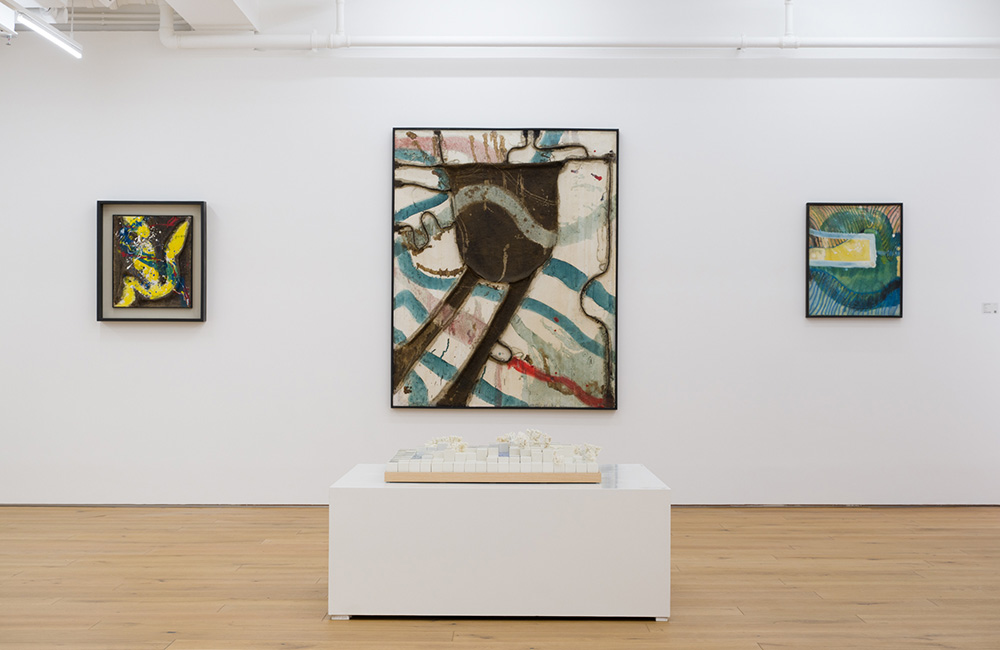
Maekawa’s works date from the early 1960s to 2015 and are all variations of his signature jute/burlap cloth on canvas: using adhesive and paint, he shapes the cloth on the canvas so as to create a three-dimensional element. He adds paint either before shaping the cloth or after, creating abstract works that immediately recall the Gutai approach, with its bright colours and devotion to a process that involved a rather physical approach to art making, going beyond paint and brush. The word gutai itself means “concrete” and is written using the characters for tool and body – when the group was still active, it also engaged in performances, theatre and installations.

Courtesy Whitestone Gallery.
Work (Nanameni) A-20 (1963), painted on a very pale pink background, weaves sinewy pink, red, blue, azure and brown lines, while a piece of brown jute stretches on the canvas as if it were a primitive container. Untitled 141236 (2014), on the other hand, shows how decades of manipulating the thick burlap cloth has created a deep intimacy between Maekawa’s hands and his favourite technique: the large sack cloth occupies the full size of the canvas. It is fully saturated with glue and has been positioned so as to create large waves and valleys, like the bed of a sharply curving river, made exuberant by splashes of bright yellow, white, blue and red paint. Untitled 160108 (2015) presents the same kind of strong ridges on the canvas, made with burlap and covered in white and blue paint, with just a few splashes of white and red, creating a powerful bridge between painting and sculpture. His later works take a much gentler approach to this same technique, as he used a sewing machine to produce more regular ridges and decorative lines, on which he applied pale blues, greens and purples.
A similar passion for experiment and manual research can be found in a comprehensive selection of Julie & Jesse’s most representative works. The series Anomalous Artefacts (2012) fuses found ceramics shards – pieces of ceramic spoons, horse figurines and teapot handles – using epoxy clay.
The result is a series of fantastical creatures, like a surreal ceramic bestiary, mounted as if they were crawling up the wall in a fairy-tale procession of magical beasts. Since 2022, the artists have been making porcelain bottles using found, broken moulds, which are used and reused, allowing the porcelain slip to fill into the growing mould cracks until the moulds became unusable. The result is ceramic bottles with unexpected forms, like sudden collars or veils that cover parts of the more typical bottle shape. One of these disused plaster moulds is also there at the show, with a thick, wide, blue ribbon around it to keep the various parts together. The Taking Root series (2023) is represented by a number of works in rescued banyan tree, porcelain, glaze and wood that form semi-humanoid bodies turned into planters, to which curvy sticks of polished wood are attached.

Courtesy Whitestone Gallery.
Mizu’s geometric-abstract works fill the gallery with colour-block canvases that recall nautical flags, or landscapes with a vague Paul Klee echo, but taken to an extreme of abstraction, leaving the blocks of colour to carry all attempts at representation. Kyomori, on the other hand, uses experimentation to mix mineral pigments and UV resins on canvas. A series of works recall decorated Mexican folk calaveras (skulls), like Flowing Skull A-UN col.1 (2023) and S Matsu #1 (2024). On a more traditional Japanese plum blossom painting, resin petals are attached to a black ink tree trunk, rendered in a very calligraphic way.
Through these works, Contours of Expressions inaugurates Whitestone’s new space with highly interesting pieces of a sort not commonly seen in Hong Kong. Through very different aesthetics, the four artists show a keen attention to experimentation, the main thread running through a show that is otherwise somewhat eclectic.
表現的輪廓
白石畫廊
香港
2025年8月9日至9月20日
日本白石畫廊香港空間近日於黃竹坑新址正式揭幕,以群展「表現的輪廓」作為開幕活動。展覽彙聚了四位藝術家的作品,包括前衛藝術團體「具體美術協會」成員前川強,該團體活躍於1954年至1972年間;於今年1月逝世、享年80歲的抽象畫家水島哲雄;1985年出生的京森康平;以及駐香港與景德鎮的陶藝雙人組Julie & Jesse——成員為瑞士設計師Julie Progin與美國藝術家Jesse Mc Lin。
前川強的作品橫跨上世紀60年代初至2015年,均以其標誌性的黃麻/粗麻布鋪在畫布上進行多元演繹。他運用粘合劑與顏料將布塑形於畫布上,打造出三維立體效果。他在布料塑形前或在塑形後添加顏料,創作出的抽象作品讓人即刻聯想到具體派的美學特徵——色彩明快,並致力於超越顏料和畫筆的限制,注重以肢體參與的方式進行藝術創作。「具體」二字本意即「具身之物」,由「工具」與「身體」兩個漢字構成——該團體活躍期間亦廣泛涉足行為藝術、劇場表演及裝置藝術。

Courtesy Whitestone Gallery.
前川強的作品《(Nanameni) A-20》(1963年)以極淺的粉色為背景,交織著剛勁有力的粉紅、天藍,青藍與褐色線條,一塊褐色麻布鋪展於畫布之上,像是一件原始容器。與之相對,作品《無題141236》(2014年)則展現了經過數十年對粗麻布的操控,前川強的雙手與他所鍾愛的技藝之間已達成深厚的默契:一大塊麻布鋪滿整個畫布,飽浸膠水後被塑形成巨浪與深壑,猶如急轉蜿蜒的河床;而飛濺其上的明黃、亮白、鮮藍、赤紅顏料,更賦予了畫面勃勃生機。《無題160108》(2015年)在畫布上呈現出同樣的立體紋路。這些紋路以麻布構成,表面覆以白、藍顏料,其間點綴著少許飛濺的白與紅,在繪畫與雕塑之間搭起一座有力的橋樑。其晚期作品對此技法進行了更為柔和的演繹,採用衣車創造出更為規整的布紋與裝飾性線條,並施以淡藍、淺綠與淺紫等色彩。
在Julie & Jesse極具代表性的系列作品中,同樣可見他們對實驗性與手工探索的熱忱。《Anomalous Artefacts》(2012年)系列用環氧黏土,將收集到的陶瓷殘片,如包括瓷勺碎片、馬形小擺件與茶壺把手,重新拼接融合。
最終所呈現的是一系列奇幻生物,猶如一部超現實陶瓷異獸圖鑒。這些生物被嵌在牆上,彷彿童話中的一隊魔幻野獸正沿著牆壁爬行。自2022年起,兩位藝術家便開始利用搜羅來的破損模具製作瓷瓶。這些模具被反復使用,瓷漿逐漸滲入模具上不斷擴大的裂縫中,直至模具徹底報廢。由此誕生的瓷瓶形態出人意料,如突如其來的衣領或面紗,遮住了常規瓶身的部分區域。展覽中亦陳列有一件廢棄的石膏模具,週邊纏繞著一條厚實而寬大的藍色緞帶,將各部件固定在一起。《Taking Root》系列(2023年)包含多件作品,均以回收的榕木、陶瓷、釉料與木材創作而成,塑造出半人形的軀體造型,這些軀體被設計成花盆,上面還附著幾根拋光的弧形木棍。
水島哲雄的幾何抽象作品以色塊畫布充盈展廳,它們既令人聯想到航海旗,亦透出保羅·克利風格的朦朧風景意趣,但藝術家將抽象推向極致——讓色塊承載一切表現意圖。京森康平則通過實驗手法,在畫布上融合礦物顏料與UV樹脂。其《Flowing Skull A-UN col.1》(2023年)與《S Matsu #1》(2024年)等作品令人聯想到裝飾性的墨西哥民間骷髏藝術(calaveras)。在一幅更具傳統意味的日本梅花畫作上,樹脂材質的花瓣附著於水墨樹幹之上,而樹幹則以極具書法韻味的筆觸揮灑而成。
通過這些作品,展覽「表現的輪廓」為白石畫廊的新空間揭幕,所展作品趣味十足且在香港藝術界中並不多見。四位藝術家雖有著迥然不同的美學風格,卻展現出對實驗精神的共同追求,成為這場略為不拘一格的展覽中貫穿始終的主線。