PalaisPopulaire, Berlin /
Deutsche Bank Artist of the Year 2025 /
The first thing you encounter upon entering Charmaine Poh’s exhibition Make a travel deep of your inside, and don’t forget me to take is a glowing hand-written phrase on the floor, ending with “how we breathe”. Projected in soft blue light, the words hover just above eye level, pulsing gently, as if taking air. This quiet invocation sets the tone for what follows: a deeply atmospheric and emotionally textured experience that unfolds as much through sensation as sight. The exhibition’s title stems from a tender mistranslation spoken by a Turkish friend practising English – a moment of care and connection that invites viewers into a shared space of inbetweenness.
From here, a spiral staircase leads upwards into the exhibition space. Poh’s exhibition moves in spatial and conceptual spirals, refusing linear progression in favour of an environment shaped by rhythm, return and echo. Visitors are then welcomed with a reading corner arranged on a wall-mounted shelves. Books in Chinese, English and German sit side by side. The selection ranges from graphic fiction (The Art of Charlie Chan Hock Chye) to queer diaspora theory (Unruly Visions) and memoir. There is no fixed narrative or required reading; instead, the shelves suggest a broader discursive and emotional landscape that informs Poh’s practice. Multilingual and cross-genre, the collection reflects themes of displacement, memory and intimate history. Rather than guiding interpretation, these books offer a quiet form of accompaniment, thinking alongside the works without defining them.

Entering the main gallery space, the mood shifts. Lighting turns ambient and atmospheric, with red, blue and green hues circulating across the walls and floor. The environment is low-lit but richly saturated, heightening tactile and sonic perception. Nestled early in this sequence is Twin (2025), where two jade bangles are embedded in a square bed of sand. Slightly submerged, the bangles echo one another in shape and material, calling forth personal and cultural memory. Jade in East and Southeast Asian contexts carries affective weight – inheritance, protection, the slow change of time. The bangles’ placement, side by side and partially buried, suggests intimacy, perhaps between sisters or generations, as well as the subtle act of care in remembering.
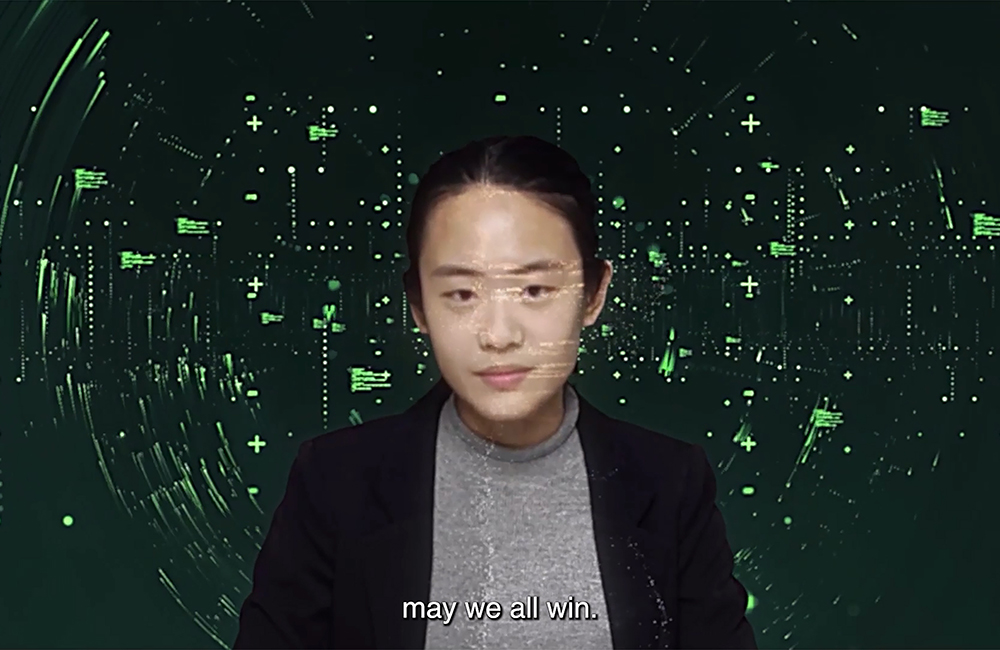
The viewer then passes through a curtain of shimmering beads, a tactile moment of transition, and encounters GOOD MORNING YOUNG BODY (2023), a single-channel deepfake video displayed on a freestanding screen. The video opens with a digital avatar of a 12-year-old Charmaine Poh, modeled on E-Ching, a character she played on the early 2000s TV show We Are R.E.M. Accompanied by the familiar Windows startup sound, the avatar speaks in looping monologues drawn from Poh’s past performances and reflections. The voice is young but unnaturally high-pitched, with an uncanny, helium-like quality. The work addresses Poh’s experiences with public scrutiny, including online harassment and media objectification during her childhood acting career. Through this digital reanimation, Poh reclaims her agency in a media landscape where images increasingly escape personal control. The piece dialogues with feminist media artists such as Hito Steyerl and Lynn Hershman Leeson, exploring themes of identity, authorship and the archival as a staged, recursive site of memory and unresolved trauma.

© Charmaine Poh. Courtesy the artist and PalaisPopulaire.
The central work in the exhibition is The Moon is Wet (2025), a new commissioned film. Installed within a circular, curtain-enclosed space with blue carpeting and speakers suspended from the ceiling, this three-channel video anchors the show’s exploration of opacity, both ecological and emotional. The three screens, arranged in a semi-enclosed arc, present overlapping narratives, in Hokkien, Cantonese and Indonesian, of three women who appear across time: a devotee at a temple to Chinese sea goddess Mazu; a 1970s domestic worker of Guangdong origin, known as a majie; and a contemporary migrant caregiver. These are languages historically spoken by Singapore’s migrant communities but long excluded from official state narratives. By foregrounding these tongues, often considered “dialects” or foreign, Poh calls attention to the politics of linguistic erasure.
Set predominantly in the intertidal zones of Singapore – spaces literally caught between land and sea, day and night – the film becomes a site for spectral encounter. Shot using prisms and flares to refract light and blur facial features, the characters appear as mythic apparitions, cloaked in veil-like masks. Poh deliberately resists exoticisation; the faces are not presented for recognition or projection. Instead, the viewer is invited to listen. “I wanted to create a distance,” she explains, “so the viewer could not reduce them to a certain identity but had to attend to what they were saying.”
That attention yields a quiet kind of power. There’s a moment in the film when the strains of a classic Anita Mui ballad waft through the audio, uncannily familiar to many across East and Southeast Asia. The past returns as atmosphere carried in songs, in gestures, in spectral presences that hover just outside our grasp.

© Charmaine Poh. Courtesy the artist and PalaisPopulaire.
As Poh notes, the majie and domestic worker characters are linked not only by occupation but also by a spiritual continuity: both are imagined as worshippers of Mazu and both embody forms of feminised labour often rendered invisible in dominant national narratives. The film gives them not just voice but cosmological weight, mapping a speculative ancestry that is both matrilineal and mythological. This orientation toward opacity, drawn in part from French writer and philosopher Édouard Glissant’s book Poetics of Relation (1990), is a recurring thread in Poh’s practice.
Emerging from this chamber, the viewer arrives at What’s Softest in the World Rushes and Runs Over What’s Hardest in the World (2024), a quieter yet no less potent video work exploring queer kinship in contemporary Singapore. Where The Moon is Wet amplifies voices across generations, this piece leans into gestures and presence. Hands pour water; bodies share space. Faces are rarely seen and, when they are, they appear in profile or soft focus. Poh’s camera lingers on domestic rituals – eating, folding, bathing – that articulate love not through grand narrative but through daily survival and mutual care.
The final section of the exhibition returns the viewer to the masks worn in The Moon is Wet, which reappear as sculptural objects displayed under gently pulsating LED lights. Nearby, photographs of the last remaining majie women in Singapore taken by the artist form a constellation of lives lived in partial view. These women are not named yet they stand in relation to one another, to the viewer and to the larger narrative arcs the exhibition evokes.
The credit wall, with text inside a full moon-like circle, thanks individuals: translators, actors and researcher communities such as the Asian Feminist Studio for Art and Research (ASFAR). It reads less like an end and more like a gesture of return, a loop back to where we began, with breath, care and shared story.
Throughout Make a travel deep of your inside, and don’t forget me to take, Poh assembles a world of slowness, polyphony and mutual regard. The exhibition resists spectacular display. Instead, it rewards attention to light, language and the ambient details of emotion. The politics here are not declarative but felt in accumulated textures: the weight of sand, the shimmer of red silk, the grain of a digitised voice.

© Charmaine Poh. Courtesy the artist and PalaisPopulaire.
Rather than centring selfhood or origin, Poh’s work invites viewers to dwell in relation to time, land and stories that do not always translate but still insist on presence. The margins, in her hands, do not whisper; they speak.
柏林人民宮
德意志銀行2025年度藝術家
傅秀璇的展覽題為 “Make a travel deep of your inside, and don’t forget me to take”(走進你內心深處,別忘了把我帶上),這句在地上發光的手寫句子,以how we breathe(我們如何呼吸)作結。柔柔藍光把文字投射在視線水平之上,輕輕跳動盤旋,彷彿正在吸氣。靜態的呼喚為後續內容定下基調:一場氣氛濃厚而富有情感層次的體驗,隨著視覺感官逐步揭開。覽題源於藝術家一位土耳其朋友在練習英語時的少許誤譯,這一刻洋溢關懷與連繫,邀請觀眾進入中庸的共享空間。
由此經螺旋樓梯往上走,便來到展覽空間。傅氏的展覽未有採取線性進展,而是在空間和概念的螺旋中移動,務求以節奏、回歸和迴響來塑造環境。一個以壁掛式書架構成的閱讀角歡迎觀眾到訪。裡面的中、英和德語書籍並排而放。選書既有《The Art of Charlie Chan Hock Chye》一類繪本小說,也有各地的酷兒理論(《Unruly Visions》)和回憶錄。這裡沒有固定的故事,也沒有必讀書冊,書架暗喻較廣泛的話語和感情面貌,也就是傅氏的實踐取材。這些書目的多種語言和跨類型特質反映了流離失所、回憶和親密過去的主題。書冊沒有指導如何詮釋,而是安靜地當襯托,為作品提供思考空間而不是定義。
進入畫廊的主空間,意境漸變。燈光變得通透而富氣氛,紅、藍與綠的色調在牆上和地上打圈。昏暗但飽和度高的環境加強了觸覺與聲音感知。在射燈編排下較早亮相的是《Twin》(2025年),兩隻玉手鐲半藏於方形沙床中,兩者在形狀與材質方面互相呼應,令人想起個人與文化的回憶。在東亞和東南亞,玉石象徵承傳、保護和時間慢慢流逝,有著情感意義。手鐲並排而部分藏於沙中,暗示著姐妹或世代之間的親密關係,還有關懷的含蓄記憶。
觀眾穿過閃亮珠簾的觸覺過渡後,可以看到《GOOD MORNING YOUNG BODY》(2023年),一段在獨立屏幕上播放的單頻道深偽錄像。開場時,傅氏的12 歲數碼分身登場,她在2000 年代初參演過電視劇《We Are R.E.M.》,數碼分身便是以她的劇中角色 E-Ching 為藍本。短片以熟悉的 Windows 啟動聲伴奏,數碼分身取材自傅氏昔日的演出和反思,不斷以年輕但異常高音的循環獨白,儼如吸入氦氣後說話。作品觸及傅氏童星時代備受公眾注目的感受,包括網絡騷擾和被媒體物化。在當今的媒體環境中,圖像越來越不受個人控制,傅氏以此數碼分身重獲主導權。作品是與 Hito Steyerl 和 Lynn Hershman Leeson 等女權主義媒體藝術家的對話,從層層漸進的記憶與未治癒的創傷探索身份認同、著作權和檔案庫內容等主題。

by Charmaine Poh at PalaisPopulaire, Berlin, Sep 11, 2025 – Feb 23, 2026.
Courtesy the artist and PalaisPopulaire.
新委約創作電影《The Moon is Wet》(2025年)是展覽的核心作品。這部三頻錄像設於以窗簾隔開的圓形空間內,配上藍色地毯與天花式揚聲器,為探討生態與情感中的不透明度做好鋪墊。三個屏幕以半封閉的弧線排列,三位女性跨越時空地以閩南語、粵語和印尼語重疊敘事,她們分別是媽祖廟內的信徒、1970年代廣東裔的「馬姐」,還有現今的外地護工。儘管新加坡的移民社群在歷史上都曾使用三人所說的語言,但這些「方言」或外語卻一直被排除在官方國家論述以外。傅氏透過這些語言作出呼籲,希望人們關注消音背後的政治。
電影主要以新加坡的潮間帶為背景,即介於陸地與海洋、白天與黑夜之間的空間,形成了鬼魅相遇的場景。她以棱鏡和強光來折射光線和模糊面部特徵,令片中主角看起來有如披著面紗的神秘幽靈。傅氏刻意去異國化,主角臉部既不易識別,也沒成為投射。相反,她請觀眾細聽。她解釋說:「我想製造距離,這樣觀眾就不能將她們簡單理解為某種身份,而是靜聽她們說話。」
專注聆聽能產生安靜的力量。影片其中一刻播出了梅艷芳的名曲,這是東亞和東南亞人耳熟能詳的旋律。歌曲、手勢和幽靈讓舊日乘著箇中氣氛回歸,徘徊在我們掌控之外。
正如傅氏指出,馬姐和家庭傭工兩個角色不僅因職業而連成一體,也有著精神上的連貫性:兩人都被想像為馬祖善信,兩人都以勞動女工的身份出現,是主流國家論述中常被忽視的人物。電影除了為兩人提供了發聲的機會,還賦予了神明的分量,從母系社會和神話角度勾勒和推敲出她們的祖傳歷史。傅氏的藝術實踐中,可以常常看到這種不透明取向,其中部分取自法國作家和哲學家愛德華.格利桑的著作《Poetics of Relation》(1990年)。
離開這個房間後,觀眾會來到《What’s Softest in the World Rushes and Runs Over What’s Hardest in the World》( 2024年)(世上最柔軟的東西衝過並輾過世界上最堅硬的東西),這是一部更安靜但同樣有感染力的錄像作品,探討當代新加坡的酷兒親屬關係。如果說《Where The Moon is Wet》放大了幾代人的聲音,這部作品則傾向手勢和存在感。以手倒水;讓身體共享空間。片中很少看到臉孔,即使出現也只是以側寫或柔焦的形式。傅氏的鏡頭圍繞著家庭日常——吃飯、折衣服、洗澡——沒有大是大非,卻透過每天的生活和互相關懷來表達愛。
展覽的最後一部分將觀眾帶回《The Moon is Wet》中主角戴過的面具,它們在柔和、脈動的LED下以雕塑品形式再度出現。附近是藝術家紀錄下在新加坡最後一代「馬姐」的照片,折射了她們的生活百態。照片中的女性沒名沒姓,但彼此之間、與觀眾和展覽所喚起的更廣義故事情節息息相關。

by Charmaine Poh at PalaisPopulaire, Berlin, Sep 11, 2025 – Feb 23, 2026.
Courtesy the artist and PalaisPopulaire.
鳴謝牆上的文字寫在滿月形狀的圓圈內,向譯者、演員和研究人員社群致謝,包括亞洲女性主義藝術與研究室(ASFAR)。這些文字讀起來並不像結束,更似回歸的姿態,周而復始地回到開始的地方,帶著呼吸、關懷和共同的故事。
在整個展覽中,傅秀璇建構出一個緩慢、有不同聲音而互相尊重的世界。展覽不走華麗呈現的路線,而是鼓勵觀眾細心留意光線、語言和情感環境細節。展覽不以宣示方式表達政治意念,而是讓觀眾透過沙子的重量、紅色的微光、數碼化的聲音等材質,逐層累積和感受。
傅氏的作品並非以自我或緣起為中心,而是邀請觀眾思考時間、土地,還有不一定能成功譯出原意,但仍然堅持存在的故事。邊緣到了她手上不會低聲細語,而是有話便說出來。