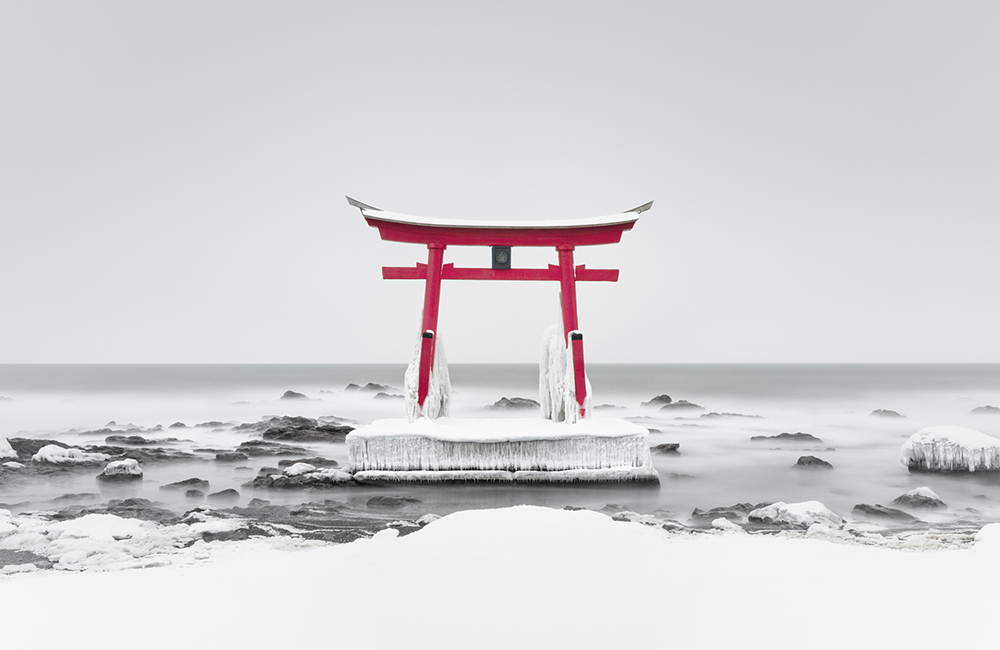
Torii /
Blue Lotus Gallery /
Hong Kong /
Nov 15 – Dec 14, 2025 /
The new body of work by Hong Kong-based Canadian photographer Ulana Switucha, presented at Blue Lotus Gallery in Sheung Wan, is like a very slow-paced meditation that constantly returns to the same shape, showing how many different forms and angles it can take. The shape in question is the torii, the mystical Japanese gate that marks the entrance to sacred spaces – whether built structures such as temples and shrines or parts of a natural landscape that have been turned into divine spots, because of either something unusual about them or the legends attached to them. They have been a fixture of Japanese religious practice for more than a thousand years and, with their delicate yet imposing presence, they announce that from that point onwards, one enters the realm of the kami, the Japanese Shinto gods – although a level of syncretism means that some Buddhist temples, too, are graced by toriis a short distance from the main entrance.
They are a captivating form, most often composed of two close-spaced horizontal wooden bars at the top and two pillar-like vertical bars that sustain the upper ones, which are ever so slightly curved. Often, they are lacquered red, and some of Switucha’s photos contrast this bright colour with the whitest of snow or misty waters, creating very dreamy images like the photo simply titled Inari. Taken in Tohoku in 2020, it shows a Senbon Torii, a thousand of the gates, surrounded and covered in snow – an image of a tunnel of red torii emerging from the white coldness, erected one near the other, which meanders through the sacred grounds of the Inari temple, founded in 1701 and dedicated to the god of harvests.

Courtesy the artist and Blue Lotus Gallery.
Ariake is another picture of a line of red torii, taken in Kyushu in 2019, at the Big Fish Shrine. Here, the gates are widely spaced and their bases are immersed in water, as, according to legend, a corrupt magistrate was saved at the last minute by a giant fish after he had been left stranded on a desert island by the villagers he was supposed to govern. In gratitude, the magistrate built this line of red toriis that extend into the sea, and returned to land – we don’t know if he mended his ways, though.
Fuji, taken in Hakone in 2023, on the other hand, is a more complex composition: a red torii partially immersed in a lake is visible on the right-hand side, while the undulating curves of two black hills divide the picture into two halves. Through the dip in the hills, we see the white, triangular shape of Mount Fuji, while grey waters and a grey sky frame these elements. This is a natural landscape, with a decisive human touch that complicates the narrative immensely. Is there a temple, behind or in front of the torii? Is this a pilgrimage spot, in one of those breathtaking sites that monks are so good at choosing for their retreats?

Courtesy the artist and Blue Lotus Gallery.
Switucha has been fascinated by the torii form for more than a decade, which she has spent travelling around Japan in search of the most poetic of these arches in out-of-the-way spots. Her lens shows how even a very simple frame, like the one drawn by a torii, can have infinite variations, if we can look attentively enough. A still from 2019, Ebisu and Daikoku, taken in Hokkaido, shows two extraordinarily shaped rocks emerging from the sea, their tops white with snow: one looks like a tree with a very full crown, while the other resembles an excessively rich pastry, well risen and covered in sugar. They are shintai rocks, inside which a deity is believed to reside; the slender one, Ebisu, is supposed to represent a fisherman, while the other, Daikoku, is a rice bale, crowned by a black torii. Together, they represent the gods of good fortune.
As far as we know, the first toriis were white – and at the show, the print Kotodama, of the Meoto Iwa rock at the Sakurai Shrine in Kyushu, taken in 2019, is the most traditional picture on view: the two rocks behind the torii are connected by a straw shimenawa rope, which is changed yearly, giving the photo an even more sacred look. It was taken with a very long exposure, turning the waves into a misty white blur that echoes the white of the torii.
Walking through the gallery, the different iterations of this simple, sacred form start to become slightly mesmerising, repetitive but never quite the same, like the different syllables of the same norito, or Shinto prayer.
Torii 鳥居
Blue Lotus Gallery
香港
2025年11月15日至12月14日
居港加拿大攝影師Ulana Switucha的全新作品在上環的Blue Lotus Gallery展出,展覽就像一場節奏緩慢的冥想,不斷回復為同一形狀,展現出鳥居的豐富形態和眾多角度。鳥居是神秘的日式大門,標誌通往神聖空間的入口——無論是寺廟、神社等人工建築,還是因獨特之處或傳說而被視為聖地的自然景觀。一千多年來,鳥居一直是日本宗教文化中不可或缺的一部分。它們精緻而莊嚴,穿過它們代表踏入神道教神靈的領域——儘管由於宗教融合,一些佛教寺廟也在正門附近建有鳥居。
鳥居的造型迷人,通常頂部有兩根間距較近、略微彎曲的橫木樑,由兩根的直立的柱子支撐。鳥居通常被塗成紅色,Switucha的一些照片將這種鮮豔的紅色與潔白的雪或朦朧的水面形成對比,營造出如夢似幻的畫面,例如名為《Inari》的照片。這張照片於2020年在日本東北地區拍攝,展示了千本鳥居。有一千座鳥居被白雪覆蓋包圍,宛如一條紅色的鳥居隧道從皚皚白雪中延伸而出,鳥居一個接一個,蜿蜒穿過的稻荷神廟的神聖之地。該座稻荷神廟建於1701年、供奉豐收之神。
另一張照片是於2019年在九州拍攝的《Ariake》,地點是大魚神社,照片展示了一排紅色的鳥居。這裡的鳥居間距很大,底部浸入水中。傳說中,一位貪官被他管轄的村民放逐到荒島上,幸得一條巨魚在最後一刻救了他。為了表達感謝,這位官吏建造了這排延伸至海中的紅色鳥居,然後又返回陸地——至於他有否改過自新,我們不得而知。

Courtesy the artist and Blue Lotus Gallery.
於2023年在箱根拍攝的《Fuji》構圖則更為複雜:照片的右邊有一座部分浸沒在湖中的紅色鳥居,兩座黑色山丘起伏的曲線將畫面一分為二。透過山丘的凹陷處,可以看到富士山白色的三角形輪廓,被灰色的湖和天空包圍。這是自然景觀,卻又有強烈的人文氣息點綴,豐富了畫面的敘事。鳥居的前後是否有寺廟?這裡是否是僧侶偏好選擇的靜修之地?
十多年來,Switucha一直對鳥居情有獨鍾,她走遍日本各地,尋找那些隱匿於偏僻角落、最具詩意的鳥居。她的鏡頭展現了即使是像鳥居這樣簡單的構圖,只要我們足夠細心,也可以帶來無限的變化。 在2019年拍攝於北海道的《Ebisu and Daikoku,》中,兩塊形狀奇特的石頭從海中崛起,它們頂部覆蓋著白雪:其中一塊像一棵枝葉繁茂的大樹,另一塊則像一塊蓬鬆飽滿、裹滿糖霜的糕點。它們是神颱石,人們相信神靈居於其中;纖細的惠比壽岩(Ebisu)被認為是漁夫的象徵,而大黑岩(Daikoku)則像一個稻穀,頂部架著一座黑色的鳥居。兩座鳥居象徵著帶來好運的神靈。

Courtesy the artist and Blue Lotus Gallery.
據我們所知,最早的鳥居是白色的——在本次展覽中,2019年拍攝的九州櫻井神社的夫婦岩照片《Kotodama》是最能代表傳統的作品:鳥居背後的兩塊岩石由一根每年更換、由稻草編織的注連繩連接,更增添了照片的神聖感。這張照片以超長曝光拍攝,將海浪暈染成朦朧的白色,與鳥居的白色相互呼應。
漫步於展廳,這種簡潔而神聖的形狀以不同的面貌出現,令人著迷。它們看似重複,卻又各有特色,如同一首祝詞(即神道教禱文)中的不同節段。