Galuh Anindita, Arahmaiani, Christine Ay Tjoe, Nadiah Bamadhaj, Kei Imazu, Ines Katamso, I Gusti Ayu Kadek, Murniasih, Citra Sasmita, Jennifer Tee /
White Cube / Hong Kong / Oct 31, 2025 – Jan 24, 2026
Chequered poleng cloths are ubiquitous in Bali. Often found wrapped around shrines, trees, statues or objects with spiritual and mystical connotations, these black and white textiles have a protective function and symbolise the coexistence of paradoxes: good and evil, order and chaos, light and dark – it’s literally woven into their materiality. For Galuh Sukardi, this coexistence of these polarised forces sparked the conceptual basis for Thresholds, an exhibition rooted in ideas of spiritual, political, physical and mythological means of transformation, largely informed by ancestral knowledge.
“Opposites don’t always have to be resolved; sometimes they are simply lived,” says Sukardi, emphasising that to allow for this co-existence, a kind of equilibrium is required. “They’re all held in a delicate balance and, within that balance, I sense a maternal energy, a presence that nurtures and guides.”
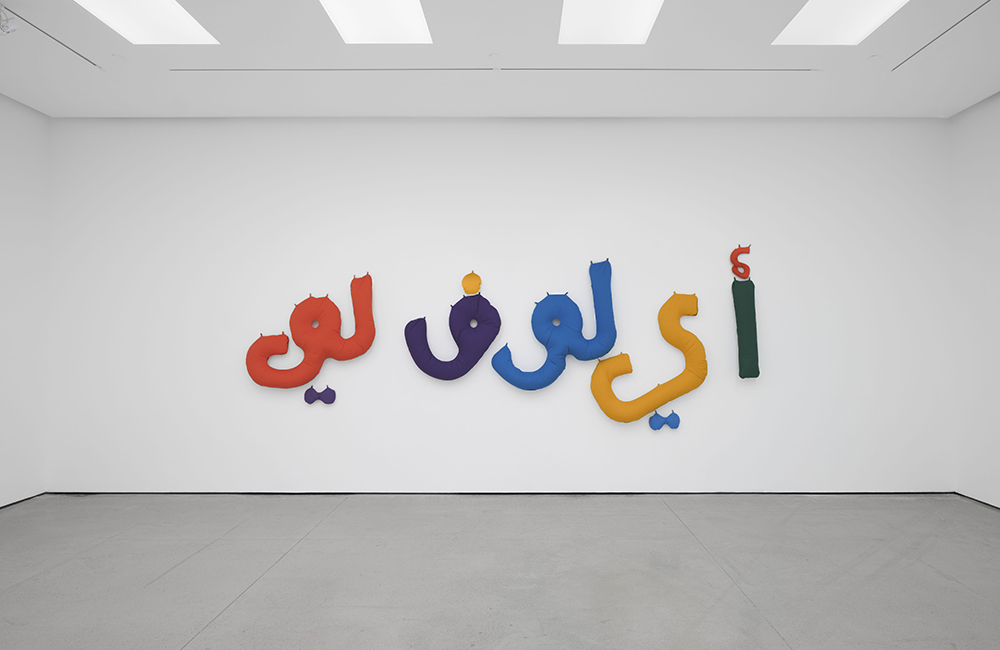
The exploration of this balance is a point of connection for nine female artists from or with deep ties to Indonesia, who Sukardi bought together for the exhibition at White Cube Hong Kong. Armed with a seamless curatorial framework that speaks to themes topical in the art world and culture at large – dissolving lines between craft and art, revival of the feminine divine and mythological narratives – Thresholds introduces local audiences to refreshing, process-driven practices and novel voices that reveal one of numerous dimensions of Indonesia’s divergent and evolving contemporary art scene.

Curated by Galuh Sukardi. Photo: © White Cube (Kitmin Lee).
Ancient ritual, layered colonial histories and a personal diasporic narrative fuse in Rotterdam-based Dutch-Indonesian artist Jennifer Tee’s Tampan Ship of Souls, Oceanic Horizon (2025). Comprising dried tulips of varying shades and species, which the artist collects and dries in a painstaking process, her intricate collage yields recreated motifs typically found on traditional hand-dyed cotton tampan and palepai textiles. Used in rituals that mark transitional periods of life such as marriage and burials, these sacred cloths primarily bear images of figures, boats, birds and fish, evoking notions of passages, migration and colonisation. Here, Tee references both her cultural and personal heritage. Her father and grandparents migrated to the Netherlands, a former naval power, in the 1950s, and her maternal grandfather was a tulip farmer and exporter. Although a popular symbol of the Netherlands, tulips originated in Central Asia and were bought to Europe in the 16th century. In alluding to this history, the artist contends with the idea of origin and references her own diasporic background; she often sees herself “as as a soul in limbo between two geographies and cultures”, embodying a balance characterised by nuance and tension.
The idea of belonging and an identity in flux is taken further in artist Ines Katamso’s practice, which literally allows her to ground herself. “As a bicultural individual between Indonesia and France, and having moved repeatedly between these two contexts, working with soil allows me to establish a direct, rooted connection to lands and to the ecosystems I engage with,” she says.
Formed with soil and pigment of her own creation, Katamso’s Series Biolateral 1 (2025) creates an earthy ecological imprint, resembling an X-ray of a plant and other vegetation that highlights biological patterns of repetition and symmetry. The symbolic value of soil lies in its default role as a witness to displacement, extraction and ecological transformation, yet it also simultaneously sustains life. The patterns are generated from microscopic data collected from various species classified as weeds, which are often viewed as a nuisance because they have no economic value yet are essential to maintain ecological balance. The artist continues this visual effect in other materials, like recycled plastic in Post Strata 5 (2024), which appears to be a skeletal structure of an insect or other organism fossilised in marble.

Curated by Galuh Sukardi. Photo: © White Cube (Kitmin Lee).
In her process, Katamso directs the flow of the pigment downwards, a gesture she says “establishes a physical and symbolic connection” to Naga Antaboga, a telluric serpent deity, and his daughter Dewi Sri, the goddess of vegetation, significant in Balinese and Javanese mythology. “They articulate cycles of life, regeneration and transformation, and offer a powerful lens through which to question our contemporary relationship with ecosystems,” she says.
Next to Katamso’s presentation, Kei Imazu also paints an interpretation of nature’s regenerative cycles. Her Jantung Pisang (2025) is imbued with the rich magenta hue of its titular vegetable – the banana blossom, a commonly used ingredient in Southeast Asian cuisine, and is a take on an Indonesian creation myth. As the lore goes, a woman called Hainuwele was killed by villagers, and the earth and its bounty sprouted into existence from her buried body.

Curated by Galuh Sukardi. Photo: © White Cube (Kitmin Lee).
The feminine divine is further invoked in Nadiah Bamadhaj’s curious The Whip, Jimat, Solar Plexus (all 2023) and The Harvest (2023-24), which are made from goat hide, resin and brass. The braid in Whip and pelvic structure of Solar Plexus immediately bring to mind the female body, while Jimat functions like a talisman. Suspended from the ceiling, the various sculptures are a visual representation of balance itself, and are inspired by the Hindu deity Durga, whose Balinese interpretation is representational of a balance between destructive and protective forces that is intrinsic to maternal and feminine energies.
One of the more established artists in the exhibition, Citra Sasmita, began 2025 with the exhibition Into the Eternal Land at London’s Barbican, and she continues to explore themes of the ancestral memory, feminine power and the inseverable bond between humans and nature. A blend of Western Balinese embroidery techniques and Eastern Balinese Kamasan painting forms Sasmita’s textile-based works, which local craftswomen help create. Functioning as a catalyst in helping to preserve these old techniques, Sasmita puts the idea of harnessing feminine power into practice. “I think that’s how female artists and artisans work together; it’s an equal distribution of empowerment and nurturing,” she says.

Curated by Galuh Sukardi. Photo: © White Cube (Kitmin Lee).
Inspired by mythology, Sasmita’s iconography always relates to the human body and its connection to nature. In Our Rooted Lineage (2025), the Naga, or serpent deity, is depicted sprouting trees with heads, extending upwards, representing a divine connection to the skies.
Inspired by strong female deity from Javanese mythology, Kanjeng Ratu Kidul, also known as the Queen of the South Sea, jewellery designer Galuh Anindita addresses ideas of healing with The Body Is A Temple, The Memory Is The Sea (2025). Although the installation might appear to be a cabinet of curiosities, it is in fact a reference to a rong telu – a cabinet meant for souls between realms. Here again, a delicate balance between various contrasting forces is at play, most notably those of protection and surrender, as many items function as amulets but also have dark connotations.
Presenting her craft as art has enabled the artist to “return to the original impulse” of what compels her to create and further explore her interest in bloodlines, ancestral objects, family myths, superstition and how memory travels.
Interested in preserving age-old traditions and inheritance, Anindita references Javanese healing points “that understand the body as an energetic and ancestral map”, she explains. Each object is crafted from silver and corresponds to a body part, evokes a myth and functions as a sacred but functional object – everything is wearable.
The most intriguing item in the cabinet is a small detail on the back – a long, spiky, silver chain replicating a spine. Called the Mayangkara, the belt signifies the act of literally harnessing impulses, desires and temptations. The form and motif allude to an umbilical cord that represents female power of creation. Usually tied around the stomach, the belt also references the organ and ideas of nourishment and sustenance, evoking a gentler function that belies its edgy appearance.
For Anindita, the feminine balance lies between what is expressed and what is contained – “the things we don’t say out loud, how we hold our lineage in ways that aren’t always visible and how that becomes part of our identity, and how we live between what we see and what we inherit”. It’s often the intangible that holds more meaning and, for Thresholds, it seems that all the artists have endeavoured in some way to make the invisible visible and the intangible tangible.

Curated by Galuh Sukardi. Photo: © White Cube (Kitmin Lee).
白立方畫廊 / 香港 / 2025年10月31日 至2026年1月24日
在峇里,黑白格紋布「poleng」隨處可見,常被披掛於神壇、樹木、雕像或帶有靈性與神秘意涵的物件之上,具守護功能,同時象徵善與惡、秩序與混沌、光與暗等對立的共存,這種二元性被編織進布料本身的物質結構之中。這種對立力量的共存啟發了Galuh Sukardi「閥限」的策展概念,展覽圍繞靈性、政治、實體與神話的蛻變軌跡,其核心思想在很大程度上源自祖先傳承的知識與智慧。
Galuh Sukardi形容:「對立力量不一定需要化解,有時它們可以共存。」她強調,要實現這種共存,需要維持一種平衡。「在這種微妙的平衡裡,我感受到一種母性力量,提供滋養與指引。」
這種對平衡的探索,成為展覽九位女藝術家的連結。這些藝術家由Galuh Sukardi邀集於香港白立方畫廊展出,她們均來自印尼,或與印尼有深厚淵源。「閥限」以縝密流暢的策展脈絡回應當代藝術與文化語境中的議題,如工藝與藝術界線的消解、女神以及神話故事的復興,為本地觀眾帶來一系列充滿新鮮感和以創作過程主導的實踐與聲音,展現印尼當代藝術其中一個多元而不斷演變的面向。
印尼裔荷蘭藝術家詹妮弗‧狄居於鹿特丹,她的作品《Tampan Ship of Souls, Oceanic Horizon》(2025年)融合古老儀式、多重殖民歷史與個人移居背景,由不同品種和色調的乾鬱金香花瓣構成。藝術家以抽絲剝繭的方式親自採集與風乾花材,拼貼出仿似傳統手染棉布「tampan」與「palepai」紋樣的圖像。這些神聖布料常用於人生重要轉折的儀式,如婚禮與葬禮,多數描繪人物、船隻、雀鳥和魚類,意喻生命旅程、遷徙與殖民。詹妮弗‧狄同時在作品中回溯文化與個人背景,她的父親與祖父母於50年代移居昔日的海上強國荷蘭,而外祖父則是鬱金香農夫兼出口商。鬱金香雖然是荷蘭的象徵,但實際原產於中亞,並於16世紀才傳入歐洲。藝術家透過呼應這段歷史探討「起源」的概念,反思自身作為海外移民的背景。她常將自己視作「漂泊於兩種地理與文化之間的靈魂」,體現一種細膩而充滿張力的平衡狀態。
伊內斯‧卡塔姆索的作品將關於歸屬感與流動身份的議題推向更深層次,讓她落地生根。她表示:「作為一位多次於印尼與法國兩地之間往返的雙文化個體,接觸泥土讓我直接和深刻地與土地和生態系統建立連結。」
伊內斯‧卡塔姆索以泥土與自製顏料創作的《Series Biolateral 1》(2025年),呈現出植物X光影像般的生態痕跡,突顯重複與對稱的生物模式。泥土見證遷徒、開採與生態轉型,同時孕育生命。模式由收集自多種被歸類為「雜草」的植物的微觀數據產生而成。這些植物往往因缺乏經濟價值而被視為滋擾,卻於維持生態平衡中不可或缺。藝術家亦將這種視覺效果延伸至其他媒界,例如由回收塑膠製成的《Post Strata 5》(2024年),形態宛如處於大理石之中的昆蟲和其他生物骨骼結構化石。
在創作過程中,伊內斯‧卡塔姆索讓顏料向下流動,她形容這個動作建立了與蛇神那伽及其女兒米神戴維‧絲莉「身體與象徵層面的連結」,兩位女神在峇里與爪哇神話中非常重要。她表示:「她們呈現生命、重生與轉化的循環,以有力的視角,讓我們重新審視當代人類與生態系統的關係。」
在伊內斯‧卡塔姆索作品旁的是今津景的《Jantung Pisang》(2025年),作品同樣以繪畫回應大自然的再生循環。她以香蕉花濃烈的紫紅色為主調,香蕉花是一種東南亞飲食文化中常見的食材,而作品亦取材自印尼的創世神話。傳說中,名為海奴韋萊的女子遭村民殺害,但被埋葬的軀體卻孕育出大地與萬物。
女神的意象亦持續在娜迪婭‧巴瑪達傑的作品中出現。她的《The Whip》、《Jimat》、《Solar Plexus》(皆為2023年)及《The Harvest》(2023–24年)以山羊皮、樹脂與黃銅製成。《The Whip》的辮子與《Solar Plexus》的盆腔結構令人想起女性的身體,而《Jimat》則像個護身符一樣。這些懸吊於空間中的雕塑本身就是一種「平衡」的視覺呈現,靈感源自印度教女神難近母。在峇里的語境中,她象徵破壞與保護並存的力量,體現母性與女性的力量。
西特拉‧薩斯米塔是展覽其中一位較為資深的藝術家,曾於2025年初在倫敦巴比肯藝術中心舉辦個展「Into the Eternal Land」,探索祖先記憶、女性力量以及人與自然之間不可分割的關係。她的紡織作品融合西峇里的刺繡技術以及東峇里的卡馬桑繪畫方式,由當地女工匠協助完成。在保存傳統技藝的同時,西特拉‧薩斯米塔將女性力量融入於實踐之中。她說:「我認為這就是女藝術家與女工匠的合作方式,平等地分享權力和養份。」
One of the more established artists in
西特拉‧薩斯米塔的作品受神話啟發,圍繞身體與大自然的連結。在《Our Rooted Lineage》(2025年)中,蛇神那伽的頭顱長出樹木並向上延展,象徵連結神聖的天界。
珠寶設計師加盧‧阿寧迪塔的作品《The Body Is A Temple, The Memory Is The Sea》(2025年)取材自爪哇神話中強大的南海女王,探討療癒的概念。乍看之下,這件裝置彷彿一個百寶櫃,但實際上是參考了用於安置遊走於不同界域之靈魂的聖櫃「rong telu」。作品亦呈現了多重對立力量的微妙平衡,尤其是保護與臣服的概念。許多物件既可用作護身符,但同時亦帶有陰暗的意涵。
將工藝作為藝術,使加盧‧阿寧迪塔獲得「原始動力」,讓她回歸創作,進一步探索血脈、家傳物件、家族神話、迷信與記憶流動的概念。
加盧‧阿寧迪塔致力保存古老傳統與傳承,她參考爪哇的療癒概念,將人體理解為一張由力量與祖先記憶構成的地圖。每件銀器皆對應身體某部位和某神話,既神聖又實用,所有作品皆可佩戴。
櫃中最引人入勝的細節,在於櫃內後方一條細長帶刺、脊椎形的銀鏈。這條腰帶名為「Mayangkara」,象徵對衝動、慾望與誘惑的控制。它的造型影射代表女性創造力的臍帶,通常繫於腹部位置,參考胃部形態並延伸出滋養與維生的象徵意涵,喚起一種溫柔的功能,與尖銳的外觀形成對比。
對加盧‧阿寧迪塔而言,女性的平衡存在於表達與內藏之間──「那些未被說出口的感受、我們如何以不可見的方式承載血脈並形塑身份,以及我們如何遊走於所見與繼承之間。」往往正是無形之物承載著更深層的意義,而在「閥限」中,所有藝術家似乎都以各自的方式,嘗試將不可見轉化為可見,將無形化為有形的實體。