Tiger in Mountains, Deer at Ocean / Blindspot Gallery / Hong Kong / Nov 28, 2023 – Jan 13, 2024 /
Tiger in Mountains, Deer at Ocean, curated by Leo Li Chen at Blindspot Gallery, focuses on Zhang Wenzhi’s latest series of works, primarily consisting of large-format ink-on-paper pieces, accompanied by a video.
Zhang’s artistic practice is deeply rooted in the historical context of Dalian, his hometown in northeastern China, now a modern port city. Throughout history, the region has experienced various periods of foreign occupation, with the British, Japanese and Russians all leaving their imprint. Zhang’s practice is embedded in this specific colonial history, as well as in the distinctive system of beliefs that once prevailed in that part of China, a fusion of Manchu shamanism, Japanese Shinto and Han religion. Within his artworks, mythological and hybrid creatures seamlessly intertwine with forest-dwelling animals, against the backdrop of the region’s complex history of rapid industrialisation and modernisation.

Bay of the Deer (2023), a large work in ink and colour pigments on paper, welcomes viewers in the first gallery space. The focal point of the composition is a majestic deer, set against a tumultuous, fantastical landscape. Its inner musculature, painted with carnal pigments, is made visible, as if we can see through the animal’s skin. While the overall palette is black and white, the sky is pierced by a scattering of golden comets, their hues mirroring the luminosity emanating from the deer. In Manchu shamanism, the spotted deer is perceived as a messenger between human beings and divinities, and these celestial elements serve as a reflection of the animal’s spiritual presence.
The whole exhibition is derived from the artist’s discovery of a stuffed spotted deer at the Natural History Museum in Dalian, allegedly made by a shaman in the 1930s. From there, Zhang delved into the life and work of this local fisherman, who could communicate with the spirits of the forest and notably with the deer god Wusizhuye. His portrait can be detected at the foot of the deer in the composition, holding a drum, his head and shoulders covered by a scaled mantle, performing amid shells, lichens and monstrous beasts. In the video work Ballad of the Deer God (2021), the artist follows the lyrics of the shaman’s song, depicting the wild forest and its transformation. The drum and bells combine to produce a breathless, powerful sound that accompanies the images, recalling the sound of express trains when they accelerate.

Courtesy the artist and Blindspot Gallery.
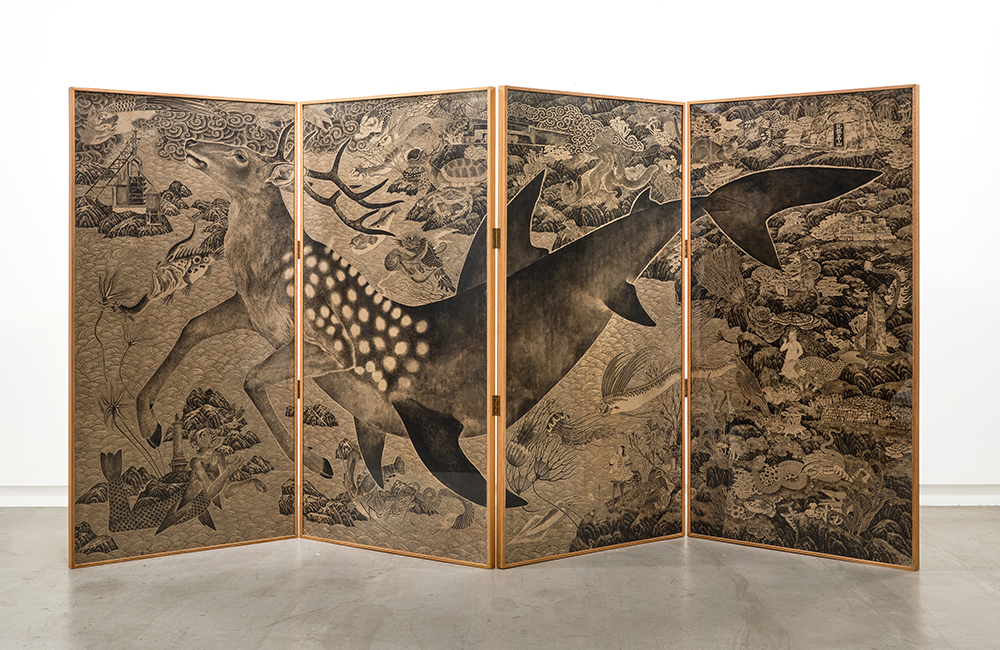
Both Russia and Japan invested in infrastructure in the areas they controlled for a time. The construction of railways, such as the South Manchuria Railway by the Japanese, brought radical changes to the landscape. Their presence pervades the artist’s work as a symbol of this heavy industrialisation. In Expedition in Manchuria (2023), for instance, the emblem of the company is engraved on a forgotten stone standing amid the remnants of factories in ruin, where birds are now nesting. In Bay of the Deer (2023), the dark silhouette of the train emerges from the clouds like a deity, hurtling towards a newly built bridge spanning a tumultuous sea. We see the train again racing out of a rocky mountain in the masterpiece of the exhibition, The Shark-Deer Chronicle (2023), a four-panel folded screen featuring a giant hybrid animal, half spotted deer and half shark.
In this latter, large, ink composition, the mythical deity hovers amid an array of fantastical beings, suspended in the air and soaring above the ocean. One characteristic of these mythological creatures is their ability to undergo transformation, granting them the power to exist both on land and beneath the water. Fish, for instance, possess legs, human beings are dotted with fins, and sea dragons support fox-like heads. They embody the fluidity that connects different realms: reality and fiction, past and present or life and death. Zhang’s collage-like technique, together with the absence of perspective, strengthen these connections. At the same time, the artist plays with traditional motifs and various artistic styles to question this line of continuity. For instance, his graceful, swirling waves and clouds evoke classical iconography, drawing from both Japanese and Buddhist painting traditions. This mixed aesthetic is in powerful contrast with all the modern components of his compositions, underscoring the clash between tradition and progress.

It is tempting to approach his work as a critique of the colonisation of nature, an idea that finds resonance in Tiger Park (2023), where a massive Siberian tiger roams in circles, confined in a tiny cage within a zoo. At the same time, nature, in his compositions, remains almighty. Birds incorporate industrial waste to make their nest, mountains absorb construction sites, and mythological creatures continue to strive and multiply. The artist leaves us with this ambiguity, inviting us to think beyond the usual dichotomy that opposes nature and civilisation.

Some of the research materials collected by the artist are glued onto the back of the panels, or directly incorporated into compositions, as in Serpent’s Reef (2023), where an army of deceased soldiers, depicted as fish, swim between old newspaper clips and a Japanese propaganda poster. With their dark, vacant eyes, they embody the soul of the warriors who fought during Russo-Japanese War (1904-1905), and who are now drawn, hypnotised, towards the isle of death. Here, the enemies of yesterday join and move away from these old archives, prompting us to think anew about history. What is left from the past? Skeletons, stuffed animals or a vital impulse that can embrace time, space and all contradictions?
Although this exhibition showcases only a few of Zhang’s artworks, it provides a profound glimpse into the complex universe of an artist who successfully transforms his research into compelling, beautiful visual narratives.
Featured image: The Shark-Deer Chronicle, [Front] by Zhang Wenzhi, Ink, archival materials mounted on paper, teakwood screen, 175.5 x 91.2 x 3.8 cm (each panel), 175.5 x 364.8 x 3.8 cm (4 panels unfold), 2023. Courtesy the artist and Blindspot Gallery.