Where does the water come from? Who is inside these empty aquariums? These questions linger in my mind as I enter the courtyard of a building in Venice’s historic Castello district, encountering Trevor Yeung’s site-specific installation Pond of Never Enough (2024). Created in response to the area’s aquatic identity and maritime characteristics, the work, part of the exhibition Courtyard of Attachments, consists of fishless tanks that extract water from the Grand Canal and filter it back to the Lagoon. Reminiscent of fish farm breeding pools or tanks in seafood restaurants, the aquariums symbolise the exertion of systemic control to produce commodities or desired outcomes. Highlighting how physical infrastructure impacts the ecosystems we inhabit, the water cycle hints at the deliberate support the system demands to maintain itself. From Hong Kong to Venice, the proximity of waterways and densely built urban spaces forms a connection that permeates our interactions with nature and social ecology.
Often departing from his personal memory and experiences, Yeung offers a sensuous perspective on how we live with and relate to others. As an immigrant to Hong Kong from Guangdong province at a young age, he felt confusion and shame about his belonging and identity during his formative years. Visiting goldfish shops in Prince Edward and Mong Kok provided an escape whenever he felt excluded in primary school. This experience of migration and displacement was shared by many facing dramatic sociopolitical changes in 1980s mainland China.

Commissioned by M+, 2024.
Finding one’s place in a new environment is more than a struggle to fit in; the feeling of alienation and transition between spaces led Yeung to construct a new, hybrid identity. His early work Live in Hong Kong, Born in Dongguan (2015), consisting an aquarium display with fish of disparate origins living together, reflects on the impact of globalisation and the illegal trade in domesticated animals. Exotic fish from a single origin or caught in the Amazon are particularly prized compared to those farmed in Southeast Asia or mainland China. The inclination to master the techniques of control to create a supposedly perfect living system is mostly shaped by our desire for consumption. This work explores the nuances of identity and migration by questioning how value is perceived and shifts in relation to difference and points of origin.
For Yeung, working with fish tanks and plants is also about creating a space where the audience can feel safe with their feelings and be hidden in a labyrinth. The chamber-like space, created using aquariums and multiple species of water plants, becomes a sanctuary for processing difficult emotions and healing traumatic experiences. Similarly, in his first UK solo exhibition Soft ground (2023) at Gasworks, the gallery space was transformed into a representation of a famous venue for public sex, lit with UV light, to subtly address the unspoken language of hiding from others and being seen in the London’s gay cruising areas. Immersed in the study of mirco-organisms and care for horticulture, Yeung has developed a keen interested in exploring how people engage with urban spaces and diverse living systems.
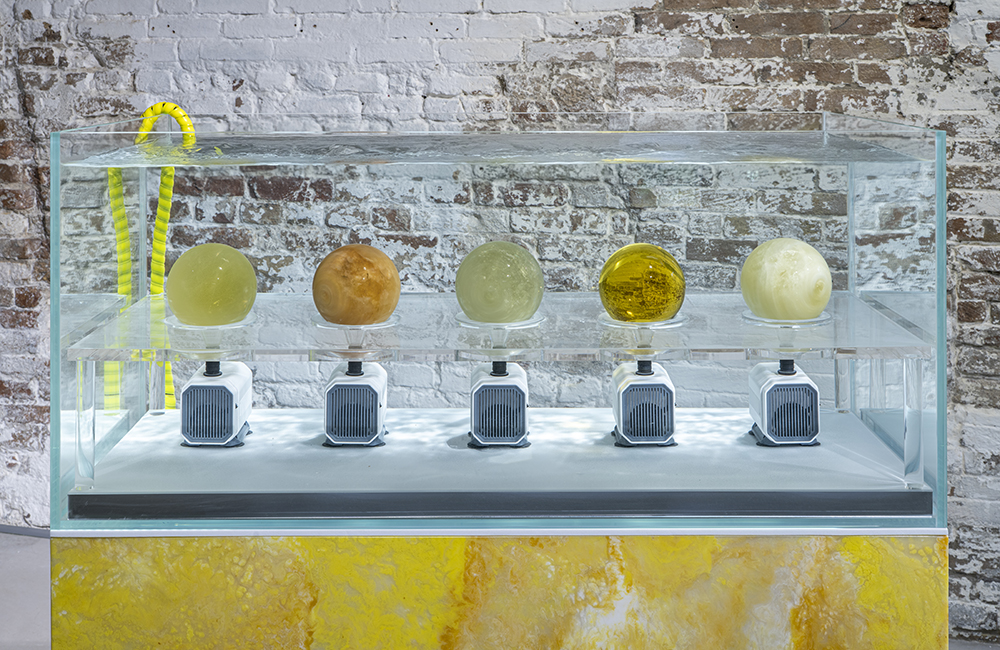
By the entrance, two well-lit aquariums placed on second-hand office tables evoked a time when small family businesses flourished in Hong Kong. Two Unwanted Lovers (2024) presents an eerie scene, with an empty, plastic-wallpapered, algae-covered fish tank waiting for the return of its caretaker, spotlighting the interdependency of systems. Here, the absence of life contrasts with auspicious motifs of fortune and wealth such as goldfish and flowing water that are common ornaments in Chinese businesses. Alongside this installation is Rolling Gold Fountain (2024), comprising five rotating citrine-like spheres on water pump stands placed in a line inside a fish tank. By appropriating cultural symbols, Yeung examines the complex business of constructing subjectivity, expressed through the deliberate and ironic arrangement of objects and systems.

Commissioned by M+, 2024. Photo: © Ela Bialkowska, OKNO studio Commissioned by M+, 2024.
Reflective thinking on desire, systemic control and surveillance is a key aspect of Yeung’s work. Inspired by his experience of travelling across borders during the height of the COVID-19 pandemic, he created Red Brighter (2023), a participatory installation resembling an immigration checkpoint, where viewers were given two pathways: to queue up and enter a room with two other works, Mr Cuddle in a Hotel Room (2023) and Wall of a Hamster Cage (2023), or walk right through in front of a billboard slogan that reads “For a brighter future”. By translating his social experiences into fables and situations inviting interaction, Yeung’s works prompt viewers to consider how systems of control embedded in our daily lives influence our emotions and behaviours.
Understanding intimacy and emotional attachment is crucial to interpreting the themes explored across the four sections of the exhibition. Like emergent creatures hidden in forests, scattered across the exhibition space are Night Mushroom in shade (Teak Cabinet) (2024) and Night Mushroom Colon (Hong Kong in Venice) (2024), illuminating a dim light for visitors in need of a quiet moment. They use a power adapter as a metaphor for how one handles being alone and adapts to a space, as well as an invitation to a freer way of inhabiting one. The enlargement of meticulously crafted objects and close observations of living mechanisms call for us to understand how to live alongside other beings, rather than applying a system of control or domination to fit our needs.

Commissioned by M+, 2024. Photo: © Ela Bialkowska, OKNO studio
At the physical and conceptual centre of this exhibition is Little Comfy Tornado (2024), a dynamic installation that casts a rhythmic spinning tornado inside a small fish tank, produced by a network of tubing connecting to a professional-grade filtration system. Excessively supported by the stacked plant tools, the fish tank presents a whirling force of authority, underpinned with a sense of fragility and hollowness. Excavating the inner logic of human relations, it illustrates a turbulent emotional landscape, echoing the cyclical nature of life exemplified in Pond of Never Enough.
The sense of absence is woven through the entire space and culminates in the final room of the exhibition. Cave of Avoidance (Not Yours) (2024) presents a mise-en-scène of a pet shop devoid of living fish, featuring a large fish tank with a one-way mirror inside it. The encircling structure of aquariums reflects the images of those who gaze at the artwork, situating the viewer in a shifting relationship between looking and being looked at – or, in other words, between caregiver and receiver. Yeung’s work engages the viewer by altering the positions of power to rethink intimacy and interpersonal relations. Unchallenged, these aquatic ecosystems, often stemming from human-centred thinking, can easily become obsessive. In this haunting installation, Yeung compels us to confront the vulnerability of our connections and the power dynamics at play in our lives, leaving us to ponder the delicate balance between control and coexistence.
Featured image: Rolling Gold Fountain (detail), Installation view of Trevor Yeung: Courtyard of Attachments, Hong Kong in Venice, 2024. Commissioned by M+, 2024. Photo: © Ela Bialkowska, OKNO studio. Commissioned by M+, 2024.
水從哪裡來?誰置身這些空水缸之中?這些問題在我走進威尼斯古老的卡斯泰洛區一棟建築的庭院中,看到楊沛鏗的《永不足夠貪婪池》(2024年)時,不斷在我腦海中盤旋。這是展覽「雙附院」的其中一件作品,回應了該地的水生特質和海洋特性。作品由無魚的水缸組成,從大運河中抽水,並將過濾乾淨的水排回潟湖。這些水缸讓人想起魚場的養殖池和酒樓的魚缸,象徵著人類為生產商品或取得預期成果而施加的系統性控制。作品強調實體基礎設施對我們居住環境的生態系統所帶來的影響,水循環暗示了系統需要刻意的支持來維持自身運轉。香港密集的城市空間和威尼斯水道的相似形成了一種聯繫,貫穿了我們與自然和社會生態的互動。
楊沛鏗經常從個人的記憶和經歷出發,以感性的視角,了解自己如何與他人生活和共處。他在年幼時從廣東移居香港,在成長的過程中對自己的歸屬感和身份感到困惑和羞愧。每當在小學被排斥時,他就會到太子和旺角的金魚店尋求慰藉。這種移居和流離失所的經歷,是許多在80年代面對中國大陸巨大社會政治變革的人共同的體會。
在新環境中尋找自己的位置,不僅僅是為了融入。疏離感和空間之間的轉換,讓楊沛鏗構建了一個混合的新身份。他的早期作品《居於香港,生於東莞》(2015年)由一個水缸組成,裡面的魚來自世界各地,反思全球化和馴養動物進行非法貿易的影響。與在東南亞和中國大陸養殖的魚類相比,單一來源或在亞馬遜捕獲的異國魚類特別受歡迎。以控制技術來創造一個所謂完美生活系統的傾向,主要由我們對消費的渴望所塑造。作品質疑價值的感知方式,以及價值隨著差異和來源所發生的變化,探索身份和移居的微妙之處。
對楊沛鏗來說,魚缸和植物創造了一個空間,讓觀眾可以藏身於迷宮中安全地感受自己的情緒。水缸和多種水生植物創造了房間般的空間,成為處理困難情緒和治癒創傷經歷的庇護所。同樣地,在他於Gasworks舉行的首個英國個展「柔軟的土地」(2023年)中,畫廊空間被改造成一個著名的公共性愛場所代表,用紫外光燈照亮,巧妙地表達在倫敦同性戀約炮區隱藏和展示自己的隱晦語言。楊沛鏗沉浸在微生物研究和園藝護理中,對探索人們與城市空間和多樣化生態系統的互動產生濃厚的興趣。
展覽入口的二手辦公桌上有兩個明亮的水缸,讓人想起香港小型家庭企業興盛的時代。《水泡情人們》(2024年)呈現了一個怪異的場景,一個空蕩蕩、貼著塑膠牆紙、長滿海藻的魚缸正等著照顧者回來,突顯了系統間的相互依賴。在作品中,生物的不存在與金魚和流水等代表幸運和財富的中國企業常見吉祥物裝飾品形成對比。裝置旁邊是《財源滾滾泉》(2024年),五個黃水晶狀的球體直線排列在魚缸內的水泵架上。楊沛鏗透過挪用文化符號,刻意和諷刺地將物件和系統並列,探討構建主體性的複雜過程。
反思慾望、系統控制和監視是楊沛鏗作品的一大重點。他受新型肺炎疫情高峰期的外遊經歷啟發,創作了參與式裝置《紅光明》(2023年)。裝置像海關檢查站一樣,參觀者有兩條路可以選擇:排隊進入展示著《酒店房裏的擁抱先生》(2023年)和《倉鼠籠裏的牆》(2023年)的房間,或者直接走到寫著「For a brighter future」(為了更光明的未來)的標語牌前。楊沛鏗的作品將他的社會經驗轉化為寓言和互動場景,促使參觀者思考日常生活中的控制系統對我們的情感和行為造成的影響。
理解親密和情感依附對於解讀展覽四個部分的主題非常重要。《蔭下的晚菇群(柚木櫃)》(2024年)和《晚菇群(香港在威尼斯)》(2024年)有如在森林暗處冒出的動物一樣,散佈於展覽空間中,為尋求寧靜的參觀者提供微弱的光線。作品以變壓器作為比喻,描述人們處理孤獨和適應空間的方式,同時邀請人們以更自由的方式居住。藝術家放大展示他精心製作的物件,對生物機制進行密切觀察,鼓勵我們反思應該如何與其他生物共存,而不是透過控制或支配系統來滿足我們的需求。
《小小安逸龍捲風》(2024年)位於展廳的中心位置,亦是整個展覽的核心之作。作品是一個動態裝置,魚缸藉一組管道連接到專業級過濾系統,投射出一個有節奏感的旋轉龍捲風。魚缸在堆起的園藝工具的過度支撐下呈現出一種旋轉的威力,同時又帶有一種脆弱和空虛感。作品探討人際關係的內在邏輯,描繪一幅動盪的情感景象,呼應了《永不足夠貪婪池》中展示的生命循環。
不存在感貫穿整個空間,在展覽的最後一個房間達到了頂峰。《(不是你的)逃避洞》(2024年)呈現了一個沒有魚的寵物店場景,房間內有一個大型魚缸,魚缸的背面內壁是鏡面。環繞式的魚缸結構反射了那些正注視藝術品的參觀者的影像,將他們置於一個注視和被注視之間的變化關係中,又或者可以說是照顧者和被照顧者之間。楊沛鏗的作品透過改變權力位置,引導參觀者重新思考親密關係和人際關係。這些水生生態系統往往以人為本,容易變得偏執。在這個令人難以忘懷的裝置中,楊沛鏗促使我們面對關係的脆弱和生活中的權力動態,思考控制與共存之間的微妙平衡。