Map of Amnesia /
Tang Contemporary Art /
Hong Kong /
Sep 13 – Oct 15, 2024 /
The latest solo exhibition of Chow Chun Fai’s works at Tang Contemporary Art, Map of Amnesia, is a return to some of the artist’s favourite themes – Hong Kong city scenes, streets, taxis (Chow was a taxi driver for a few years), Hong Kong movies and nostalgia – which are explored on 14 canvases in a bright palette, slightly acidic, recalling the neon signs that used to fill the urban landscape.
For these acrylic paintings, Chow used some of the images he has collected during more than 20 years of street photography. They show partially distorted buildings and streets, as if they were taken using an ultra-wide-angle lens. The result is akin to those vivid dreams in which familiar places appear not quite as they are in reality, yet perfectly recognisable, a kind of retinal memory that becomes entangled in meanings hidden in our subconsious. And to further complicate the picture, Chow has inserted some of the most iconic Hong Kong film stars into these highly recognisable yet heavily embellished reproductions of local landmarks, giving us what could be the camera operator’s point of view, or that of a curious passer-by stopping to observe a film shooting.
Lin Heung Tea House, in Central’s Wellington Street, for example, is depicted in a large painting (122 x 244 cm), The Longest Summer 1998, taken from director Fruit Chan’s movie by the same title starring Tony Ho and Sam Lee, the second in his 1997 Trilogy, in which a group of disaffected Hong Kong ex-soldiers from the British Army find themselves adrift after the handover. The soldiers start working for triad gangs and then decide to rob a bank to sort out their sudden economic difficulties; the plot is foiled by another gang wanting to rob the same bank. In Chow’s painting, we see two criminal gangs confronting each other with knives, right at the corner with Aberdeen Street where the tea house has been located for decades. The gang on the right has just got out of two red taxis, while Tony Ho walks away with a glass of beer in his hand. It is a night scene, dominated by red and green: an image that is violent and static at once, like an imaginary film still, with the powerful wide-angle distortion of the streets and buildings underlining its dreamlike quality.

Courtesy the artist and Tang Contemporary Art.
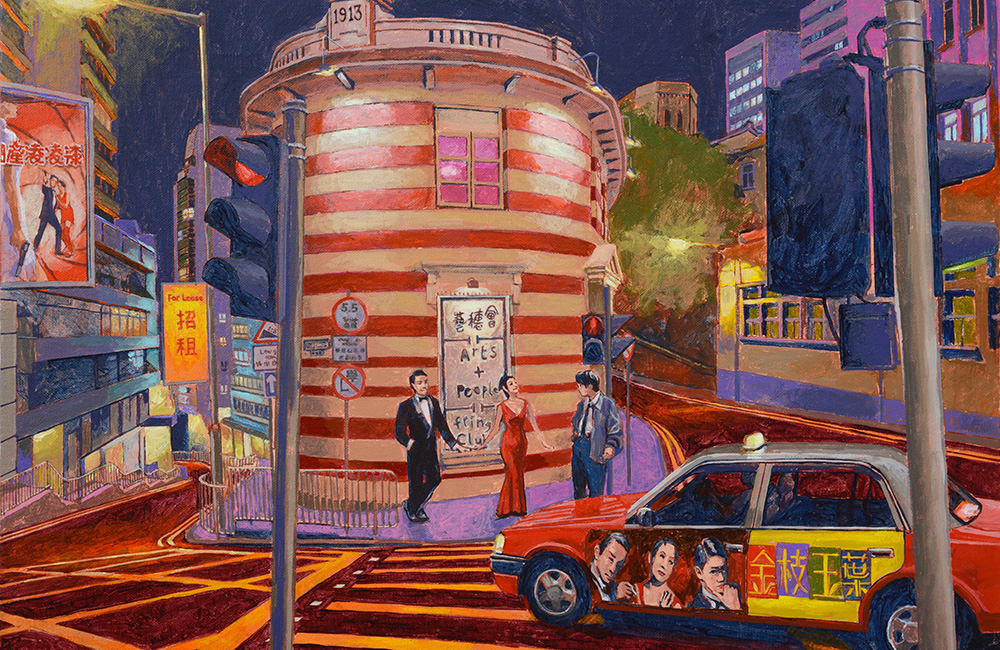
A smaller painting (43 x 60 cm), He’s a Woman She’s a Man 1994 at Fringe Club, taken from the title of a romantic comedy directed by Peter Chan and starring Leslie Cheung and Anita Yuen, shows another night scene with predomiant reds and browns, where the rounded shape of the Fringe Club is framed by Wyndham Street and Lower Albert Road. The sense of surrealism is made stronger by a red taxi passing by, with an ad for the movie that is currently being shot pasted on its side, as if it’s already been made.
The feeling of recognition and dislocation is further enhanced in the painting City War 1988 (152 x 100 cm), from the title of a thriller directed by Suen Chung and starring Chow Yun-fat and Ti Lung, back together on screen after box office hits A Better Tomorrow 1 (1986) and its 1987 sequel, directed by John Woo. Here, the plot sees Chow and Ti hunting down a crime boss just released from prison who is seeking revenge on his former criminal partners. In the painting, the two actors are standing by the Star Ferry Car Park, since demolished; in the background are Chater Gardens, IM Pei’s Bank of China Tower (although it was not yet completed at the time the movie was shot), Norman Foster’s HSBC Main Building and the current Court of Final Appeal, which used to house the Legislative Council. The palette is complex, with bright orange clouds in the sky, and the buildings in pink, blueish and green hues. The sense of nostalgia evoked by the old car park is dislocated by the anachronism of the more recent buildings appearing already completed in the picture, again layering memories with the present, creating a half imaginary, half cinematic scene that seems to hint at a parallel, unexplored possibility.

All the paintings on show explore this layering of different times and realities – the recognisable city spots; the gritty newer highways that have modified the landscape; the stars of some of the best-known Hong Kong films, from Infernal Affairs to Comrades: Almost a Love Story to As Tears Go By, among others.
Here Chow reiterates his recurring Hong Kong themes, but in a new incarnation. He creates an unusual, captivating tension between reality and cinematic imagination, and between different eras of the city that continue to coexist in our minds, clashing with the city’s ever-changing landscape.
《失憶地圖》
當代唐人藝術中心
2024年9月13日至10月15日
當代唐人藝術中心的「失憶地圖」是周俊輝的最新個展,展覽回到周氏最喜歡的主題,包括香港的城市面貌、街道、的士(周氏有幾年曾當的士司機),還有香港電影和懷舊。他在14幅畫布上以鮮明色調來探索這些主題,筆風略帶微酸,讓人緬懷昔日閃耀全城的霓虹招牌。
周氏這些丙烯畫取材自20 多年的街拍圖像,畫面中的建築物和街道略呈扭曲,就像是超廣角鏡頭拍下一樣。效果就如逼真夢境之中,熟悉的地方卻與現實有所不同,但卻一望而知,是藏身潛意識內但意義糾纏不清的視覺記憶。周氏作品中繪有辨識度極高的本港地標複製場景,除了飾以大量點綴,還加入了最經典的香港電影明星,營造出攝影師的視角。觀眾也可以理解為路人駐足觀看電影拍攝的角度。
題為《1998年的去年煙花特別多於蓮香樓》的大型畫作(122 x 244厘米),描繪了位於中環威靈頓街的蓮香樓,靈感源自陳果導演1998年的《去年煙花特別多》,該片由何華超和李燦森主演,是陳導「九七三部曲」的第二部。故事講述英國駐港軍事服務團在香港主權移交後解散,一群退役華裔英兵驚覺自己漂泊不定,開始投靠黑社會,並決定打劫銀行以解決突如其來的經濟困難。因另一黑幫意圖打劫同一家銀行,令退役華裔英兵的計劃失敗。在周俊輝的畫作中,我們看到兩個犯罪集團在鴨巴甸街的轉角處,即已在該處開業已數十年的蓮香樓前亮刀對峙。右邊的那幫人剛從兩輛紅色的士下車,而何華超則拿著啤酒走開。畫中夜景以紅色和綠色為主:畫像既暴力又靜態,就像虛構電影的劇照,街道和樓宇有如被大廣角扭曲,加強了如夢似幻的感覺。
《1994年的金枝玉葉於藝穗會》是較小的畫作(43 x 60 厘米),取材自陳可辛導演、張國榮和袁詠儀主演的浪漫喜劇,刻畫出另一幅以紅色和棕色為主的夜景。雲咸街和下亞厘畢道形成的方框與藝穗會的圓形相映成趣。路過紅色的士車身上貼有當下正在拍攝且尚未上映的電影廣告,為畫面注入強烈的超現實主義。
《1988年義膽紅唇於天星碼頭停車場》(152 x 100厘米)令人更深入體會既熟悉又錯落的感覺。作品取名自由孫仲執導、周潤發和狄龍主演的驚悚片,兩位主角繼1986年和1987年演出吳宇森導演的票房大熱《英雄本色》和續集後,再次合作演出。電影的情節是周潤發和狄龍追捕一名剛出獄的犯罪頭目,而頭目正在向他的前犯罪夥伴報復。畫中兩位演員站在現已拆卸的天星小輪馬頭停車場旁,背景是遮打花園、貝聿銘設計的中銀大廈(儘管在電影拍攝時尚未完工)、霍朗明(Norman Foster)設計的滙豐銀行總行大樓和前身是立法局的終審法院。作品選色錯綜複雜,天上的雲以艷橙表達,而建築物則抹上粉紅、藍和綠。舊停車場本應喚起的昔日情懷,因為畫面中出現了已經完工的較近期建築而變得時空錯亂,在記憶上加上了當下的層次,營造出半虛構、半電影的場景,似乎暗示著平行時空中有待探索的可能性。
展出的所有畫作均探討了不同時空與現實的層次,既有一眼便認得出來的的城市景點,也有高度逼真、令城市面貌大變的較新高速公路,還有一些香港電影明星的經典場面,包括《無間道》、《甜蜜蜜》和《阿飛正傳》等。
周俊輝在個展中重申了他不斷繪製的香港主題,但以新的形式出現。他在現實和電影想像之間,還有一直活在觀眾腦海中香港不同時代的面貌之間,創造出非比尋常的迷人張力,與香港瞬息萬變的景觀互相碰撞。