Author: Caroline Ha Thuc

Kurt Chan 陳育強

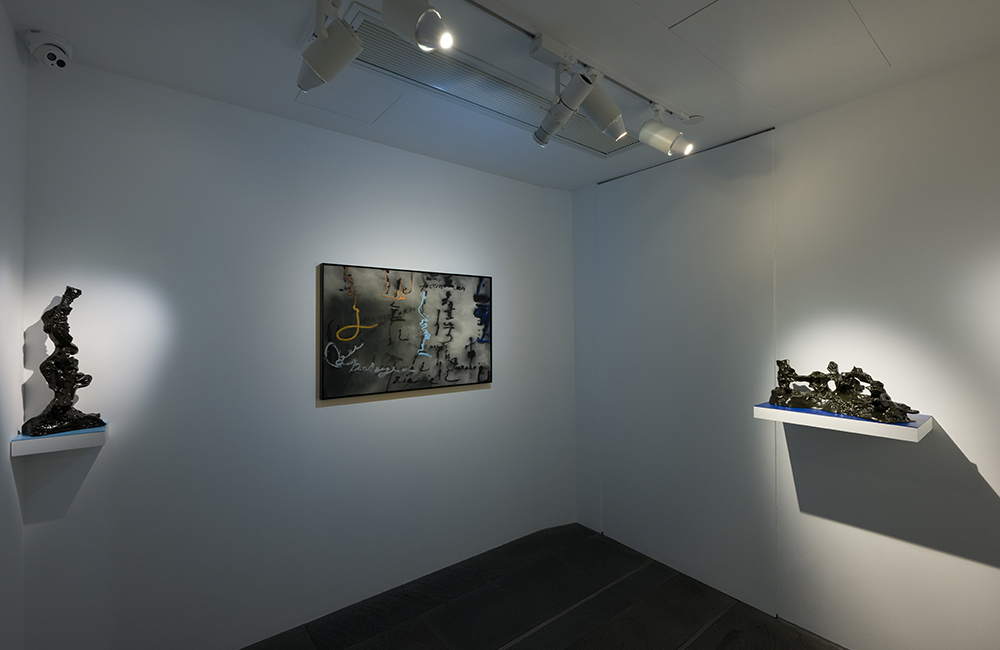
Kurt Chan received formal training in traditional Chinese art in the late 1970s and later studied contemporary art in the US in the mid-80s. For almost 25 years, he focused on mixed media sculpture, aiming to bridge the influences of both traditions. Recently, though, he decided to go back to ink painting and calligraphy, questioning the very essence of painting and landscapes as representations of reality and nature. His new experiments reflect his desire to continue challenging the artistic means of expression and, at the same time, respond to the current global political and ecological crisis.  Caroline Ha Thuc:  It has been five years now since you retired from The Chinese University of Hong Kong to focus exclusively on your art practice. What are your takeaways from your long teaching experience? Kurt Chan: I taught at The Chinese University for 27 years, focusing on mixed media, art history and theory. I have witnessed a significant change in how art is taught. In the 1980s, there were only a few art students at The Chinese University, and they were still learning …

Szelit Cheung 張施烈

Szelit Cheung’s paintings offer viewers open spaces in which to wander, escape or retreat. Neither abstract nor realistic, they feature imaginative architectural settings that are at the same time familiar and unknown. Fascinated by the concept of the void, the Hong Kong artist builds structural and poetic landscapes that attempt to embody the texture and complexity of emptiness expressed through a rich range of colours and contrasts. With no foreground or tangible objects to hold onto, the gaze plunges immediately into a geometrical world of light and shadows where time appears suspended. Light radiates and exceeds frames, including the canvas itself, while the void tends to echo the projection of our own selves. Caroline Ha Thuc: Do you remember why you originally wanted to be an artist? Szelit Cheung: I love the process of making art; it is as simple as that. The only thing I can remember from childhood was drawing with a pencil for hours until the sun went down. There was nothing that made me happier than painting and drawing. Then, in …

Zhang Wenzhi 

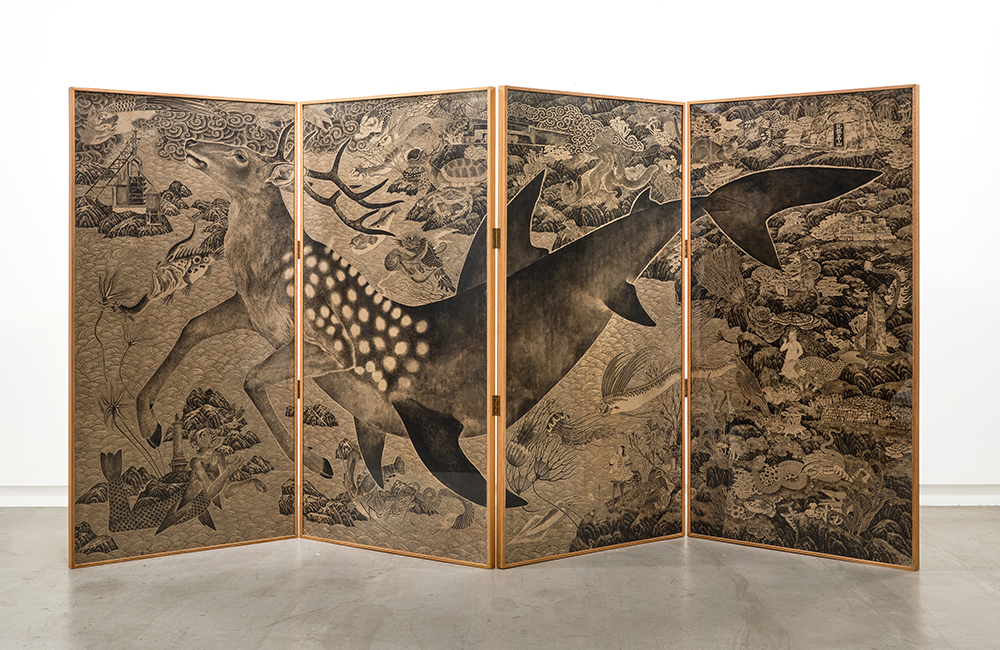
Tiger in Mountains, Deer at Ocean / Blindspot Gallery / Hong Kong / Nov 28, 2023 – Jan 13, 2024 / Tiger in Mountains, Deer at Ocean, curated by Leo Li Chen at Blindspot Gallery, focuses on Zhang Wenzhi’s latest series of works, primarily consisting of large-format ink-on-paper pieces, accompanied by a video.   Zhang’s artistic practice is deeply rooted in the historical context of Dalian, his hometown in northeastern China, now a modern port city. Throughout history, the region has experienced various periods of foreign occupation, with the British, Japanese and Russians all leaving their imprint. Zhang’s practice is embedded in this specific colonial history, as well as in the distinctive system of beliefs that once prevailed in that part of China, a fusion of Manchu shamanism, Japanese Shinto and Han religion. Within his artworks, mythological and hybrid creatures seamlessly intertwine with forest-dwelling animals, against the backdrop of the region’s complex history of rapid industrialisation and modernisation.  Bay of the Deer (2023), a large work in ink and colour pigments on paper, welcomes viewers …

Enzo Camacho & Ami Lien

Offerings for Escalante / Para Site / Hong Kong / Oct 21, 2023 – Feb 8, 2024 / Negros is a large island located in the Visayas, in the central part of the Philippines, with a population of about 4.7 million. Since the mid 19th century, it has relied on the production of sugarcane, a crop that quickly became one of the Philippines’ most important export goods. During the first Marcos government (1965-86), sugar was very lucrative, yet its profits were mainly kept by political cronies and landlords, and did not benefit local workers. From the early 1980s, a drop in raw sugar prices resulted in dramatic famines, child malnutrition, unemployment and a significant rise in poverty on the island. On 20 September 1985, not only sugarcane farmers but also fishermen, students and all types of unaffiliated workers joined a nationwide protest asking for wage increases, better living conditions, human rights and a demilitarisation of the territory. The local militia replied with guns and violence. Twenty people were killed.  Known as the “Escalante massacre”, this event …

Leung Chi Wo 梁志和

For decades, Leung Chi Wo has been exploring the history and historical sites of Hong Kong, mixing archival material with photographs, videos, texts and multimedia installations. While his research-based practice brings forth the contradictions and complexities of historiography, it also injects fantasies, intimacy and emotion into collective narratives. Time, and how to embody its multiple dimensions, is the artist’s main subject, reflected in the title of his new solo exhibition, Past-Future Tense, opening in May 2023 at Blindspot Gallery. Caroline Ha Thuc: You have recently been to London to look for archives dealing with British plans for the future of Hong Kong after World War Two. What drove you to do so? Leung Chi Wo: I don’t really know why, but I always feel dragged to stories which read unreal but are true, or vice versa. And historical subjects are mostly such: they always claim to be real. They’re sort of far away and so close at the same time. And supposedly, I am part of a colonial history which has been erased and rewritten, …

Shubigi Rao 舒比吉·拉奧 

Eating One’s Tail / Rossi & Rossi / Hong Kong / Mar 18 – May 13, 2023 / Eating One’s Tail, the title of Shubigi Rao exhibition at Rossi & Rossi, conjures up an image of a self-ingesting creature. As a metaphor, it questions human beings’ tendency to destroy, transform and reappropriate their own creations – and, more generally, it suggests the limits of self-reference. Rao’s artistic practice, in contrast, is an invitation to discover and experiment with multiple ways to inhabit and connect to the world. More subtly, perhaps, the title humorously evokes the artist’s attempt to reflect on her own practice and her claim to subjectivity. As this is her first exhibition in Hong Kong, the whole scope of her practice is presented, with selected artworks from different series. This eclecticism appropriately reflects Rao’s multidisciplinary, encyclopedic working process, which aims to resist any kind of linear, authoritarian mode of thinking.    Dead Duck (2013) is the first artwork that attracts the attention when entering the gallery. The large ink drawing features a hanging …

Bouie Choi 蔡鈺娟 

Crossing the nights Filling the lines / Grotto SKW / Mar 8 – Apr 1, 2023 / With what she calls her “emotional landscapes”, Bouie Choi continues to portray Hong Kong as a city on fire, undergoing perpetual mutation. Large, watery flows of paint merge with finer architectural elements in dynamic, poetic compositions where human beings seem lost: in the shape of either tiny figures or giants, they keep searching for their place in a reality that has clearly outgrown them. Despite its apocalyptic atmosphere and the many clouds that threaten the city, the artist’s new solo exhibition at Grotto Fine Arts is not about despair; on the contrary, an extraordinary vitality arises from each painting. A time of change and uncertainty is also a time for potential regeneration. Walking inside the exhibition space involves walking into darkness. The night seems to be total, just like during the blackout that happened in the western New Territories in June 2022. At that time, Bouie Choi was commuting back home, and was trapped in sudden obscurity. She …

Daphné Mandel

French urban designer Daphné Mandel used to work in public spaces before moving to Hong Kong, where she decided to reinvent herself as an artist. Since then, she has been observing, depicting and reimagining the landscape of the territory, questioning its identity and specificities. Increasingly, she has engaged deeper in fieldwork, exploring abandoned villages in the New Territories and collecting stories from local villagers whose lifestyle is on the brink of disappearing. Between fantasy and reality, her artworks invite viewers to project themselves into this collective heritage and to dive into the unalterable cycle of time. Daphné Mandel. Courtesy the artist. Caroline Ha Thuc: You worked as a landscape architect for a long time. What triggered your desire to become an artist? Daphné Mandel: I moved to Hong Kong in 2008. Seeing the city with my own eyes for the first time, I thought: “How am I going to find work as a landscape architect in such urban density? Where is the public space?”Knowing that I couldn’t practise landscape architecture in the same way that …

Sharon Lee 李卓媛

Sharon Lee’s practice explores and questions photography as a medium. Inspired by her family life and by the everyday, the Hong Kong artist experiments with various techniques, textures and materials to mould the blurry remains of memory, poetically capturing the slippery layers of time. Her work revolves around the notions of absence and disappearance as tangible and often constructed presences. Caroline Ha Thuc: From the start, you have explored photography in association with various modes of printing, including ceramics. Where does that come from? Sharon Lee: I use photography; meanwhile I do not conform to photography. I embrace alternative image-making as a form of negotiation, not necessarily with a single photograph but with the history, culture, art, science and technology that it carries.  I started photography when I found myself with no resources for art making – no studio, no art supplies but a 55-sq-ft shared bedroom. I find the medium a great tool to construct a visual reality. It frames and unframes, hides and reveals simultaneously. I was in Vienna for an academic exchange year …

Apichatpong Weerasethakul

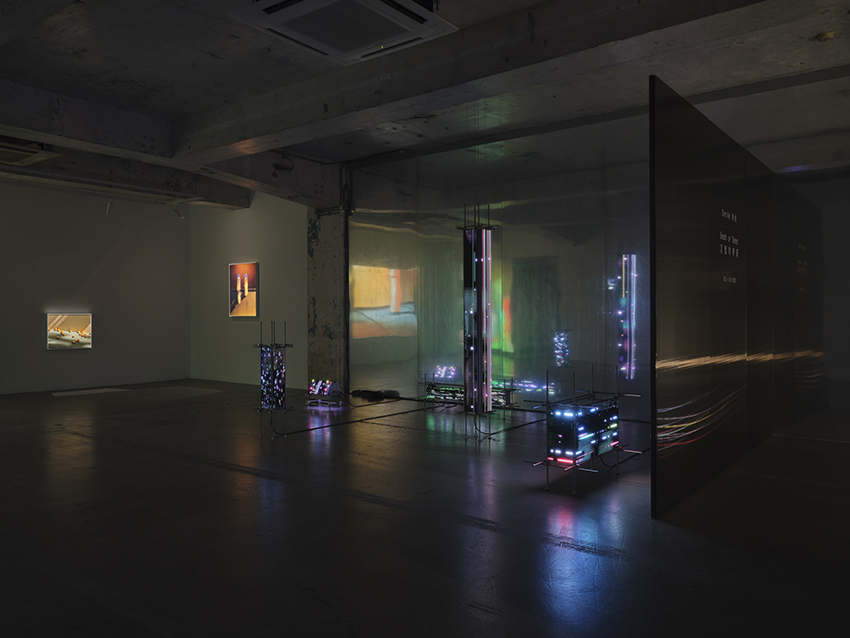
Six years after his first solo exhibition at Para Site, Apichatpong Weerasethakul has come back to Hong Kong to present his recent artworks at Kiang Malingue Gallery. The Thai artist and film director has played with the gallery’s unusual architecture, filling its high ceilings and empty spaces with haunting presences, widening hitherto invisible fault lines and holes from which the mind can easily flee away. Conceived as a calm, meditative exhibition, A Planet of Silence gathers an incredibly rich array of works from different series, reflecting the multiple experimental approaches of the artist’s practice.  It opens with A Minor History (2021), Apichatpong’s recent series of photographs taken in Isan, Thailand’s northeastern region and the artist’s homeland. He travelled there during Covid, along the Mekong River, staying in different hotel rooms that he photographed. The departure point of his journey was a piece of news about the murder of two political dissidents, whose bodies were found in the river. However, many more issues coalesce in this eerie series, which portraits the Mekong as a witness and …