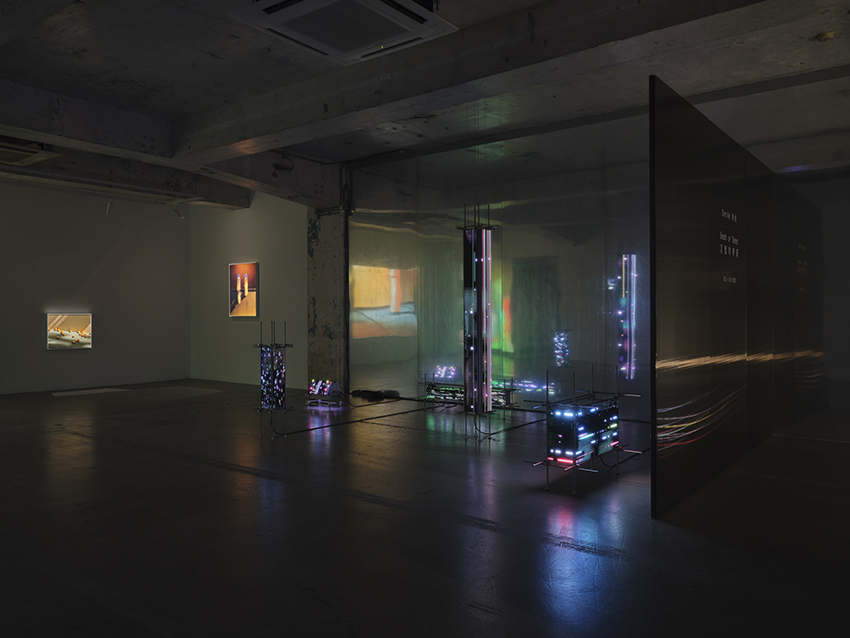
Entering Chen Wei’s new solo exhibition at Blindspot Gallery is akin to stepping into an alternate space-time continuum. Where visitors enter, the title is displayed on a semi-transparent silver partition, illuminated by undulating waves of light that oscillate like a musical frequency. This partition functions as a threshold, inviting visitors to traverse into the world of the Chinese artist, renowned for his meticulously staged photographs and his enigmatic universe, situated between dream and reality.
Chen has conceptualised and curated the gallery space, integrating its peeling walls and concrete flooring to construct an environment reminiscent of a theatrical stage. Through the subtle interplay of light, shadow lines that echo the linear compositions of his artworks and a carefully orchestrated dialogue between colours and textures, the exhibition creates a cohesive visual and spatial experience. The artist demonstrates here that image-making is not his sole end but that he rather operates as an architect or a stage designer whose apparatus aims to question our collective sense of reality and our ability to seize it.

Courtesy the artist and Blindspot Gallery.
The artist has long been fascinated by the liminal space between the real and the virtual world. His photographs are entirely constructed within his studio, conceived methodically as cinematic tableaux that often verge on the absurd yet remain impeccably balanced. His compositions impart a sense of perfection so striking that it borders on the surreal. However, the objects and scenes he captures are drawn from everyday life: stacks of paper, lemons, a door handle, a man engrossed in his mobile phone – familiar elements that, once framed by the artist’s lens, detach from reality and transition into a realm of uncanny strangeness.
A significant portion of the works presented belong to the New City series, initiated in 2013. This body of work can be interpreted as a portrait of Beijing, where the artist is based, or more broadly as a reflection of any city that, like the Chinese capital, embraces rapid modernisation in an unceasing pursuit of vertical expansion and dazzling spectacle. Over time, the series has evolved, continuing to mirror the country’s social transformations as observed by Chen. More recently, his works have drawn inspiration from the Covid crisis, the growing influence of social media and the advancement of artificial intelligence.
Figures are scarcely present in Chen’s work, probably because they are crushed under the weight of unfulfilled desires and the illusion of progress or absorbed by social media and its promises of a better world. Breath of Silence (2024), the work that lends its title to the exhibition, is a large-scale nocturnal photograph depicting the silhouette of a man, backlit, hunched beneath a transparent tent. This tent, resembling an oversized, yellow-tinged rain cape, also evokes the protective coverings used during the pandemic. Anchored by large stones, it completely encloses the figure, reinforcing a sense of absolute solitude. However, the man is illuminated by the beam of a blue spotlight – a hue reminiscent of the core of a flame. Surrounding him, a yellow halo further accentuates this interplay of light. This composition generates a striking tension between the absolute stillness of the scene and the evocative palette of fire, seemingly smothered beneath the plastic shroud.

Courtesy the artist and Blindspot Gallery.
This tension is also evident in the three videos Light Me (2021), which open the exhibition. These moving images resemble lightboxes, so subtle are they in their motion – flickering halos of light and shadows that imperceptibly stretch, suspending time itself. Each video presents an individual entirely absorbed by a phone or computer, so captivated that their consciousness is fully immersed in the virtual realm. What is revealed to the viewer are absent bodies, positioned within a cold, blue-toned environment, while the screens burn with an icy flame.
Opposite this series of videos, the LED sculptures from Trouble City (2025) shine brightly, their multicoloured points of light twinkling in the night, drawing attention to and embellishing the structures they adorn. Like the gleaming towers that define contemporary cityscapes, they symbolise economic success, attracting workers from across the country. Yet these structures remain under construction, their scaffolding still visible. The scrolling messages they display are company slogans aimed at corporate employees, which the artist generated using ChatGPT: phrases such as “Work hard. Have fun. Make history.” or “Watch anywhere. Cancel anytime.” These pieces of text, barely discernible beneath the vibrant LED motifs, appear almost concealed. The use of artificial intelligence to generate these slogans inevitably raises questions about their authenticity, reinforcing a central theme in Chen’s work – the perpetual confusion between reality and its simulacrum.
Further, in the large photograph Tears on the Ground (2024), a solitary column stands alone, surrounded by glass spheres within a deserted place bathed in sandy hues. This may represent a train station or a waiting room. Transitional spaces seem to hold particular significance for the artist, who presents locations functioning as passages between distinct worlds and states of being. A floating curtain separates the two exhibition rooms, symbolising this transition. A blurred image of a rain-soaked landscape, captured through a window, is projected on its light surface. Movement from one side to the other occurs fluidly, accompanied by the persistent sound of rain throughout the gallery. This experience parallels the crossing of the mirror in Alice in Wonderland. What worlds do we traverse? Fantasies, dreams or tangible territories? The work, in any case, casts its soft, bluish-golden lights throughout the space, acting as a lure.

Courtesy the artist and Blindspot Gallery.
Opposite, The Stars of Last Night (2024) seems to offer key insights for deciphering the artist’s work: the photograph depicts the abandoned front of a traditional shop, likely closed due to its inability to compete with the profitability of larger retailers. The broken display window, with its scattered and damaged neon lights, speaks of a world that has ceased to exist. However, a door to the left stands ajar. This is the same door found in other works, characterised by its fine, semi-transparent stripes. What world does it open to? If the shop’s display is merely a facade, where are the behind-the-scenes elements? We find ourselves at the heart of a cascade of mise en abyme, copies of the same image recurring infinitely within itself, without a reference point to identify the real. And after all, is this necessary?
One leaves the exhibition with a long-lasting sense of internal emptiness yet paradoxically also with one of hope: beyond or despite illusions, and in whatever world we inhabit, we can still create marvels to hold onto.
步入刺點畫廊陳維的最新個展,彷彿踏入了一個異次元時空。入口處,展覽標題映現於一面半透明的銀色隔板上,光線如音波般起伏,宛如在演奏一曲視覺旋律。這面隔板如一道無形的門,引領觀者步入這位中國藝術家的世界——他以精心佈置的相片及其游走於夢境與現實之間的神秘宇宙而聞名。
是次展覽,陳氏對畫廊空間進行了整體概念設計與構建,將斑駁剝落的牆面與裸露的水泥地面融入其中,使整個環境如一個充滿劇場感的舞台。透過光線與投影線條的微妙互動,線條的律動與其畫作中標誌性的線性構圖相互呼應,輔以色彩層次與材質肌理間精妙編排的對話,展覽構建出一個統一的視覺與空間體驗。藝術家藉此表明,其創作核心早已超越映像製作,而是以建築師或舞台設計師的思維,通過視覺裝置,對我們的集體現實認知及把握現實的能力發起詰問。
這位藝術家長久以來一直對現實與虛擬之間的閾限空間充滿興趣。他的攝影作品均在工作室中精心搭建而成,像佈置電影場景般精心設計,使得畫面常常帶有一種荒誕感,卻又保持著極致的平衡。他的構圖展現出一種強烈的完美感,甚至有些超現實的意味。然而他所拍攝的物件和場景均來自日常生活:一叠叠的紙張、檸檬、門把手、低頭看手機的男人……這些熟悉的元素一旦被藝術家收入鏡頭,便脫離了現實轉而進入一片陌生而詭秘的領域。
展出的作品中,相當一部分來自《新城》系列。該系列發起於2013年,既可以解讀為藝術家對其駐地北京的肖像描繪,亦可更寬泛的理解為為對任何一座城市的寫照——這些城市如同北京一般,在擁抱了急速的現代化進程中,不停追求於摩天高樓與視覺奇觀。隨著時間推移,這一系列作品不斷演變,持續映射著陳維所觀察到的中國社會變遷。近年來,他的創作靈感取材於新冠疫情、社交媒體日益增長的影響力以及人工智能的快速發展。
在陳維的作品裡,人物形象鮮少出現。或許是因為他們被無盡的欲望和進步的幻影所壓垮,又或許是被社交媒體及其構建的美好世界圖景所吞噬。展覽標題作品《沉默的呼吸》(2024年)是一幅大型夜景攝影,描繪了一個男人的剪影——他背光而立,蜷縮在一頂透明帳篷下。帳篷形似一件巨大、泛黃的雨衣,讓人聯想到疫情期間使用的防護罩。帳篷被大石塊固定,將男人完全包裹,加強了一種絕對的孤獨感。然而,男人被一束藍色聚光燈照亮——這種色調讓人聯想到火焰的核心。他周圍環繞著一圈黃色光暈,更加凸顯了光線的交織互動。此構圖在絕對靜止的場景與如火焰般的色彩間製造出強烈的張力,彷彿火焰被塑膠雨衣所悶滅。
這種張力也展現在展覽開篇的三段錄影作品《Light Me》(2021年)中。這些動態映像宛如燈箱,其變化極為細微——閃爍的光暈和陰影在不知不覺間延展,讓時間隨之靜止。每段錄影中都有一個人全神貫注地盯著手機或電腦,他們的意識完全沉浸在虛擬世界裡。觀者看到的是置身於冷藍色調環境中、心不在焉的軀體,而螢幕上則燃燒著冰冷的火焰。
在這系列錄影的對面,LED燈箱雕塑作品《故障都市》(2025年)熠熠發光,五彩斑斕的光點在夜色中閃爍,吸引著人們的目光,也裝點著它們所裝飾的架構。這些LED雕塑猶如定義了當代城市景觀的閃耀高樓,象徵著經濟成功,吸引著全國各地的打工者。但這些建築結構尚在建設中,棚架仍舊可見。LED滾動播放著面向公司員工的標語:如「努力工作、盡情玩樂、創造歷史」或「隨處可看、隨時取消」。標語是藝術家用ChatGPT生成的,這些文字在絢麗的LED圖案光效下變得很難看清,近乎被隱藏。用人工智能生成的標語無疑引發了人們對其真實性的質疑,這印證了陳維作品中的核心主題——現實與類比物之間不止不休的混淆。
此外,大幅攝影作品《Tears on the Ground》(2024年)中,一根孤零零的柱子矗立於沙色調籠罩的廢棄場所裡,周遭是一些玻璃球。這裡或許是個火車站或是候車室。過渡性空間似乎對這位藝術家有著特殊意義。他所呈現的場所,充當著不同世界與存在狀態間的通道。一道輕盈飄動的簾幕分隔了兩個展廳,正是象徵著這種過渡。一副透過窗戶拍下的被雨水浸透的模糊風景影像,投射在簾子通透的表面上。觀者流暢地穿梭於簾幕兩側,伴隨著展廳內始終縈繞的雨聲。此番體驗,猶如《愛麗絲夢遊仙境》裡穿越鏡子的情節。我們究竟穿越到了何種世界?是幻想、夢境,還是真實可觸的疆域?無論如何,這件作品在整個空間內灑下柔和的藍金色光芒,好似誘餌一般。
放置於對面的作品《The Stars of Last Night》(2024年)似乎為解讀藝術家的創作提供了關鍵見解:照片記錄了某間傳統店鋪的廢棄門面,很可能是因無法與大型零售商的盈利能力競爭而關門歇業。破碎的櫥窗裡散落損毀的霓虹燈,訴說著一個已然消逝的世界。然而,左側的門微開著。這扇門有著精緻的半透明條紋,正是在藝術家其他作品中反復出現過的那扇門。它通向哪個世界?若這店鋪的陳列只是表像,那麼幕後的元素又在哪呢?我們發現自己置身於一連串套層結構的核心,相同畫面在其內部無盡複現,卻沒有任何參照點來辨別何為真實。畢竟,有必要嗎?
觀者離開展覽時,心中會長久縈繞著某種內在空虛感,卻又矛盾地懷揣著希望:即便幻象重重,無論身處怎樣的世界,我們仍能創造值得堅守的奇跡。