HOFA Gallery, in partnership with PhillipsX and Hivemind Capital Partners, presents a landmark new group exhibition spotlighting 32 of the world’s leading digital artists. Running from 16–22 May 2025 at Phillips London, the exhibition showcases the winners and finalists of the inaugural Digital Art Awards and follows the awards ceremony on 15 May.
Curated across four categories — Still Image, Moving Image, Experiential and Innovation — the public show features 32 artworks exploring the full spectrum of contemporary digital practice, from generative systems and AI to immersive installations, robotics and data-led works, representing a bold, genre-defying snapshot of digital art at its most visionary.
A collaboration between internationally acclaimed media artist Refik Anadol and the Yawanawá Indigenous community of Brazil, Winds of Yawanawá, is a standout highlight of the exhibition. The experiential category work draws on environmental data from the Amazon rainforest, transformed through AI into a digital artwork shaped by the visual traditions of Yawanawá artists Nawashahu and Mukashahu. The piece honours the Yawanawá’s deep connection to nature, bridging ancestral wisdom and cutting-edge technology.
Talking about the work and the Digital Art Awards, Refik Anadol says: “It’s a deep honor for me to collaborate with Chief Nixiwaka and Putanny, who are my mentors and teachers. They have guided my team and me in creating one of the most significant pieces of AI artwork in history. I hold great love and respect for Yawanawa culture, and I hope this project serves as a positive example for humanity, reminding us that a bright future is rooted in ancestral wisdom. We are honoured to be selected for these awards.”
Other Exhibition Highlights Include
Still Image Category
Emily Xie — algorithmic compositions inspired by textile traditions and architectural forms.
Kevin Abosh — conceptual works exploring identity and value in digital and physical media.
Moving Image
Six n Five — a decentralised AI artist governed by a global community, challenging notions of authorship and creative agency.
Niceaunties — emotionally charged AI-generated videos reflecting on memory, womanhood and everyday life.
Experiential
Operator — immersive installations blending performance, surveillance and spatial interaction.
Sasha Stiles — AI poetry across page and space, merging human language and machine logic.
Innovation
Damien Bénéteau — kinetic light sculptures transforming digital logic into meditative, optical form.
Cem Sonel & Ramazan Can — a collaborative practice merging generative systems and Anatolian heritage to explore identity, perception and cultural memory through interactive digital art.
Each of the four category winners will receive a $10,000 USDC commission from the Digital Award’s backers Hivemind Capital Partners, supporting the development of a new work, which will be exhibited as part of HOFA Gallery’s future programming in contemporary and digital art. The Awards are designed not only to recognise exceptional achievement but also to provide meaningful momentum, offering long-term opportunities for artists in the digital space.
The Digital Art Awards are proudly backed by Hivemind Capital Partners’ Digital Culture Fund. Hivemind is committed to championing established digital artists while nurturing emerging talent and building a sustainable economic foundation for the flourishing digital art ecosystem. Other partners include ApeChain, a global platform for the next generation of creators and culture shakers, and global crypto bank Amina.
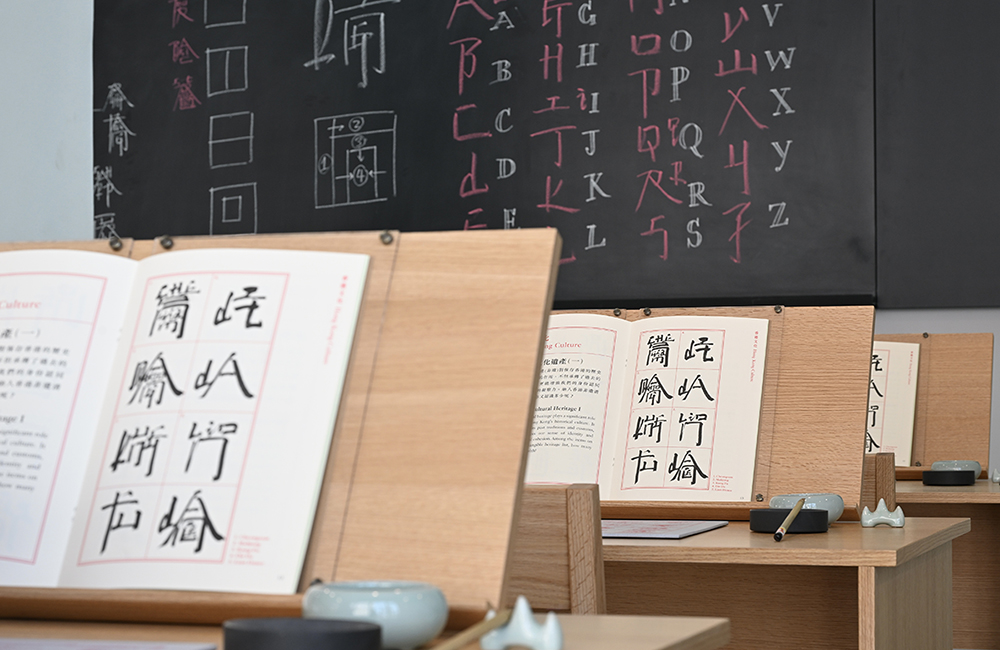
After he was appointed as Hong Kong’s Ambassador for Cultural Promotion in 2024 for a term of five years, renowned Chinese artist Xu Bing’s first commissioned art initiative, Xu Bing in Hong Kong: Square Word Calligraphy, can be seen at locations around Hong Kong. His exhibition at the Hong Kong Museum of Art (HKMoA), Eying East, Wondering West – Square Word Calligraphy Classroom, has converted the museum’s ground-floor annex into a classroom where the audience can learn about and practise Square Word Calligraphy, a unique form of writing he developed that transforms English into a visual style strongly resembling Chinese characters.
Newly emblazoned on the museum’s exterior glass canopy using Xu’s Square Words are the museum name and the text: “Connect Art to People”. Expressing both the museum’s mission and Xu’s belief “in making art accessible to everyone”, this new display demonstrates the contrast between traditional Chinese calligraphic forms and the English alphabet to become an old-new, east-west, cross-cultural blend.
Courtesy the Leisure and Cultural Services Department.
Taking Xu’s art outside the museum to the public, his calligraphy is now exhibited to passengers at Admiralty, Exhibition Centre and Wan Chai MTR stations, with newly decorated pillars at concourses feature each station’s name in Xu’s Square Word Calligraphy. The idiom “long time no see” is prominently displayed using Square Words on the Kennedy Town-bound platform screens of Sheung Wan MTR station. This phrase is uniquely used in both Chinese and English. It is said that the English idiom may have derived from a 19th-century expression used by Cantonese speakers.
Courtesy the Leisure and Cultural Services Department.
This idiom joins other commonly used Hong Kong proverbs, phrases and cultural terms – many borrowed from English – in a Hong Kong edition of the textbook. Designed to resemble the exercise books used by local students, this new textbook especially developed for the Hong Kong exhibition aims to offer a sense of familiarity to the audience. Xu explains that, “For [this] inaugural art project, I introduced Square Word Calligraphy to Hong Kong, a place where East meets West, infusing it with elements of local culture.” While appreciating and learning Square Words, the audience can explore Hong Kong’s linguistic diversity and rich culture by uncovering the local expressions and cultural terms. These include shared idioms and English words adopted into Cantonese, such as “baa si” (for bus) and “do si” (for toast); and common “Konglish” terms now universally adopted and used in English, such as “milk tea” and “yum cha”.
Xu studied printmaking at the Central Academy of Fine Arts in Beijing and his interest in written text can be seen in his monumental Book from the Sky, a four-year project (circa 1987-91) to carve over 4,000 characters, the number required to read a common Chinese publication, in movable wood letterpress type. Each unique character was invented and is completely meaningless, despite looking similar to Chinese text in form. Printed in ink on paper as four books in an edition of 120, of which the HKMoA has one, Book from the Sky has been exhibited to the public as an impressive installation of a book displayed with the text fully visible, with side-wall and hanging printed ceiling scrolls.
In the early 1990s, Xu was invited to the US by the University of Wisconsin-Madison. Experiencing an unfamiliar culture and challenged by living in a new country and its language, and believing that writing “was the essence of culture”, he developed his new form of calligraphy, combining the Chinese written form with the English alphabet. Eventually, he organised the 26 letters of the English alphabet to resemble the radicals of Chinese characters, arranged in a “Square Word” format according to the Chinese writing method: from left to right, top to bottom and outside to inside.
Xu first transformed an exhibition space into an interactive classroom to promote his newly developed calligraphy in 1994. Exhibited worldwide and now at the HKMoA, his installation Square Word Calligraphy Classroom is an immersive experience allowing the audience to learn, practise and write Square Word Calligraphy. The classroom is set up with a traditional blackboard, desks and chairs, writing tools and copybooks. Participants from different cultural backgrounds can experience the pleasure of holding a brush and rendering brushstrokes in water while appreciating the beauty of traditional Chinese calligraphy.
Courtesy the Leisure and Cultural Services Department.
After understanding the writing principles of Square Word Calligraphy, the audience can themselves conceptualise and design new Square Words using a digital interactive installation, filling in the sentence “Connect Art to…”. The audience can then download their own designs by using a QR code.
There has long been a tradition of bilingual education in Hong Kong. The city’s students are taught in English and/or Chinese and have well-developed writing skills in both languages. Despite this knowledge, Square Word Calligraphy can still provide a cross-cultural and progressive experience to encourage reflection on language, culture and creativity when switching between languages. When introducing the unfamiliar Chinese calligraphic traditions to a western audience, Square Word Calligraphy also presents more: a new conceptual language. Hong Kong audiences may be a step ahead by already having some ink and brushstroke skills, but the rendering of English as a Square Word, as if it were Chinese, is also an entirely new conceptual language that challenges their experience of traditional Chinese words and calligraphy.
Courtesy the Leisure and Cultural Services Department.
Xu’s Square Word Calligraphy highlights the interplay between the Chinese and English languages and eastern and western cultures. His combining of the writing of the two written languages also reflects Hong Kong’s own vibrant cross-cultural and historical depth, and its unique intersection of east and west.
為配合展覽,藝術館的玻璃外牆亦煥然一新,換上以英文方塊字書寫的館名及字句「Connect Art to People」(讓藝術連結生活)。這不僅是藝術館的使命,也呼應了徐冰相信藝術應該普及大眾的理念。未進入展廳,觀眾已經能夠先體會傳統書法與英文字母兩套截然不同的書寫系統,如何交匯融合並帶來貫通古今、跨越東西方的文化交流。
徐冰的作品更走出展廳,步入日常生活。大家可於港鐵金鐘站、會展站及灣仔站大堂一睹他以英文方塊字寫成的車站名字,而上環站往堅尼地城方向的月台幕門則展示了以方塊字寫成的「Long Time No See」(很久不見)。這句問候語現在已成為中英文使用者都熟知的通用語句,更有說法指它可能是源於十九世紀某一群粵語使用人士衍生而成英文的常用語。
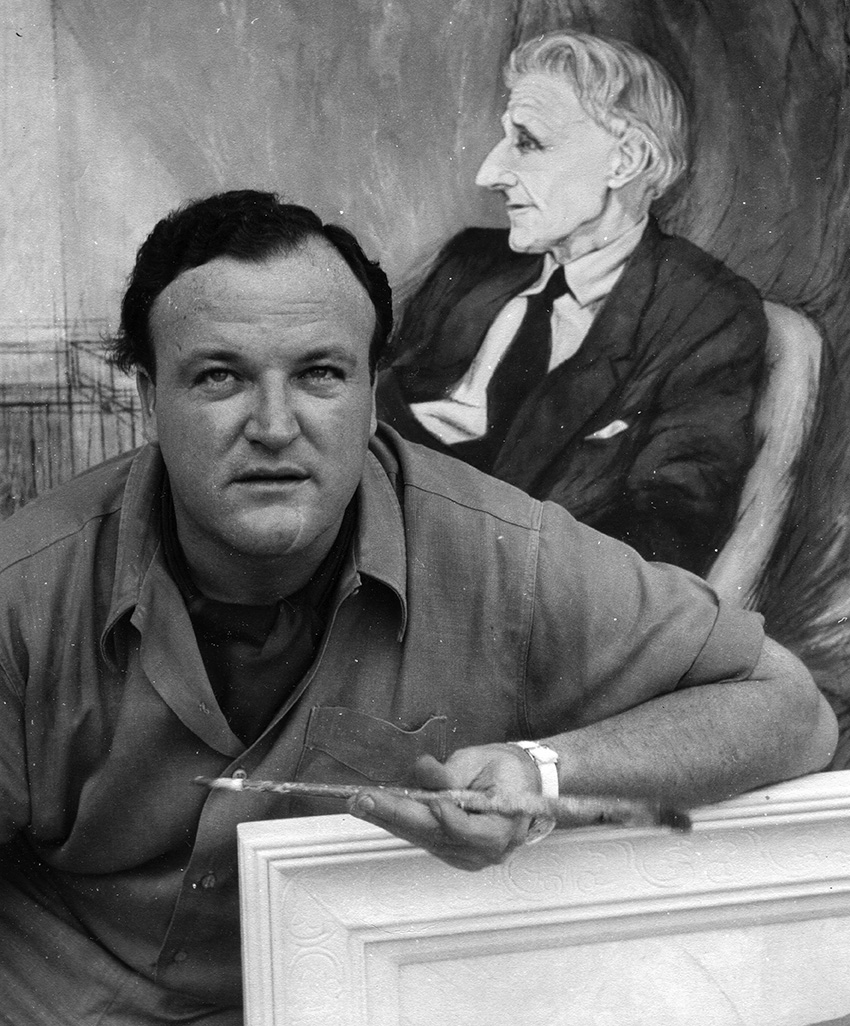
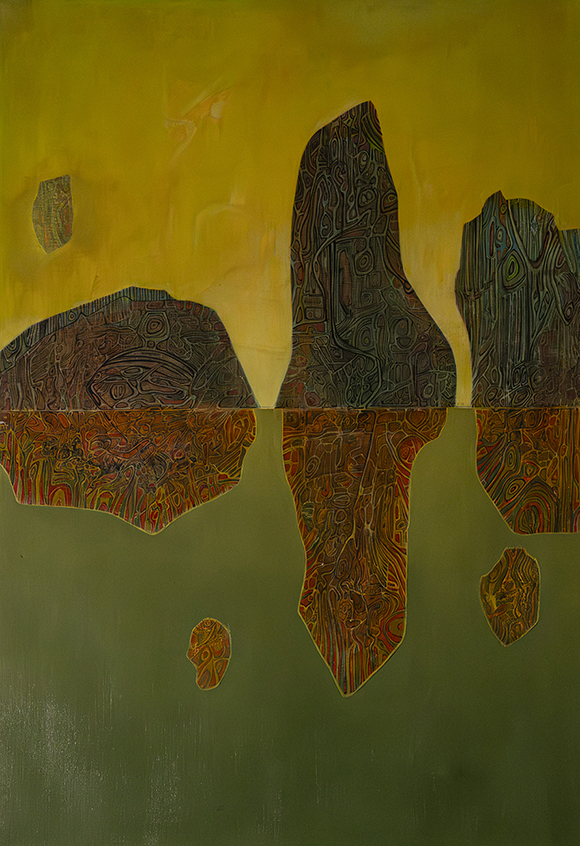
In 1976, the Hong Kong Museum of Art held an exhibition called The World of Douglas Bland. Nigel Cameron, the South China Morning Post’s respected art critic, gave the show a stellar review. He praised Bland’s “astonishing energy”, “emotional intensity”, profoundly imaginative quality” and “great estuarine areas of lucid paint”. He believed that Bland had finally discovered what he wanted to do with paint in 1971 and he particularly referred to his “great” Reflections series, in which he was “trying to compose forms which contain ideas about places and things reflected in spaces”. Cameron, who could be annihilating in his opinions, described Bland as “the most accomplished western painter to work in the Orient since George Chinnery died in Macau”.
By then, Bland himself was dead: he’d never regained consciousness after stomach surgery the previous year, at the age of 52. For almost three decades, he’d been striving to express his artistic response to China – its landscape, its culture, its mystic energies. He’d found inspiration in Chinese seals, calligraphy and, ultimately, oracle bones. He was determined to fuse west with east and, unusually for the colonial era, he’d shown his work alongside such Hong Kong artists as Lui Shou-kwan and Kwong Yeu Ting. Nowadays, critics might call that cultural appropriation but then it was more of a mutually beneficial mind-meld for all concerned. At the time, Chinese artists were influenced by western painting. Bland wanted to travel in the opposite direction.
He pursued his task with a concentration so intense, it became a form of meditation. He exhibited frequently. He was commissioned for prestigious projects and purchased by such collectors as Peggy Guggenheim, Hong Kong’s movie mogul Run Run Shaw and Mapie de Toulouse-Lautrec. When he died, the prevailing sense was that he had been unjustly snatched away just as he was approaching his prime. For the Hong Kong Museum of Art to dedicate a solo show to his memory within a year is evidence of how highly Bland, now almost forgotten, was once regarded.
The desire to create had been present since at least his early teens. In Hong Kong interviews, he liked to give the impression he was Irish by birth and had studied at Oxford’s Ruskin School of Art. Neither claim was true (and he wouldn’t be the first person to exercise artistic licence with his background in a far-flung colony). In fact, he’d been born in Derbyshire, England in 1923 and had grown up in Sheffield in a working-class household. He’d studied art at a local college, then progressed to designing windows for a local department store.
When the Second World War began in 1939, he was just 16. By the time he was 20, he’d been called up and, having been identified as officer-class material and finished his training in South Africa, he’d become a lieutenant in the Royal Navy. On two occasions, he was on board ships that were sunk beneath him. Years later, he needed surgery in Hong Kong to have shrapnel removed from his shoulder. In a different man, being twice torpedoed might have left a horror of the sea but all his life Bland loved being on or near water.
After the war, he was demobbed in Southeast Asia, spent some time in Bali and then, in May 1947, according to its archived lists of former British staff, joined the Chinese Maritime Customs Service as acting first officer. The work had its own dangers – there were various adventures involving pirates – but as a cartographer, he had unparalleled access to China’s waterways. He always said observing and then charting those sinuous paths made him an artist.
It was also preparation for a life in which art and a salaried job would have to flow in parallel. In 1948, he joined the Hongkong and Kowloon Wharf and Godown Company; by the following year, he was exhibiting 44 watercolours and oil paintings in the Hong Kong government’s Public Relations Office in Statue Square. According to the South China Morning Post, he was the only British painter to hold one-man shows in the postwar colony. Those early titles (The Erecting of the Government Flats, View of Tai Tam, Wong Nei Chong Gap) suggest a newly arrived observer. The newspaper’s reviewer thought Bland’s need for self-expression hadn’t yet the “complex urgency of a man who has found his very own medium”.
Yet an urgency seized him. Bland was then 26 and, although he didn’t know it, he’d already lived half his life. Later, some people wondered if he’d anticipated the sudden scythe and that was why he relentlessly juggled Wharf and art. He could be ruthless about destroying his creations but he worked on several canvases at a time and, despite the lack of ideal exhibition space in Hong Kong, there were always regular shows. He was brave enough, or driven enough, to present his experimental output continually in public. One critic in 1955 described his work as “very likeable … if a little sugary”; by 1957, he’d executed 17 black-and-white illustrations for Oscar Wilde’s The Ballad of Reading Gaol that appeared, somewhat unpredictably, in Elixir, the journal of the Hong Kong University Medical Society, and later in a limited-edition book. Their anguished forcefulness evokes Francis Bacon, while one upside-down nude male anticipates the German painter Georg Baselitz, who would not begin painting his upside-down figures until 1969.
It was the abstract, however, that came to fascinate him. In 1958, Bland met the Chinese painter Zao Wou-Ki, who had moved to France in 1948 and a decade later was a visiting professor at the School of Fine Arts in New Asia College, now part of The Chinese University of Hong Kong. Zao, who was teaching western oil painting, exemplified the artistic combination of east and west. Bland was his mirror image. “We found we were thinking along the same lines,” Bland said later of their encounter. “We both had an appreciation of ancient Chinese painting and the marvellous expression of space that you often find in it. We were both conscious that this tradition was lost and felt, in rather a romantic way, that the spirit of it should be revived using the western medium of oil paint.”
It was the turning-point of his artistic life. He had never studied calligraphy but he was familiar with Chinese seals from his days in the Chinese Maritime Customs Service and he could create abstract designs and collages based on Chinese ideograms. Raymond Tang Man-leung, deputy director of The Chinese University of Hong Kong’s art museum, says, “In the 1960s Douglas, as someone who devoted himself to abstract painting and the style of abstract expressionism, was … a pioneer for a younger generation who knew him or had a close relationship with his circle – artists like Wucius Wong, Hon Chi-fun and even, later, Irene Chou. It was a very small circle but it was important.”
Petra Hinterthür, in her 1985 book Modern Art in Hong Kong, also classifiesBland as a pioneer. He’s the only westerner she lists as tackling new artistic frontiers in the city’s post-war era. Along with ink painter Lui Shou-kwan and Kuang Yaoding, who’d trained as a landscape architect, he became a founding member of the Society of Hong Kong Artists.
In the early 1960s, the Hong Kong Hilton hotel asked him to do a series of large murals – 2m high and 10m long – that would dominate its lobby when it opened in 1963. It was a prestigious commission at a time when high-end hotels were suddenly blooming in the city. Bland decided that his theme would be the rivers of China but, perhaps in the spirit of east-meets-west, the water that inspired him to work was in Italy, in a rented house on the shores of Lake Maggiore. His position at Wharf had its marine advantages: Douglas, his wife Ronnie and their three children Siobhan, Diarmuid and Clodagh (all aged under 10), plus the family car, travelled over on a Lloyd Triestino liner. Then they sailed back to Hong Kong with the huge, completed panels.
The venture was such a success that, with the help of the generous Hilton fee, Bland bought an old farmhouse in Italy’s Veneto region. There he built a studio for his annual summer leaves. The rest of the year, creativity had to be squeezed into a smaller space at home in Kowloon, and it was strictly timetabled: Bland’s life at Wharf, where he eventually became commercial manager, was demanding. What his children remember now is the self-discipline. Every day, unless there were inescapable social obligations, he returned from the office, changed into what Diarmuid calls “his paint-splattered kit”, had a cup of tea, then went to his studio, which was a converted bedroom. (The girls shared another bedroom and Diarmuid slept in the TV room.) There he worked for several hours before dinner. His artistic practice pervaded all their lives. The Bland family dined later than other expatriate families; their father wore his painting kit at the table; and, upstairs, their house always smelt of oil paint. “He was just our dad and that was what he did,” says Siobhan. “Other kids’ dads went and played golf. He painted.”
Reflections 9 by Douglas Bland, Acrylic on canvas, 95 x 135 cm, 1972. Private collection. Photo: Studio8ight.
At the Italian farmhouse, he was less frenzied. “When he was spending summers in Italy, he had all the time in the world to paint,” says Siobhan. “But he didn’t paint any more than when he was working. Sometimes we used to think he needed the pressure of work to have that need to release it by painting.” He represented Hong Kong in Saigon’s first international art salon in 1962 (winning a bronze medal) and in a 1963 exhibition of Commonwealth art in London and Edinburgh. He exhibited in New York, England and Brazil. Still, he strove for more. He liked to quote the 11th-century Chinese painter Guo Xi, who thought that “a poem is a painting without forms and that a painting is a poem with forms”. His body of work made a cartographer of the viewer too: it was possible to map the influences in his prolific artistic life through to the final depths of the Reflections series.
After his death, the Hong Kong Museum of Art held its 1976 tribute show. In 1979, there was an exhibition at the Hong Kong Arts Centre of 87 Bland works that the family had either kept in storage or discovered in the Italian farmhouse and decided to sell. Since then, there has been nothing. In 1995, the Hong Kong Hilton was demolished and the fate of the huge riverine murals is unknown. Much of his other work has disappeared. His paintings held by the Hong Kong Museum of Art have never gone back on display.
Tang, who first heard of Bland when he was a researcher at the Hong Kong Museum of Art in the 1990s, says he is not popular among collectors. “Irene Chou, Hon Chi-fun and Cheung Yee are still remembered because the galleries think they have good market value and so they continue promoting them. But who will do that for Douglas?” His exhibitions were covered in Hong Kong’s English-language press but many of those readers who bought his work have long since left the city; and Tang hasn’t found a single reference to Bland in the Chinese newspapers of the time. His influence was significant but it was limited; it did not extend to the next generation of artists, who, as Tang remarks, would not have been museum-goers. And so his formative place in history, like those of old underground tributaries that once flowed through major cities, has – almost – been lost.
Ariel by Douglas Bland, Oil on canvas, 172 x 162 cm, 1972. Private collection. Photo: Studio8ight.
Petra Hinterthür在她1985年出版的《香港現代藝術》(Modern Art in Hong Kong)一書中也將布蘭德歸類為先鋒藝術家。她所列出的在戰後香港探索新藝術前沿的人中,他是唯一的西方人。他與水墨畫家呂壽琨以及曾接受景觀設計師培訓的鄺耀鼎一同,成為香港藝術家協會(Society of Hong Kong Artists)的創始成員。
London-based artist, activist and Chinese drag king Whiskey Chow’s practice defies conventional boundaries, spanning performance, moving image, digital art, sculpture and experimental print to challenge established narratives around gender, masculinity and Asian identity. Through their multifaceted approach as an artivist – an artist with the heart of an activist – Chow creates work that interrogates systemic inequalities while carving out spaces for marginalised voices, particularly within the Chinese and other Asian diaspora communities and beyond.
Drawing from their early experiences in feminist and LGBTQ activism in China, including organising groundbreaking events like For Vaginas’ Sake (將陰道獨白到底, 2013) and the first Chinese LGBTQ music festival, Lover Comrades Concert (愛人同志音樂會), Chow’s work offers a distinctive non-western perspective within western contexts. Their work you must everywhere wander (你必顧盼, 2021) in the exhibition On Queer Ground at Yorkshire Sculpture Park and performances at renowned institutions like the Tate Modern and V&A demonstrate the growing recognition of their unique artistic vision.
Whiskey Chow during her residency at Studio Voltaire Open House, London, 2024. Courtesy the artist.
Jessica Wan: Your journey from organising feminist and LGBTQ events in China to your current artistic practice in London spans multiple forms of expression. How did this evolution shape your understanding of art as a tool for social change? Whiskey Chow: At the core of my practice is my artivist heart and lens – I strive to create space for marginalised communities, challenge power structures and empower audiences. My work presents provocative questions, makes the invisible visible and seeks to change the world through art.
My practice is context-sensitive, evolving with the sociopolitical environments I navigate. In China, my work responded to gender norms and homophobia within society at the time. In the UK, my Asian and migrant identity became a significant part of my intersectional experience, shaping my everyday observations and artistic responses as an othered body.
However, my work extends beyond personal experience – I use it to expose and challenge systemic inequalities, offering multiple entry points for engagement while placing radical care at the centre.
JW: As a drag king performer, how does your approach to masculinity differ when performing in western versus Asian contexts? How do audiences’ reactions vary? WC: I began my drag performance in 2016, just six months after moving to the UK. At the time, no one was referencing Cantonese opera in drag king performances. As a young Asian queer artist, having researched western drag history, I asked myself: how could I make my work relevant to my identity and cultural background?
Cantonese opera emerged naturally as an influence, offering a different aesthetic compared to the dominant western depictions of theatrical masculinity, from its colour palette and facial contouring to its ideals of masculinity. The king I embodied was unconventional by western drag standards – a pink-cheeked, soft-featured figure performing a dumpling-making act, slicing my fake beard and mixing it into the filling.
Rather than simply being a persona, I see this king as a radical embodiment and a decolonial gesture, challenging the definition of “drag king”. Some audiences didn’t know how to react; they had never seen anything like it before. One person awkwardly returned the beard dumpling I had handed out, saying, “I think I’d better give it back. I can’t eat it but I don’t want to throw it away.” This unexpected response mirrored my practice: combining consumable elements (food, cultural products) to create something that ultimately resists consumption, much like my position as an Asian queer artist in the west.
Although I’ve performed less frequently in Asia, in 2018 I presented M.A.C.H.O in Suzhou, a one-hour performance exploring racial hierarchy, masculinity and desirability politics within the gay community. I performed with 15 moustached balloons attached to my white shirt, stepping on 60kg of white button mushrooms, while blowing up three masculine inflatable dolls – hairy-chested, eerily smiling, with black hair, blue eyes but no genitals. I stood on the mushrooms, then squeezed the dolls, forcing the air out and leaving their deflated bodies collapsed on the mushrooms. Finally, I removed my white shirt, which remained suspended in the air, held up by the attached moustached balloons, creating a sculptural residue inside the museum space.
The audience reactions were strikingly different between Suzhou and London. In London, audiences came and went freely; a gay man from Hong Kong later told me how deeply he resonated with the piece. In Suzhou, the audience stood watching intently for the entire hour, carefully documenting the residue on their phones yet rarely engaging in immediate discussion.
Since my work is context-sensitive, I look forward to spending more time in Asia, creating performances shaped by my experiences and observation, while forging deeper connections with local audiences.
Whiskey Chow, Video projection. Courtesy the artist.
JW: Tell us more about your current residency at Studio Voltaire. How did you begin the residency and what have you been working on? WC: I began my residency at Studio Voltaire in November 2023, and I’ve felt fully supported and nourished by both the artist community and staff. In high-rent cities like London and New York, an artist studio with integrity like this is rare. The SV team deeply respect artists, recognising that professional development needs vary, and they offer insightful, tailored support, from one-on-one consultations to small-group workshops.
Resident artists are at different career stages and not everyone works as a full-time artist due to financial realities. SV understands this and remains flexible. The community also organises social gatherings around Christmas and Easter, as well as workshops on topics like art insurance, art law and access rider development. We support, celebrate and grow together.
SV’s robust exhibition programme, Open Studios, and international artist residency ensure that resident artists remain actively connected to the broader art world.
For my own project, I am developing a silicone version of Phoenix Chow – a queer hero I embody, inspired by Bruce Lee, Tom of Finland and UK LGBT history. Last year, I created a stainless steel Phoenix Chow sculpture alongside a CGI animation. This year, my focus is on silicone casting, experimenting with scale, and exploring the tension between soft and hard materiality, continuing to queer mainstream heroism and interrogate impenetrable masculinity.
JW: Through Queering Now 酷兒鬧, you’ve created a platform for queer Chinese and other Asian diaspora voices. What gaps in the current art landscape did you aim to address with this initiative? WC: My initial drive was to create something I longed for but couldn’t find. In 2019, after a few years of practising as an artist, I saw how marginalised identities were consumed by the western art world, with culturally specific nuances often lost in translation.
I wanted to build a space beyond the institutional and white gaze – where Chinese/Asian queer diaspora artists were supported by curators who truly understood their cultural context; where artists didn’t have to perform their identity to meet diversity requirements; where exhibited works could generate dialogue and enable intergenerational conversations. I wanted to support my peers in the way I wished to be supported. When I finally launched Queering Now酷兒鬧 in 2020 in London, the ecstatic Asian queer crowd and the feedback from participating artists confirmed its relevance and its essential role in the community.
Today, Queering Now酷兒鬧 continues to leave a lasting impact by inspiring new queer Asian programmes, collectives, platforms and events. Many have been initiated by individuals who once worked with, exhibited in or followed Queering Now酷兒鬧.
Radical and grassroots, yet maintaining high artistic quality, Queering Now酷兒鬧has cultivated a global community, amplified further by its digital edition in 2021. As my research continues, I hope to expand Queering Now酷兒鬧 through international residencies and fellowships, curating new editions worldwide and celebrating the Chinese/Asian queer diaspora across different cultural landscapes.
Whiskey Chow, Video projection. Courtesy the artist.
JW: Your work has been shown at institutions like the Tate Modern, V&A and Yorkshire Sculpture Park. How do you see your practice evolving, particularly in relation to institutional spaces? WC: Over the past eight years, I’ve performed and showcased my work twice at the V&A and three times at the Tate. I believe it’s vital for audiences to see diverse representations in major institutions, especially work by artists from less privileged backgrounds. To see and to be seen hold equal significance – our lived experiences are embedded in our work and institutions act as bridges, fostering dialogue and connecting our realities. Sometimes, they allow work to reach unexpected audiences – those who need it most. Art can offer them a space for being held and understood. This is the power of institutions and the magic that occurs when they centre marginalised voices.
From a professional standpoint, institutional recognition can open doors to greater exposure. For instance, after my work you must everywhere wander was shown at Yorkshire Sculpture Park in 2022, it was exhibited at the Leslie-Lohman Museum in New York in 2023. However, beyond visibility and recognition, what matters most to me is the critical friendships I’ve built with curators and fellow artists along the way. More importantly, it’s about how my work – on these major stages – can shift perspectives and spark meaningful conversations that inspire both others and myself.
Purely Beautiful New Era by Whiskey Chow, CGI Animation installation and live performance. Photo: Amber Yi Zheng. Courtesy the artist.
JW: As someone working at the intersection of performance, activism and education, what future possibilities do you envision for artist-activists working in diaspora communities? WC: We live in a chaotic world filled with uncertainty and crisis. Arts funding is shrinking and many artists are struggling with the rising cost of living. GoFundMe campaigns are everywhere – those who can vocalise their precarity often receive community support but what about those equally in need yet less skilled in initiating digital advocacy?
A radical redistribution of power and resources is crucial. For artists, activists and the diaspora community, hope remains. There is still the possibility to build a new ecosystem – one where mutual care is the norm and essential needs like housing and visas are actively supported.
Queering Now 酷兒鬧 is my way of reimagining the world. Being a tutor at a top art school [the Royal College of Art] allows me to facilitate meaningful change. My performances and artworks are my way to call for a radical future. I remain open – to all who dream of making the world better in their own way. And I hope my journey serves as a reminder that power lies within us and those willing to join the revolution – both within themselves and in the world – can create real change.
Ping Pong Gintonería is delighted to present Reflections, a retrospective of the late artist Douglas Bland (1923-75). This marks the first major exhibition of the artist’s work in Hong Kong since 1979, offering a rare opportunity to rediscover one of the most innovative yet overlooked figures in Hong Kong’s 20th-century art history.
Bland, a British-born artist who made Hong Kong his home in 1947, was a pioneer in the fusion of Chinese and western art traditions. This exhibition features a collection of his paintings, including works from his important Reflections series, showcasing his relentless pursuit of Asian modernism. It will also highlight rarely seen archival material, including photos of his lost large-scale murals for the Hong Kong Hilton in the early 1960s.
Bland’s work, once celebrated by critics and collectors alike, has largely faded from public view since his untimely death in 1975. However, his legacy as “the most accomplished western painter to work in the Orient since George Chinnery” (Nigel Cameron, South China Morning Post) deserves renewed attention.
Playscape is one of many sculptures for playgrounds that American-Japanese artist Isamu Noguchi (1904-1988) intentionally designed (but rarely realised) for children to climb on and play around. A selection of these sculptures are displayed on the M+ museum’s rooftop. The stepped concrete form of Playscape, looking more pyramid than rectangle, comprises blocks and in-between voids. There is an element of risk if jumping across one block to another; the gap is slightly more hazardous than safe, and a missed jump could result in a six-metre fall to ground. But, no-one falls.
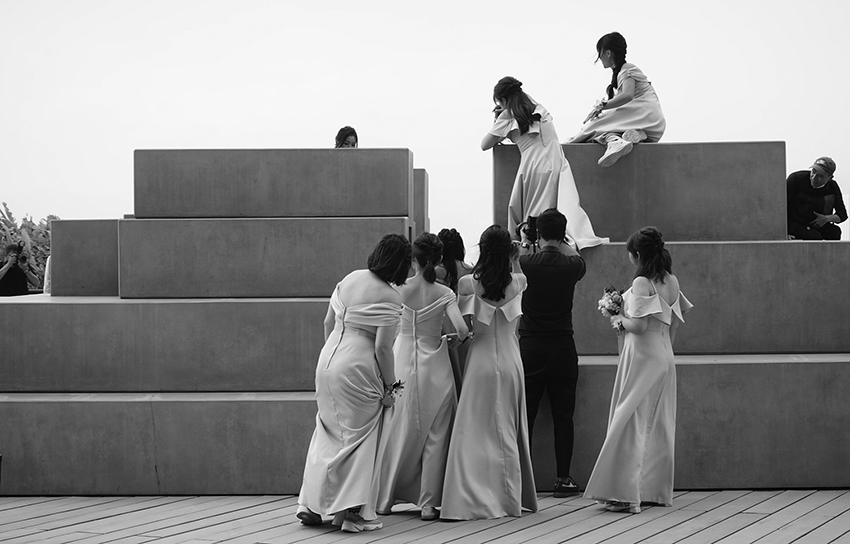
The M+ rooftop, lobby, Mediatheque of videos to watch, and the basement Found Space are all free entry within the non-payment areas of the museum. Consequently, the rooftop has become a favoured spot for wedding photography, including for couples travelling from the mainland. The rooftop offers contrasting scenes. Bisected into two halves by the tall inverted ‘T’ of the building’s large LED screen, the ‘front’ – the Victoria Harbour side – of the rooftop has magnificent waterfront views looking towards Hong Kong island and its famous skyline. The ‘back’ view, in which Noguchi’s sculpture is placed, has excellent views towards the Palace Museum, Stonecutter’s island, the West Kowloon docks and shipping, Kowloon peninsula and Lantau island in the distance. This view is better experienced atop Noguchi’s Playscape.
Wedding parties bring an ephemeral dynamic to Noguchi’s sculpture. Not out of place as a minimalist ballet stage design, this photograph captures bridesmaids flowing around and over the sculpture as photographers position themselves to photograph the partly-hidden bride and fully-hidden groom. In reverse of the photo-shoot’s intention, bridesmaids and photographers take the limelight.
Complementing Noguchi’s rooftop sculpture is Danh Vo in Situ: Akari by Noguchi, currently showingin the museum’s Found Space. This is a beautiful exhibition of designed structures by Vietnamese artist Danh Vo (born 1975) in which a selection of Noguchi’s Akari lamps or “light sculptures” are hung and displayed. The exhibition, however, has an almost opposite intention from Playscape, that encourages play and activity. According to the museum’s description, Danh Vo “…will transform the Found Space into an intimate social environment in which visitors can slow down and spend time.”
John Batten:幾位伴娘和攝影師為一對新人在野口勇《Playscape》 雕塑前拍照。M+屋頂花園,西九龍,香港,2023年2月12日。
When Columbian-Belgian choreographer Annabelle Lopez Ochoa was a child, she thought pantings could come to life and that at night, the objects and figures in them would walk out of frame. “I would look at the painting, look away, and then look back and it felt like they moved. I thought they had a soul,” Lopez Ochoa recalls. “The artist made a decision and froze a certain moment in time [in the painting], so I know they have a present and future. My process is to reverse the freezing and ask: but how did we get to that moment and what happened after that moment?”
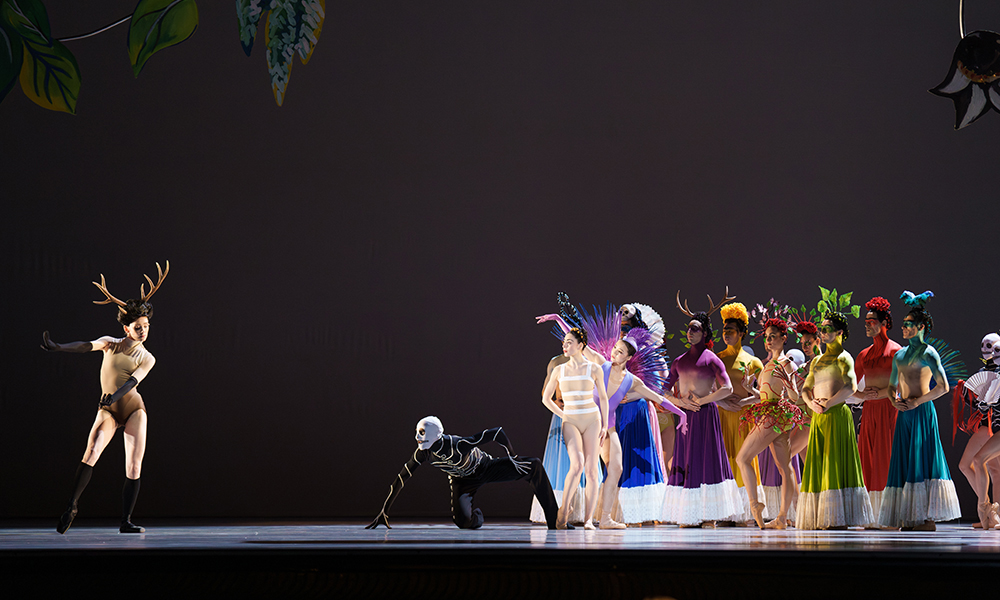
The paintings Lopez Ochoa has been ruminating on are those of Frida Kahlo. The Mexican artist is the subject of her ballet Frida, which is premiering in Asia this April, performed by the Hong Kong Ballet. “What really fascinated and inspired me [about Kahlo] was how this artist was unashamed about expressing her emotions, the pain she felt and the tragedy that she lived,” the choreographer tells Artomity a month before the show opened, allowing a glimpse into the studio rehearsals at Hong Kong Cultural Centre’s backstage theatre.
An urgent but excitable energy was palpable as the dancers attempted to harness Kahlo’s intense passion, enacting a particularly dramatic scene when Kahlo catches her husband, famed artist Diego Rivera, cheating on her with her sister, Christina. Xuan Cheng and Feifei Ye, both Hong Kong Ballet’s principal ballerinas, are essaying Kahlo’s role. While practising this particular scene, Ye storms onto the floor (gracefully) in a blaze of fury. “I needed someone who was powerful but very vulnerable at the same time,” Lopez Ochoa says of selecting the dancers for the role of the artist.
Dancer Xuan Cheng. Photo: SWKit. Courtesy of Hong Kong Ballet.
The ballet will focus on Kahlo’s inner world, portraying her emotions and thoughts through episodes from her life. From suffering a traumatic bus accident in her teens to having medical problems including a miscarriage, and from projecting bold post-colonial and feminist ideals and experiencing success in her artistic practice to her tumultuous relationship with Rivera, Kahlo felt the extremes of both pain and passion in her short but eventful life.
The painter’s body of work is known for being largely autobiographical; many of her best-known paintings are self-portraits and showcase her feelings about various episodes of her life. It is widely believed that Christina and Rivera’s betrayal inspired Kahlo’s 1935 painting A Few Small Nips, which portrays Kahlo with freshly chopped hair (Rivera was known to love her long hair), lying nude on a bed with what appear to be multiple bleeding stab wounds. Rivera appears in another work, The Wounded Table (1940), which famously disappeared in the 1950s but exists in photographic records. Kahlo began the painting in 1939, the year she finalised her divorce with Rivera. A bleeding table representing her broken family foregrounds her work, with the artist depicted sitting in the centre, A papier-mâché skeleton and her pet deer Grazina are on Kahlo’s left, and Christina’s children, and a pre-Columbian figurine are portrayed on the artist’s right.
Butterflies, deers and skeletons are among the motifs Lopez Ochoa has incorporated into her ballet from the vivid imagery in Kahlo’s work. Red vines or cords are also present as large props and parts of dancers’ costumes, referencing bloodlines, as seen in Kahlo’s My Grandparents, My Parents, and I (1936), which depicts Kahlo’s kin in the style of a family tree, and in The Flying Bed (1932), which the artist painted after having a miscarriage, in which the red lines coming out of her body are in fact umbilical cords. Describing the raw emotion the works emit and their confrontational nature, Lopez Ochoa says, “It’s extremely shocking and unapologetic, and that’s what makes her a feminist. She really painted how women were and not how they appear through the male gaze.”
Lopez Ochoa began Frida as a 46-minute presentation for the English National Ballet. After realising she couldn’t fit the artist’s life into that short time span, she created a fully fledged production for the Dutch National Ballet in 2020, following which it was performed by Ballet Arizona. “As a young choreographer, I would always try to tell other stories, those that you wouldn’t normally see in ballet, because it’s just more exciting to reinvent stories from the perspective of a woman,” she says.
Stage photo. Courtesy Nationale Opera & Ballet.
Septime Weber, artistic director of the Hong Kong Ballet, invited Lopez Ochoa to bring Frida to Hong Kong. He had previously collaborated with her on Coco Chanel in 2024 and is on a mission to tell stories with strong female characters.
“One of the goals for me [with Coco Chanel] was to quietly begin to dismantle the myth of how women are depicted in classical ballet and ensure women were depicted in complex, modern and realistic ways, as strong and independent women who were in charge of their own destiny,” says Webre. “And so Frida Kahlo seemed like an interesting next step. The whole world has changed their approach towards how they see gender roles and ballet has followed suit, but we’re late to market. It’s important as a director to fast forward the process and present these strong women.”
Stage photo. Courtesy Nationale Opera & Ballet.
Webre has galvanised Hong Kong’s ballet scene by prioritising engaging local audiences in creative ways, including adapting and contextualising his productions to reflect the city’s sensibilities. This is exemplified by his production of Butterfly Lovers, an adaption of the epic Chinese legend of humble scholar Liang Shanbo and aristocratic heiress Zhu Yingtai, which will visit New York’s Lincoln Centre this autumn as part of a tour. “I want to ensure that while developing a strong Hong Kong identity, we also remained international. And Frida Kahlo’s work represents Latin culture and a different point of view, which has appeal.”
Lopez Ochoa has bought Mexican and other Latin elements into the production. She insisted that musical director Peter Salem include the late Costa Rican singer Chavela Vargas’s music in the score. Vargas was known for her interpretation of Mexican rancherasongs and was rumoured to be Kahlo’s lover.
Dancer Xuan Cheng. Photo: SWKit. Courtesy of Hong Kong Ballet.
Elements of traditional folkloric dance forms are also alluded to and incorporated in the choreography. “There’s also a lot of stamping,” says Lopez Ochoa of her routines. “It’s effective in expressing strong emotion, and I drew a lot from my background in flamenco.”
Set and costume designer Dieuweke van Reij has channelled Kahlo’s distinctive style into the consumes, which feature bold colours, floral motifs and dramatic silhouettes, all of which enhances the effect of Lopez Ochoa’s heightened, fusion choreography. “She gets the dancers to really move in a contemporary way, breaking the bunhead mould,” says Webre of Ochoa’s ability to shake up even the most dedicated dancers deeply ingrained classical ballet training. “but she still allows for ballet to remain as the main language.”
Ballet has always been an expressive medium rather than a narrative-driven one, which lends itself to showcasing Kahlo’s emotional journey but also to surrealism, with its highlighting of the subconscious and absurd. Sergei Diaghilev, founder of the Ballets Russes, invited surrealists Joan Miró and Max Ernst to design costumes for his 1926 production of Romeo and Juliet; the radical results astounded audiences. Salvador Dalí designed nine ballets for its successor company Ballet Russes de Monte Carlo, starting with Bacchanale in 1939.
Stage photo. Courtesy Nationale Opera & Ballet.
“The ballet is really about describing social atmosphere, ideas about the human experience and character – it excels at giving life to symbolic figures, of which there are plenty of in surrealist paintings,” says Webre, using the deer, blood and butterflies in Kahlo’s works as examples.
“The vast majority of her life was spent in bed, thinking and reflecting,” says Lopez Ochoa of Kahlo. “There was so much going in there.” She cites an example in Frida, where nine male dancers represent her inner emotions and thoughts as nine characters – nine Fridas, amplifying the effect of what Kahlo experiences.
The choreographer has created works about Dalí and other surrealist artists, and is a big fan of the movement. “Theatrical production lends itself well to it; we can have 50 people on stage depicting one emotion. We really can create a multiplication of an emotion.”
Timely and topical, Frida opens right after Hong Kong’s bustling art week. Its depiction of Kahlo’s life through the medium of dance merges the best of the visual and performing arts.
Concert Hall, Hong Kong Academy for Performing Arts / Hong Kong / Mar 2, 2025 / Ernest Wan /
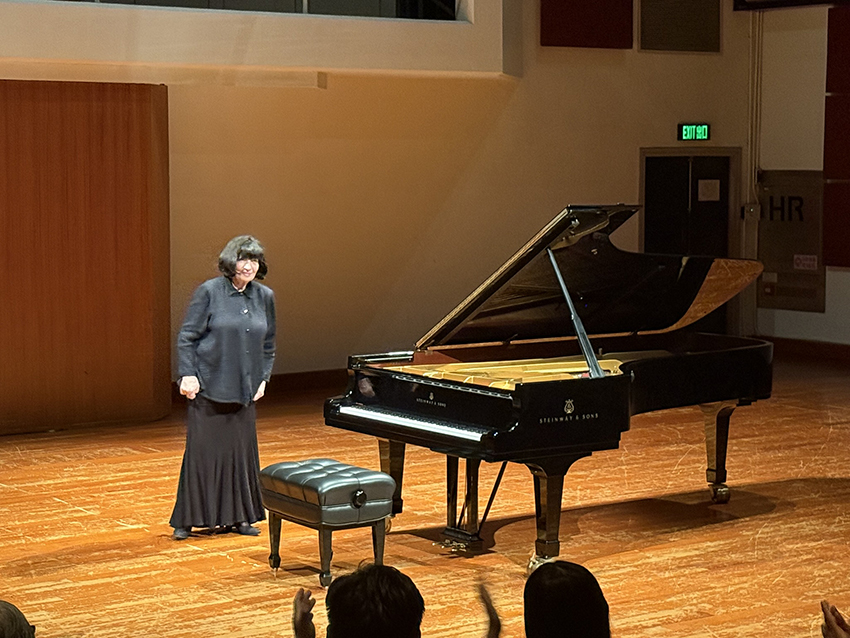
The great Georgian pianist Eliso Virsaladze made her Hong Kong debut in 2017 at the age of 74, playing both solo and chamber music, and returned two years later for a concerto performance. Now 82, she was back at this year’s Hong Kong Arts Festival for a solo recital, one in which her powers proved largely undiminished.
The recital began with Schubert’s Moments musicaux, the middle four of which were played in a straightforward fashion. In the C-major opening piece, Virsaladze’s left and right hands at times went slightly out of sync so as to clarify the interaction of two imitative voices, a rare practice among today’s pianists. In the outer sections of the sixth and last piece, in A-flat major, such was the extreme flexibility of her tempo – it changed almost every bar and the music slowed down massively upon settling into F-flat major (notated as E major) – that the triple metre was often difficult to discern.
Next was Brahms’s Op 1 Sonata, a youthful work often criticised as bombastic and ignored by most pianists. The remarkable fluency of Virsaladze’s rendition, as manifested in the Andante by the seamlessness with which she moved from one variation to the next, proclaimed her belief in this music, for decades a part of her repertoire. The subtle tempo changes in the course of the beginning Allegro were masterfully effected, while the propulsion of the third and final movements, both marked con fuoco, suited the fiery temperament of the pianist, who would much rather hit a few wrong notes than slow down and impede the music’s momentum.
After an expressive account of Liszt’s nocturne-like Consolation No 3 came the first of the same composer’s Trois études de concert. The title the latter later acquired, Il lamento, is a misnomer; as the markings on the score’s first page (a capriccio, dolce, appassionato con tenerezza, allegro cantabile) make plain, there is nothing mournful about it. This étude, the longest and by far the least popular in the set, found a most persuasive champion in Virsaladze, in whose hands it was a great outpouring of emotion that sounded compelling rather than rambling, as is typically the case with lesser artists.
Throughout her recital, the octogenarian displayed boundless energy, even when she was not playing: she didn’t pause between movements of a work and didn’t need much of a break between works either. She plunged into the last work on her demanding programme, Prokofiev’s wartime Sonata No 7, the very moment she sat down, if not before. Her accents and secco, detaché playing added to the sinister quality of the opening march. The slow movement started liltingly with a gentle rubato but built up to a climax, with peals of bell-like repeated chords that remained haunting to the end. In the final Precipitato, notwithstanding a memory lapse that resulted in a strange cut in an already short movement, Virsaladze demonstrated full control of the obsessive motoric rhythm essential to the success of the performance.
Doing Is Living / Once in a Blue Moon / David Zwirner / Hong Kong / Nov 19, 2024 – Feb 22, 2025 /
David Zwirner Hong Kong’s double show, with ethereal sculptures by Ruth Asawa (1926-2013) on the lower floor and the moon paintings of Scott Kahn (b. 1946) on the upper one, pairs two very different artists, allowing the viewer to find unexpected connections between their works.
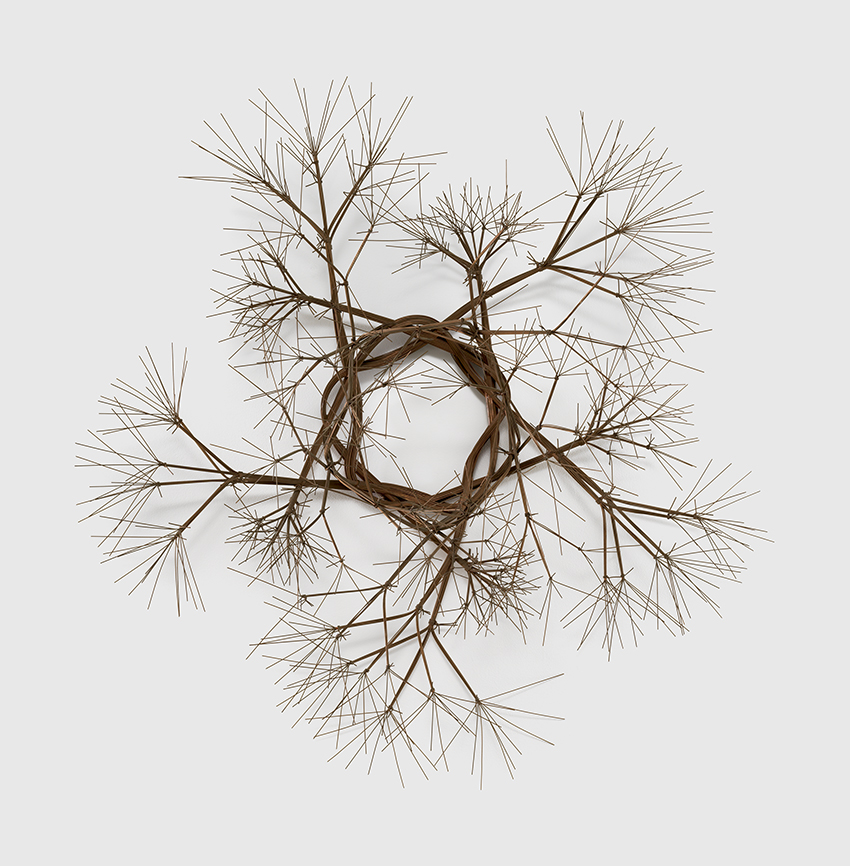
In Asawa’s first solo show in Greater China, Doing is Living, her mesmerisingly beautiful sculptures float in the air with magical, perfectly mathematical rhythms. Born in California, Asawa created these, as she has said in a past interview, “by observing plants” and then taking “a wire line and [going] into the air and [defining] the air without stealing it from anyone”. In this show, complementing the sculptures hanging from the ceiling, we can also admire a series of lesser-seen preparatory works, mostly watercolours of roses and irises but also meticulous renderings of leaves and their veins, and initial transpositions of these into patterns of lines and curves, both in ink: geometrical diagrams that will eventually take on a 3D volume. Also on the walls are some sepia and black-and-white photographs of Asawa herself, gently holding her see-through creations as they hang from the ceiling. The longer we look at these seemingly floating sculptures, the more images they conjure: imaginary sea-creatures, unlikely trees, even body organs of unknown lifeforms that rock gently in front of our eyes as they double up in their own different layers – many sculptures are made like Russian dolls, semi-transparent shapes containing further semi-transparent shapes – which multiply further in the shadows they project in the floors and walls. Sensuous, undulating and semi-transparent, these sculptures offer the impression of smooth simplicity, belying the intensive work they required, and presenting a sharp contrast between their aerial softness and the metallic material of which they are composed.
Kahn’s sharp moon edges and spacious landscapes, on the other hand, show the significance he accords to emptiness and to what in the 3D world would simply be air. He does so in a way that is diametrically opposed to Asawa’s: her mobile structures are interested in the aerial lightness drawn by her coiled wires, while he achieves the same aim through very compact surfaces, covered by thick layers of oil paint.
This is Kahn’s first solo show in Asia and takes its title from one of the works on display, Once in a Blue Moon. The full moon, represented in various colours in the different paintings, has a static, imposing presence devoid of any moongazing romanticism but more akin to an interrogating Sybill: it looks at us looking at it, as if questioning our presence. In the painting Blue Moon (2023), the moon is doubled up, a pale azure moon superimposed on a darker turquoise one – echoing the astronomical phenomenon of a “blue moon” or two full moons in one single calendar month – against black nighttime skies. Channel Sky (2007), meanwhile, presents open views in which the sky is framed in between the earth and a thick layer of clouds. Kahn’s colour palette is decisive, if always slightly surreal – with red trees (in Blue Moon) and orange hills under a sky of floating pink and white clouds (Sunset Behind the Privet Hedge, 2023) – and hyper-realistic. The stillness of his scenes gives no easy clue to his intended underlying narrative, leaving the viewer to interrogate these paintings in a subjective manner. Colours contrast sharply with one another, with very precisely delimited contours, acting as one of the most constant signifiers in his practice: whether it is a strong green in a hedge or a bush, a flashy magenta used for the trees or a marbleised blue and green sea (in The Cliffs at Stoke Fleming IV, 1987), Kahn gives the impression of working in a colour-coded universe, for which he doesn’t give us the key. We are left to wander into these landscapes, accepting their bursts of chromatic assertion and choosing for ourselves the precise meanings we wish to assign to each hue. All of the eight paintings on show at David Zwirner emanate a very static presence, looking like wordless landscapes that have never had any sound in them but where everything is characterised by flatness. The images we see are disconcerting, mostly because of their chromatic inventiveness but also because their flatness suggests something else, something more, taking place behind the still hills, trees and rocks, to which we have no access unless, once again, we search in our own imagination.
The two shows surprisingly complement each other thanks to the high degree of poetic vision that characterises both artists. Asawa’s with imaginary shapes play with light and media, pulling strings that we never knew our hearts had, while Kahn’s chromatic scenery offers the possibility of a different natural environment, without really granting us access to it.
Xu Bing / Eying East, Wondering West — Square Word Calligraphy Classroom / Mar 26 – Jul 30, 2025 /
The Wing (Lower) G/F, Hong Kong Museum of Art 10 Salisbury Rd, Tsim Sha Tsui Mondays to Wednesdays and Fridays 10am – 6pm Saturdays, Sundays and public holidays 10am – 9pm Free admission
Following Xu Bing’s appointment as Hong Kong’s Ambassador for Cultural Promotion in 2024, Xu Bing in Hong Kong: Square Word Calligraphy marks the renowned artist’s inaugural commissioning art initiative in the city. One of the featured programmes of the project is the Eying East, Wondering West — Square Word Calligraphy Classroom exhibition.
Square Word Calligraphy is a form of writing Xu Bing began developing in 1993, in which English is written to resemble Chinese characters. This writing system highlights the interplay between Eastern and Western cultures, aligning with Hong Kong’s vibrant cultural tapestry. This exhibition invites the audience to explore Square Word Calligraphy from three perspectives: “Appreciation”, “Learning” and “Application”, encouraging them to reflect on language and culture, challenges fixed ways of thinking, and sparking creativity through the switching between languages. Xu Bing has especially incorporated Hong Kong’s distinctive linguistic features in the exhibition, further enriching the meaning and interpretation of Square Word Calligraphy and opening up new possibilities for intercultural and interlingual communication.
Throughout the exhibition, the prominent area on the glass canopy at the entrance of the Hong Kong Museum of Art transforms its style, presenting the museum’s name and mission in the form of Square Word Calligraphy, enhanced with interactive augmented reality effects. “Connect Art to People” is one of the missions of the museum, aligning perfectly with Xu Bing’s belief in making art accessible to everyone. Presenting this phrase in the form of Square Words embodies the museum’s curatorial approach, which embraces a wide world of contrasts, from old to new, from East to West.
Presented by the Leisure and Cultural Services Department Organised by the Hong Kong Museum of Art and the Art Promotion Office
About the artist Xu Bing (1955 — ) was born in Chongqing, China, and raised in Beijing. He completed his studies at the Central Academy of Fine Arts (CAFA) in Beijing in 1981, after which he joined the faculty. In 1990, he was invited to the United States as an honorary artist and has since received numerous awards in the international art scene, including the MacArthur Fellowship (1999), the Artes Mundi Prize (2004), the Lifetime Achievement Award from the Southern Graphics Council (2007) and the Xu Bei Hong ─ Art Creation Award by the CAFA (2018). Recognised internationally as one of the most creative contemporary artists, Xu Bing masterfully blends traditional Chinese culture with contemporary elements. By transcending cultural boundaries and pioneering new perspectives of thinking, he has garnered widespread attention and acclaim. In March 2024, the Culture, Sports and Tourism Bureau appointed Xu Bing as Hong Kong’s Ambassador for Cultural Promotion for a term of five years. During his tenure, he is responsible for initiating a series of large-scale art projects in Hong Kong and nurturing young talents to promote cultural development.