All posts tagged: Diana d’Arenberg Parmanand

Jessica Rankin 傑西卡‧蘭金

Australia-born, New York-based artist Jessica Rankin recently opened her first Hong Kong solo exhibition, Sky Sound at White Cube, which was two years in the making. It comprises 26 works of acrylic and embroidery on linen, and of acrylic, graphite, watercolour and thread on paper; coils of floating colour and shapes swirl and shift across the surface of her intimate and monumental works, intersecting with rigid lines of embroidered thread, a signature element of her work. Rankin builds on the creative innovations of 1970s feminists like Judy Chicago and Margaret Harrison, who upended the traditional hierarchy and distinction between art and craft, bringing “women’s craft” and needlework into the contemporary art space, while at the same time developing her own distinct visual vocabulary. Embracing a fluid approach to media, Rankin uses brushstrokes and embroidery interchangeably, fusing the two with “masculine” fields like cartography, and incorporating geometric forms, astronomical signs and the written word to create an abstracted language.  The written word, in fact, has come to be as much a defining element in Rankin’s work …
Lawrence Carroll

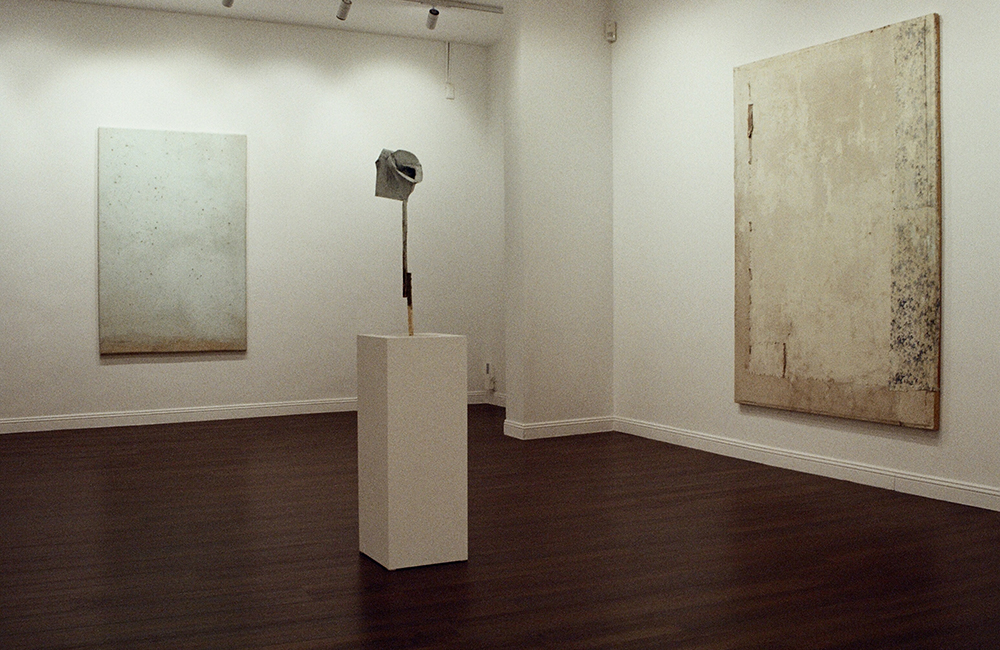
Whispers of the Soul / Villepin Gallery / Hong Kong / Nov 26, 2023 – Feb, 2024 / In an art market flooded with so much noise, it’s easy to overlook the work of Lawrence Carroll. The Melbourne-born American artist, who died in 2019, created works that fill a room with silence and inspire contemplation. They encourage slowness and consideration in how we approach and understand painting. Whispers of the Soul, Carroll’s first Hong Kong exhibition, at Villepin Gallery, features a selection of the artist’s sculptural canvases, photographs and sculptures. Curated by Olivier Kaeppelin and Arthur de Villepin, in collaboration with Carroll’s wife, Lucy Jones Carroll, the exhibition juxtaposes Carroll’s works with a scattering of others by Cy Twombly, Giorgio Morandi, Giorgio de Chirico and François Halard – artists who inspired Carroll and whom the artist admired. This curation enhances and creates dialogue between Carroll’s own works and the supporting artists. But make no mistake, Carroll’s works are the stars here. Throughout much of his painting career – putting aside his album cover artwork for American …

Julie Curtiss 朱莉·柯蒂斯

Hair, both beautiful and abject, ornamental and beastly, is a semiotic system that holds a powerful attraction for French-born, Florida-based artist Julie Curtiss. Born and raised in Paris, Curtiss studied at l’École des Beaux-Arts and then at the Hochschule für Bildende Künste in Dresden before making her way to the School of the Art Institute of Chicago.  Arguably, the Chicago imagists of her alma mater, like Christina Ramberg – to whose work Curtiss’ is often compared – and her years working as a studio assistant to both Jeff Koons and Brian Donnelly (aka KAWS) have informed Curtiss’ aesthetic, with its vibrant colours, cartoonish figuration and smooth, skilfully rendered lines. It’s a highly stylised visual language that helped her work get noticed on Instagram and reach stratospheric heights of success in the art world. But unlike Kaws’ Happy Meal cartoons and figurines, Curtiss’ work is personal, a deep dive into the female psyche and femininity through Jungian archetypes.   Bitter Apples, Curtiss’ first exhibition at White Cube Hong Kong, brings together works across varied media, including …

Haim Steinbach

tin drum / White Cube / Hong Kong /Sep 14 – Nov 12, 2022 / Four horizontal display shelves line the exhibition walls of White Cube’s ground floor gallery. The open shelves are lined with groupings of objects – rubber dog chew toys, robots, spaceships and monsters, metal Star Wars lunch boxes. The display is reminiscent of a child’s bedroom, with cherished objects lined up on shelves in a way that may be cryptic to an outsider but hold personal meaning to the child. Angular and wedge-shaped, the shelves and the objects are all in a palette of black and red, sitting in stark contrast against the white walls. Two geometric, black and red toy cars sit beside a snowman-shaped black dog chew toy atop a red and black shelf. The work, El Lissitzky II-4 (2008-2012), references the Russian artist who cofounded the suprematism movement. Allusions to the Russian constructivist movement are echoed throughout the four shelf arrangements, creating a formal visual cohesion.  ‘tin drum’ – named after a 2011 work, tin drum, in the exhibition, …

Cerith Wyn Evans 凱裡斯·懷恩·埃文斯

Since the 1990s, Welsh conceptual artist Cerith Wyn Evans has created work about language, perception and representation. The artist skilfully weaves in elements of the musical, literary, philosophical and cinematic, resulting in exhibitions that are densely layered and at times even cryptic, and that have won him acclaim from international institutions such as the Tate Britain, Musée d’Art Moderne de Paris and Austria’s Kunsthaus Graz, and participation in numerous biennales and triennials. His most recent exhibition at White Cube Hong Kong, …)( of, a clearing, featuring installation, sculpture, painting and sound, continues his exploration of the visual and the aural, the relationship between them and the things that lie in between. Using the work of several modern artists as a point of departure, Wyn Evans creates a series of pieces that refer to seminal moments in art history theory, in particular Lucio Fontana’s Concetto Spaziale aesthetic (1947–68), which erased the boundaries among architecture, painting, sculpture and the fourth dimension within art, which cubist artist Max Weber described as “the consciousness of a great and overwhelming …

Sherrie Levine 谢丽·利文

Hong Kong Dominoes / David Zwirner / Hong Kong / Sep 4 – Oct 13, 2021 / American artist Sherrie Levine’s recent exhibition Hong Kong Dominoes at David Zwirner in Hong Kong comprised six bodies of work that span three decades of the artist’s career.Levine rose to prominence as a member of the Pictures Generation, a group of artists based in New York in the late 1970s and 80s. Originally trained as a printmaker, this has continued to influence her work, of which multiple images and mechanical reproduction form the foundation. The artist chooses, reproduces and re-presents the works of dead white male artists as her own – works in the past have appropriated Walker Evans, Matisse, Brâncuși and Duchamp – undermining and calling into question concepts like authorship, originality and authenticity, and our fetishisation of these values and of certain works of art. Several works in the current exhibition make reference to modernist works. In the group of 22 watercolour on paper drawings After Henri Matisse (1985), Levine recreates and presents a sequence of …

Bruce Nauman 布魯斯·瑙曼

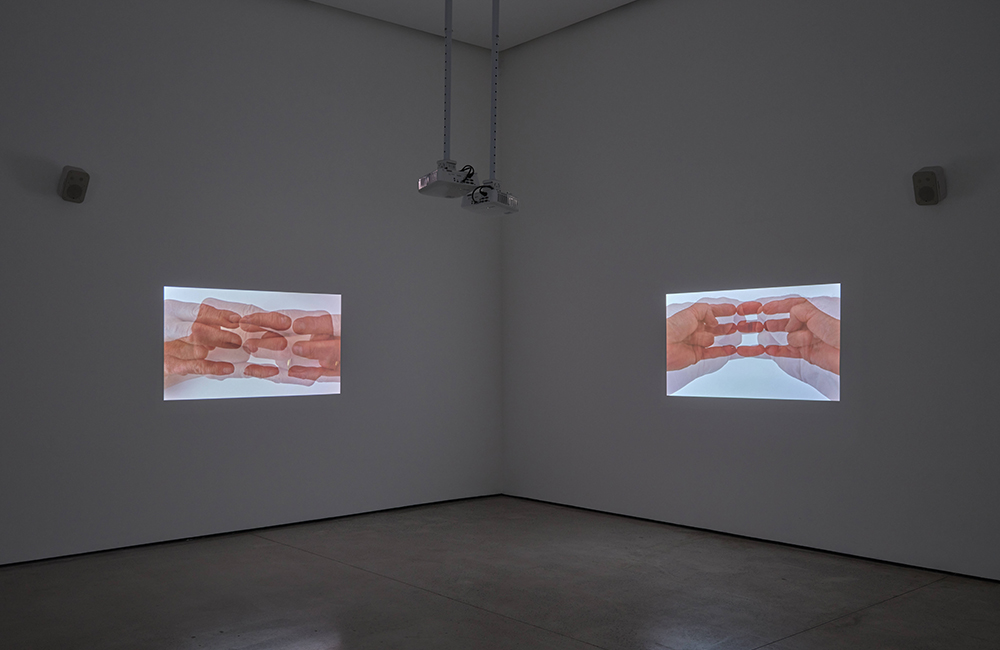
This year marks the 80th birthday of American artist Bruce Nauman. Following on from a recent Tate retrospective is Presence/Absence at White Cube, the first exhibition in Hong Kong for the pioneering video artist, featuring five works: two single-channel pieces, from 1999 and 2001; and three dual-screen projections made in 2013. The artist is present in all but one of them. Many of Nauman’s earlier works are about time and endurance: his own as an artist, as he pushes himself to physical limits; and the audience’s, as they try to sit through videos of maniacal clowns (Clown Torture, 1987), and of the artist performing mundane tasks. In one of several early videos from 1968, we see him bouncing off the wall (Bouncing in the Corner I), making the viewer dizzy in the process. In another, Walk with Contrapposto (1968), he walks back and forth in a narrow corridor, exaggeratedly swinging his hips side to side. Similarly, in Walking in an Exaggerated Manner Around the Perimeter of a Square (1968), he places one foot in front …

Andreas Mühe 安德里亚斯·穆埃

Pathos as Distance / By Diana d’Arenberg Parmanand / Shown at Whitestone Gallery in Hong Kong, Pathos as Distance by Andreas Mühe is a survey of the artist’s work, comprising 30 photographs taken from 2004 to 2018. The East German-born photographer, who grew up in the last decade of the Cold War in a still divided Germany, creates images that portray the present through the lens of history using temporal distance to invoke pathos in a contemporary society suffering from historical amnesia. Mühe displays a fascination with power, pomp and grandeur, photographing monumental buildings, politicians, celebrities and rock stars, and even the German chancellor Angela Merkel. But he also dives into his country’s own history, subverting the totalitarian aesthetics and discourses of power that he draws on. The first photographs encountered in the exhibition are four self-portraits of the artist from the series Mühe Kopf (2018). Resembling album covers by German rock band Rammstein, with whom the artist has worked, the white, sculpted clay faces stare at the viewer with piercing blue, ceramic eyes. They are a form of vanitas, …

McArthur Binion

Hand: Work: II / Lehmann Maupin and Massimo de Carlo / Hong Kong / May 22 – July 6 / Diana d’Arenberg Parmanand / After decades of being overlooked, 73-year-old American artist McArthur Binion is having a moment. With a spate of recent exhibitions, notably his inclusion in the 2017 Venice Biennale Viva Arte Viva and a 2018 solo exhibition at the Cranbrook Art Museum in Detroit, this past month the artist has also celebrated the opening of several solo exhibitions in Asia. One at Lehmann Maupin Seoul was preceded by Hand:Work:II, a two-gallery show spread out across Massimo de Carlo and Lehmann Maupin in Hong Kong’s Pedder Building.  In the late 1970s Binion found himself at the centre of the dizzying, meteoric art scene in Soho, New York, hanging out with artists like Jean-Michel Basquiat, Dan Flavin and Sol LeWitt. Binion’s works are seemingly cut from the same mould as the two minimalist figureheads; they appear minimalist from a distance, but up close reveal themselves as something entirely different. Using oil stick, Binion draws vertical and horizontal lines in a grid over …

Chen Danqing

By Diana d’Arenberg Parmanand / Shanghai-born artist Chen Danqing was only 14 when he started painting Mao propaganda posters in the 1970s. “I painted more than 100 portraits of Chairman Mao on the street walls in Shanghai and its suburbs and also on factory iron sheets,” he says. “During that time, there were millions of amateur and professional painters in China who painted millions of portraits of Mao Zedong.” Sent to live in the countryside in Jiangxi province for five years as part of a nationwide programme of forced collectivisation during the Cultural Revolution, Chen painted what was prescribed in the socialist realist style. The posters were part of a progression in a career that would eventually earn him accolades as a painter in China. After the Cultural Revolution he was admitted to the China Central Academy of Fine Arts, graduating in 1980 and staying on to teach until he moved to New York City a couple of years later. It was during this period that he painted his series of seven Tibetan paintings, which would …