Awakening /
Alisan Fine Arts, Central /
Hong Kong /
Feb 1 – Mar 16, 2023 /
Chu Chu’s second solo exhibition at Alisan Fine Arts in Hong Kong was an overview of the emerging artist’s works from 2007 to the present. It was curated mainly to provide viewers with background knowledge of her practice, featuring some of her best-known earlier works, as well as showcasing her latest multimedia experiments. Highlighting her roots in photography and Chinese calligraphy, Awakening not only traces Chu’s development over the past decade and a half, but also serves as an affirmation of her talent at reinterpreting and reconciling vastly different genres.
The presentation started with her iconic Material Immaterial series from over a decade ago, featuring five monochromatic works depicting dried fruits, gardenias and twigs. You could easily be forgiven for dismissing the photographic renderings of such objects as banal or commonplace. However, understatement is the key here. Embedded in the photographs among the nuanced shadows are calligraphic scrolls so subtle and delicate that they could easily be mistaken for shadows themselves. For example, in Whispers of Trees – Bamboo (2011-21) and Whispers of Trees – Cercis (2011-17), tiny Chinese characters hide behind the photographed objects, peeking out only if the viewer actively searches for them. They add depth to the shadows and transform the works into objects of contemplation.

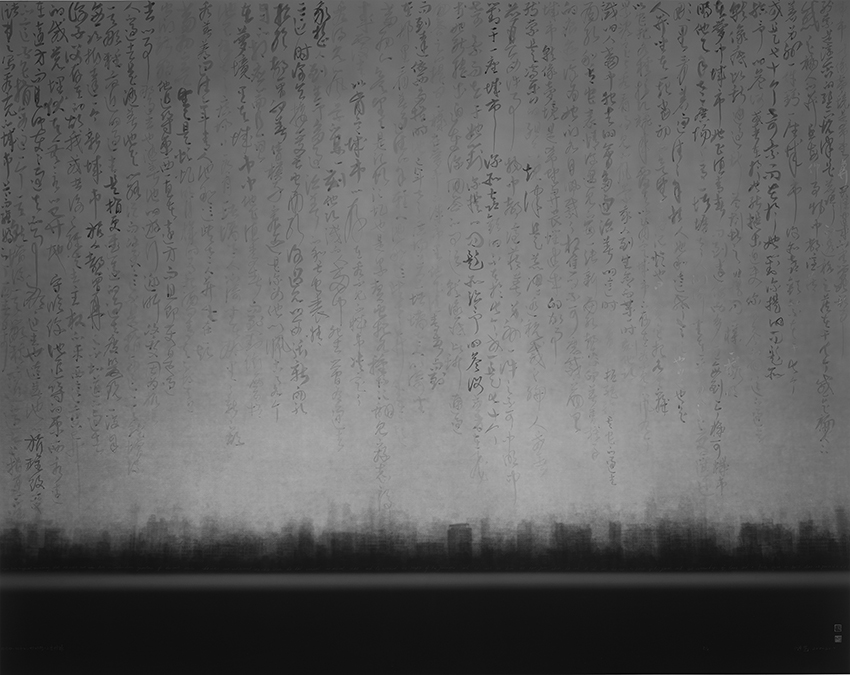
Another body of works is inspired by Italian writer ltalo Calvino’s book Invisible Cities (1972), in which he describes 55 fictitious cities. In Cities-Bergamot (2007-18), the artist’s works become metaphors for these imagined cities and what they represent. Capturing urban skylines across bodies of water in photographs, she embellishes the overcast sky with calligraphic Chinese characters that look like large raindrops fading into the horizon. Most of her works are inspired by a diverse range of ancient texts, from Marcus Aurelius (121-180) to Wen Tingyun (812-870) of the Tang dynasty to Lord Byron (1788-1824). The poetic and philosophical references help the artworks emanate a melancholic longing for days past.
Finally, viewers are treated to splashes of colour in the artist’s most recent series, Bright Stars, which she produced during the pandemic. Stylistically, the works vibrate with energy and colour unseen before. The Golden Seal (2020-22) is inspired by John Keats’s Love Letter to Fanny Brawne, in which the author references the short but fruitful lives of butterflies in the summer. Although the work consists of discrete panels of photographed leaves that are placed together, the treatment of colour gives the overall composition a peculiar harmony. In addition, gold calligraphy flows through the foreground, expertly scrawled in an organised frenzy. Instead of hiding in the background, Chu’s calligraphy now boldly greets her viewers, in a departure from the simplicity of her earlier monochromatic works.

A romantic at heart, Chu is a master at capturing mood and emotion, and tempting her viewers with the promise of more. While her style is like the seasons, ever-changing and ever-evolving, she remains faithful to her cross-disciplinary practice of photography and calligraphy, referencing nature and also drawing inspiration from historical, cultural and literary sources. Although her earlier works exude a quiet sophistication, they merely set the stage for bigger things to come.
Featured image: Cities-Bergamot by Chu Chu, 75 x 94.5cm, 2007-2018. Courtesy the artist and Alisan Fine Arts.
儲楚
蟄蟲始振
中環藝倡畫廊
2023年2月1日至3月16日
香港藝倡畫廊第二次舉辦儲楚的個展,縱覽這位新晉藝術家從2007年至今的作品。展覽讓觀眾了解她創作的背景,包括一些最著名的早期作品,以及展示她最新的多媒體實驗。《蟄蟲始振》展現她在攝影和中國書法多年的造詣,追溯其過去十五年的演變,也是對她重新詮釋及調和截然不同流派的肯定。
展覽以其十多年前的標誌性《物非物》系列為序幕,其中包括五幅描繪乾果、梔子花和樹枝的單色作品。你很容易會覺得這些物體的攝影效果圖是平庸或司空見慣。然而,輕描淡寫是這裡的關鍵。在細微的陰影中嵌入照片的書法捲軸是如此微妙和精緻,以至於它們很容易被誤認為是陰影本身。例如,在《樹的低語——竹子》(2011-21)和《樹的低語——瑟西斯》(2011-17)中,細小的漢字隱藏在拍攝的物體後面,觀眾主動探尋才會看到。它們增加了陰影的深度,並將作品轉化為沉思的物件。
另一部作品的靈感來自義大利作家阿爾塔洛.卡爾維諾(ltalo Calvino)的著作《看不見的城市》(1972年),他在書中描繪55個虛構的城市。在《城市-佛手柑》(2007-18年)中,藝術家的作品成為這些想像城市及其所代表的隱喻。她在照片中捕捉水體上的城市天際線,用書法漢字點綴陰雲密佈的天空,看起來像大雨滴消失在地平線上。她的大部分作品都由各種古代文本的啟發,從唐朝的馬庫斯.奧勒留(121-180年)到温庭筠(812-870年)再到拜倫勳爵(1788-1824年)。詩意和哲學的引用幫助藝術品散發出對過去的憂鬱渴望。
最後,觀眾可以在藝術家的最新系列《明亮的星星》欣賞到色彩飛濺,這是她在疫情期間製作的。在風格上,這些作品充滿了前所未有的能量和色彩。《金印》(2020-22年)的靈感來自約翰.濟慈寫給范妮.布朗的情書,作者在其中提到了夏天蝴蝶短暫但豐富的生活。雖然這件作品由將照片中的葉子組成的離散面板組成,但顏色的處理使整體構圖具有獨特的和諧感。此外,金色書法流經前景,在有組織的狂熱中熟練地潦草。藝術家的書法不再隱藏,而是大膽地迎接觀眾,這與她早期單色作品的簡單截然不同。
藝術家的內心浪漫,擅長捕捉情緒和情感,並承諾給予更多來吸引觀眾。雖然她的風格就像季節一樣,不斷變化和發展,但她仍然忠於攝影和書法的跨學科實踐,參考自然,並從歷史、文化和文學來源中汲取靈感。儘管她早期的作品散發著安靜的熟練,但它們只是為更大的創作奠定基礎。