Field Signs /
David Zwirner /
Hong Kong /
Nov 16, 2023 – Feb 24, 2024 /
Throughout history, human beings have always sought signs: from zodiac signs that give meaning to what they believe in or do to literal signs that provide instructions during an election or protest. The pursuit of signs often reaches a climax at the end or beginning of the year, when we want to peer into a crystal ball and figure out what the new year has in store.
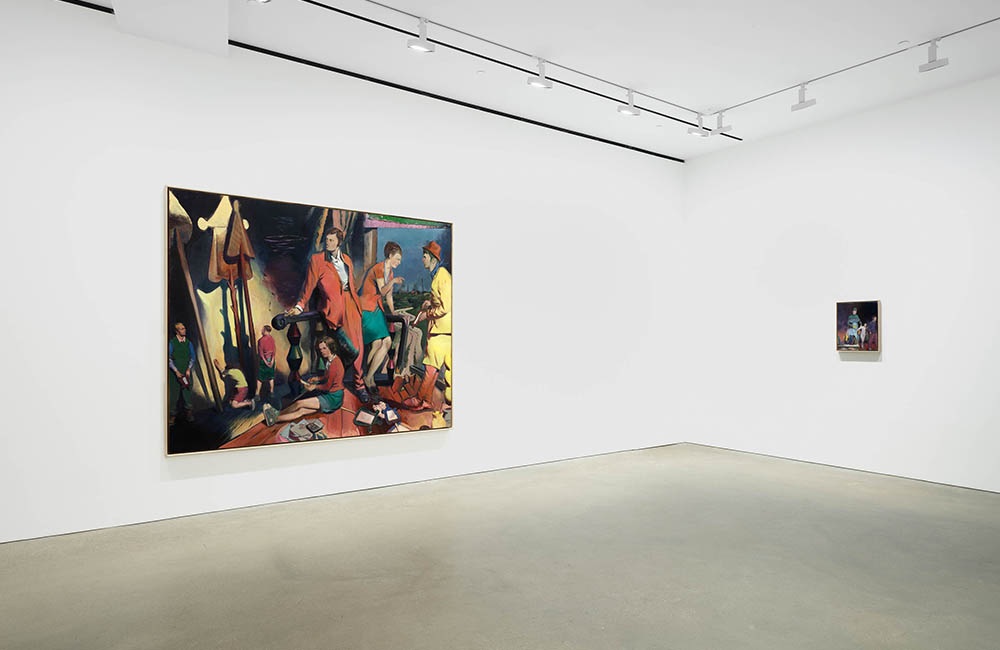
Field Signs, Neo Rauch’s latest exhibition at David Zwirner Hong Kong, also features plenty of signs. While anyone hoping to find easy meaning in Rauch’s art will be sorely disappointed, the exhibition feels as contemporary and relevant as the artist’s work always does.
The exhibition title has a double meaning, referring not only to signs farmers use to mark a crop variety but also to signs used by warring states or parties in the past. The exhibition trots out Rauch’s usual bevy of people at work or play, following socialist realist art traditions – until you realise they aren’t your usual humans and landscapes.
Shape shifters inhabit the scenes, with fins growing from shoulders, wings from backs, tails from behinds. Distinct but varying scenes converge in the same painting, giving the impression that they should be viewed as an unfolding story – but when we attempt to, we find they make little sense.
There is also an underlying violence that gives rise to unease: a man holding a sharp blade behind his back as he observes a woman marching down a field with a sign; a pool of blood that’s accumulated next to the head of a fish that’s being gutted.

© Neo Rauch/VG Bild-Kunst, Bonn. Courtesy the artist, Galerie EIGEN + ART Leipzig/Berlin, and
David Zwirner. Photo: Uwe Walter, Berlin
There is a recurring image of crowds wielding signs and marching with them. In one painting, someone carries a burning torch, a house of cards has been set on fire and a woman appears to be comforting a man who is covering his face with his hands. Barely legible on a billboard is the German word “Reue” (“remorse”), calling to mind political events such as the march on the US Capitol on January 6, 2023 and the subsequent regret expressed by some of the protesters.
But the attitude towards these figures is ambiguous at best. We are made to wonder if the figures actually wield agency over their own actions and fate, or are merely pawns in a chess game. A painting featuring two men rolling a massive dice seems to explicitly point to the latter. The flagrant disregard for perspectives and proportions also means figures of various sizes are placed on the same plane, creating an uncanny effect where some of the smaller figures look like dolls rather than humans.
If they are puppets, it raises the question of who the puppet master is. The artist? Rauch might deny that.

© Neo Rauch/VG Bild-Kunst, Bonn. Courtesy the artist, Galerie EIGEN + ART Leipzig/Berlin, and David Zwirner. Photo: Uwe Walter, Berlin
One prominent motif in this body of works is moths – or “die Nachtfalter” (“the night butterflies”), as Rauch calls them. For the artist, the Nachtfalter symbolise inspiration and intuition – and, like the Nachtfalter, who come to you at night, these images and motifs come to him, eventually landing on his canvases.
But there is also a Rauch-like figure in Sonne (2023). He is decked out in a green coat and a cross-body satchel, a set of paint brushes next to him, and his hand is raised in an ambiguous gesture. Is he providing instruction to a girl who is balancing some coloured orbs or outlining the contours of the girl’s dress? Or is that the viewer’s wishful thinking? In a tumultuous world, we want a sign that somehow, everything that happens is governed by an invisible hand, rather than being the product of a serendipitous set of encounters.
長久以來,人類一直在尋找標誌,無論是為他們的信仰和行為添加意義的星座符號,還是選舉和抗議時提供指令的標記信號。人們在年末和年初往往最想得到標誌啟示,窺探新一年會發生的事。
尼奧.勞赫在香港卓納畫舉辦的最新展覽「地標」蘊含大量標誌,想在尼奧.勞赫的藝術中找尋簡單含義的人會非常失望,不過展覽充滿現代感和共鳴,就像藝術家一貫的作品一樣。
展覽名稱有雙重意思,不單是指農民標示農作物種類時用的標誌,也指交戰國家和戰士以前所用的記號。展覽沿襲社會主義現實主義的藝術傳統,展示尼奧.勞赫創作時經常描繪的工作和娛樂場景的人物,不過你會發現他們並不是普通的人和風景。
各個場景都充斥著變形人,有些肩膀上長了鰭,有些背上長了翅膀,有些背後長了尾巴。同一幅畫有著不同的場景,讓人覺得它們應該是一個故事。但當你嘗試連結各個場景時,你會發現它們並沒有什麼關係。
有一些暴力場景會讓人不安,例如是一名拿著利刀藏在背後的男子正觀察著一名舉著標語在田野上行進的女子;魚的內臟被掏空,有一灘血積聚在魚頭的附近。
作品反覆出現人群揮舞著標誌行走的畫面。在其中一幅畫作中,有人舉著燃燒的火把,紙牌屋著火了,有一名女子正在安慰用手摀著臉的男子。告示牌上寫著幾乎看不到的德文字「Reue」(「悔過」),讓人想起一些政治事件,例如2023年1月6日美國國會大廈的遊行以及後來一些抗議者表達的悔意。
但藝術家對這些人物的態度模稜兩可,我們不禁好奇他們是否真的能夠掌控自己的行為和命運,又或只是棋局中的一隻棋子,一幅描繪兩名男子擲巨大骰子的畫似乎明確地指向了後者。藝術家故意忽略視角和比例,意味不同尺寸的人物都在同一平面上,產生一種不可思議的效果,一些較小的人物看起來像布偶不像人類。
如果他們是布偶,那麼操縱布偶的人是誰?是藝術家嗎?尼奧.勞赫可能會否認這一點。
這組作品有一個突出的主題,就是飛蛾,尼奧.勞赫稱之為「夜行雌蛾」。對藝術家來說,夜行雌蛾象徵靈感和直覺。牠們會在深夜時分出現在人面前,好比這些圖像和主題來到他身邊,最終落在畫布上。
在《太陽》(2023年)中有一個類似尼奧.勞赫的人物,他穿著一件綠色外套,背著一個斜揹袋,旁邊放著一套畫筆。他舉起了手,做出了一個不明的姿勢。他是在指導正在平衡彩色球體的女子,還是在勾勒她衣服的輪廓?還是只是觀眾一廂情願?在動盪的世界中,我們都想尋找標誌,證明一切都是由一隻無形的手所控制,而不是偶然發生。