By DeWitt Cheng /
In The Invention of Morel, a 1940 novella by Adolfo Bioy Casares, a Venezuelan writer sentenced to exile on a deserted island in the South Pacific hides from a group of tourists who arrive suddenly. Observing them daily, he becomes fascinated and begins a journal recording their doings – and starts falling in love with a young woman named Faustine, who strangely ignores him when he approaches her. Even stranger, all the intruders repeat their actions again and again, as if caught in a Groundhog Day time loop. Later, the narrator discovers that the group’s host, Morel, is a scientist, and that the visitors are projected recordings of his guests, all of them granted technological immortality. After the guests have departed, the writer, having learned to operate Morel’s machine, interpolates his image into the projection, pretending to interact with Faustine.

Photo: Don Ross. Courtesy SFMOMA.
Eighty-odd years later, such plot lines may be commonplace in movies – like Woody Allen’s The Purple Rose of Cairo, with its movie characters stepping off-screen and into the real world – but the idea of interacting with fictive creations through advanced technology remains appealing and seductive, especially as reality seems more and more chaotic and threatening. Intentness and songs, an installation by Hong Kong multimedia artist Samson Young at the San Francisco Museum of Modern Art, his first American museum exhibition, reminded me of Casares’ narrator’s search.
Young is a postmodernist conceptual artist in his mid-40s who has had an extraordinary career. After earning University of Kong Kong bachelor’s degrees in music, philosophy and gender studies; a master’s in philosophy; and a PhD in music composition from Princeton, he began working with Hong Kong multimedia artists and expanded his practice to embrace drawing, video and performance.
His sociopolitical work, which touches on racial identity, migration and border issues, includes Nocturnal Music (2015), a New York performance in which the artist, clad in military garb, sat watching video of US war on terror aerial strikes with the sound muted, adding live foley sound effects to the onscreen pyrotechnics, both bringing the audience into the violence and distancing them from it, like the controllers who do their geopolitical jobs from computers thousands of miles from their victims. In Canon (2016), based on the 1979 Vietnamese refugee crisis, Young, wearing a police uniform and standing atop a scissor lift, projected the sounds of birds’ distress calls to viewers far away with an LRAD (Long Range Acoustic Device) sound cannon normally used in nonlethal but painful crowd dispersal. In 2017, Young represented Hong Kong at the 57th Annual Venice Biennale. His work has won many prestigious awards and is collected internationally.

Photo: Don Ross. Courtesy SFMOMA.
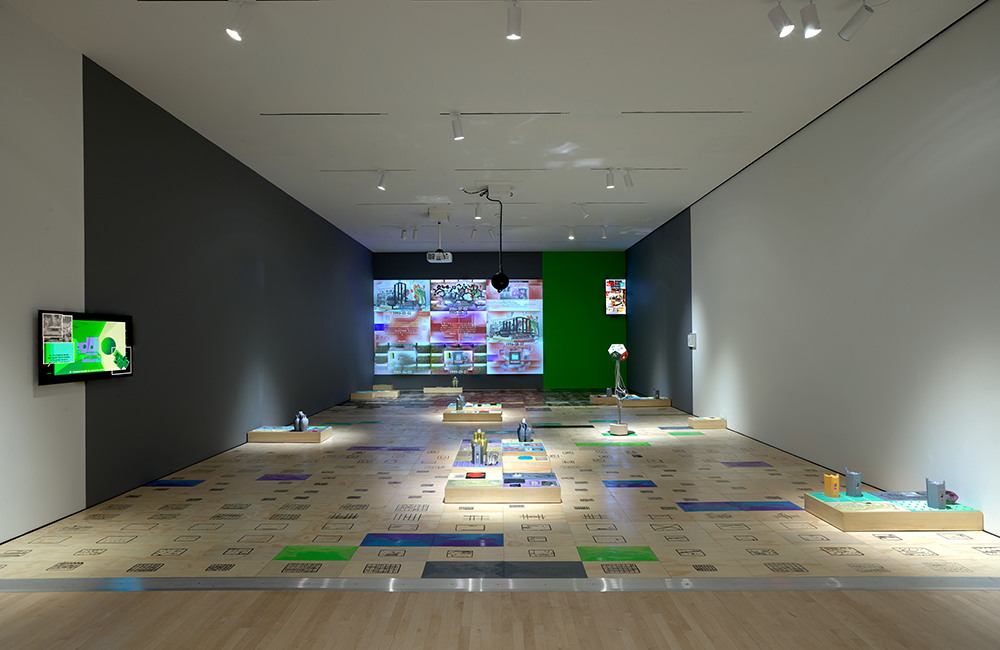
For Intentness and songs, he worked with the museum’s curators Alison Guh and Karen Cheung and a technical crew of 30 designers, project managers, fabricators and installers. In this complex installation of sculptures, videos and recorded music, he focuses on the personal and domestic, displaying ephemeral objects or their 3D-printed simulacra – such as beloved books, obsolete electronic gadgets, crystals, cigarette packs, magazines and keychains – important to the artist or his partner, Tommy, on 3D-printed panels. These tabletop assemblages – which may remind viewers of Rauschenberg’s once-revolutionary “flatbed” notion of composition, an approach that positions the canvas as a flat surface where various elements can be arranged, through techniques like collage and assemblage, without the limitations of depth or perspective – rest on low rectangular plinths, each adorned with a 3D-printed hexagonal tower/speaker programmed to play choral music to AI promptings based on real-time video feeds from the gallery or Young’s Hong Kong studio. Three video monitors present an ever-changing slide-show array of numbers, photographs, snatches of conversation and graphic images scraped from the internet or fed into AI by the artist, including his Google Calendar entries and recorded interviews. The plinth displays, the videos and the computer-drawn wooden tiles below, with each tile representing a month and each row of tiles a year, are connected electronically, with their AI magic concealed. All source material dates from between 2011, when the artist met his partner, and 2023.

Photo: Don Ross. Courtesy SFMOMA.
Young has claimed, self-deprecatingly, in an interview, “I am reasonably lousy at programming and 3D modelling but I have a lot of fun trying.” Viewers may be ignorant of the meanings of Young’s artefacts – although we are cognisant that the artefacts of any life can take on significance if considered metaphysically. The themes of memory, love and time receive a galvanic contemporary upgrade in Young’s songs of the self, exuberant yet elegiac, fashioned with the powerful, fun tech available now to digital-cloud netizens everywhere.
《莫雷爾的發明》是阿道夫.比奧伊.卡薩雷斯於1940 年發表的中篇小說,故事中的委內瑞拉作家被判處流放到南太平洋荒島,突如其來的遊客令他把自己隱藏起來。作家每天觀察遊客,為之著迷,還開始以日記寫下他們的一舉一動,更愛上了名叫科詩婷的少女。作家走近時,她會奇怪地無視。更奇怪的是,所有外來人會不斷重複行為,彷彿陷入了電影《偷天情緣》的時間循環。後來,敘事者發現招待旅客的莫雷爾原來是一名科學家,所有遊客都是投影錄像,是科技令他們擁有不死之身。遊客離開後,作家學懂如何操作莫雷爾的機器,把自己的形像加進投影,假裝與科詩婷互動。
八十多年後,類似情節在電影已見怪不怪。在活地.亞倫的《戲假情真》中,電影角色從銀幕走進現實世界便是一例。然而,以先進技術與虛構作品互動的想法仍然很富吸引力,特別是現實世界越來越混亂和嚇人。香港多媒體藝術家楊嘉輝在三藩市現代藝術館的裝置作品《Intentness and songs》是他首個在美國藝術館舉行的展覽,讓我想起了卡薩雷斯筆下那位敘事者所想尋找的事物。
楊嘉輝現年40 多歲,是後現代主義概念藝術家,事業也非比尋常。取得香港大學的音樂、哲學和性別研究的學士學位後再獲哲學碩士,然後於普林斯頓大學獲得音樂創作博士學位,自此開始與香港的多媒體藝術家合作,並將藝術實踐延展至繪畫、錄像和表演。
他的社會政治作品涉及種族身份、移民和國界等課題。2015年在紐約的表演《Nocturnal Music》中,楊嘉輝身穿軍裝,在靜音下坐著觀看美國反恐戰爭空襲的片段,現場螢幕上的煙火配上擬音效果,既將觀眾帶進暴力,又使他們遠離暴力,就像那些在距離受害者數千英里的電腦上進行地緣政治工作的控制者一樣。在《Canon》(2016年)根據 1979 年的越南難民危機改編,楊氏身穿警服,站在剪刀式升降台上,以一般用於非致命但痛楚的人群驅散,名為 LRAD(遠端聲學裝置)的音炮,將鳥兒的求救聲向遠方的觀眾投射。2017年,楊嘉輝代表香港參加了第 57 屆威尼斯雙年展,作品囊括許多著名獎項,在國際間廣獲收藏。

Photo: DeWitt Cheng. Courtesy DeWitt Cheng.
在創作《Intentness and songs》時,他與博物館的策展人Alison Guh和Karen Cheung,以及由30名設計師、項目經理、製造商和安裝人員組成的技術團隊合作。複雜的裝置包括雕塑、錄像和預錄音樂元素,楊嘉輝的主題是個人和家庭,他在3D 打印的面板上展出各種稍縱即逝的物件或3D 打印的虛擬圖像,包括心愛的書籍、過時的電子產品、水晶、煙盒、雜誌和鑰匙扣,這些都是對他或其伴侶 Tommy 來說很重要的物件。桌面上的林林總總,或許會令觀眾想起勞森伯格一時無兩的創新「平板」構圖意念,這種方法視畫布為平面,以拼貼和組合技巧把各種元素排列在上,不受深度或視覺限制;這些物件放在矮身的矩形基座上,每個基座都以 3D 打印的六角形塔或揚聲器裝飾,再以程式控制裝置根據來自畫廊或楊氏香港工作室的實時錄像,按AI 提示播放合唱音樂。三個顯示屏上,是從網上擷取或由藝術家以AI輸入的數字、照片、對話片段,以不斷變化的投影片呈現,包括楊氏的Google行事曆條目和訪問錄音。基座顯示器、錄像和下方由電腦繪製的木板,每塊木板代表一個月分,每行木板代表一年,各種組件均以電子連接,把AI魔法隱藏起來。所有素材都來自 2011 年,即楊嘉輝與伴侶邂逅的一年,至2023 年。
楊氏曾於訪問中自嘲說:「我的程式設計和 3D 建模相當不濟,但從嘗試中獲得很多樂趣。」觀眾可能不知道楊氏展品的含義,儘管我們意識到從形而上學的角度來說,人生中任何物件都可以有其重要性。記憶、愛情和時間的主題在楊嘉輝各首自我歌曲中化身現代化的昇華版本,扣人心弦、華麗而不失典雅;當中所採用的有趣科技強而有力,而且是全球數碼雲端網民都可以接觸的技術。