records / Side B / We Buy White Albums /
GOLD /
Hong Kong /
Oct 24 – Dec 19, 2026 /
Many collections never stop growing. In Hong Kong, collecting is often a way of keeping parts of a city that won’t stop changing. Neon signs come down, tenements give way to towers, and the shop that sold the first album you bought for yourself can shutter without notice. So people preserve what they can: the figure bought from a speciality toy shop or the record that once played on repeat. Holding onto these objects is a small act of resistance against forgetting. Nostalgia is as much sentiment as it is record-keeping, one nook or shelf at a time.
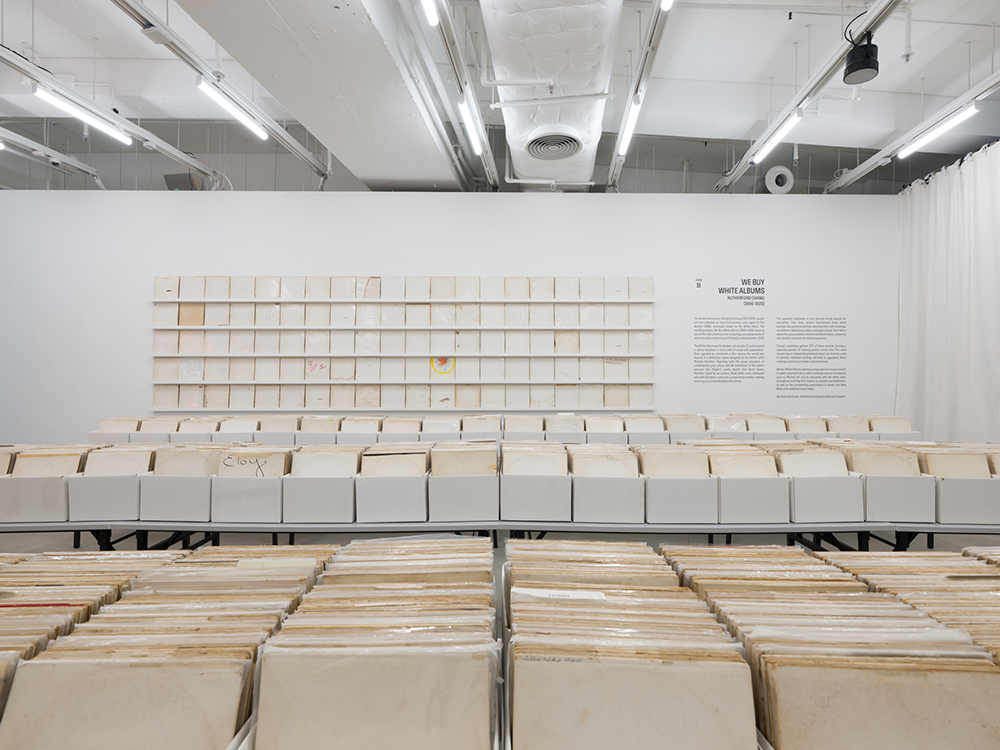
The late artist Rutherford Chang took that instinct to its limit in We Buy White Albums (2006-25), an artwork that is essentially a set of first-pressing copies of The Beatles (1968), more commonly called The White Album. Chang bought his first copy for US$1 at a garage sale when he was a teenager in the 1990s, seeding a collection of 3,717 copies by the time he passed away in 2025, each one embossed with “The Beatles” and stamped with a unique serial number on the sleeve – a design by Richard Hamilton, an artist who was friends with Paul McCartney.

About three million copies of The White Album were pressed, an edition on a scale rarely seen in contemporary art. Chang’s rule of collecting was to never spend more than US$20 on an acquisition. Sometimes, people would send him their copies after hearing about the project, gratis.
The sleeves of copies that are part of We Buy White Albums are posted on Instagram. All have been weathered over time, the discs forcing their way out to leave circular imprints on what were pristine surfaces. Some have marks left by blooming mould or water damage; some have red or brown rings left by wine glasses or coffee mugs; some have doodles, stickers or price tags that were never peeled off. Copies bought by fans of The Beatles in Japan have obis – paper strips printed with short promotional blurbs, typically used so that a separate Japanese-language cover wouldn’t need to be designed.
We Buy White Albums was part of “records”, an exhibition at GOLD. It was the sole artwork in “Side B” of the show, with “Side A” featuring other recordings chosen by artists, musicians, DJs and researchers from Hong Kong, Tokyo and Bangkok. Each of their selections had shaped their practice in some way; if these together were a patchwork of personal influences, then Chang’s artwork demonstrates how one record can carry thousands, if not millions, of private stories.

That notion of a shared starting point before quick divergence is best captured by a double LP made by Chang, featuring layered recordings of 100 copies within his collection. It was released in 2013 as The Beatles – We Buy White Albums. The opening track, Back in the U.S.S.R., sounds like a choral rendition of the original but the audio loses sync gradually in the second track, Dear Prudence. It’s an almost ghostly listen as soon as the song starts, with speed differences and decades of scratches brought to the fore. Halfway through side one, the sound is barely intelligible. The record does with sound what Chang’s larger collection of sleeves does with images, bringing attention to individual histories in aggregate.
Even though Chang’s artwork doesn’t directly draw from The White Album’s contents, a conceptual affinity still exists. The Beatles’ tracks move through folk, country rock, British blues, ska, music hall, hard rock and avant-garde – a fragmentary experience that was a distinct break from the thematic neatness of Sgt. Pepper’s Lonely Hearts Club Band, the band’s previous studio album. The White Album was released during a turbulent time: the Vietnam War was dragging on and the assassination of Martin Luther King had crushed whatever idealism remained following 1967’s Summer of Love.
Art historians might view We Buy White Albums as a spiritual successor to Robert Rauschenberg’s white paintings or Robert Smithson’s Spiral Jetty (1970), which was built to dramatise entropy; Chang’s layered tracks could also be considered through the legacy of composer Steve Reich’s phase pieces. But his artwork sparks a different association in the Hong Kong context. Walk through any of the city’s dense neighbourhoods and you will see the growing number of closed shops, none of them ever blank. Once the shutter comes down, it is covered with layers: wheatpasted posters, “for lease” notices, estate agents’ phone numbers, each pasted against or over the last. The commerce and human activity are gone but their sites become a surface that records different expressions, much like the sleeves collected by Chang. Hamilton’s cover was a white surface that thousands of owners treated like a wall, adding their own marks and embellishments until the blankness became a palimpsest of their lives.

That blank record sleeve left room for strangers to express themselves, an invitation that echoes the story behind one of the album’s best-known songs. John Lennon wrote Dear Prudence in Rishikesh, India, in early 1968 for Prudence Farrow, the sister of actress Mia. Prudence had retreated into her hut at an ashram to meditate and refused to come out. Her friends worried, so Lennon and George Harrison went to coax her out. The song asks her to open her eyes, notice the sky and remember that she is part of a bigger everything. The song’s lyrics say the world is waiting and that you are not alone in it.
Sometime later, someone, somewhere may have felt similar feelings and penned an inscription for people they cared about on a copy of The White Album. It was shown on a wall in GOLD:
My friends
To walk that road whose curves are far from refined
They twist the depths of my mind
Preparing it for the warmth
That fate can’t help but to design
It must be magic for once I get past that big oak tree
A mass of blue hits me
And my eyes rejuvenate
Under the sight of sky and sea
Then to climax my ecstasy
The cottage wobbles into view
With the door swung open from when my arriving wind blew
And standing, smiling, laughing, singing
Are all of you
The poem’s cursive slants across the sleeve, every flick of the pen filled with care. In a city where the places we love are painted over or vanish overnight, a collection is how we say that someone, somewhere mattered to us, and that we were around to notice.
records / Side B / We Buy White Albums
GOLD
香港
2026年10月24日至12月19日
收藏往往沒有終點,總是在不斷累積。面對不斷變遷的香港,收藏是一種保存城市片段的方式。霓虹招牌相繼拆卸,唐樓逐漸被高樓大廈取代,而那間你曾為自己購入人生第一張唱片的店舖,也可能在毫無預警下結業。所以人們希望盡可能保存眼前所能留住的東西:在玩具專門店買的模型,或是一張曾經反覆重播的唱片。留住這些物件,也是在與遺忘抗衡。懷舊既是一種記錄,也是一種情感,透過每個角落或層架,一點一滴地累積。
已故藝術家張能傑在作品《我們收購白色專輯》(2006–2025年)中,將這種收藏本能推向極致。作品本質上是一系列披頭四於1968年發行、俗稱「白色專輯」的首版唱片。張能傑在90年代的青少年時期,於一次車房二手貨出售中以$1美元買下第一張唱片,從此展開他的收藏歷程。直至2025年離世時,他累積這張專輯為數3,717張。每張唱片封套均壓印着「The Beatles(披頭四)」,並蓋有獨一無二的序號。這個設計出自藝術家李察.咸美頓之手,他是保羅.麥卡尼的友人。
「白色專輯」當年印製了約三百萬張,在當代藝術中,如此龐大的發行數量實屬罕見。張能傑的收藏原則是,每次購藏絕不花費超過$20美元。有些人得知這項計劃後,甚至會免費寄出自己珍藏的專輯給他。

《我們收購白色專輯》收藏的唱片封套均會上載至Instagram。歲月在每張封套上留下痕跡,唱片逐漸在封套上施壓,在原本潔淨的表面留下圓形印記。有些封套留有霉菌滋生或水漬侵蝕的痕跡;有些印着酒杯或咖啡杯留下的紅色或啡色圓圈印痕;有些則畫有塗鴉、貼有貼紙,或從未撕下的價錢標籤。在日本購買的披頭四樂迷版本,則附有日文宣傳紙帶,印有用來介紹唱片的簡單宣傳文案,讓唱片公司無需另外設計日文封面。
《我們收購白色專輯》是GOLD展覽「records」的一部分,也是展覽「Side B」唯一的作品。「Side A」呈現來自香港、東京及曼谷的藝術家、音樂人、DJ和研究人員所挑選的其他唱片。每人的選擇,都或多或少形塑了他們的創作實踐。如果說這些選曲拼湊出一幅由個人影響交織而成的圖景,那麼張能傑的作品則進一步展示一張唱片如何承載成千上萬計的人生故事。
這種從共同起點出發、隨後迅速分流的概念,在張能傑製作的一張雙黑膠唱片專輯中表現得最為鮮明。唱片收錄了他收藏中100張「白色專輯」唱片的播放聲音疊加而成的錄音,於2013年以《披頭四-我們收購白色專輯》為名發行。開場曲〈Back in the U.S.S.R.〉聽起來猶如原曲的合唱版本,然而到了第二首〈Dear Prudence〉,各段錄音便逐漸失去同步。播放速度的差異,以及歷經數十年的刮痕,令歌曲一開始聽起來便有某種詭異氛圍。唱片A面播放至中段時,聲音已幾乎難以辨認。這張唱片以聲音所呈現的效果,正如張能傑大量收藏的唱片封套,以影像所呈現的效果一樣,透過匯集不同痕跡,讓每個人的故事得以浮現。
儘管張能傑的作品並非直接取材自「白色專輯」的內容,兩者之間仍存在概念上的呼應。披頭四在該專輯內的歌曲穿梭於民謠、鄉村搖滾、英式藍調、斯卡音樂、音樂廳風格、硬式搖滾及前衛音樂等不同類型,形成一種碎片化的聆聽體驗,與樂隊上一張錄音室專輯《Sgt. Pepper’s Lonely Hearts Club Band》井然有序的主題編排截然不同。「白色專輯」發行之際,世界正處於動盪之中:越戰仍然持續,而馬丁路德金遇刺,亦粉碎了1967年「愛之夏」之後所餘下的理想主義。
藝術史學者或會將《我們收購白色專輯》視為羅拔.華森堡白色繪畫系列,或羅拔.史密森《螺旋形防波堤》(1970年)的精神延續,後者以作品具體呈現「熵」的概念。張能傑疊加的音軌,亦可置於作曲家史提夫.萊許相位音樂作品的脈絡下理解。然而在香港的語境中,這件作品卻引發了另一種聯想。走過城中任何一個人口稠密的社區,都會看見愈來愈多已結業的店舖,而它們的鐵閘從來不會是空白。當鐵閘拉下,表面便逐漸被層層覆蓋:以漿糊貼上的海報、出租告示、地產代理的電話號碼。每一層都貼在前一層上,或與之交疊。商業活動與人流雖然消失,但這些場所卻成為記錄不同表達痕跡的表面,猶如張能傑所收藏的唱片封套一樣。李察.咸美頓設計的封套原本是一片白色,卻被數以千計的擁有者當作牆壁,添上各自的印記與裝飾,最終使原本空白的表面,化為記錄他們生命的重寫本。
這些空白的唱片封套,為陌生人留下了表達自我的空間。這份邀請,亦令人想起專輯中其中一首最廣為人知的歌曲背後的故事。約翰連儂於1968年初在印度瑞詩凱詩創作〈Dear Prudence〉,獻給女演員美亞.花露的妹妹普魯登斯.花露。當時,普魯登斯.花露在一所靜修院中退居小屋冥想,拒絕出外。朋友們為她感到擔憂,於是約翰連儂與佐治.夏里遜前去勸她出門。歌曲邀請她睜開雙眼,留意天空,讓她記起自己是廣闊世界的一部分。歌詞提醒她,世界正等待着她,而她並非孤身一人。
或許在某個時刻,某個地方,有人也會懷着類似的心情,在一張「白色專輯」上寫下送給摯愛的題字。GOLD的牆上寫着:
我的朋友們
走上那條曲折不平的路
它們扭動着我內心深處
為它預備好迎接那份溫暖
那是命運注定要為我帶來的
越過那棵大橡樹時一定是有魔法
一大片藍色迎面而來
我的雙眼重新煥發光彩
在天空與海洋的景致之下
然後當我欣喜若狂至頂峰
那間小屋終於映入眼簾
隨着我乘風而至,門扉早已敞開
而站在那裡微笑、歡笑、歌唱的
正是你們所有人
詩歌以流暢的草書斜斜地寫滿封套,每一筆一畫都蘊含着細膩的心意。在這座我們所愛的地方可能會於一夜之間被重新粉刷、甚至消失的城市,收藏成為我們表達某個地方、某個人對我們意義重大的方式。而我們也曾在該處,見證其存在。