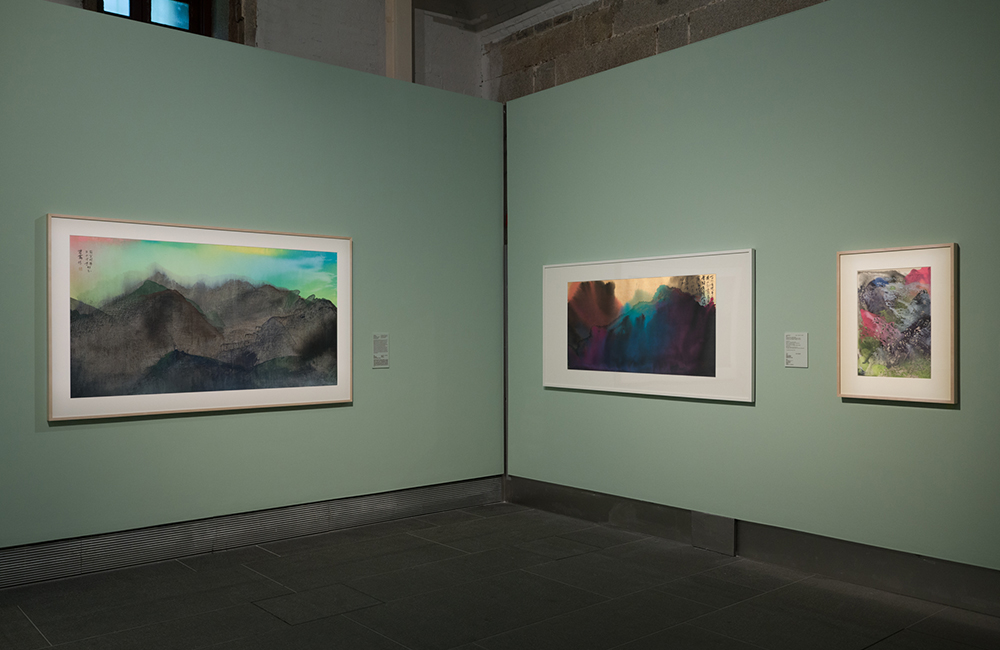
The retrospective at the Asia Society of Wesley Tongson’s work, Singing and Dancing with Brush and Ink, has offered the public the possibility of seeing some of this too-little-known artist’s impressively varied and consistently high-quality paintings. Born in Hong Kong in 1957, Tongson began studying ink when he was 17 and kept developing his approach to the medium throughout his life, while pursuing his studies in Hong Kong and Toronto. He went from more academic pieces, often inspired by masters from the Chinese canon, to a much more tactile and physical relationship with ink and its possibilities. He produced, in his later years, paintings made entirely without a brush, instead using his own fingers, nails and hands – turning ink into a tactile, nearly sculptural element. While his approach to hand-painting was pretty unconventional, there are precedents in ink art, like the Qing dynasty painter Gao Qipei (1660-1734), who was likely known to Tongson.
The show is curated by Julia M White and Yi Yi Mon (Rosaline) Kyo, with crucial input from Tongson’s sister, Cynthia Tongson. “I am involved in the show as a supporter to the two curators,” she says. “They were the ones who wanted to do a Tongson exhibition and insisted on doing it in Hong Kong, as they felt Wesley was still overlooked in his hometown.” She shared his archives and personal notes, and allowed them to interview his former classmates, friends, family members and collectors.

Divided into five different sections, the exhibition brings together pieces scattered among museums and private collections to offer a more complete view of a body of work that is both vast in scope and stubbornly dedicated to all the possibilities of ink. The first room presents studies of rocks, plants and water that evolve from the classical – like the undated Untitled (Orchids),which offers a formal but still forceful and lively composition of orchids on rocks – to works like Untitled (Orchid and Rock), dated 2010, two years before his death, which appears as a burst of ink on paper, a dynamic, passionate take on the same theme, produced using his fingers and nails.
Diagnosed with schizophrenia at 15 and put on psychiatric medication, Tongson struggled with mental illness and gender identity throughout his life, and used his artistic practice to explore and tame the difficulties he faced. Spiritual Mountains, for example, his last series, produced from 2009 to 2012, consists of very large paintings on which he created the shapes of misty mountains through finger painting and splashed ink, made dreamier yet by the addition of colour. He put on the canvas his spiritual pursuits, as he tried to overcome anxiety and find solace in exploring a number of spiritual and religious traditions, from Buddhism and Daoism to Christianity.

These mountain landscapes are produced using different ink techniques, from rubbing to marbling, to create the effect of dense vegetation or jagged rocks. The deep grey-black of the ink is set against deep purples, bright oranges, pinks, red and greens that form a lysergic sky, underlining the possibility of watching a spiritual, otherworldly landscape. In a video interview that can be viewed at the show, recorded at the opening of his 1992 Mountains of Heaven show at the Hong Kong Arts Centre, Tongson talks about his religious explorations and the central role that mountains play in his form of spirituality, adding that he could only create these paintings “with the Buddha’s blessing”. In the written notes that he left behind, collected from his studio and his home and provided by his sister Cynthia Tongson, some of which have been reproduced, enlarged and hung on the walls next to the paintings for this exhibition, he further expresses his wish to be reborn in the Chinese Buddhist idea of a western mountain or western paradise, variants of Pure Land Buddhism’s land of the Amitabha Buddha, even if his Christian upbringing meant that he often seemed to move in a personal form of religion that mixed elements from different faiths.
In Palace of Royal Purple (1994), the ink is first splashed onto the board, then made to form rivulets by turning the board around to create different directions for it to drip, producing a pattern reminiscent of trees and vegetation. A later Untitled (landscape) from 2002 uses the same technique for the small patches of black ink, which are overpowered by the emerald green of the mountains and a bright yellow and pink that float in the valley in front of them, under a bright yellow sky filled with clouds and stars.
These mystical, hazy mountains, while coalescing into a full-blown series in his later years, are a presence throughout his productive years, as can be seen in Landscape 2 (1987), in black, dark pink and greenish blue on gold paper, with an inscription that reads “Green mountains and red clouds rise with a tranquil morning, a record from the elegant peaks studio, Tang Jiawei (Tongson’s name in Mandarin) with new ideas of splashed ink, I thought such fleeting visions must be preserved” (translation by Keyu Yan, from the exhibition catalogue). The seal with which he marked the painting reads: Long live Jiawei.
The spiritual practices he pursued, of which he wrote quite frequently in his notes, tended to clash with his gender ambiguity: he sometimes wrote about his desire to get married – which he wrote with the Chinese character that implies a woman getting married to a man, jia – and how this was in contradiction with his Chan (Zen) Buddhist practice. Occasionally, he would sign some of his paintings, like the Untitiled (Bamboo) of 2012, a reproduction of a group of bamboo branches with thick foliage, which he signed Painted by Shandou (meaning “mountain Daoist”). The piece, produced through finger painting, seems to portray a profound inner tension, tamed by the edges of the paper: the upper part of the dark bamboo leaves and branches are cut as if seen through a window, or as if the limited surface of the paper could not contain all their vitality and emotion.

Also worthy of attention are his calligraphic works, which once more span the whole range from classical compositions that pay homage to Chinese masters to exuberant, highly expressive pieces produced mostly with fingers, hands and nails. The latter stretch the Chinese characters represented on the paper into abstract form, capable of conveying anxiety, hardship and an interior force with which Tongson constantly battled. In the piece With the Prevalence of Ink, We Can Observe the Teachings of Buddha, Whose Wisdom is All-encompassing, painted in 2011 and signed Shandou, the energy of the Chinese characters is achieved by first dripping the ink on the white paper, then producing each individual word with his nails and fingers, creating multi-stroke characters that merge abstraction with writing.
This tension, like a suppressed energy that would burst out on the paper, is one of the constants of his works. Tongson expressed to his family his desire to undergo gender-affirming surgery and become a woman. And while his family was ready to support him through that transition, the operation could not be done in Hong Kong and carried an even greater stigma at the time than it does today. In the end, Tongson did not undergo the surgery and kept pouring this compressed vitality into his works, giving them an extraordinary strength. The large-scale paintings in the exhibition were very important to him, even if he was then forced to stop painting them due to the physical side-effects of the medications he was on, which affected his joints and made him drowsy.
And yet, throughout his struggles, ink was always what he stayed with. “Wesley was deeply devoted to his craft,” says Cynthia Tongson. “Even though he always painted for himself, he wanted to do his best and worked relentlessly to find his own voice – to be unique. He was never satisfied; when he reached one goal, he would set another goal. He had many struggles in life, even with his own art. I feel these struggles, the constant tension that drove his art. He was very smart, quiet and mild in nature but he had a dark side due to his mental health condition. It was not easy for him – nor for us, his family.”
The Asia Society’s show brings back into Hong Kong’s art scene a highly original, uniquely forceful painter, whose works are testimony to an incredibly complex biography.